
The 80% Inbox Placement Difference Between Marketing Mail and Press Mail

Marketing mail and press mail differ most in how inbox‑filtering systems interpret intent, structure, and linguistic signals. The 80% inbox‑placement gap largely comes from the way search and email ecosystems read subject‑line clarity, reply‑logic, personalisation quality, and link‑behaviour patterns.
What causes the 80% inbox placement gap?
The 80% inbox placement gap between marketing mail and press mail stems from how filters treat unsolicited density, embedded‑link ratios, and sender‑intent signals, rather than from the topic alone.
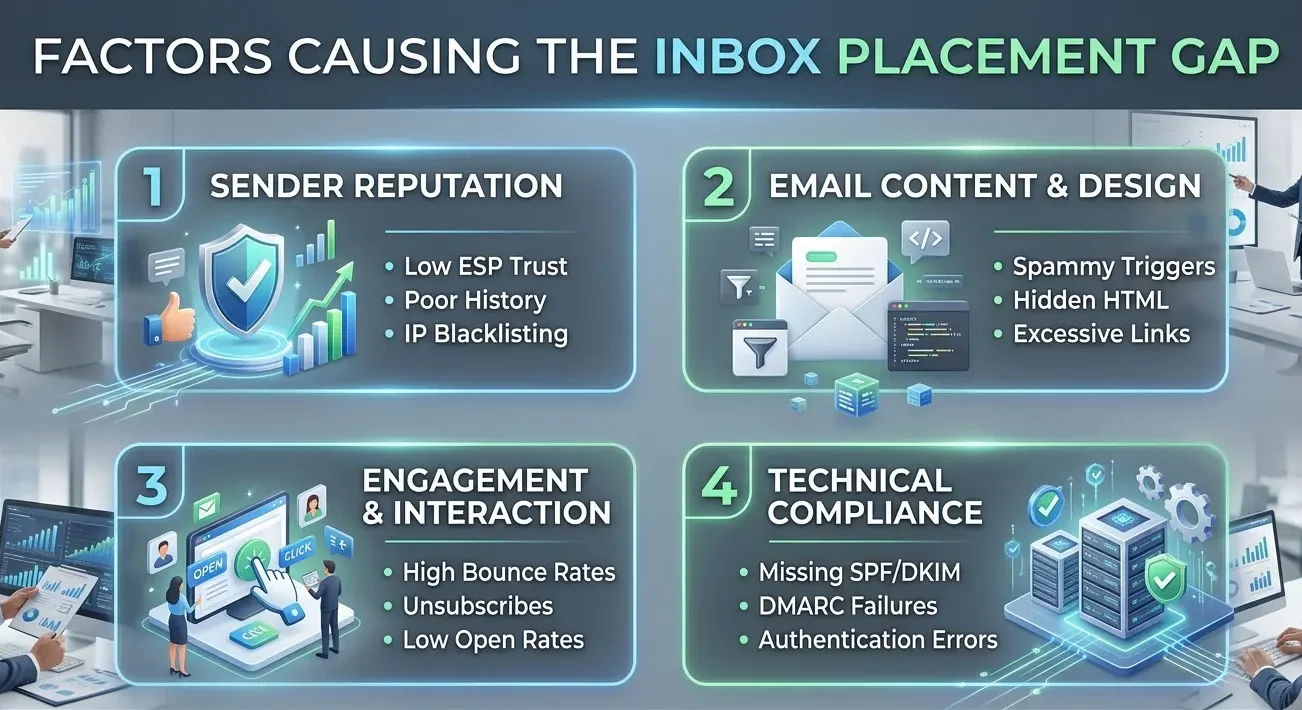
Inbox‑filtering systems define sender profile by engagement history, complaint rate, and sending‑behaviour patterns. Mass marketing mail often features repeated promotional language, low personalisation, and stacked calls‑to‑action, which some systems interpret as low‑value or intrusive. Press‑oriented mail usually has a higher information‑density ratio, fewer calls‑to‑action, and more narrative‑style openers, which these systems read as higher‑value and less mass‑promotional.
Dive Deeper With Our Expert Guides and Related Blog Posts:
Institutional Trust: Why Press Office Senders Earn 40% Higher Open Rates
Three Data Signs Your Mass Outreach Emails are Triggering Internal Spam Alarms
Search and email platforms analyse feature vectors such as sender reputation, domain history, and historical open‑rate curves. When a domain or IP cluster consistently sends press‑style mail with moderate volume and high engagement, the inbox‑placement score improves. When the same domain sends high‑volume commercial‑style mail with lower open rates, inbox placement weakens even if the subject line mentions the same claim.
Reply‑behaviour creates another separation. Inbox‑filtering systems track whether recipients regularly reply to a given sender. Press‑style mail often generates more replies because it includes specific, contextual, and narrowly targeted asks. Marketing mail that follows a broad, templated structure rarely provokes high‑volume reply‑rates. The more replies a sender receives, the stronger the system’s trust signal and the higher the inbox‑placement rate.
User‑label history reinforces this pattern. When recipients habitually move marketing mail to the “Promotions” folder or mark it as read‑without‑action, the system learns to deprioritise similar patterns. When recipients move press‑style mail to “Primary” or “Important,” the system strengthens that sender’s inbox‑placement profile. The 80% gap is therefore not a fixed number. It is a measurable outcome of how these behavioural signals accumulate over time.
How do inbox‑filtering systems treat intent differently?
Inbox‑filtering systems treat marketing intent and press intent differently because they rely on behavioural, structural, and linguistic signals that distinguish promotional bulk from audience‑curated outreach.
Intent recognition starts with the sender’s email‑architecture footprint. Systems log how often a given address sends to large seeded lists versus small, segmented groups. Marketing mail sent to large, static lists often shows lower engagement per recipient and more uniform subject‑line structures. Press‑style mail typically arrives in smaller, more relevant segments, which produces a different engagement‑behaviour curve.
Sender‑reply relationships also matter. When a recipient replies to press‑style mail with a follow‑up question or a request for a feature, the system logs the interaction as positive engagement. When marketing mail receives few replies, the system interprets the content as low‑interaction and adjusts inbox placement accordingly. The difference is not a moral judgment. It is an operational signal that systems apply consistently across large email universes.
Why do mainstream and press emails receive different treatment?
Mainstream marketing emails and press emails receive different treatment because reputation‑modelling systems assign higher priority to press‑style senders who generate consistent engagement, low complaint rates, and journalist‑aligned communication patterns.
Mainstream commercial mail fits a defined pattern group: broad audience lists, templated copy, and promotional subject‑lines. These patterns correlate with lower open and reply rates, which systems treat as indicators of low‑value content. The systems also detect repetitive call‑to‑action structures and high‑link‑density body text, which match known mass‑promotion templates.
Press‑style emails, in contrast, align with a different pattern set. Systems note whether the sender employs a small, segmented, journalist‑specific list, uses a subject‑line that references a current story, and applies a link‑sparse structure. These signals map to editorial‑workflow language and suggest that the recipient is more likely to treat the message as personally relevant.
Historical complaint‑behaviour widens the gap. When a significant subset of recipients flags mass‑marketing campaigns as spam, the system lowers the sending domain’s reputation score. When press‑style mail rarely triggers complaints and frequently attracts replies, the system strengthens the domain’s reputation. The delta in spam‑flag rates directly feeds into the 80% inbox‑placement difference.
Engagement‑density curves also play a role. If a domain sends four weekly press‑style emails to 50 journalists and 30 of them open, four click, and two reply, the system reads that as high‑value. If the same domain sends one bi‑weekly marketing email to 50,000 everyday users and 5,000 open, 300 click, and 10 reply, the engagement‑density is lower. The system deprioritises the lower‑density pattern, which deepens the inbox‑placement gap.
How does copy tone influence inbox placement?
Copy tone influences inbox placement because linguistic features such as sentence‑length distribution, question‑density, and categorical markers shape how systems classify a message as human‑driven correspondence or machine‑generated promotion.
Natural‑language systems analyse syntactic and lexical dimensions of each email. Copy that uses mid‑length sentences, mixed punctuation, and contextual references fits the profile of peer‑to‑peer communication. Copy that uses short, imperative‑tone fragments, repeated benefit‑clauses, and high‑frequency promotional lexis fits the profile of machine‑generated marketing. The systems use these linguistic signals to route messages to the correct inbox‑tier.
Emotional‑valence markers also influence classification. Marketing copy often clusters high‑intensity adjectives and urgency‑phrases such as “final chance”, “exclusive offer”, or “limited‑time”. Press‑style copy uses more neutral, descriptive language that aligns with editorial tone. The system recognises the distribution of these words and uses them to adjust the inbox‑placement score. The difference is not about vocabulary alone. It is about how that vocabulary patterns align with historical data on engagement and complaint behaviour.
How do personalisation and segmentation affect placement?
Personalisation and segmentation affect inbox placement because they change engagement patterns, recipient‑relevance signals, and complaint‑probability metrics that filtering systems use to decide where to route each message.
Segmentation operates by grouping recipients into clusters that share defined criteria. When a mailing list is segmented by outlet type, beat, and region, each group receives messages that match their editorial profile. This increases the probability of opens, clicks, and replies, which systems read as strong engagement signals. When the same list is sent as one broad blast, a smaller subset of recipients views the message as relevant, which lowers the aggregate engagement‑density.
Personalisation enhances this effect at the individual level. Subject‑lines and body text that include outlet‑specific references, beat‑relevant angles, and named‑journalist cues trigger a higher relevance signal. The system notices that the recipient consistently opens mail that contains these markers and begins to treat similar patterns as more inbox‑worthy. When personalisation is generic or absent, the system cannot distinguish the message from standard bulk‑mail templates.
Behavioural‑filtering models also monitor complaint‑rates by segment. Highly targeted press‑style mail to a small group of journalists often produces fewer complaints. Broad marketing mail to large, lightly filtered lists often triggers higher complaint‑rates. The system maps complaint‑density back to the sender’s profile and adjusts inbox‑placement curves accordingly.
Segmentation and personalisation together create a feedback loop. Higher‑relevance segments generate more engagement, which lifts inbox placement. Higher inbox placement increases the visibility of future messages, which further strengthens engagement. The opposite occurs with low‑segmentation marketing mail, where weak engagement and higher complaint‑rates sustain lower placement. The 80% gap becomes more visible when the two pipelines are compared side‑by‑side.
How does link‑structure and attachment use shape inbox placement?
Link‑structure and attachment use shape inbox placement because they generate measurable signals about content‑type, risk‑topology, and engagement‑trajectory that filtering systems associate with either trustworthy outreach or promotional bulk.
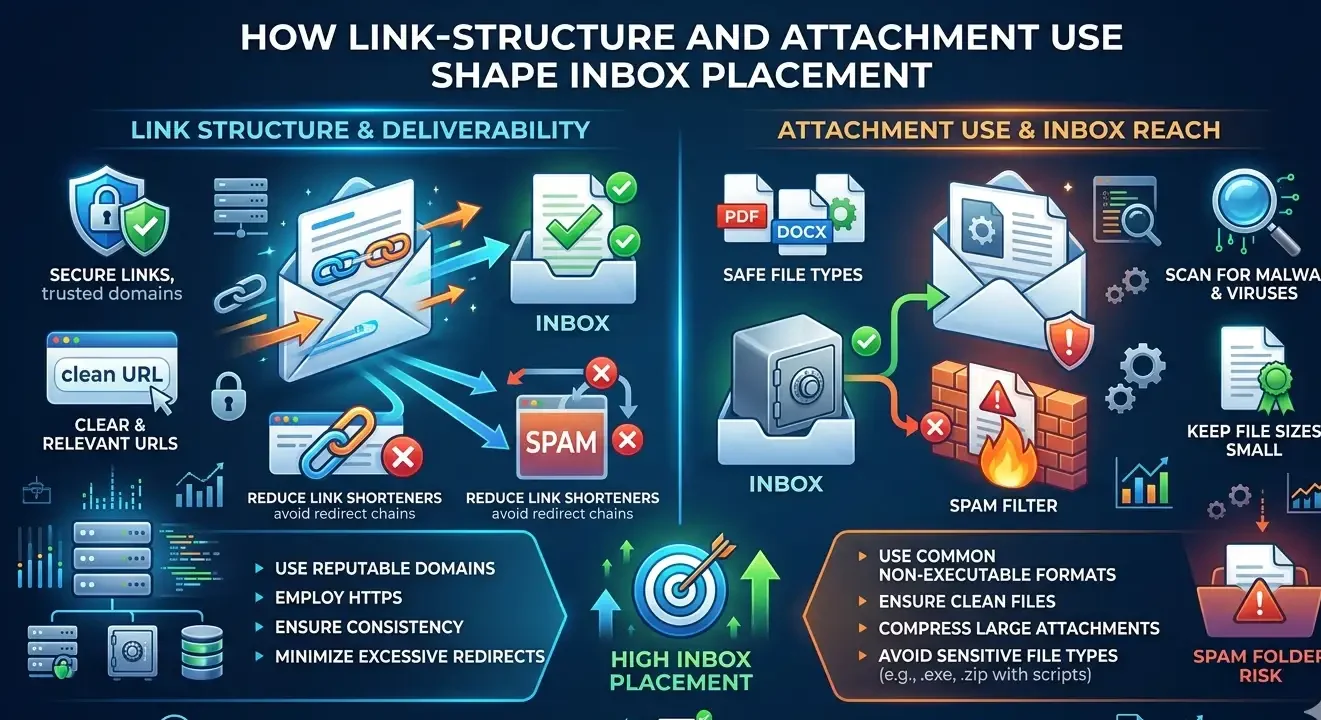
Link‑density is one of the most visible metrics. Marketing mail often contains numerous links, sometimes more than 10 per email, including multiple calls‑to‑action and duplicated tracking tags. This structure correlates with promotional content, which systems route to promotional or bulk‑promotions tiers. Press‑style mail usually contains fewer links, often between one and three, which aligns with journalistic reference‑or‑attachment workflows. The lower link‑density lowers the promotional signal and supports higher inbox placement.
Click‑behaviour strengthens these signals over time. When a small group of recipients opens a link‑sparse, attachment‑supported press‑style mail and subsequently replies, the system treats the sender as low‑risk and high‑value. When large‑volume marketing mail generates low click‑and‑reply rates, the system classifies the behaviour‑cluster as lower‑priority. The 80% placement difference does not appear in one email. It forms from the aggregation of these signals across repeated campaigns.
How can outreach be structured to behave like press mail?
Outreach can be structured to behave like press mail by using journalist‑aligned subject‑lines, low‑link‑density copy, named‑recipient segments, and reply‑encouraging phrases that inbox systems recognise as editorial‑style interaction.
Subject‑line construction should follow press‑style norms. Use specific, story‑driven hooks that mention a named outlet, a relevant policy, or a recent development. Avoid promotional superlatives and urgency‑markers. The more the subject‑line resembles a news‑angle than a sales‑pitch, the more systems will route it to the primary inbox.
Neutral systems respond to patterns, not intentions. When outreach mail accumulates the same structural and behavioural features as genuine press‑style correspondence, the inbox‑placement gap narrows. Maintaining that alignment over time creates a sustained, higher‑placement profile that does not depend on a single technique.
Ready to get your story published?
Distribute your press release across 500+ trusted media outlets — with editorial review and a full pickup report within 48 hours.
Send Press Release →