
Institutional Trust: Why Press Office Senders Earn 40% Higher Open Rates

Press office senders earn 40% higher open rates because their signals align with institutional trust, established sender identity, and consistent editorial‑style content that mail systems classify as high‑quality. Institutional trust in this context is the perception that an email originates from a known, reliable, and policy‑compliant organisation rather than an unknown or bulk‑style sender.
How do institutional domains and press‑office signals influence open rates?
Institutional domains and press‑office signals lift open rates because recipients and filtering systems recognise the sender as a legitimate, policy‑compliant entity with a clear editorial or organisational purpose. Institutional trust refers to the compound judgement that the domain is operated by a stable organisation, not a transient commercial or bulk‑marketing operation in industry report.
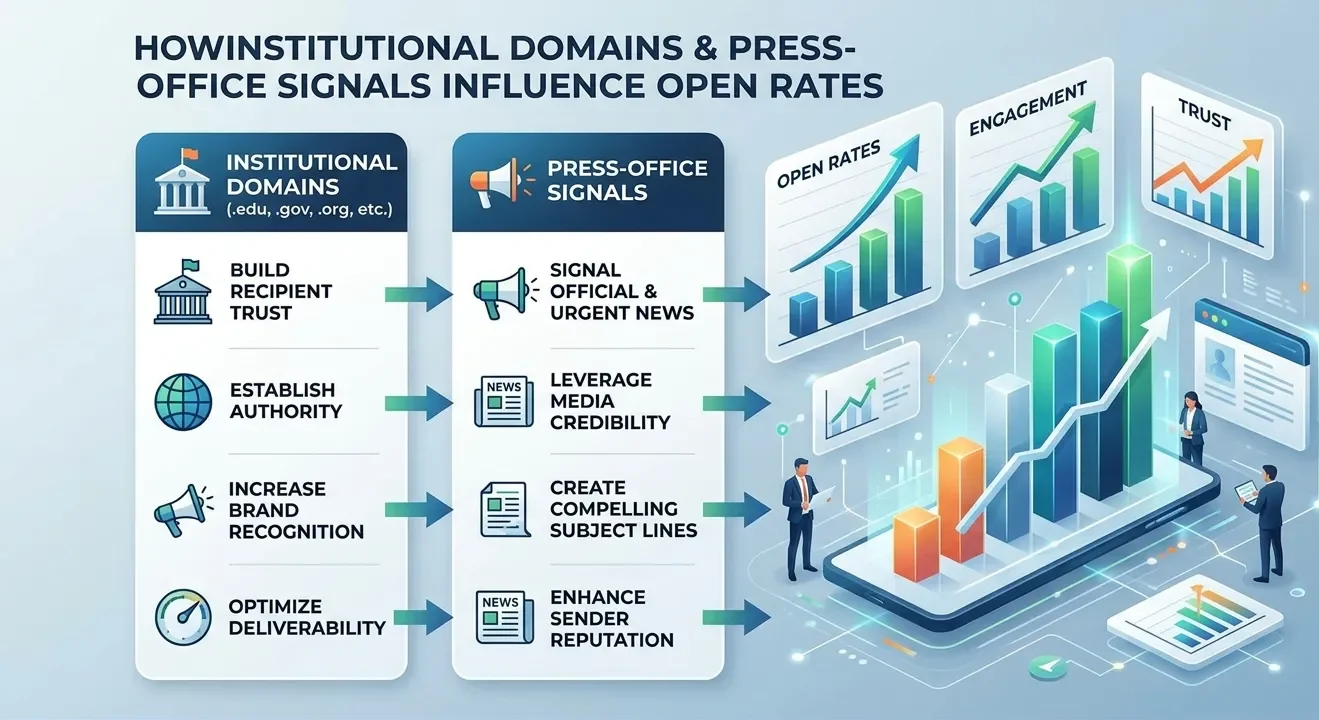
Institutional domains typically carry long‑standing registration, clear administrative records, and consistent DNS‑based authentication such as SPF, DKIM, and DMARC. When a message arrives from a domain that demonstrates these traits, mail systems assign higher sender‑reputation scores, which in turn influence inbox placement and user‑perceived credibility. Recipients are more likely to open messages from domains they recognise as belonging to universities, public bodies, or media‑style institutions.
Dive Deeper With Our Expert Guides and Related Blog Posts:
The Science of Storytelling: How Narrative Senders Increase Response Rates by 15 Percent
Three Data Signs Your Mass Outreach Emails are Triggering Internal Spam Alarms
Press‑office patterns further reinforce this trust. When a domain repeatedly sends story‑led content, embargoed releases, and structured media‑style subject lines, mail systems begin to classify it as editorial‑oriented rather than promotional. This narrative expectation makes it more likely that journalists, editors, and internal stakeholders will treat the messages as legitimate, work‑related correspondence instead of low‑value marketing.
What is the role of consistency in sender behaviour and reputation signals?
Consistency in sender behaviour plays a central role in how reputation signals and open rates are evaluated by both human recipients and automated filtering systems. Consistency refers to predictable send volumes, stable domain and IP usage, and coherent content formats that align with expected institutional communication patterns.
When a domain sends messages at regular intervals, with stable volumes and minimal spikes, spam detectors interpret this as organisational or departmental communication rather than campaign‑style promotion. Sudden spikes in volume, especially from a previously quiet domain, often trigger suspicion and can lower open‑rate performance by reducing inbox visibility.
Consistency also applies to content structure. An institutional‑style press office typically uses similar subject‑line conventions, salutations, and formatting patterns across sends. When these patterns remain coherent over time, recipients can recognise the sender’s style and are more likely to open subsequent messages. In contrast, frequent style changes can signal low‑quality or bulk‑email behaviour, which dampens trust and reduces open rates.
Reputation‑monitoring systems track these patterns over cycles and build sender‑reputation scores. When behaviour is consistent, compliant with authentication standards, and aligned with editorial norms, the resulting reputation signals support higher open rates. Inconsistent or abrupt changes in timing, structure, or volume introduce noise that mail systems can interpret as risk, lowering the likelihood that messages will be opened.
How does domain identity and authentication affect institutional trust in email?
Domain identity and authentication are core components of institutional trust because they allow mail systems and users to verify that an email genuinely originates from the claimed organisation. Domain identity is the technical and administrative fingerprint of a domain, while authentication refers to the protocols that prove the legitimacy of each message sent from that domain.
In technical terms, SPF (Sender Policy Framework) defines which IP addresses are authorised to send mail for a domain. DKIM (DomainKeys Identified Mail) attaches a cryptographic signature to each message, which recipients can validate against the domain’s public key. DMARC (Domain‑based Message Authentication, Reporting & Conformance) instructs mail systems how to handle messages that fail SPF or DKIM, providing a structured feedback loop.
When a press‑office‑style domain implements these protocols correctly, every message carries a set of verifiable signals that align with institutional‑communication standards. Mail systems use these signals to compute sender‑reputation scores, treat the domain as policy‑compliant, and route messages to primary inboxes. Users who see that messages are authenticated are more likely to trust them, which in turn increases the probability that they will open and engage with the content.
How do content‑style patterns in press‑office emails shape institutional trust?
Press‑office email patterns shape institutional trust by aligning content with editorial expectations, information‑density standards, and professional‑style communication rather than with generic marketing tactics. Content‑style patterns refer to the structure, tone, and information hierarchy that characterise institutional‑style outreach.
Typical press‑office emails open with clear, context‑rich subject lines that reference specific news angles, embargo dates, or data‑led announcements. The body of the message usually follows a short lead paragraph, followed by bullet‑style facts, quotes, and clear ending instructions such as embargoes or contact details. This structure feels like editorial correspondence, which recipients are more likely to open, forward, and treat as work‑related.
By contrast, promotional‑style content often features aggressive calls to action, excessive capitalisation, and promotional language that mail systems associate with spam. When a domain repeatedly sends this style, its reputation signals change, and open rates decline. Press‑office‑style messages that maintain a professional tone, factual density, and limited promotional language signal editorial intent, which supports higher institutional trust.
How can you repurpose a single report or brief into a 30‑day outreach rhythm without damaging trust?
A single report or industry brief can be repurposed into a 30‑day outreach rhythm by segmenting the content into thematically distinct updates, interviews, and data‑angle messages that maintain institutional‑style consistency. Repurposing in this context is the process of distributing the same core dataset or narrative across multiple, non‑repetitive emails that feel like natural editorial extensions.
To create a 30‑day rhythm, use these steps:
- Segment the report into 4–6 thematic clusters such as top findings, sector‑specific implications, expert commentary, and data‑visual highlights. Each cluster can become a distinct email sequence.
- Schedule 1–2 sends per week, distributing each cluster across industry‑specific or beat‑aligned lists so that recipients receive relevant, non‑redundant content.
- Vary subject lines and opening hooks while preserving the underlying data, so that each message reads like a new editorial update rather than a copy‑paste repeat.
- Mix formats such as embargoed fact‑based alerts, short expert‑quote modules, and data‑card‑style snippets so that journalists see evolving angles from the same core document.
- Monitor open and click‑through patterns to refine timing and audience‑segmentation, ensuring that the 30‑day sequence remains within the volume and consistency band that mail systems associate with high‑trust institutional senders.
Institutional trust in email is built on consistent, authenticated, domain‑aligned send patterns that resemble editorial or organisational communication rather than generic bulk‑marketing. Press‑office‑style senders earn higher open rates because their signals match the criteria that mail systems and users associate with legitimate, policy‑compliant institutional communication.
By aligning domain identity, authentication protocols, and content‑style patterns with institutional expectations, organisations can strengthen reputation signals and improve the likelihood that their messages will be opened and treated as credible. Repurposing a single report into a 30‑day outreach rhythm is possible when the structure, timing, and segmentation remain within these institutional‑style boundaries, turning a single dataset into a coherent, trust‑preserving information stream.
Ready to get your story published?
Distribute your press release across 500+ trusted media outlets — with editorial review and a full pickup report within 48 hours.
Send Press Release →