
Three Data Signs Your Mass Outreach Emails are Triggering Internal Spam Alarms

Three data signs that your mass outreach emails are triggering internal spam alarms are unusually high bounce rates, low open and click‑through rates, and repeated inbox rejections or spam‑folder placement. Email‑based outreach is a reputation‑sensitive channel because recipient systems log and evaluate every send, creating a technical footprint that can degrade deliverability when signals skew toward spam.
What data indicates that mass outreach emails are being treated as spam internally?
Three primary data indicators show that mass outreach emails are being treated as spam internally: consistently high bounce rates, declining open and click‑through percentages, and a rising proportion of messages flagged as spam or blocked by filters. These metrics are not just engagement signals; they are real‑time feedback from mail servers and security systems that interpret your sends as suspicious or low‑quality.
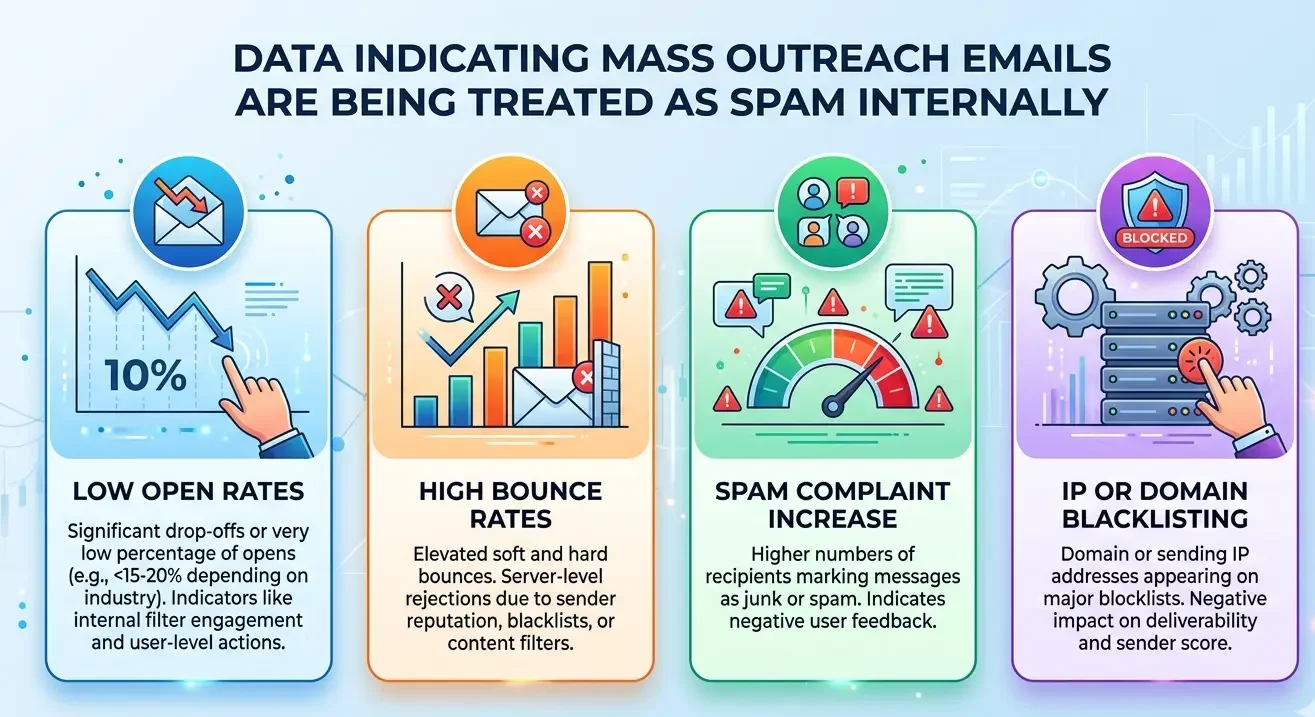
High bounce rates often appear when outreach lists contain outdated or invalid addresses, or when ISPs detect repeated sending to non‑existent accounts. When bounce rates exceed around 5% on a campaign, many systems start treating the domain and IP as higher‑risk. This perception can trigger stricter filtering, especially if the sends are clustered over a short window.
Dive Deeper With Our Expert Guides and Related Blog Posts:
Why Most Media Distribution Tools Have a Failing 0.1% Pickup Rate
The Science of Storytelling: How Narrative Senders Increase Response Rates by 15 Percent
Low open and click‑through rates act as a secondary signal. When a substantial share of delivered messages sits unopened or generates no interaction, spam detectors infer that recipients either dislike the content or have not consented to receive it. This behavioural pattern can reduce the perceived trustworthiness of the sending domain over time, even if the content itself appears neutral.
A third sign is internal spam‑folder placement. When internal systems consistently move mass outreach emails into spam or junk folders instead of the primary inbox, it means gatekeepers have classified the messages as low‑relevance or high‑risk. This placement is rarely visible to the sender, but it generates measurable degradation in response rates, which can be inferred from downstream engagement and reply patterns.
How do bounce rates, spam complaints, and inbox placement metrics feed into spam detection?
Bounce rates, spam complaints, and inbox‑placement metrics feed into spam detection by providing signal clusters that internal systems analyse to decide whether to accept, block, or deprioritise future emails. Each metric captures a different aspect of sender behaviour and recipient reaction, and together they form a composite risk profile.
Bounce rates are logged by mail servers every time an email cannot be delivered to the recipient address. High or rapidly increasing bounce rates indicate that lists are not cleaned or updated, which ISPs treat as a sign of poor list hygiene. This perception can lower the sender’s reputation score, making it more likely that future emails will be throttled or filtered before reaching the inbox.
Spam‑complaint rates measure how often recipients mark a message as spam within their mail client. When a small percentage of recipients signal rejection, the system records that feedback as negative reputation data. If complaint rates rise above roughly 0.1–0.3% across a campaign, some platforms may begin to treat the domain as problem‑prone and restrict delivery volume or route messages to bulk folders.
Inbox‑placement metrics capture whether emails land in the primary inbox, promotions tab, or spam folder. Internal systems often track this via internal labelling, filtering logs, and user‑feedback loops. When a particular sender or template pattern is repeatedly relegated to spam or bulk folders, the system learns to associate that configuration with low‑quality mail. This learned behaviour then shapes how future messages from the same source are handled.
Search and reputation systems sometimes ingest this email‑reputation data indirectly. When a domain or IP gains a poor reputation for bulk outreach, it can influence how any associated content is interpreted in broader information ecosystems. This does not mean the emails appear in search results directly, but it can degrade the overall trust assigned to the domain, which in turn affects how linked content is ranked and evaluated.
How does internal spam filtering distinguish mass outreach from legitimate business communication?
Internal spam filtering distinguishes mass outreach from legitimate business communication by applying identity‑based, behavioural, and content‑based rules to each message. Mass Email & Media Outreach campaigns often trigger these rules more frequently than one‑to‑one correspondence, because their structure and distribution patterns resemble spam‑like traffic.
Identity‑based filtering examines sender domains, IP addresses, and authentication records such as SPF, DKIM, and DMARC. When a domain sends thousands of messages in a short period, especially from shared or low‑reputation IPs, systems may treat that configuration as more aggressive or bulk‑oriented. In contrast, authenticated, low‑volume, relationship‑based emails typically pass through with fewer restrictions.
Behavioural rules analyse patterns such as send volume, timing, and recipient interaction. A campaign that pushes tens of thousands of emails across a narrow time window and shows low engagement metrics can be flagged as bulk marketing or low‑quality outreach. Conversely, steady, low‑volume sends with regular interaction are treated as lower‑risk and more likely to reach the primary inbox.
Content‑based rules scan subject lines, body text, and attachments for common spam characteristics. Generic language, excessive capitalisation, promo‑heavy phrasing, and links to short or unknown domains are all markers that can push a message towards the spam folder. When media‑style outreach emails mimic these patterns—such as using overly promotional subject lines or embedding many links—internal filters are more likely to treat them as suspicious, even if the intent is editorial or informational.
How can technical metrics reveal the difference between high‑performing and underperforming outreach campaigns?
Technical metrics reveal the difference between high‑performing and underperforming outreach campaigns by quantifying deliverability, engagement, and recipient behaviour across each send. These metrics are not abstract analytics; they are direct indicators of how mail systems and spam filters are interpreting the campaign’s design and structure.
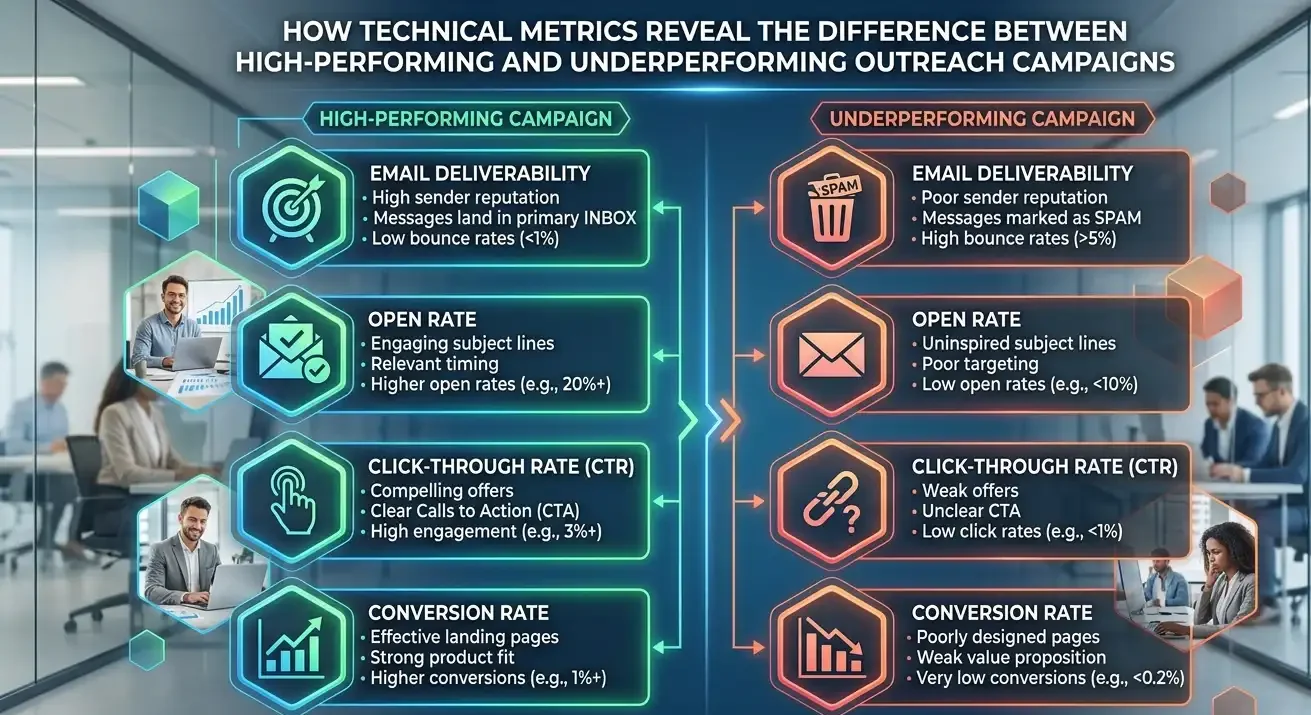
High‑performing campaigns typically show low bounce rates, for example under 2–3%, and a stable sender‑reputation profile. They also exhibit higher open and click‑through rates, indicating that recipients perceive the emails as relevant and consented to receive them. Spam‑complaint levels remain close to zero, and inbox‑placement tests show most messages landing in the primary inbox rather than spam or bulk folders.
Underperforming campaigns tend to display the opposite pattern: bounce rates that climb above 5%, declining open rates, and rising spam‑complaint ratios. Inbox‑placement tests may reveal that a growing share of sends are routed to bulk or spam sections, which directly suppresses visibility and response. Over time, these metrics accumulate into a negative sender‑reputation signal that can throttle future outreach potential.
Five technical signs of a high‑performing media outreach campaign include:
- Maintain bounce rates below 3% by using regularly cleaned, permission‑based lists.
- Achieve open rates above 20–25% on targeted segments, suggesting relevance and consent.
- Register click‑through rates above 2–5% on key campaign links, confirming active engagement.
- Hold spam‑complaint levels near 0% through clear opt‑out mechanisms and proper segmentation.
- Pass inbox‑placement tests consistently, with the majority of messages appearing in primary inboxes.
Mass outreach emails trigger internal spam alarms when their technical signals resemble those of low‑quality bulk mail rather than legitimate business communication. These signals include high bounce rates, low open and click‑through figures, and consistent spam‑folder placement, all of which feed into spam‑detection systems that gradually degrade sender reputation.
Technical metrics provide a clear, quantifiable way to distinguish between effective outreach campaigns and those that are harming deliverability. High‑performing programmes maintain low bounce rates, strong engagement figures, and clean complaint records, while underperforming campaigns show the opposite pattern. For organisations using email‑based outreach, understanding these data signs is essential to maintaining inbox visibility and preserving long‑term reputation within internal spam‑filtering ecosystems.
Ready to get your story published?
Distribute your press release across 500+ trusted media outlets — with editorial review and a full pickup report within 48 hours.
Send Press Release →