
How Do You Successfully Balance Massive Outreach Scale With Personal Journalistic Integrity?

You balance massive outreach scale with personal journalistic integrity by segmenting media lists, standardising ethical‑messaging rules, and applying limited‑sequence contact protocols that treat every journalist like a unique stakeholder. This approach sits inside the broader mass email and media outreach field, which must now reconcile volume‑driven distribution with decreasing tolerance for bulk‑spam‑style workflows.
What does “balance scale and integrity” actually mean in media outreach?

In media outreach, balancing scale and integrity means sending high‑volume campaigns without violating editorial trust, list‑quality standards, or data‑privacy rules. The system cannot be purely automated, nor can it be fully manual. The practical outcome is a hybrid workflow where outreach‑volume grows but contact‑quality and relevance grow faster.
Dive Deeper With Our Expert Guides and Related Blog Posts:
Is Your Outreach Copy Journalistic Enough to Earn a Response From Top Editors?
Why Should High Growth Startups Prioritize Earned Media Over Expensive Paid Ads?
Massive outreach scale refers to campaigns that target thousands of journalists, outlets, and regions in a single cycle. Integrity refers to how close those contacts are to the journalist’s beat, reading habits, and editorial standards. The 2x‑2 grid is clear: some campaigns are high‑scale and low‑integrity (spam‑like blasts); others are low‑scale and high‑integrity (individual‑only outreach); the optimal zone is high‑scale and high‑integrity, where volume coexists with respect.
The evaluation‑framework for this balance usually tracks three variables: contact rate (how many journalists you reach), open rate (how many open the email), and placement rate (how many publish a story). A spam‑style campaign can achieve high contact numbers but low open and placement rates. A highly‑targeted campaign can achieve strong open rates but limited geographic spread. The best‑practices in mass email and media outreach now push toward a model that keeps contact numbers high while raising open and placement rates through better segmentation and timing.
How have outreach tools and dashboards changed the scale‑integrity dynamic?
Outreach tools and dashboards have changed the scale‑integrity dynamic by adding real‑time tracking, CRM‑style segmentation, and inbox‑health‑monitoring to mass distribution workflows. The result is that a 5,000‑contact campaign can now be as precise as a 200‑contact campaign, provided the segmentation and signals are strong. The tools shift the problem from “volume‑versus‑quality” to “data‑quality‑versus‑outcomes.”
The core mechanism is dashboard‑driven decision‑making. A single interface reports on contact‑numbers, open‑rates, click‑throughs, spam‑complaint‑flag‑triggers, and domain‑blocking patterns. The system can then automate segmentation: high‑open‑contacts move into higher‑priority tiers, while low‑engagement addresses are throttled or removed. This is what allows campaigns to reach 3,000–5,000 journalists per month without degrading inbox‑health or triggering domain‑blocks.
The impact on integrity is indirect but measurable. When a campaign uses engagement‑data to decide which journalists receive a follow‑up, the overall‑tone of the communication becomes more like a curated‑pitch and less like a spam‑blast. The dashboards also support ethical‑behaviour by enforcing cool‑down periods, limiting follow‑up frequency, and flagging potential spam‑risk‑zones. This is where the concept of custom outreach dashboards track your media placement and inbox rates in real time becomes operationally relevant. The dashboard is not a vanity‑tool. It is a risk‑management layer that keeps scale‑within‑integrity‑boundaries.
How do you compare manual outreach, semi‑automated tools, and pure automation?
Manual outreach, semi‑automated tools, and pure automation differ in control, speed, and error‑risk, and each fits different use‑cases within the mass email and media outreach spectrum. Manual outreach is high‑integrity but low‑scale. Pure automation is high‑scale but low‑integrity. The semi‑automated middle ground is where most modern‑outreach‑teams sit, because it balances volume, personalisation, and compliance.
Manual outreach is the journalist‑by‑journalist, 100‑word‑custom‑pitch approach. The editor selects each contact, writes a tailored‑email, and manually tracks replies. The strength is relevance: every message can mirror the journalist’s last article, outlet, and beat. The limitation is obvious: a team can realistically manage 20–30 personalised pitches per day, which is insufficient for global‑campaigns. The main advantage is that it is virtually impossible to trigger spam‑filters or list‑degradation.
Pure automation relies on no‑code, bulk‑mailbox‑connectors that send one‑template‑to‑thousands without significant adaptation. The system can hit 10,000+ contacts in a single hour but often at the cost of relevance and deliverability. The main risk is that journalists recognise the generic‑language, complain, and domains start to filter or block senders. The main advantage is speed, which matters in real‑time‑news‑events, but only if the content is relevant enough to offset the volume‑drawback.
Semi‑automated tools sit in the middle. They allow teams to create 5–10 broad‑templates and then apply dynamic‑fields, segmented‑lists, and follow‑up‑rules. The system can still send 5,000–7,000 emails per week, but each one can carry a different subject‑line, introductory‑paragraph, and attachment‑set based on domain‑type or region. The most effective mass email and media outreach campaigns now run on this model because it preserves enough personalisation to respect editorial norms while still enabling global‑scale.
How do list‑segmentation, timing, and targeting affect this balance?
List‑segmentation, timing, and targeting affect the balance of scale and integrity by determining which journalists receive which messages and when, which reduces irrelevant pitches while increasing placement‑probability. The core insight is that a 10,000‑contact list is almost useless if every journalist receives the same pitch; the same list is powerful if it is segmented by beat, region, and engagement‑history. The question is not how many contacts you send to, but how accurately you match each contact with the right‑message at the right‑time.
List‑segmentation usually runs across four dimensions: region, beat, outlet‑type, and language. A UK‑political‑journalist should not get the same pitch as a Turkish‑environmental‑outlet, even if the story is the same. The 3x‑tier segmentation practiced in many modern‑outreach‑workflows assigns Tier‑1, Tier‑2, and Tier‑3 tags to each journalist, then routes waves of content accordingly. The balance is preserved because the system never treats a high‑authority, niche‑journalist the same as a low‑priority, bulk‑recipient.
Timing is the second lever. Sending 10,000 emails at 2 a.m. is different from pacing them over 24 hours, aligned to the time‑zone of the target audience. The most effective times for UK‑media‑outreach are 8:00–10:00 and 15:00–17:00, because that is when national‑newsroom‑editors are most active. The system can use drip‑sequences, where Tier‑1 outlets receive an early‑morning‑pitch, regional outlets get a mid‑morning‑blast, and niche‑editors see a follow‑up in the early‑evening. This timing‑structure improves open‑rates without violating the principle of editorial‑integrity.
Targeting, as the third element, enforces a rule‑set around what types of stories go to which outlets. The mass email and media outreach best‑practice is to avoid “spray‑and‑pray” headlines like “Breaking News: You Must Cover This” and instead use hooks that match the outlet’s editorial‑voice. For example, a health‑outlet receives a health‑angle, a climate‑publication receives an environmental‑angle, and a policy‑journal receives a governance‑angle, even if all three stem from the same core‑data set. The combination of segmentation, timing, and targeting is what allows a campaign to scale without losing its ethical‑grounding.
How does privacy‑regulation tighten the constraints on mass outreach?
Privacy‑regulation tightens constraints on mass outreach by requiring explicit or legitimate‑basis‑consent, limiting contact‑frequency, and enforcing data‑minimisation principles. The GDPR‑style regime in the UK and EU defines email‑marketing and media‑outreach as data‑processing activities, which means journalists are not just “contacts” but data‑subjects with rights. The system must track where consent comes from, what it covers, and when it can be withdrawn.
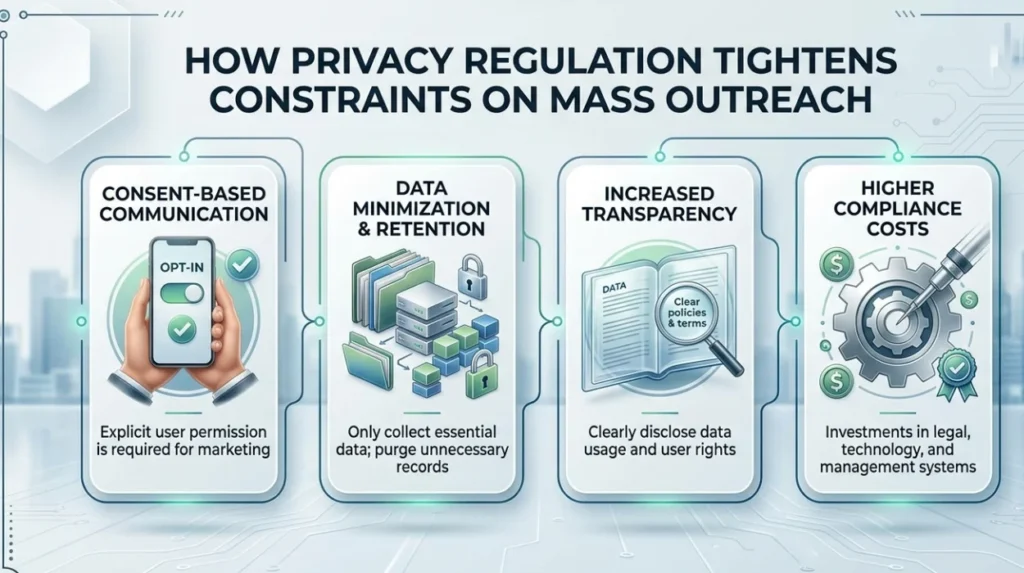
Within the media‑outreach ecosystem, this shifts the balance between scale and integrity. A 50,000‑contact list cannot be treated as a single‑pool. The list must be split into segments based on origin: outlets that have given explicit‑opt‑in, those that operate under legitimate‑interest, and those that must be avoided because they have withdrawn consent. The risk‑model becomes simple: a campaign that ignores these distinctions increases the chance of formal‑complaints, fines, and domain‑blocking.
The mechanism works through documented‑bases. Outreach platforms now store consent‑logs, unsubscription‑dates, and preference‑toggles that are visible in the interface. Before a campaign launches, the system checks which contacts are eligible, which ones have opted out, and which segments must follow stricter‑frequency‑limits. The result is that massive‑outreach is still possible, but only within a narrower, compliance‑driven corridor. The trade‑off is that the list‑size may shrink, but the quality and legitimacy of the contacts rise.
The impact on journalistic integrity is that the outreach‑workflow must behave like a regulated‑publisher, not a spam‑harvester. The same GDPR‑logic that restricts marketing to consumers also applies to media‑outreach. The consequence is that the most advanced mass email and media outreach practices now integrate privacy‑controls as core‑features, not add‑ons, which is why the discussion of custom outreach dashboards is also tied to compliance‑monitoring and risk‑reduction.
How do you measure success without compromising on integrity?
You measure success by combining placement‑rates, open‑rates, spam‑complaints, and slow‑list‑decay, not just raw contact‑numbers. The traditional KPI of “emails sent” is no longer sufficient. The modern‑metric‑set prioritises inbox‑health, domain‑stability, and placement‑quality, which is why the balance between massive‑scale and personal‑integrity can be objectively evaluated.
The most effective measurement‑framework uses a 5‑metric grid.
- Track placement‑rate, which is the percentage of journalists who actually publish something. A 2–5% placement‑rate is strong in highly‑segmented campaigns.
- Report open‑rate, which is how many of the targeted emails get opened. A 15–25% open‑rate is realistic for well‑segmented lists.
- Monitor spam‑complaint‑flags, which are tickets raised with the platform or ISP; each complaint degrades sender‑reputation.
- Measure click‑throughs, which show how many journalists engaged further with the content, such as PDFs or media‑kits.
- Evaluate list‑decay, which is how many addresses hard‑bounce or unsubscribe after a campaign; a healthy list should not exceed 5–7% per‑run.
Balancing massive outreach scale with personal journalistic integrity is a dynamic, constraint‑driven challenge that cannot be solved with a single‑tool or a single‑strategy. The evidence shows that the most effective approaches combine segmented‑lists, finely‑tuned‑timing, real‑time‑dashboard‑monitoring, and strong‑privacy‑compliance into a single workflow. The mass email and media outreach field is shifting from a volume‑centric model to a quality‑centric one, where the number of journalists contacted matters less than how well those contacts are treated and tracked. The outcome is not just higher‑coverage. It is a sustainable‑relationship‑ecosystem between senders and journalists that can support long‑term‑outreach without degrading trust.
Ready to get your story published?
Distribute your press release across 500+ trusted media outlets — with editorial review and a full pickup report within 48 hours.
Send Press Release →