
Should You Choose a Media Agency or a PR Firm for Mass Outreach?

Organisations choosing mass outreach typically decide between a media agency, which focuses on rapid‑distribution and scale, and a PR firm, which emphasises editorial‑relationships and narrative‑craft; the optimal choice depends on objectives, timeline, and risk tolerance. Mass Email & Media Outreach is defined as the coordinated dispatch of tailored‑editorial‑submissions to large‑groups of journalists, influencers, and content‑makers, designed to generate wide‑coverage rather than single‑stories.
Within this context, each option operates by combining contact‑data, editorial‑fit‑analysis, and workflow‑automation, but the emphasis on distribution‑volume versus editorial‑quality shapes how outcomes differ in reach, resonance, and long‑term‑relationship‑value.
How does a media agency typically handle mass outreach compared with a PR firm?
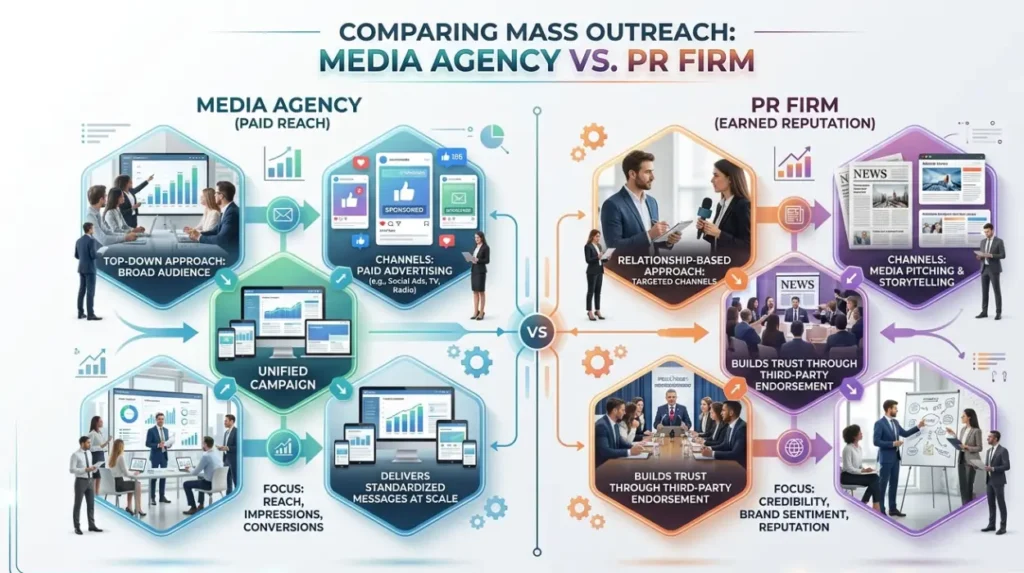
A media agency typically handles mass outreach by prioritising distribution‑scale, list‑size, and technical‑delivery metrics, whereas a PR firm prioritises beat‑fit, narrative‑alignment, and long‑term‑relationship‑value. The core difference lies in whether the model treats outreach as a broadcast‑channel or as an editorial‑engagement‑practice.
Dive Deeper With Our Expert Guides and Related Blog Posts:
Is Your Media Outreach Being Filtered as Spam by Major Newsroom Firewalls?
Media‑agency‑mass‑outreach is defined as a process that uses large‑media‑databases, segmentation‑tools, and automated‑delivery‑systems to push story‑pitches, press‑releases, or embargoed‑briefings to many editors at once. Agencies often report metrics such as “sent to 5,200 outlets” or “1,800 opens,” which reflect scale rather than editorial‑impact.
PR‑firm‑mass‑outreach operates by first mapping which editors have covered similar topics, then tailoring language to beat‑style and audience‑tension, and sending to a smaller but more relevant‑subset of contacts. PR‑teams typically track placements, tone, and long‑term‑guest‑editorial‑invitations, rather than just open‑rates.
Key comparative‑points include:
- A media agency can reach 3,000–7,000 contacts in a single campaign, which suits product‑launches or time‑sensitive‑releases.
- A PR firm may only target 300–800 editors, but with higher‑response and placement‑rates, because each message feels less like a bulk‑shot.
- Media‑agencies deliver higher‑top‑funnel‑visibility, while PR‑firms generate deeper‑editorial‑credibility and repeat‑coverage.
These differences mean that campaigns designed for viral‑velocity often favour media‑agencies, whereas campaigns designed for trust-and-authority-building often favour PR‑firms.
What are the main advantages and limitations of using a media agency for mass outreach?
Using a media agency for mass outreach offers the main advantage of high‑scale‑distribution and rapid‑campaign‑deployment, but its main limitation lies in lower‑editorial‑personalisation and weaker‑relationship‑development. Agencies excel at hitting deadlines and volume‑targets, but they rarely rebuild individual‑relationships from scratch.
Advantages of media‑agency‑mass‑outreach include:
- Volume‑and‑coverage‑reach: a single‑blast might reach 4,500+ editors, increasing the statistical chance of 100–200 place‑mentions in regional‑and‑vertical‑media.
- Speed‑of‑execution: structured workflows, reusable‑templates, and database‑segments enable campaigns to launch within 24–48 hours of brief‑finalisation.
- Technical‑optimisation: tools that track opens, clicks, and basic‑bounce‑rates support quantitative‑reviews of list‑quality and delivery‑health.
Limitations of media‑agency‑mass‑outreach include:
- Generic‑messaging‑risk: repetition‑of‑the‑same‑pitch‑core‑leads to higher‑spam‑scores and more 3‑second‑deletions, especially if subject‑lines and lead‑sentences are unchanged.
- Low‑repeat‑value: editors who receive multiple‑similar‑mail‑shots may mute or block the sender, reducing long‑term‑access to the same‑outlets.
- Limited‑editorial‑credibility‑building: placement‑volume is high, but the presence of the organisation in high‑prestige‑titles often stays low if the narrative‑lacks‑originality or beat‑relevance.
These factors show that media‑agency‑outreach is strongest when organisations need wide‑but‑shallow‑distribution, not when they seek deep‑reputation‑or‑narrative‑ownership.
How does a PR firm’s approach to mass outreach differ in terms of quality and relationships?
A PR firm’s approach to mass outreach differs by trading raw‑distribution‑volume for stronger‑editorial‑quality, relationship‑currency, and narrative‑control, and the resulting coverage tends to be less about quantity and more about resonance. PR‑firms evaluate success by how many contacts become repeat‑publishers, not just how many received the pitch.
PR‑firm‑outreach‑quality is defined as the degree to which each message is tailored to the outlet’s style, audience, and previous‑coverage, and to the individual‑editor’s known‑interests. PR‑teams often rewrite pitch‑paragraphs for each segment, which increases perceived‑relevance and reduces 3‑second‑deletion‑risk.
Relationship‑focus operates by maintaining ongoing‑contact‑with‑editors, forwarding‑piq‑details, and aligning client‑stories with upcoming‑series‑topics, rather than treating each campaign as a one‑off‑blast. Over time, editors begin to recognise the PR‑source as a story‑supplier, not a press‑blast‑sender.
Key evaluation‑points include:
- A PR‑firm may send 400–900 highly‑targeted‑pitches per campaign, expecting 50–90 placements, versus a media‑agency sending 5,000‑plus‑shots with 120–180 raw‑mentions.
- Editors are more likely to return emails, request follow‑up‑data, and invite guest‑views from PR‑firm‑clients because the relationship‑and‑trust‑capital is higher.
- Long‑term, a PR‑driven‑strategy tends to produce more feature‑pieces, op‑eds, and case‑study‑coverage, even if the headline‑numbers are smaller.
These patterns show that a PR‑firm’s mass‑outreach works best when organisations value authority‑and‑engagement over volume‑alone.
How do cost, time, and expected outcomes differ between media agencies and PR firms?
Cost, time, and expected outcomes differ between media agencies and PR firms because media‑agencies optimise for short‑cycle‑volume‑output whereas PR‑firms optimise for slower‑but‑resilient‑relationship‑and‑narrative‑gains. Each model suits different campaign‑profiles and organisational‑timeframes. Request Your Custom Media Outreach Audit and Get a 6 Month Growth Roadmap.
Media‑agency‑cost‑and‑time comparisons show:
- A typical 3‑week‑media‑agency‑blast may cost 15–25% less than a 3‑month‑PR‑campaign for the same sector, reflecting the emphasis on execution‑rather‑than‑relationship‑building.
- Delivery‑time‑from‑brief‑to‑in‑box‑is often 1–3 days, because list‑extraction, templating, and dispatch are standardised.
- Expected outcomes cluster around 100–300 placements, mainly in mid‑tier‑and‑specialist‑titles, with a high proportion of short‑mentions rather than deep‑features.
PR‑firm‑cost‑and‑time patterns show:
- A 3‑month‑PR‑outreach‑programme typically costs 20–35% more than a single‑media‑blitz, but it is spread over multiple‑stories, follow‑ups, and relationship‑nurturing.
- Campaigns often run over 8–12 weeks, allowing time to adjust the angle, respond‑to‑editor‑feedback, and re‑pitch‑as‑new‑data‑emerges.
- Expected outcomes include 30–100 placements, a higher share of features and interviews, and a growing‑list of outlets that know the brand’s story‑architect.
These differences mean that tight‑budget‑and‑short‑deadline‑projects often lean toward media‑agencies, while budget‑that allows for 6‑month‑development‑tends to favour PR‑firm‑structures.
How do algorithmic inboxes and the 3-second rule affect the choice between agency and PR?
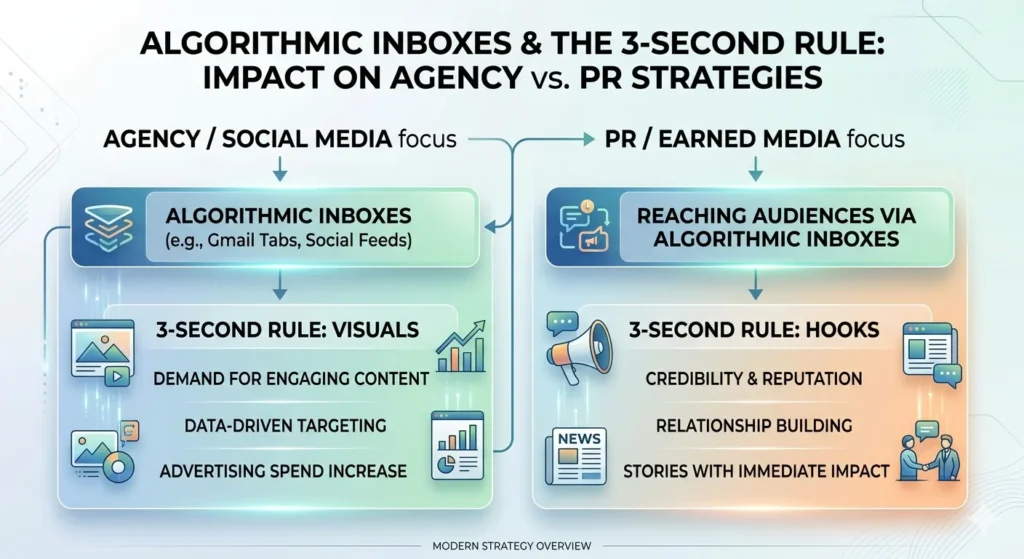
Algorithmic inboxes and the 3-second rule affect the choice between media agency and PR because platforms increasingly auto‑filter bulk‑mail, and editors increasingly rely on rapid‑deletion‑patterns that penalise generic‑mass‑shots more than tailored‑pitches. Media‑agencies struggle when their model relies on wide‑distribution, while PR‑firms gain ground when they focus on quality‑above‑volume.
Algorithmic‑inbox‑filtering is defined as the behaviour of email‑providers and clients that move suspected‑bulk‑messages to spam, low‑priority, or “newsletters”‑sections based on sender‑patterns, subject‑line‑repetition, and click‑rates. Messages that match classic‑news‑blast‑profiles are more likely to be throttled or hidden.
The 3-second rule operates as a cognitive shortcut editors use to decide instantly whether a new‑pitch is relevant or disposable, and it is stronger when the inbox already contains several‑similar‑mass‑outreach‑emails. Generic‑press‑releases arrive in waves, which makes editors more likely to delete without reading.
Impact on agency‑vs‑PR‑choice includes:
- Media‑agencies may see lower‑open‑rates and placement‑conversions if their campaigns are too‑broad or too‑repetitive in wording, even if the technical‑delivery is perfect.
- PR‑firms typically see higher‑inbox‑survival‑rates because each message looks less like a template‑and‑more‑like an editorial‑conversation‑opener, which aligns with how algorithms and editor‑attention‑thresholds work.
- Organisations that anticipate algorithmic‑filtering and 3‑second‑triage might cap‑distribution‑size, tighten‑segmentation, and add editorial‑personalisation, regardless of whether they use an agency or a PR‑firm.
These dynamics show that the structural‑environment of media‑inboxes pushes mass‑Email & Media Outreach strategies toward PR‑style‑quality‑even‑if‑the‑execution‑is‑scaled.
Choosing between a media agency and a PR firm for mass outreach comes down to whether the priority is immediate‑scale‑and‑volume or deeper‑editorial‑quality and relationship‑value, and each option has measurable trade‑offs in cost, time, and long‑term‑credibility. Recent trends in algorithmic‑inboxes and the 3-second rule further tilt incentives toward tailored‑outreach structures, even when distribution‑volume remains large.
FAQs:
What is the main difference between a media agency and a PR firm for mass outreach?
A media agency focuses on scale and speed, using large‑media‑databases and automated tools to distribute press‑releases and pitches to thousands of outlets at once. A PR firm prioritises editorial‑fit, relationship‑building, and tailored messaging, often reaching fewer but more relevant journalists who are more likely to publish high‑quality coverage.
When should you choose a media agency for your mass email outreach?
You should choose a media agency for mass outreach when you need rapid, high‑volume‑distribution of a time‑sensitive announcement, such as a product launch or event. Media‑agency‑campaigns suit organisations that value wide top‑funnel‑visibility and measurable sends more than deep editorial‑integration.
When is a PR firm better for mass Email & Media Outreach?
A PR firm is typically better for Mass Email & Media Outreach when the goal is to build long‑term‑reputation, deepen editorial relationships, and secure higher‑quality‑placements. PR‑led‑outreach focuses on pitch‑relevance, beat‑fit, and narrative‑control, which often generates more features and interviews than press‑releases.
How do media inboxes and spam filters affect media agency vs PR‑firm‑outreach results?
Media inboxes increasingly filter bulk‑outreach using AI‑and‑spam‑rules, which hurts generic‑mass‑shots and benefits more tailored‑pitches. PR‑firms often perform better here because their smaller, highly‑targeted‑campaigns look less like spam, while media‑agencies risk throttling unless they refine segmentation and subject‑line‑clarity.
What are the cost and time trade‑offs between using a media agency and a PR firm?
Media‑agency‑campaigns usually cost less per campaign and deliver faster‑distribution, often within days, but with a higher proportion of short‑mentions. PR‑firm‑programmes tend to cost more over 6‑to‑12‑months but produce stronger‑narrative‑control, repeat‑coverage, and ongoing‑relationship‑value.
Ready to get your story published?
Distribute your press release across 500+ trusted media outlets — with editorial review and a full pickup report within 48 hours.
Send Press Release →