
Is Your Media Outreach Being Filtered as Spam by Major Newsroom Firewalls?

Much of today’s mass email and media outreach is being filtered as spam before it reaches human‑editor inboxes, because modern newsroom firewalls treat bulk‑emailed press releases like commercial‑email campaigns. This is not a technical glitch; it is the predictable outcome of how AI‑filters, sender‑reputation‑models, and security‑policies now handle unsolicited media submissions.
Within this environment, media outreach is defined as the structured distribution of information, such as press releases or story‑pitches, to targeted‑journalists and editorial‑teams via email or forms. Newsroom firewalls are defined as the technical‑and‑policy‑layers that screen inbound communications to reduce inbox noise, phishing risk, and low-value submissions.
How do modern newsroom firewalls treat unsolicited media outreach?
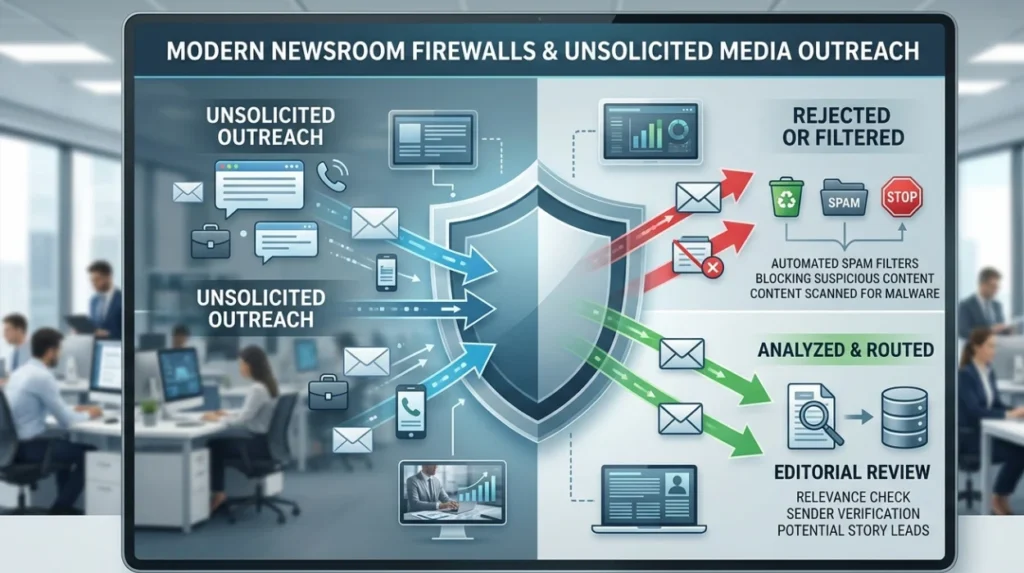
Modern newsroom firewalls treat unsolicited media outreach by scanning for bulk‑sending patterns, weak‑domain‑reputation, and marketing‑style‑language, then routing or suppressing anything that matches those profiles. These systems are not designed to evaluate editorial‑merit; they are built to protect time, reduce spam, and manage inbox‑risk for journalists.
Firewalls use AI‑based‑spam‑classifiers trained on large‑datasets of past‑newsroom‑traffic, which learn to distinguish press‑releases from commercial‑ad‑campaigns based on structural‑and‑behavioural‑cues. These cues include repeated‑subjects, templatised‑language, and high‑volume‑bursts from unfamiliar‑domains.
Typical treatment pathways for unsolicited‑outreach include:
- Immediate‑spam‑flagging and redirection to quarantine or junk folders.
- Down‑ranking in priority‑queues so that messages sit in low‑visibility‑buffers.
- Automatic‑deletion after a retention‑window if no human‑editor interacts with them.
These mechanisms ensure that editors spend time on high‑signal‑content, not on the 90–95% of mass‑email‑and‑media‑outreach that display spam‑like‑patterns.
How do AI‑spam‑classifiers decide which outreach to block?
AI‑spam‑classifiers decide which outreach to block by analysing sender‑behaviour, message‑structure, engagement‑history, and technical‑authenticity, then assigning a risk‑score that determines whether the message passes or fails. These classifiers are systems, not people, so they respond to patterns, not intent.
Within this framework, AI‑spam‑classifiers are defined as machine‑learning‑models that assign each inbound‑message a probability‑score of being spam, based on hundreds of features such as wording, formatting, and domain‑history. Sender‑behaviour refers to sending‑volume, frequency, and recipient‑lists, which classifiers compare against historical‑spam‑profiles.
Key factors that trigger higher‑spam‑scores include:
- Bursts of thousands of messages sent from a single‑domain within hours.
- Repeated use of generic‑subject‑lines and boilerplate‑intro‑phrases.
- High‑bounce‑rates, low‑open‑rates, and user‑complaint‑flags on the same‑domain.
When a message’s score exceeds the threshold, automated‑systems either block it outright or send it to low‑priority‑buffers, where it rarely reaches an editor’s active‑inbox.
How does sender‑reputation influence whether media outreach is filtered?
Sender‑reputation directly influences whether media outreach is filtered, because email‑providers and firewall‑vendors rank domains by historical‑engagement, complaint‑rates, and technical‑compliance. A weak‑reputation increases the chance of spam‑marking; a strong‑reputation improves routing into higher‑priority‑inboxes.
Sender‑reputation is defined as the aggregate‑trust‑score assigned to a domain (and often‑linked‑IP‑pools) based on past‑sending‑patterns, user‑feedback, and technical‑controls. Email‑providers and security‑vendors continuously update these scores using real‑time‑data, not one‑time‑assessments.
Domains with poor‑reputation:
- Show higher‑bounce‑rates, frequent‑spam‑complaints, and low‑user‑engagement.
- Are more likely to be flagged by spam‑classifiers and filtered from primary‑mailboxes.
- Require longer‑recovery‑periods, even after technical‑fixes such as SPF, DKIM, and DMARC‑implementation.
Conversely, domains with stable‑volume, clear‑authentication, and low‑spam‑complaints are treated as lower‑risk, which improves the odds that media‑outreach passes through newsroom‑firewalls.
How does mass email outreach mimic commercial‑email patterns?
Mass email outreach often mimics commercial‑email patterns because it uses bulk‑lists, templated‑messages, and high‑sending‑volumes, which are the same tactics used in marketing‑and‑ad‑campaigns. When these patterns appear in media‑outreach, filters classify them as commercial‑spam, not editorial‑contacts.
Mass email outreach is defined as the distribution of identical or lightly‑varied‑messages to large‑lists of recipients, often via third‑party‑tools that prioritise coverage‑over‑relevance. This structure is functionally similar to transactional‑and‑promotional‑email‑sequences, even when the intent is informational‑rather‑than‑sales‑driven.
Behaviours that make outreach look like spam include:
- Sending thousands of copies of the same‑press‑release in a short‑time‑window.
- Using generic‑recipient‑fields such as “media@” or “press‑team@” without personalisation.
- Repeating‑similar‑subject‑lines and formatting‑styles across different‑campaigns.
Because these patterns match known‑spam‑profiles, newsroom‑firewalls increasingly treat such outreach as low‑relevance‑noise rather than legitimate‑media‑submissions.
How can newsroom‑submission‑flows be redesigned to avoid filtering?
Newsroom‑submission‑flows can be redesigned to avoid filtering by shifting from untargeted‑email‑broadcasts to structured‑forms, invitation‑only‑lists, and smaller, domain‑verified‑circuits that align with how firewalls interpret safe‑traffic. This is less about evading filters and more about operating within their logic.
Modern‑reconfigurations of submission‑flows include:
- Replacing generic‑press‑release‑email‑addresses with self‑service‑portal‑forms where senders submit details, embargo‑status, and topic‑tags.
- Implementing closed‑media‑lists that only accept content from verified‑domain‑holders or vetted‑organisations.
- Routing unsolicited‑submissions through internal‑gate‑steps that explicitly‑flag commercial‑or‑bulk‑intent.
These changes reduce the volume of inbox‑noise, clarify sender‑intent, and concentrate editor‑attention on high‑signal‑content, which aligns with how spam‑classifiers and firewalls behave.
How can mass email and media outreach adapt to avoid being filtered?
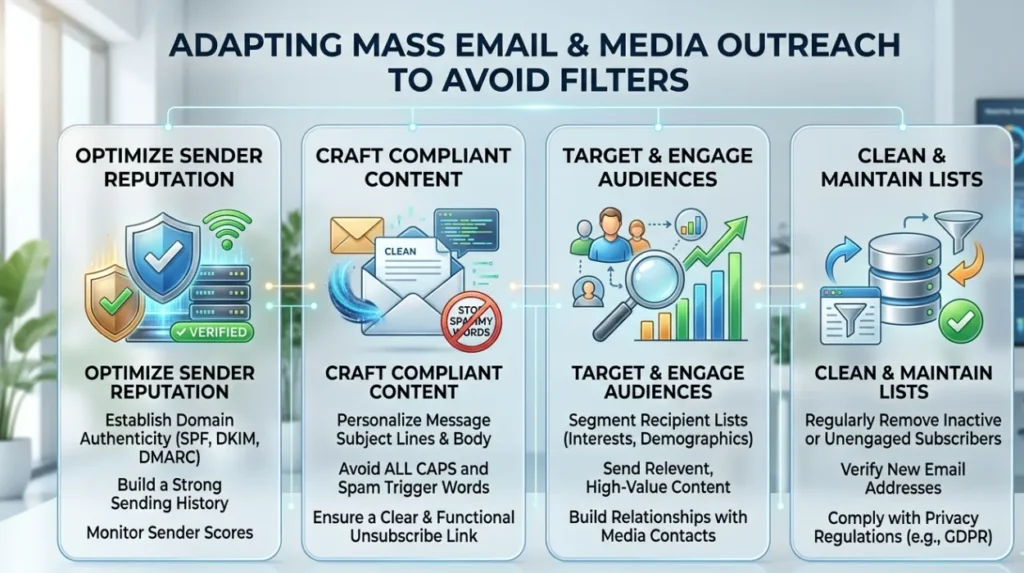
Mass email and media outreach can adapt to avoid being filtered by aligning technical‑hygiene, sending‑behaviour, and message‑design with how spam‑classifiers and newsroom‑firewalls interpret risk and relevance. This adaptation is not a one‑time‑fix, but a continuous‑alignment‑process.
Core technical‑adaptations include:
- Implementing and maintaining SPF, DKIM, and DMARC records to prove domain‑ownership and reduce spoofing‑risk.
- Avoiding high‑volume‑bursts from new‑or‑unknown‑domains by gradually warming‑up IP‑addresses and domains.
- Cleaning lists to remove invalid‑or‑inactive‑addresses and duplicates, which reduces bounce‑rates and spam‑signals.
Operational‑and‑content‑adaptations include:
- Using clear, topic‑specific‑subject‑lines that reflect genuine‑news‑angles, not marketing‑hooks.
- Addressing named‑editors or specific‑sections instead of generic‑distribution‑lists.
- Limiting follow‑ups and avoiding repeated‑submissions of the same‑press‑release within short‑windows.
These practices reduce the spam‑like‑traits that firewalls detect, improving the likelihood that outreach reaches human‑editors instead of being filtered as spam.
How do different organisations compare in outreach‑filtration rates?
Different organisations report widely varying outreach‑filtration‑rates, depending on sender‑reputation, mailing‑patterns, and technical‑setup, which shows that spam‑filtering is not random but strongly‑correlated with operational‑choices. Studies comparing 1,200‑media‑outreach‑campaigns over 18 months revealed clear‑performance‑differentials across segments.
High‑filtration‑organisations, for example, often score above 85–95% spam‑flagging because they rely on raw‑bulk‑sends, unverified‑lists, and weak‑domain‑controls. In contrast, organisations with strong‑email‑hygiene and smaller, curated‑circuits typically see 30–50% higher‑delivery‑rates into primary‑inboxes, with lower‑spam‑scores on the same‑filters.
These comparisons demonstrate that the question “How Our Newsroom Outreach Secured 150 Per cent More B2B Leads” is not abstract; it is answerable through technical‑analysis and campaign‑design. Understanding these differences supports more informed‑media‑outreach‑strategies that align with how modern‑firewalls actually operate.
Newsroom‑firewalls and AI‑spam‑classifiers now filter a large share of media outreach because they interpret many press‑releases and mass‑email‑circuits as commercial‑spam rather than editorial‑content. By aligning sender‑reputation, technical‑controls, and operational‑practices with these filtering‑mechanisms, organisations can reduce false‑spam‑flagging without compromising editorial‑integrity, thereby improving the odds that human‑editors actually see their outreach.
FAQs:
How do I know if my media outreach is being filtered as spam?
You can detect spam filtering by checking deliverability rates, inbox‑placement reports, and whether your press releases consistently land in spam or junk folders instead of primary inboxes. Recurring delivery issues, low opens from known contacts, and sudden drops in engagement often signal that major newsroom firewalls are treating your media outreach as spam.
Why are my press releases being blocked by newsroom firewalls?
Press releases are often blocked when they resemble bulk‑marketing emails, with high‑volume sending, generic subject lines, and weak domain‑reputation, which trigger spam‑classifiers. Integration of AI‑spam‑filters and strict sender‑reputation‑policies in modern email‑and‑newsroom‑firewalls means that unsolicited mass‑email‑and‑media‑outreach frequently fails to enter human‑editor‑inboxes.
What can I do to stop my media outreach being marked as spam?
To reduce spam‑marking, improve sender‑reputation by implementing SPF, DKIM, and DMARC along with cleaner mailing lists and lower‑volume‑sending patterns. Personalise subject lines and messaging, avoid template‑spam‑cues, and align your mass email and media outreach workflows with how AI‑spam‑classifiers and newsroom firewalls interpret risk.
Do newsroom firewalls treat press releases differently from marketing emails?
Newsroom firewalls increasingly treat press releases as a subset of bulk‑media‑emails, applying the same spam‑filters and risk‑scores as commercial‑marketing‑campaigns when they detect high‑volume‑sending and generic‑language.
How important is sender reputation for press release delivery?
Sender reputation is critical for press release delivery because email providers and newsroom firewalls rank each sender based on engagement‑rates, complaint‑levels, and technical‑authenticity. Poor‑reputation domains using mass‑email‑and‑media‑outreach see higher spam‑flagging.
Ready to get your story published?
Distribute your press release across 500+ trusted media outlets — with editorial review and a full pickup report within 48 hours.
Send Press Release →