
A press release that meets journalistic standards follows a structured, fact-led format with verified information, clear attribution, and editorial relevance. It is written to support newsroom workflows rather than marketing narratives.
It uses objective language, verified data points, and a hierarchy of information that allows editors to assess news value quickly. It also aligns with newsroom expectations for clarity, timing, and source credibility without promotional framing.
What structural elements define a press release that meets journalistic standards?
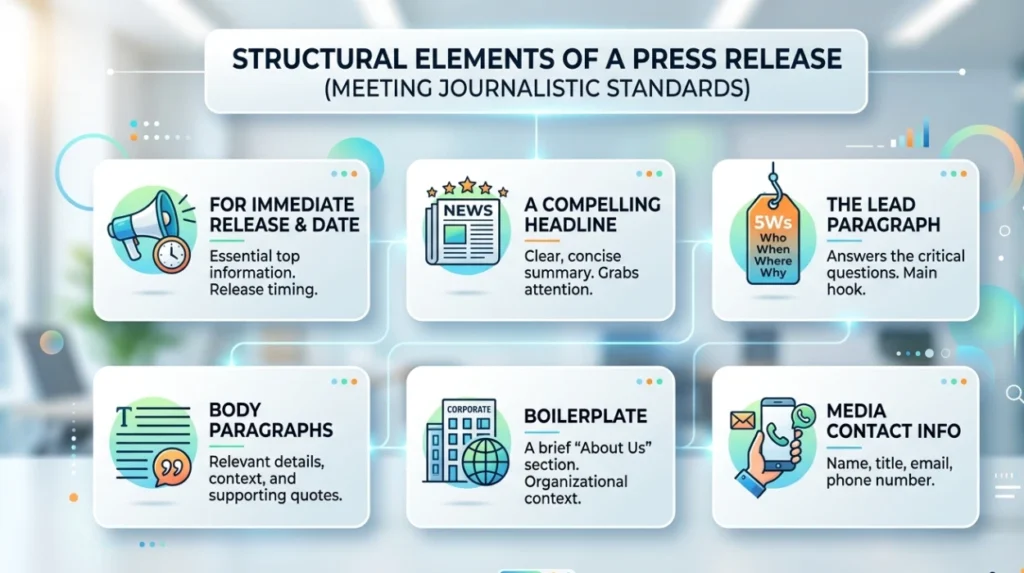
A press release meets journalistic standards when it follows a strict inverted-pyramid structure, prioritises factual clarity, and separates key information from supporting detail. It begins with the most newsworthy point and descends into context, background, and supplementary data. It avoids subjective language and ensures attribution for every claim.
A structured press release improves editorial usability because journalists scan content quickly for relevance, accuracy, and completeness. It reduces interpretation effort and increases the likelihood of publication in news-driven environments. It also ensures consistency across different media formats.
A 40-word structural snippet defines the core approach: journalistic press releases prioritise factual hierarchy, start with the most newsworthy statement, and organise content from critical facts to supporting detail while maintaining neutrality and attribution clarity for editorial use.
Dive Deeper With Our Expert Guides and Related Blog Posts:
How to Manage a Press Embargo Without Leaking Your Story
A Guide to Business Distribution Services and Media Visibility
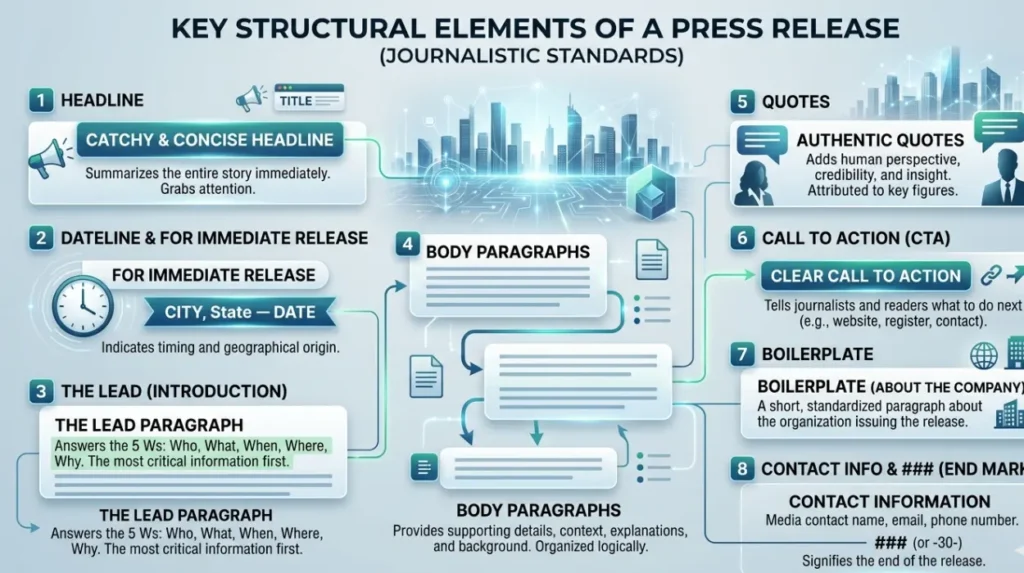
A press release structure typically includes a headline, dateline, lead paragraph, body paragraphs, and boilerplate. Each component serves a distinct function in newsroom evaluation. The headline must summarise the event in one line without exaggeration. The lead paragraph must answer who, what, when, where, and why within two sentences.
The body expands on verified details using supporting evidence such as statistics, statements, or event context. Journalists evaluate whether each paragraph adds informational value. The boilerplate provides organisational context but must remain factual rather than promotional. This separation of functions allows editors to extract usable content efficiently.
How do journalists evaluate press release credibility and relevance?
Journalists evaluate credibility by checking source attribution, factual consistency, and relevance to current editorial priorities. A press release must demonstrate verifiable claims, named sources, and timely relevance to news cycles. Unsupported statements reduce trust and often lead to rejection.
Relevance is assessed through alignment with audience interest, sector developments, and timing. A press release that connects to broader industry movements or measurable change is more likely to be selected. Editorial teams prioritise information that adds public value or updates existing narratives.
A 40-word evaluation snippet clarifies newsroom logic: journalists assess credibility through verifiable sourcing, factual consistency, and named attribution while evaluating relevance based on timeliness, audience interest, and alignment with ongoing editorial or industry developments.
Credibility increases when press releases include direct attribution to identifiable roles or organisations rather than anonymous claims. It also increases when data points are sourced from measurable outcomes such as sales figures, event attendance, or operational milestones. Journalists reject vague statements because they cannot be independently confirmed.
Relevance depends on whether the information contributes to ongoing public discourse. A press release about a product update may be ignored unless it reflects broader industry change. Journalists compare multiple submissions and prioritise those with clear informational value rather than promotional intent.
Which formatting choices improve editorial acceptance rates?
Formatting improves editorial acceptance rates when it supports readability, skimmability, and extraction of key facts. Journalists prefer press releases that use clear paragraphs, consistent punctuation, and standardised section order. Dense formatting reduces usability and lowers acceptance probability.
Formatting also influences how quickly editors identify key information. Short paragraphs, defined sections, and structured data presentation increase engagement. Press releases that mimic newsroom style conventions are processed faster and are more likely to be published.
A 40-word formatting snippet explains the principle: effective formatting uses short paragraphs, clear headings, structured sequencing, and consistent punctuation to improve readability, accelerate editorial scanning, and increase the probability of acceptance in newsroom environments.
Effective formatting begins with a concise headline followed by a lead paragraph that contains all essential facts. Supporting paragraphs must expand logically without repetition. Each paragraph should contain a single informational focus to prevent cognitive overload during editorial review.
Stepwise formatting practices improve clarity:
- Structure headlines to summarise one key news angle, for example a launch or measurable milestone.
- Separate factual sections into clearly defined paragraphs.
- Present numerical data in consistent formats for quick verification.
- Avoid decorative language that obscures meaning.
These formatting decisions reduce editorial friction and improve extraction speed. Journalists prioritise content that can be repurposed with minimal rewriting. Clear formatting directly supports that requirement.
What common mistakes reduce press release effectiveness?
Press release effectiveness declines when content contains promotional language, lacks verifiable data, or presents unclear structure. Journalists reject material that appears subjective or unsupported by evidence. These mistakes reduce editorial trust and distribution reach.
Another critical issue is information overload without hierarchy. Press releases that mix key facts with minor details make it difficult for editors to identify news value. This leads to omission or full rejection.
A 40-word mistake analysis snippet states: ineffective press releases rely on promotional tone, lack structured hierarchy, and omit verifiable data, causing editorial rejection due to reduced clarity, low news value, and inability to validate claims efficiently.
Common mistakes include the use of exaggerated claims that cannot be verified. Journalists avoid content that uses subjective language rather than measurable facts. Another mistake is failing to answer core journalistic questions in the opening paragraph, which delays comprehension.
Additional errors include inconsistent formatting and absence of attribution. When sources are unclear, editorial teams cannot assess reliability. Press releases also fail when they do not align with current news cycles or industry relevance, making them appear outdated or irrelevant.
How does distribution strategy influence journalistic pickup?
Distribution strategy determines how widely and effectively a press release reaches editorial networks. A structured distribution approach increases visibility among relevant media outlets and improves the likelihood of coverage. Poor distribution limits exposure regardless of content quality.
Journalistic pickup depends on timing, targeting, and contextual alignment. Press releases distributed during peak editorial cycles or aligned with relevant news themes perform better. Distribution also affects how quickly content is indexed and reviewed.
A 40-word distribution snippet explains: distribution strategy shapes visibility, timing, and editorial reach by aligning press release delivery with newsroom cycles, targeting relevant media segments, and ensuring content is available during peak editorial review periods.
Effective distribution evaluates audience segmentation before release. Press materials must be aligned with relevant industry sectors, geographic regions, and editorial beats. Targeted distribution increases relevance and reduces noise in newsroom inboxes.
Timing also plays a decisive role. Releases aligned with industry events, policy updates, or sector announcements receive higher attention. Distribution systems that prioritise structured dissemination improve pickup rates by ensuring consistency across multiple editorial channels.
A BOFU connection appears when distribution is linked to execution tools and services. Strategic distribution often requires structured systems that manage targeting, timing, and reach. This is where PR Distribution for Your New Store becomes relevant as a BOFU consideration point for execution-focused implementation decisions.