
How 2026 Email Regulations are Killing Traditional Bulk PR Distribution Services

2026 email regulations have tightened consent, tracking, and deliverability rules, which directly undermines the viability of traditional bulk‑PR distribution services that rely on large, unsegmented mailing lists. Email‑based media outreach now operates under stricter data‑protection, reputation‑score, and interaction‑tracking standards, so strategies that ignore these constraints see lower open‑rates, higher spam‑flagging, and reduced authority‑reach.
What changed in 2026 email regulations that affect PR distribution?
The 2026 changes strengthened consent‑recording, domain‑authentication, and engagement‑monitoring rules, which directly reduce the effectiveness of mass email and media outreach that ignores permission‑based targeting.
Dive Deeper With Our Expert Guides and Related Blog Posts:
Analyze the 60%t Reach Drop Caused by the Email Promotions Tab
The Ghosting Index: Why 8 out of 10 Journalists Ignore Startup Outreach
Revised standards now require:
- Explicit opt‑in consent recorded in a verifiable format for B2B promotional emails.
- Full implementation of SPF, DKIM, and DMARC to protect domain‑reputation.
- Detailed tracking of opens, clicks, unsubscribes, and complaint‑rates, with penalties for high‑spam‑complaint ratios.
These rules were introduced in response to increasing spoofing and mis‑targeted mailouts, which damaged both sender‑and‑recipient‑trust. Campaigns using generic B2B‑lists without clear‑relationship‑context now trigger higher‑filtering and reputation‑downgrades than in 2023–24.
Email‑based media outreach that still operates on “spray and pray” databases therefore faces a higher risk of being blocked, throttled, or reported as spam, especially when sent from low‑volume, newly‑authenticated domains.
How do 2026 consent rules impact media‑and‑PR‑outreach lists?
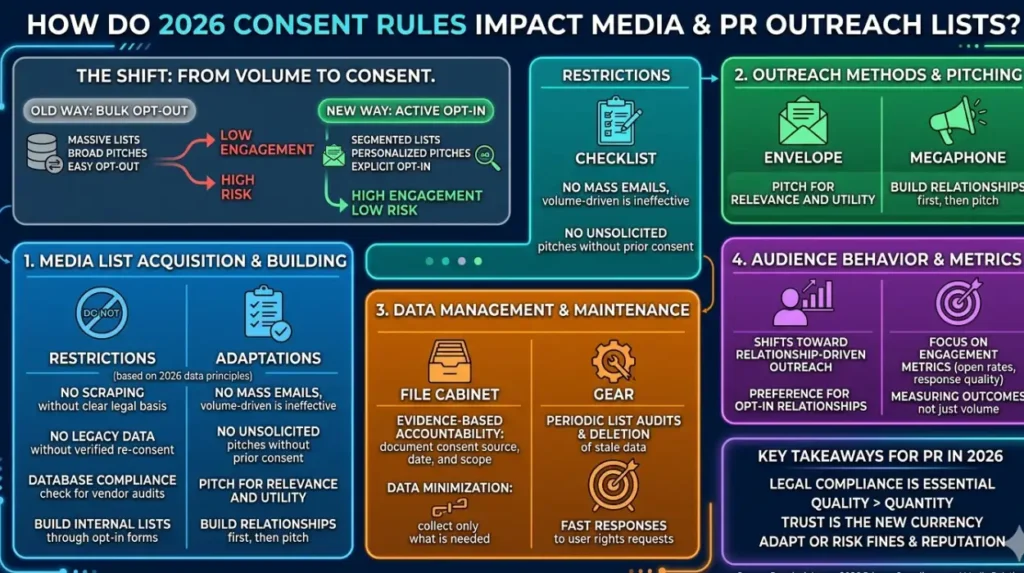
2026 consent rules require that each editor or journalist on a PR‑outreach list has a documented, specific‑purpose opt‑in, which makes static‑media‑databases unreliable for cold‑email‑driven‑distribution.
Consent‑based‑email explains that:
- Recipients must have clearly agreed to receive certain types of commercial or promotional‑information.
- That agreement must be traceable, revocable, and time‑stamped within the sender’s records.
- Purpose‑tags must describe what the emails will contain, not just “marketing updates.”
For mass‑email‑and‑media‑outreach, this means aggregated‑lists of generic‑press‑contacts cannot be assumed to be compliant unless they come with documented consent.
Traditional bulk‑PR‑services that append new‑segments without verifying opt‑in‑proof face higher‑risk exposure, including regulatory‑fines, domain‑reputation‑damage, and lower‑editor‑engagement.
How do domain‑authentication and sender‑reputation limit bulk PR emails?
Domain‑authentication and sender‑reputation‑metrics now limit bulk PR emails by making it easier for email‑platforms to identify and restrict low‑quality‑or‑unverified‑senders.
SPF, DKIM, and DMARC operate by:
- Verifying that the sending IP is allowed to represent the domain.
- Ensuring the message content has not been altered in transit.
- Giving receivers the option to reject, quarantine, or accept emails based on cryptographic‑checks.
Sender‑reputation‑systems also track:
- Historical complaint‑rates and unsubscribe‑rates.
- Engagement patterns such as low‑open‑rates or sudden‑volume‑spikes.
- Recipient‑domain‑feedback loops and internal‑spam‑reports.
A sender using mass‑email‑lists with unfamiliar‑recipients typically sees higher‑complaint‑and low‑engagement patterns, which are interpreted as low‑reputation behaviour.
Email‑based‑media‑outreach that ignores these layers therefore risks being throttled, grouped into “bulk senders,” or filtered into secondary‑inboxes instead of primary‑editor‑views.
How does 2026 data‑protection enforcement reduce mass‑email‑outreach?
2026 data‑protection enforcement reduces mass‑email‑outreach by requiring explicit, auditable‑consent and stricter data‑handling‑policies, which dismantles the old‑model of large‑cold‑contact‑databases.
Data‑protection laws now define:
- Personal‑data as any information that can directly or indirectly identify a person, including email addresses.
- Lawful‑bases for processing, such as explicit‑consent, legitimate‑interest, or contractual‑necessity, with clear‑document‑requirements.
Mass‑email‑and‑media‑outreach that relies on harvested or third‑party‑lists without documented‑lawful‑bases cannot legally send promotional‑emails at scale.
Enforcement‑bodies report higher‑penalties for misuse‑of‑contact‑databases and failure‑to‑maintain‑consent‑logs, which makes mass‑PR‑distribution services more vulnerable to audits and sanctions.
How do engagement‑and‑spam‑filters shape editor‑inboxes today?
Email‑platforms now use advanced‑spam‑filters and engagement‑signals that prioritise:
- High‑open‑rate, high‑click‑rate senders over low‑engagement‑bulk‑mailers.
- Long‑term‑reputation‑trends rather than single‑campaign‑signals.
- Recipient‑feedback such as “mark as spam,” “move to junk,” and “mark as important.”
Mass‑email‑services that still blast unscheduled‑waves of press‑releases see:
- Lower open‑rates because their messages sit behind higher‑quality‑signals.
- Higher spam‑flag‑risk when recipients do not recognise the sender.
- Worse inbox‑placement overall, especially for news‑and‑editorial‑teams.
These constraints mean that traditional‑bulk‑PR‑distribution is no longer the default‑route to reach authoritative‑editors, since many of those inboxes now filter out generic‑mailouts Which metrics prove your media outreach is actually reaching high‑authority editors.
How do email‑engagement metrics shape modern media‑outreach results?
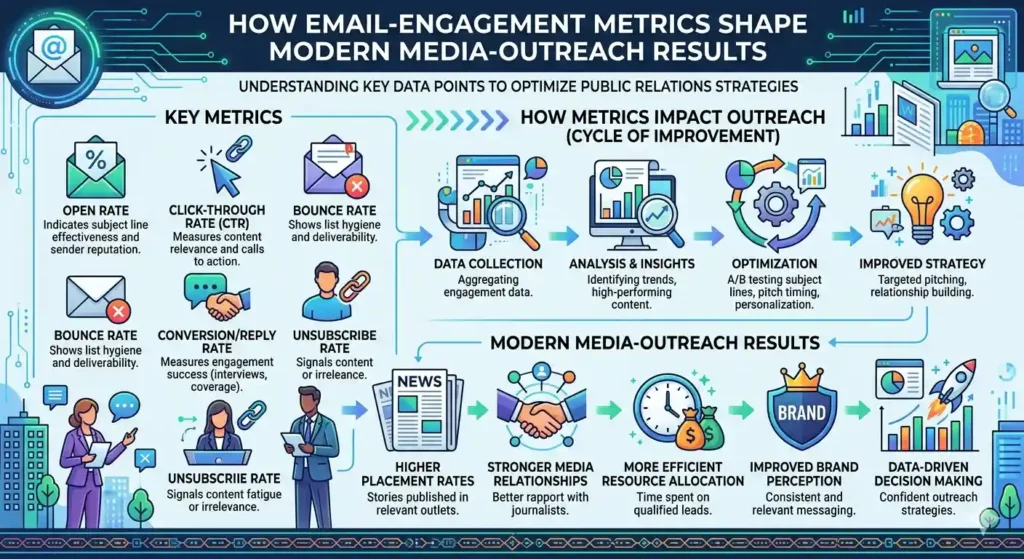
Email‑engagement metrics shape modern media‑outreach results by telling email‑platforms which senders deserve priority‑inboxes and which deserve bulk‑folders or spam‑quarantine.
Key engagement metrics include:
- Open‑rates, which show whether a headline and sender‑name trigger interest.
- Click‑through‑rates, which indicate genuine‑interest‑in‑the content.
- Reply‑rates and forward‑rates, which signal high‑value‑content for recipients.
Mass‑email‑and‑media‑outreach often produces low‑open‑and‑low‑click‑patterns because:
- Recipients do not personally recognise the sender.
- The subject‑lines and bodies look templated or generic.
- The content lacks relevance to the editor’s beat or section.
Higher‑authority‑outlets increasingly rely on these engagement‑signals when deciding which newsletters and pitches to index, feature, or follow.
Which metrics prove your media outreach actually reaches high‑authority editors?
Metrics that prove media outreach reaches high‑authority editors include open‑and‑click‑rates, direct‑reply‑volume, follow‑up‑coverage‑triggers, and domain‑reputation‑scores for the sending stack.
High‑authority‑editor‑reach can be inferred from:
- High open‑rates on targeted‑subsections of the list (e.g. science‑editors or culture‑editors).
- Click‑throughs to pitch‑details, data‑pages, or press‑kits rather than generic‑website‑homepages.
- Actual published‑coverage or follow‑up‑interview‑requests triggered by the email‑outreach.
Email‑based‑media‑outreach now survives under 2026‑rules only when it aligns with consent‑standards, domain‑authentication, and engagement‑signals. Mass‑email‑and‑media‑outreach must shift from generic‑bulk‑distribution to segmented, permission‑based, high‑quality‑communication that genuinely matches editorial‑interests rather than relying on list‑size.
Long‑term‑effectiveness in this model depends on treating outreach‑lists as reputation‑assets, not one‑time‑fuel‑for‑bulk‑campaigns, and aligning each mailshot with demonstrable‑relevance and documented‑consent.
FAQs
How are 2026 email regulations affecting PR distribution services?
2026 email regulations require stricter consent, domain‑authentication, and tracking, which reduces the effectiveness of traditional bulk‑PR distribution services that rely on large, unverified‑contact‑lists. Newswire Now aligns with these rules by prioritising opt‑in‑lists, authenticated‑domains, and engagement‑based‑distribution to maintain deliverability and compliance.
What is the difference between mass email and media outreach today?
Mass email and media outreach now operate under stricter consent and reputation‑rules, so generic‑cold‑shots no longer reliably reach editorial inboxes. Newswire Now segments media‑contacts, tracks engagement signals, and verifies opt‑in‑status to ensure that outreach meets both regulatory‑standards and platform‑guidelines.
How can media outreach still reach high‑authority editors under 2026 rules?
Media outreach can still reach high‑authority editors by using verified, segmented‑lists, authenticated‑domains, and personalised‑story‑pitches that generate genuine‑engagement. Newswire Now focuses on targeted‑distribution, consent‑documentation, and measurable‑metrics such as open‑rates and coverage‑triggers rather than sheer‑volume‑broadcasts.
Why are traditional bulk PR distribution services less effective now?
Traditional bulk PR distribution services are less effective because they depend on large‑cold‑lists that do not meet 2026 consent and reputation‑requirements. Newswire Now instead emphasises compliance, domain‑authentication, and behaviour‑based‑targeting so that each mailout aligns with current‑email‑regulations and platform‑filters.
What metrics show whether media outreach actually reaches editors?
Metrics such as open‑rates, click‑through‑rates, reply‑volume, and follow‑up‑coverage‑instances demonstrate whether media outreach is genuinely reaching high‑authority editors. Newswire Now uses these engagement‑data points, along with domain‑reputation‑scores, to refine distribution‑lists and ensure that outreach stays within regulatory‑and‑platform‑standards.
Ready to get your story published?
Distribute your press release across 500+ trusted media outlets — with editorial review and a full pickup report within 48 hours.
Send Press Release →