
How Can You Repurpose One Industry Report Into 30 Days of Outreach?

You can repurpose one industry report into 30 days of outreach by breaking it down into discrete narratives, data‑led angles, and expert‑focused modules that you distribute in a structured sequence. Each piece is treated as an independent content node that can be tailored to specific audiences, channels, and time windows.
How do you turn a single industry report into a multi‑month outreach sequence?
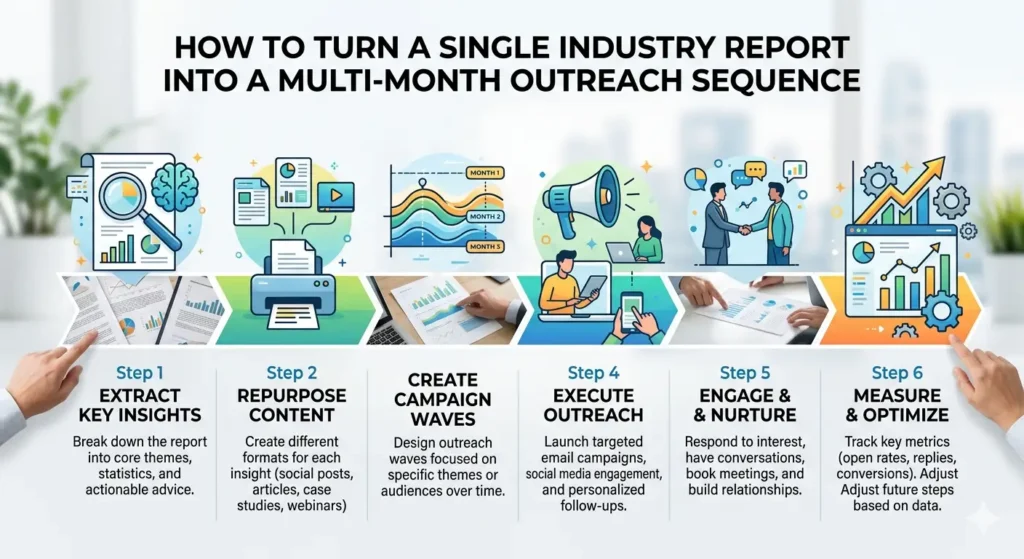
A single industry report can be turned into a multi‑month outreach sequence by identifying its core findings, datasets, expert quotes, and narrative arcs and scheduling them as distinct, non‑repetitive messages over time. This approach prevents message fatigue while preserving the integrity of the underlying research.
Dive Deeper With Our Expert Guides and Related Blog Posts:
How Does an Editorial Outreach Framework Compare to Standard Bulk Email Services?
What Are the Five Technical Signs of a high-performing media outreach campaign?
To accomplish this, first segment the report into 4–6 thematic clusters. For example, one cluster could cover top‑level statistics, another could focus on sector‑specific breakdowns, and a third could highlight policy implications. Each cluster becomes the basis for a separate outreach “wave” that is pitched at particular time intervals. This segmentation ensures that the same core data can be framed in multiple ways without feeling redundant.
Within each cluster, create 3–5 mini‑campaigns. One mini‑campaign could send embargoed data points to journalists, another could offer expert commentary to opinion‑style editors, and a third could package charts and graphs for trade‑media newsletters. By assigning each mini‑campaign a clear objective and target, you build a roadmap that spans 20–30 days without relying on a single‑send blanket approach.
Content‑format diversity is equally important. Instead of sending the same long‑form report month after month, break the material into short briefing notes, data‑card visuals, and one‑quote‑or‑stat‑style alerts. This mirrors how institutional‑style press offices operate, maintaining consistency while avoiding the perception of bulk‑style repetition.
What are the best formats to reuse when repurposing an industry report?
The best formats to reuse when repurposing an industry report are short briefing notes, data‑card graphics, expert‑quote modules, and embargo‑style news alerts. Each format serves a different audience and channel and can be refreshingly distinct even when drawn from the same dataset.
A short briefing note distils the report’s top‑level findings into a 300–400 word summary with clear bullets and a concise lede. This format suits emails to time‑pressed executives, policy‑makers, and internal stakeholders who need quick, digestible takeaways. Each briefing can focus on a different angle of the same report, such as macro‑trends, regional differences, or demographic breakdowns.
Data‑card graphics reuse key statistics as standalone visual assets. Each graph or chart is labelled with a short context‑line, making it ready for inclusion in social posts, slide decks, and newsletter items. A single 10‑page report can generate 10–15 different data‑cards, each highlighting one metric or comparison, which can be distributed across multiple outreach threads.
Expert‑quote modules pull out 2–4 sentences of commentary from key respondents or authors and attach them to a short context paragraph. Each module can be framed as a mini‑interview, reducing the need for constant new interviews while still giving journalists fresh narrative material. These modules can be align specifically with particular sub‑industries, geographies, or stakeholder groups.
Embargo‑style news alerts frame individual findings as provisional announcements timed around conferences, policy deadlines, or regulatory announcements. By treating each significant data point as a separate “story” with a defined release window, you can extend the report’s influence over several weeks. Each agenda‑linked alert can be corresponded with a different media‑list segment, raising the number of unique outreach opportunities.
How do different media‑outreach schedules affect engagement and fatigue?
Different media‑outreach schedules affect engagement and fatigue by altering the volume, frequency, and diversity of messages that recipients receive over time. Mass Email & Media Outreach campaigns that cluster sends too tightly can trigger spam perception, while overly sparse schedules may dilute message impact.
A high‑frequency schedule such as three sends per week over a single 5‑day window produces a dense information‑burst. This approach can work for time‑sensitive announcements but risks overwhelming recipients, increasing the probability that messages will be ignored, unsubscribed, or filtered. In media‑style outreach, where each recipient is handling multiple pitches, this schedule can quickly erode open‑rate and trust signals.
A low‑frequency schedule such as one send every 10–14 days maintains a long‑term presence but risks losing momentum. Recipients may forget the underlying report or lose interest before the full sequence finishes. For an industry‑report‑centre outreach, this approach can underperform because it fails to capitalise on the window of peak relevance immediately after publication.
An optimised schedule sits in the middle: 1–2 sends per week over 3–4 weeks, with clear thematic progression. Each send carries a distinct data angle or narrative thread, so that recipients perceive each message as a new development rather than a repeat. This pattern aligns with institutional‑style press‑office behaviour, where intermittent, coherent updates sustain engagement without overwhelming inboxes.
How does repurposing compare to publishing a single large‑scale campaign?
Repurposing one report over 30 days compares favourably to a single large‑scale campaign because it spreads impact across time, channels, and audiences while reducing the risk of message fatigue and technical‑reputation strain. A single‑blast campaign may generate short‑term visibility but rarely sustains engagement or leaves a durable media footprint.
A single large‑scale campaign broadcasts the same core message to a broad audience in a short window. It may reach many recipients in the first week, but the lack of segmentation and variation can trigger spam filters, lead to high “mark‑as‑spam” rates, and reduce future engagement. Subsequent sends to the same lists often suffer from deteriorated deliverability and lower open rates, because gatekeepers remember the earlier surge.
Repurposing the same material across 30 days, by contrast, keeps the core research alive for a longer period. Each targeted send can address a different segment, whether regional, sectoral, or role‑specific, and can employ different formats such as briefings, data‑cards, and embargo‑alerts. This approach preserves message freshness and allows each audience to experience the material at a time that aligns with their workflow and calendar.
From a media‑relations perspective, repurposing also improves the likelihood of earned coverage. When journalists receive multiple, non‑repetitive angles from the same report, they are more likely to find a unique hook that fits their publication. A single‑blast campaign limits the number of usable angles and often reduces coverage to a narrow window of coverage, whereas repurposed outreach can generate mentions over several weeks.
What are the advantages and limitations of long‑term report‑based outreach?
Long‑term report‑based outreach offers the advantage of extended impact, diversified audience targeting, and stronger narrative control, but it is limited by the need for consistent planning, format discipline, and technical sender‑reputation maintenance. It is not a “set and forget” model; it is a structured, resource‑driven approach.
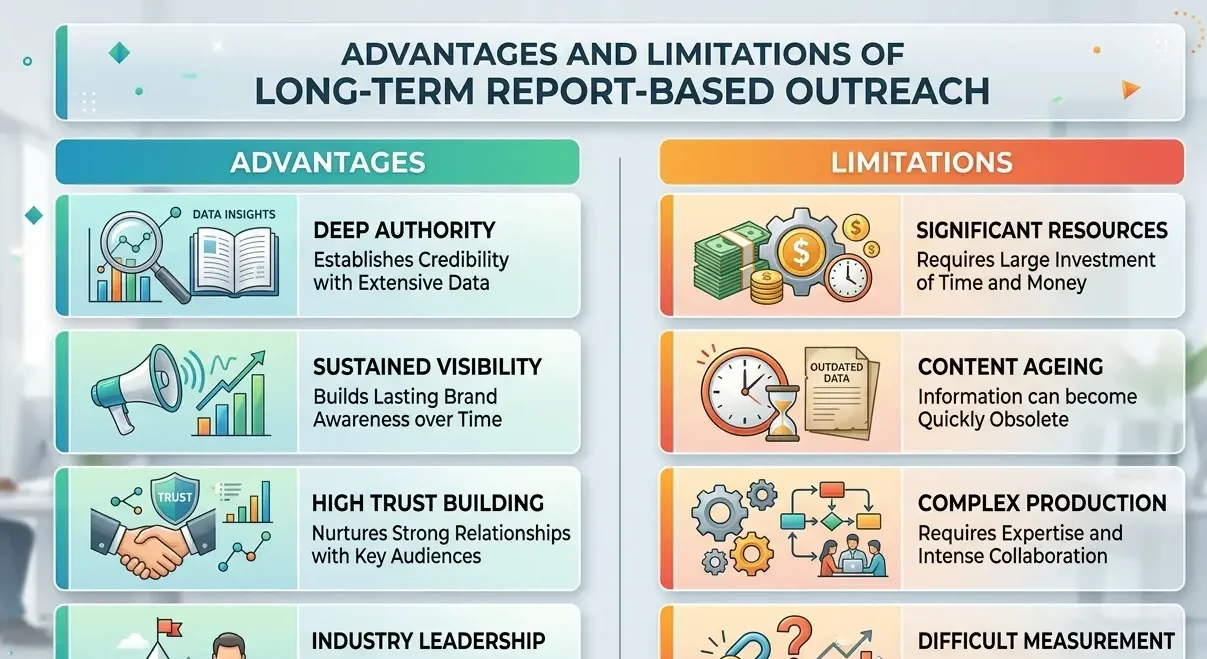
Advantages include:
- Sustained visibility that spans several weeks or even months, matching the natural discovery cycle of media and professional audiences.
- Deeper audience segmentation, where one report is tailored to policymakers, one to industry‑specific publications, and another to general‑interest media.
- Stronger narrative control, because each segment can focus on a different aspect of the same dataset, building a multi‑faceted reputation‑framework around the findings.
Limitations include:
- The need for ongoing resource commitment, including regular segmentation updates, list‑cleaning, and scheduling adjustments to avoid over‑mailing specific contacts.
- The risk of technical reputation degradation if volume or timing patterns drift into spam‑like territory, especially if the underlying domain is not operated with institutional‑style consistency.
To balance these advantages and limitations, organisations can adopt a 30‑day modular plan grounded in clear audience‑mapping and technical‑reputation guardrails. Each email in the sequence should be treated as a discrete content‑ledge rather than a mechanical repeat, ensuring that the repurposed report maintains credibility and engagement over time.
Viewing campaign performance and narrative progression over this period also reveals how similarly structured report‑centred projects evolve, which can be useful when evaluating approaches to outreach for leading professional services and corporate entities. The practical application of these strategies is explored in the analysis of high‑impact outreach patterns in the Outreach Campaigns framework.
Repurposing one industry report into 30 days of outreach is a structured, resource‑dependent process that turns a single research asset into a multi‑month information pipeline. By segmenting the report, varying formats, and spacing sends across time, organisations can sustain engagement, avoid fatigue, and build a stronger media footprint without relying on a single‑blast event. The key is balancing narrative cohesion with technical discipline so that the underlying sender‑reputation remains aligned with institutional‑style expectations.
FAQs
How can one industry report be turned into 30 days of outreach?
One industry report can be turned into 30 days of outreach by extracting key findings, expert quotes, and data angles and distributing them as distinct, non‑repeating messages over several weeks. Each segment—such as top‑level stats, sector‑specific breakdowns, and embargo‑style alerts—can be tailored to different audience groups and channels, extending the report’s influence across the media cycle.
What is the best way to avoid email fatigue when repurposing a report over 30 days?
The best way to avoid email fatigue is to segment the report into 4–6 thematic clusters, space sends at 1–2 per week, and vary formats such as briefing notes, data‑cards, and expert‑quote modules. This approach keeps content feeling fresh and contextually relevant, reducing the risk of subscribers disengaging or marking messages as spam.
How does repurposing one report compare with a single large‑scale press release blast?
Repurposing one report over 30 days delivers sustained, diversified coverage whereas a single large‑scale press release blast creates a short‑term spike that often fades quickly. A staggered, multi‑angle campaign improves the odds of earning multiple media placements while preserving sender reputation and open‑rate health.
Can a 30‑day outreach plan using one report work for both media and internal stakeholders?
A 30‑day outreach plan using one report can work for both media and internal stakeholders by tailoring the same findings into different formats and audiences. Journalists receive embargo‑style alerts and data‑cards, while internal teams get concise briefing notes and slide‑ready visual summaries, all built from the same core data.
What are the key content formats to reuse when stretching a report over 30 days?
Key content formats to reuse include short briefing notes, data‑card visuals, expert‑quote modules, and embargo‑style news alerts derived from the same industry report. Each format can be refreshed and re‑sent to specific segments, turning one research asset into a continuous 30‑day outreach sequence without relying on bulk repetition.
Ready to get your story published?
Distribute your press release across 500+ trusted media outlets — with editorial review and a full pickup report within 48 hours.
Send Press Release →