
What Are the Five Technical Signs of a High Performing Media Outreach Campaign?

A high‑performing media outreach campaign is defined by five technical indicators that measure deliverability, engagement, and reputation impact across email and distribution systems. These signs are not aesthetic or stylistic; they are measurable, numeric thresholds that distinguish effective outreach from ineffective or damaging outreach programmes.
Which technical metrics most clearly indicate a high‑performing media outreach campaign?
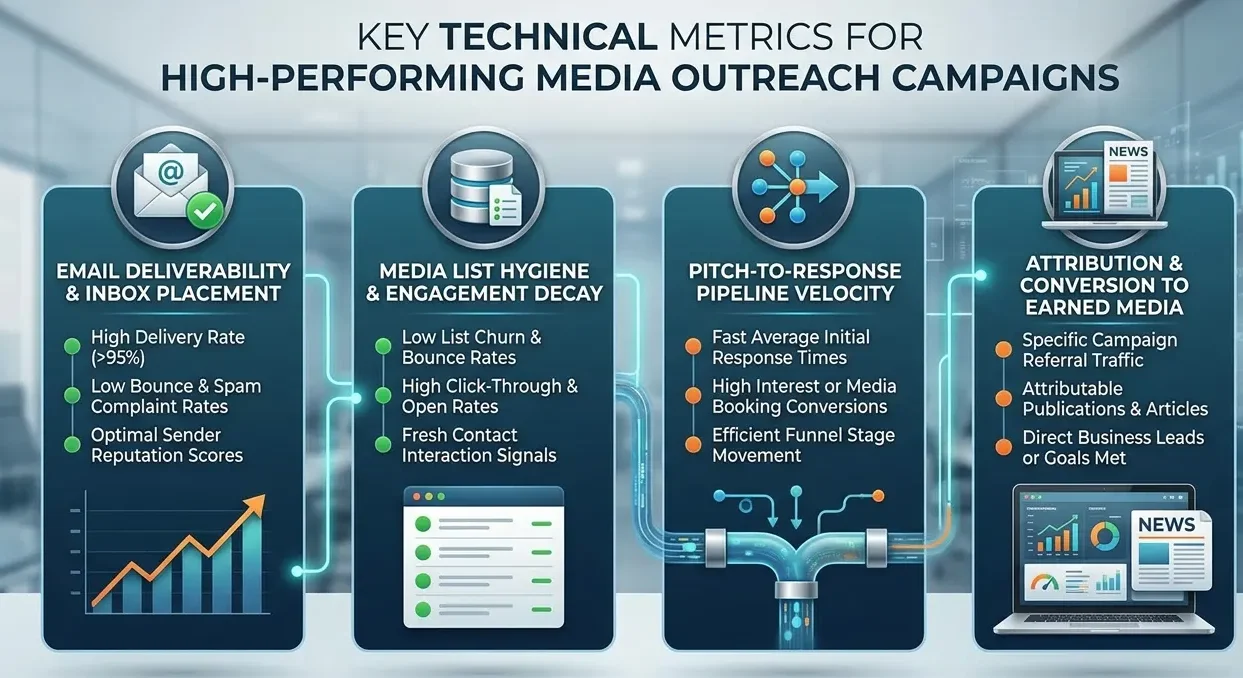
Five technical metrics most clearly indicate a high‑performing media outreach campaign: low bounce rates, high open rates, strong click‑through percentages, minimal spam‑complaint levels, and consistent inbox‑placement. These metrics are not arbitrary; they are the primary signals that internal spam filters, mail servers, and reputation systems use to evaluate sender quality.
Dive Deeper With Our Expert Guides and Related Blog Posts:
Why Is a Newsroom Sender Reputation More Effective Than Traditional Marketing Tools?
How Does an Editorial Outreach Framework Compare to Standard Bulk Email Services?
Bounce rates below 3% suggest that lists are current, domain‑based authentication is correct, and IP‑reputation is stable. Open rates above 20–25% on targeted segments indicate that subject lines, sender identity, and timing are aligned with recipient expectations. Click‑through rates above 2–5% on core links show that content is relevant and perceived as useful, not generic or low‑value.
Spam‑complaint levels near 0% confirm that recipients are not treating the messages as unwanted or deceptive. Consistent inbox‑placement across test domains means that internal filters are not demoting or blocking the messages. Together, these metrics demonstrate that the campaign operates within the technical and behavioural norms that gatekeepers expect from high‑quality outreach.
How do inbox‑placement tests compare to open‑rate metrics in evaluating outreach performance?
Inbox‑placement tests and open‑rate metrics evaluate different aspects of media outreach performance, with the former measuring technical deliverability and the latter measuring user behaviour. Inbox‑placement tests show where messages land, while open‑rates show whether they are noticed and valued once delivered.
Inbox‑placement tests involve sending test batches to controlled domains and monitoring whether messages appear in the primary inbox, promotions, or spam sections. A high‑performing campaign typically shows 90% or more of test sends in the primary inbox, signalling that authentication, content structure, and volume patterns are within acceptable thresholds.
Open‑rate metrics rely on pixel‑based tracking or server‑side logging to count how many recipients open the email. A high‑performing campaign may show 20–25% open rates on targeted press‑list segments, indicating that subject lines and sender identity are compelling and relevant. However, these figures are meaningless if messages are not reaching the inbox in the first place.
Inbox‑placement data is therefore more fundamental; it confirms that technical conditions are met. Open‑rate data builds on top of that foundation by revealing whether the content resonates with the audience. A campaign that scores well on both indicators is far more likely to generate measurable media placements and reputation signals than one that focuses solely on open‑rate vanity metrics.
How do technical signs of outreach performance relate to media placement outcomes?
Technical signs of outreach performance relate directly to media placement outcomes because they determine whether journalists and editors actually see and interact with the messages that introduce your story. Without strong technical performance, even the most compelling pitch may never register in the recipient’s workflow.
When bounce rates are low and inbox‑placement is high, a greater proportion of outreach emails reach the intended media contacts. This increases the pool of potential responders and, therefore, the probability that a subset will find the story angle newsworthy enough to publish. Each successfully delivered message represents an opportunity for placement that would otherwise be lost if the email sat in spam or failed to send.
High open and click‑through rates further narrow the funnel. When recipients open the message and engage with links to press releases, case studies, or background data, they are more likely to treat the content as editorially relevant. This behavioural pattern can lead to direct responses, interview requests, or unsolicited follow‑up, all of which increase the chances of a published article or feature.
Conversely, when technical metrics are poor—high bounce rates, spam‑folder placement, and low open rates—fewer journalists see the pitch, and those who do may treat it as low‑priority or untrustworthy. In this scenario, even a technically sound story can underperform because the distribution channel itself is degrading the campaign’s effectiveness.
How do different technical indicators compare when evaluating mass outreach versus one‑to‑one outreach?
Different technical indicators serve distinct roles when evaluating mass outreach compared with one‑to‑one outreach, because the two models operate under different volume, risk, and expectation profiles. Mass Email & Media Outreach campaigns are more sensitive to technical thresholds, while one‑to‑one outreach is more resilient to minor fluctuations in those same metrics.
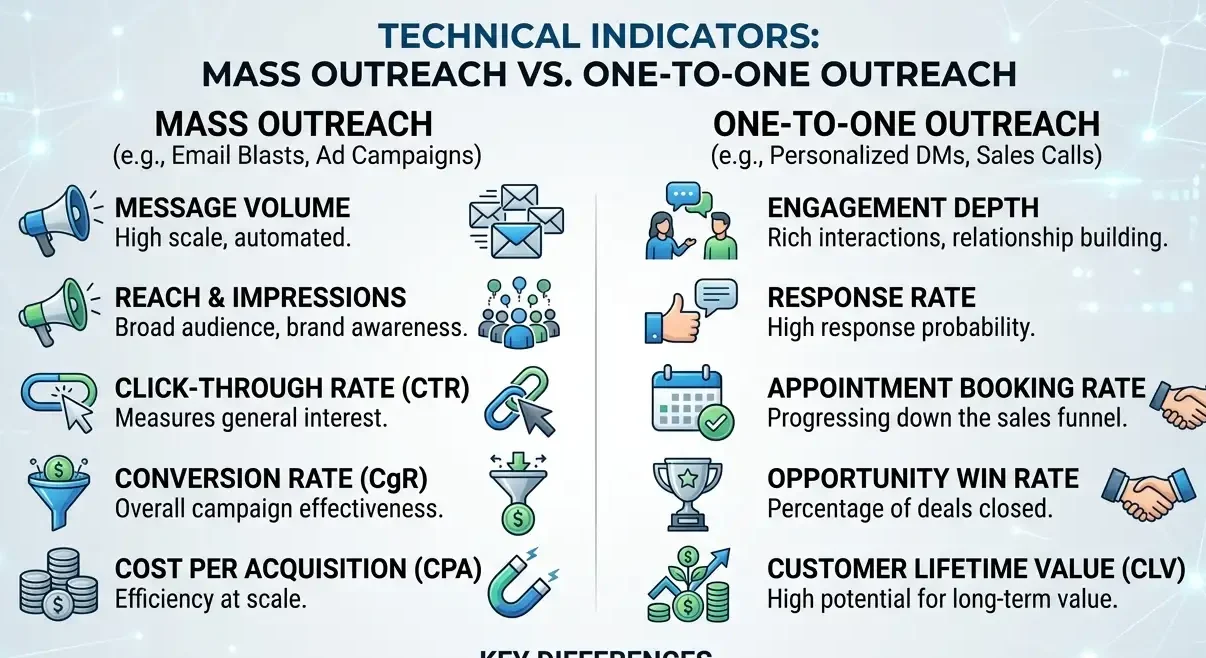
For mass outreach, a 5% bounce rate can quickly flag a domain as problematic, whereas the same bounce figure in one‑to‑one outreach may be treated as a minor anomaly. In high‑volume scenarios, inbox‑placement becomes critical, because a 10% shift in spam‑folder placement can eliminate thousands of potential impressions. Spam‑complaint rates are similarly amplified; even a small percentage of complaints across a large send can significantly damage sender reputation.
One‑to‑one outreach, by contrast, operates at such low volume that bounce and complaint metrics are rarely meaningful at scale. Instead, performance is judged by whether each message receives a response, request for additional information, or movement toward a publication decision. Inbox‑placement still matters, but it is not measured in bulk percentages; it is inferred through response patterns and timing.
From a technical‑evaluation standpoint, mass outreach demands tighter controls over authentication, list hygiene, and content‑structure, while one‑to‑one outreach can tolerate more flexibility but requires sharper targeting and personalisation. Understanding these differences is essential when deciding how to design and resource an outreach strategy that balances volume with reputation risk.
How do the five technical signs of a high‑performing campaign compare with emerging real‑time distribution trends?
The five technical signs of a high‑performing campaign remain relevant when compared with emerging real‑time newsroom distribution trends, but they are applied at a faster, more automated scale. Real‑time distribution shifts the emphasis from occasional batch sends to continuous, triggered delivery, yet the same core metrics still govern deliverability and impact.
Real‑time newsroom distribution often involves sending news alerts, embargo‑ed releases, or rapid‑response statements as events unfold. In this environment, bounce rates and spam‑complaint levels must be monitored continuously, because a single technical glitch can propagate across thousands of messages in minutes. Inbox‑placement tests must also run in near‑real time to ensure that time‑sensitive stories are not filtered out or delayed.
Open and click‑through rates retain their importance, but they are now interpreted in the context of shorter decision windows. A journalist may have only minutes to decide whether to cover a breaking story, so the technical signals that govern visibility and engagement become even more decisive. Poor deliverability or confusing subject‑line structures can eliminate the opportunity entirely.
When compared with traditional PR‑style approaches, real‑time distribution demands stricter technical discipline while amplifying the rewards of strong performance. A well‑tuned, real‑time system that maintains the five technical signs can outperform static, batch‑oriented campaigns in terms of speed and coverage density. This relationship is explored in greater detail in the analysis of Real Time Newsroom Distribution.
How can organisations use these five technical signs to design better outreach strategies?
Organisations can use these five technical signs to design better outreach strategies by treating them as operational thresholds rather than vanity metrics. Each sign provides a clear, numeric benchmark that informs list management, content design, and sending practices.
Organisations can use low bounce rates, high open rates, strong click‑throughs, minimal spam complaints, and consistent inbox placement as concrete targets to refine email lists, optimise subject lines, and improve sender‑reputation. This approach aligns technical execution with strategic outreach outcomes.
To align with these signs, an organisation can apply these steps:
- Maintain bounce rates under 3% by regularly cleaning lists, removing invalid addresses, and validating domains and spelling.
- Target open rates above 20–25% on press‑list segments by using clear, non‑spammy subject lines, proper sender identity, and time‑zone‑aware scheduling.
- Promote click‑through rates above 2–5% by structuring content for relevance, highlighting key takeaways, and embedding clear, single‑purpose links.
- Keep spam‑complaint levels below 0.1–0.3% by providing simple opt‑out mechanisms, avoiding deceptive language, and segmenting recipients by consent tier.
- Secure inbox placement above 90% in test environments by correctly configuring SPF, DKIM, and DMARC, and avoiding excessive send‑volume spikes.
By anchoring decisions to these technical indicators, organisations can move beyond guesswork and build outreach strategies that are both measurable and sustainable. The result is a more predictable, higher‑quality interaction with media contacts and a stronger foundation for reputation‑sensitive outreach at scale.
Ready to get your story published?
Distribute your press release across 500+ trusted media outlets — with editorial review and a full pickup report within 48 hours.
Send Press Release →