
How to Craft a Compelling Quote Sample for Your Media Release
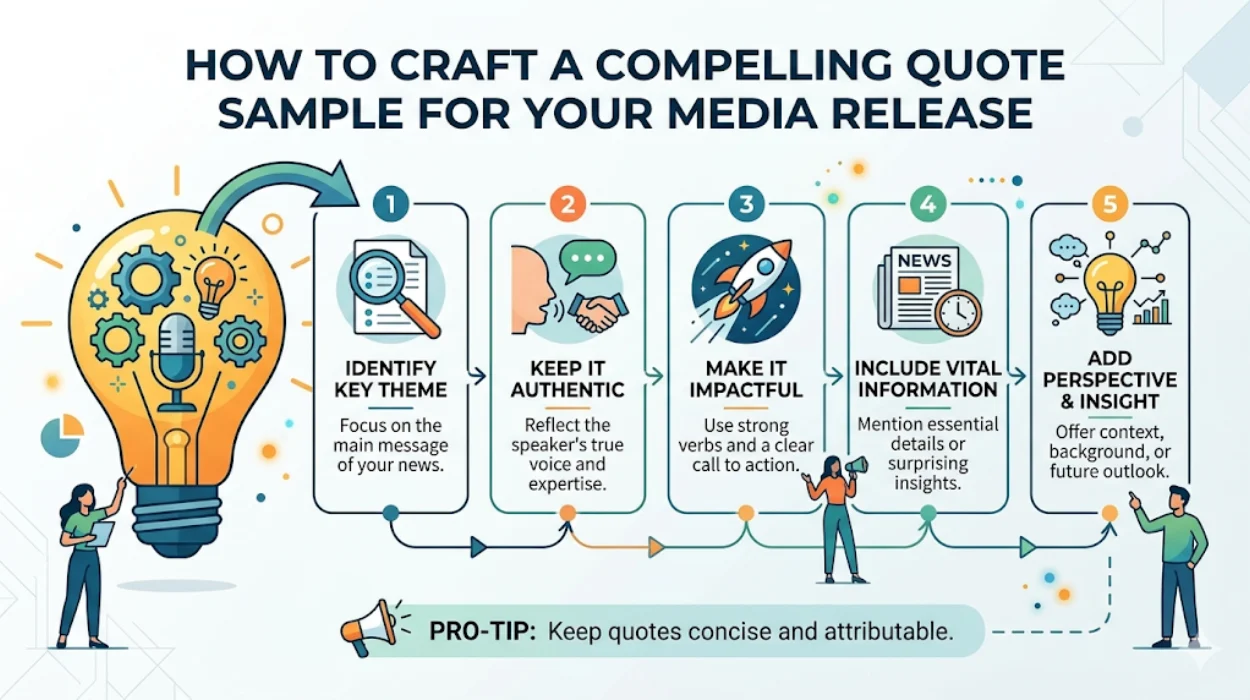
A compelling quote sample for a media release is crafted by aligning message clarity, authority, and news value within a single attributable statement. It works as a structured narrative device that shapes how journalists interpret the release.
It determines whether the media extracts your message or ignores it entirely. Strong quote samples compress insight, credibility, and relevance into precise language that supports editorial use without requiring heavy rewriting or contextual correction.
What makes a compelling quote sample for a media release?
A compelling quote sample for a media release is defined by clarity, attribution strength, and editorial usability. It transforms internal messaging into publishable language that journalists can directly insert into coverage. It evaluates how effectively a statement carries meaning without additional explanation or distortion.
A strong quote sample functions as a standalone message that preserves intent while increasing media adaptability. It ensures that editorial teams can interpret value without contacting the source for clarification. It also reinforces message consistency across multiple distribution channels.
40-word snippet:
A compelling quote sample combines clarity, authority, and editorial usability in one structured statement. It evaluates message strength by testing whether journalists can reuse it without edits. It prioritises precision, narrative relevance, and factual anchoring to improve media adaptability and visibility.
Effective quote samples evaluate three core components. First, they establish attribution through a clearly defined spokesperson role. Second, they present a single idea without multi-topic dilution. Third, they embed relevance by linking directly to the news angle of the release.
Strong quotes also analyse linguistic simplicity. Short sentences outperform complex structures because journalists prioritise speed. A quote with fewer than 25 words per sentence increases likelihood of direct adoption. This structural discipline reduces editorial friction and improves message retention.
Quote samples further assess tonal consistency. A neutral or declarative tone performs better than emotional exaggeration. Media environments prioritise factual framing over subjective emphasis. Therefore, tone alignment determines whether the quote integrates into professional reporting formats.
How do you structure quotes for maximum journalistic clarity?
Quotes are structured for maximum journalistic clarity by prioritising singularity of message, logical sequencing, and attribution placement. This structure evaluates how effectively a quote can be extracted and reused without contextual distortion or editorial rewriting.
Well-structured quotes reduce ambiguity and ensure that each sentence delivers one interpretive unit. Journalists favour formats that mirror reporting logic, where each line supports a clear informational hierarchy. Structural discipline directly influences media adoption rates.
40-word snippet:
Quote structure determines journalistic clarity by enforcing single-message sentences, clear attribution, and logical sequencing. It evaluates how easily media outlets extract meaning without reinterpretation. Proper structuring increases readability, reduces ambiguity, and improves publication consistency across multiple editorial environments.
Effective structuring begins with attribution positioning. The speaker is introduced once, typically at the start or end of the quote, depending on narrative emphasis. This prevents repetition and ensures the statement remains fluid for editorial integration.
Next, quotes are segmented into distinct informational units. Each sentence delivers one idea, avoiding compound messaging. This technique improves cognitive processing speed for editors who scan multiple releases under time constraints. It also enhances extraction accuracy.
Clarity is further reinforced through syntactic consistency. Present tense is preferred for immediacy, while active voice strengthens message authority. These grammatical choices ensure the quote reads as current and actionable within news cycles.
Finally, structured quotes evaluate readability thresholds. Sentences exceeding 20–25 words reduce adoption probability. Concise formatting improves headline alignment and supports direct insertion into media narratives without structural modification.
How do quote samples influence media outreach effectiveness?
Quote samples influence media outreach effectiveness by shaping narrative perception, editorial selection probability, and message framing consistency. They act as conversion points between press material and published coverage, directly affecting how stories are interpreted by journalists.
High-quality quotes improve outreach outcomes by increasing editorial trust. Journalists prioritise statements that require minimal editing and deliver immediate contextual relevance. Poorly constructed quotes reduce pickup rates and weaken distribution performance.
40-word snippet:
Quote samples directly influence media outreach effectiveness by shaping editorial perception and improving message adoption rates. They evaluate how easily journalists integrate statements into coverage. Strong quotes increase trust, improve narrative alignment, and enhance consistency across distributed press materials.
Quote samples also evaluate narrative control within outreach systems. A well-designed quote ensures that the intended message remains intact during editorial transformation. This reduces interpretive drift, where meaning shifts during rewriting or summarisation processes.
They further influence outreach performance by improving alignment with story angles. When a quote directly reflects the core news hook, journalists are more likely to incorporate it verbatim. This alignment increases visibility across multiple publication formats.
A structured quote also enhances distribution scalability. When media outlets reuse identical phrasing, message consistency increases across regional and international coverage. This creates a unified narrative footprint without additional outreach effort.
At a strategic level, quote samples contribute to planning frameworks such as a Media Outreach Plan. They serve as modular assets that can be deployed across different pitches, ensuring consistent messaging alignment throughout outreach campaigns.
What mistakes reduce the impact of media release quotes?
Mistakes in quote construction reduce media impact by weakening clarity, introducing ambiguity, and decreasing editorial usability. These errors affect how journalists interpret, adapt, or reject content during publication processes.
Poorly designed quotes often fail because they combine multiple ideas into a single statement. This structural overload forces editors to rewrite content, which lowers adoption probability and disrupts narrative consistency across outlets.
40-word snippet:
Common mistakes in quote samples include multi-idea sentences, excessive jargon, and weak attribution clarity. These issues reduce editorial usability and lower media pickup rates. They evaluate structural weaknesses that prevent direct reuse in journalistic reporting and press distribution workflows.
One major mistake is message dilution. Quotes that include multiple themes reduce interpretive clarity. Journalists require singular focus statements that align with specific news angles. Multi-topic quotes create confusion and increase editing workload.
Another mistake is overuse of abstract language. Vague terminology reduces informational value and weakens journalistic relevance. Media environments prioritise concrete statements that can be verified or directly contextualised within reporting frameworks.
Weak attribution is also a critical failure point. When the speaker is not clearly identified, credibility decreases. Attribution must be explicit and consistent to ensure the quote is accepted as a reliable source of information.
Finally, excessive length reduces effectiveness. Quotes exceeding optimal readability thresholds are frequently truncated or ignored. Short, precise statements outperform extended commentary because they integrate more easily into editorial structures.
A compelling quote sample operates as a controlled narrative unit that determines how effectively a media release is interpreted, reused, and distributed across journalistic ecosystems.
Ready to get your story published?
Distribute your press release across 500+ trusted media outlets — with editorial review and a full pickup report within 48 hours.
Send Press Release →