
The Difference Between a Press Release and a Media Statement
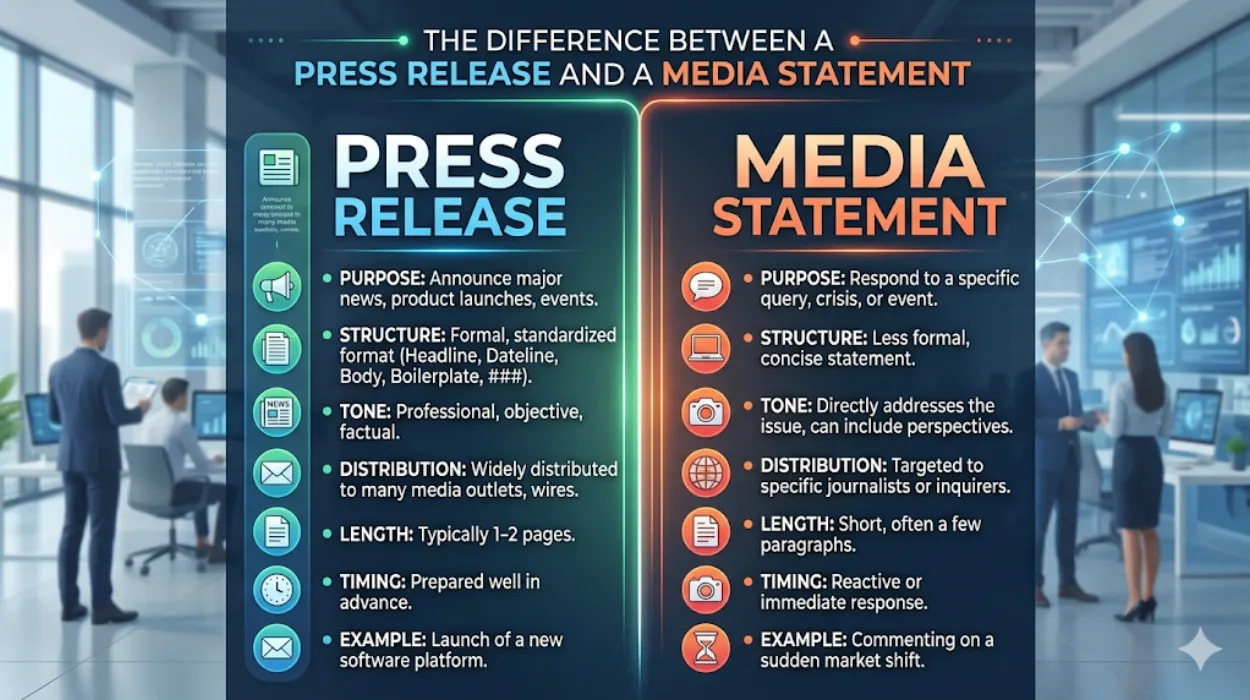
A press release is a structured informational document that announces verifiable news.
A media statement is a concise official response that clarifies a position or issue.
This distinction defines how organisations communicate information to the media and the public. A press release delivers structured news content with detailed context and supporting data. A media statement delivers direct clarification with controlled messaging and immediate relevance. Both formats operate within formal communication systems. Each format serves a distinct informational function within media communication frameworks. The macro topic defines how information flows from an organisation to public channels.
What defines a press release in semantic communication?
A press release defines structured informational content that communicates verified news through formal channels.
It establishes factual reporting, contextual detail, and informational completeness within a defined communication format.
A press release operates as a news-oriented document that communicates events, developments, or updates in a structured form. It defines informational hierarchy through a headline, subheading, body content, and concluding details. Each section performs a semantic role in guiding interpretation and comprehension. The document prioritises clarity, factual precision, and informational density.
A press release maintains a consistent structure that enables media extraction and redistribution of information. It includes descriptive language that explains context, background, and significance of the communicated content. The structure supports indexing and semantic interpretation by search systems and editorial frameworks. It also ensures that each informational unit remains independently interpretable.
The function of a press release centres on information delivery rather than response or clarification. It communicates prepared content designed for publication and redistribution across communication channels. The format supports detailed explanation of developments within a defined informational boundary. This structure enables consistent semantic mapping across media systems.
Structural components of press releases
Headline defines the core informational message of the document. Subheading refines the context of the primary message. Body text expands informational detail through structured paragraphs. Concluding information provides reference data and contact metadata. Each component reinforces semantic clarity and hierarchical organisation.
What defines a media statement in official communication?
A media statement defines a concise official communication that responds to specific issues or clarifies a position.
It delivers controlled messaging designed for direct interpretation without extended informational expansion.
A media statement operates as a response-oriented communication format that addresses a defined issue or query. It prioritises clarity, precision, and immediacy in message delivery. The structure remains minimal and avoids extended narrative development. Each sentence serves a direct informational function.
A media statement communicates stance, clarification, or correction within a limited textual framework. It eliminates structural complexity in favour of immediate semantic clarity. The format supports rapid dissemination across media channels. It ensures that interpretation remains aligned with the intended message.
The communication function focuses on response rather than announcement. It defines position through direct language and controlled informational scope. The document restricts contextual expansion to maintain message integrity. This ensures consistent interpretation across different media environments.
Functional characteristics of media statements
Media statements prioritise brevity and directness in communication structure. Sentences remain focused on singular informational points. The format excludes layered contextual development. Each statement maintains semantic containment within a defined message boundary. This structure reinforces clarity and interpretative consistency.
How does structure differ between a press release and a media statement?
A press release uses a multi-layered structured format, while a media statement uses a condensed single-layer format.
This structural difference defines how information expands or contracts within formal communication systems.
A press release structures information through hierarchical components that guide interpretation step by step. It includes multiple sections that expand detail and context systematically. Each section builds semantic depth and informational continuity. The structure supports redistributable and reference-oriented content.
A media statement compresses information into a unified block of text. It removes hierarchical segmentation and prioritises immediate clarity. The structure limits informational expansion and avoids layered explanation. Each sentence functions independently while contributing to a single communicative purpose.
The difference in structure reflects the informational intent of each format. Press releases expand knowledge through structured detail. Media statements restrict content to essential communication units. This contrast defines their operational roles in media communication systems.
Structural comparison framework
Press releases organise information through segmented hierarchy. Media statements organise information through linear compression. Press releases support extended readability. Media statements support rapid comprehension. Each structure aligns with a distinct communication objective.
How do purpose and intent separate press releases from media statements?
A press release aims to inform and distribute structured news content, while a media statement aims to clarify and respond to specific issues.
This difference in intent determines how each document functions within communication workflows.
A press release functions as an informational distribution tool that communicates new developments. It delivers structured content designed for publication and archiving. The intent focuses on informing audiences through complete and contextualised information. It establishes informational presence within media ecosystems.
A media statement functions as a corrective or clarifying communication tool. It delivers immediate responses to queries, issues, or interpretations. The intent focuses on message control and interpretative alignment. It restricts content to essential communication requirements.
The distinction in purpose defines the semantic role of each format. Press releases expand informational visibility through structured narrative. Media statements control informational interpretation through concise messaging. Each serves a distinct function in communication strategy systems.
Intent-driven communication roles
Press releases prioritise information dissemination. Media statements prioritise message clarification. Press releases extend informational reach. Media statements stabilise interpretative accuracy. These roles define how organisations structure communication output.
How does tone differ between press releases and media statements?
A press release uses a descriptive and informational tone, while a media statement uses a direct and declarative tone.
This tonal distinction defines how meaning is constructed and interpreted across communication formats.
A press release maintains a formal informational tone that explains context and detail. It uses structured language that supports clarity and semantic expansion. The tone remains neutral while enabling detailed explanation of subject matter. Each sentence contributes to informational development.
A media statement uses a declarative tone that prioritises directness and clarity. It eliminates extended description and focuses on precise communication. The tone supports immediate comprehension without interpretative delay. Each sentence communicates a single defined message unit.
The tonal difference reflects the functional purpose of each document type. Press releases construct meaning through structured explanation. Media statements construct meaning through direct assertion. This distinction shapes how audiences interpret and process information.
Tonal classification model
Press releases adopt explanatory tone structures. Media statements adopt declarative tone structures. Press releases extend informational depth through language. Media statements compress meaning into direct assertions. Tone alignment defines communication effectiveness.
When does each document type apply in communication workflows?
A press release applies when structured information requires distribution, while a media statement applies when immediate clarification or response is required.
This workflow distinction defines document selection within communication systems.
A press release applies in situations where information requires structured dissemination and archival clarity. It supports content that benefits from detailed explanation and contextual layering. The format integrates into long-form communication pipelines. It enables systematic distribution across media channels.
A media statement applies in situations where communication requires immediate response and message control. It supports scenarios that demand clarity without informational expansion. The format integrates into rapid-response communication pipelines. It ensures consistent message delivery under time constraints.
The workflow separation ensures that communication output aligns with informational requirements. Press releases support informational expansion workflows. Media statements support interpretative control workflows. Each format operates within defined communication boundaries.
Workflow selection criteria
Press releases align with structured information delivery systems. Media statements align with response-based communication systems. Press releases extend informational architecture. Media statements stabilise communication interpretation. The selection process depends on informational intent and message function.
What role does a Compelling Quote Sample play in press release structure?
A Compelling Quote Sample defines a structured statement that adds interpretative depth within a press release.
It integrates authoritative language that reinforces informational clarity and message emphasis.
A Compelling Quote Sample functions as a semantic reinforcement element within press release construction. It introduces direct speech that highlights key informational points. The quote structure supports emphasis and interpretative alignment. It strengthens the clarity of the communicated message.
The inclusion of structured quotes enhances informational hierarchy within press releases. It separates factual reporting from interpretative expression. This separation improves semantic clarity and message organisation. Each quote operates as a focused informational anchor.
A press release integrates quoted content to reinforce key communication points without altering structural integrity. The quote remains consistent with the informational context of the document. It functions as a supporting semantic layer within the overall structure.
Quote integration framework
Quotes operate as embedded informational units. They reinforce key message components. They maintain structural alignment with press release content. They enhance semantic clarity without expanding narrative scope. This ensures controlled informational reinforcement.
How do press releases and media statements shape media communication systems?
A press release and a media statement define two complementary communication structures within media systems.
Each format regulates how information expands, contracts, and stabilises across communication networks.
Press releases expand informational ecosystems through structured distribution of detailed content. They establish foundational informational material for media interpretation. They support indexing, retrieval, and structured dissemination. This expands semantic coverage across communication channels.
Media statements stabilise communication ecosystems through controlled messaging and immediate clarity. They regulate interpretation during issue-driven communication cycles. They maintain consistency in message delivery. This stabilises informational understanding across audiences.
Together, both formats define a dual-layer communication system. One expands informational depth. One controls informational interpretation. This balance supports structured communication flow within media environments.
System-level communication balance
Press releases expand structured knowledge distribution. Media statements regulate message interpretation. Press releases increase informational density. Media statements reduce interpretative variability. This dual structure defines communication system efficiency.
What distinguishes informational depth between press releases and media statements?
A press release contains high informational depth through structured expansion, while a media statement contains low informational depth through direct compression.
This distinction defines how information volume and clarity interact across communication formats.
A press release increases informational depth through layered explanation and contextual development. It expands subject matter into structured sections that enhance understanding. Each section adds semantic value to the overall communication. The format supports comprehensive informational mapping.
A media statement reduces informational depth to essential communicative units. It eliminates contextual expansion and focuses on core message delivery. This compression supports rapid interpretation. It ensures message clarity without additional informational layering.
The difference in informational depth defines how each format operates within communication frameworks. Press releases build informational complexity. Media statements reduce informational complexity. This structural contrast ensures communication precision across contexts.
Depth classification model
Press releases operate as high-depth informational systems. Media statements operate as low-depth informational systems. Press releases expand semantic layers. Media statements compress semantic layers. This classification defines their functional separation.
Ready to get your story published?
Distribute your press release across 500+ trusted media outlets — with editorial review and a full pickup report within 48 hours.
Send Press Release →