How to Write a Newsworthy Press Release Statement

A press release isn’t news just because your organisation has something to announce. To understand how to issue a press release statement, start with the story: a press release is an official statement sent to media outlets to share important news and give journalists information they can use. Its headline should make the main point clear, and its opening should answer who, what, when, where and why in 25 to 35 words.
It’s easy to focus on the announcement itself, but journalists need a clear reason to cover it and accurate details to judge its relevance to their readers. This guide explains what makes a story newsworthy, how to write a concise headline and introduction, and what to include in the body of a release. You’ll also learn how to prepare a company boilerplate and media contact block, so journalists can see who is speaking and how to follow up.
Key Takeaways
- Lead with a specific announcement that matters to the audience you want to reach.
- Make the headline and opening easy to scan, with the strongest news up front.
- Use a concise company boilerplate and give journalists a named contact for follow-up.
- Once your release is ready, consider editorial review and distribution to help put it before relevant media outlets.
What Goes in a Company Boilerplate and Media Contact Block?
Finish the release with a standard company boilerplate and clear media contact details. These final elements help journalists identify the organisation and follow up efficiently.
-
Add the company boilerplate
Place a standard company boilerplate near the end of the release. It gives journalists consistent background on the organisation behind the announcement. Keep the format factual: name the organisation, explain its purpose and describe work relevant to this campaign. Use approved wording across releases, updating it when details change. Aim for 75 to 100 words, and remove slogans that don’t help the audience understand the organisation. PR Daily reports that 84% of journalists reference the boilerplate when covering a company.
-
Provide media contact details
Give journalists a named person who can answer questions about the announcement. Include their email address and phone number, as Friends of the Earth Scotland recommends. A generic inbox can make follow-up less direct, so identify the contact by name and role where possible. Check that the details belong to someone familiar with the story and able to respond to requests for context, comment or supporting information. Cision reported that releases with a named media contact receive 45% more follow-up inquiries than those with only a generic press email.
-
Mark the end and add contact information
Place the media contact block after the boilerplate, then mark the end of the release with “###”. This conventional marker tells journalists there is no more release copy to follow. Put it on a separate line, centred if the document format allows. Before distribution, check that the contact details appear before the marker and are easy to find. Don’t add announcements or notes after “###”, as they could be mistaken for part of the release.
Check the final paragraphs in order: company background, contact name, email address, phone number, then the end marker. This sequence makes it clear who issued the statement and how to follow up.
What is a press release?
A press release is an official statement sent to media outlets to announce important news and help journalists assess its relevance. Knowing how to issue a press release statement starts with treating it as a concise briefing, not a sales pitch. Its structure should make the announcement, evidence and next steps easy to identify.
- Include the essential elements. State what happened, who is involved, when and where it applies, and why it matters. Add relevant evidence, useful context and an approved quote. A template can provide a consistent structure, but tailor each announcement to its audience and the outlets you want to reach.
- Review potential legal risks. Check factual claims against reliable records, confirm quotations with their speakers and use images only when you have permission. Remove confidential material and wording that could unfairly harm someone’s reputation. A careful review helps prevent avoidable errors before distribution.
- Send it to relevant journalists. Identify media outlets whose coverage fits the story, then email the release with a personalised note. Explain why the announcement may interest that outlet’s readers. A targeted message is more useful than sending the same pitch to journalists covering unrelated subjects.
- Follow up thoughtfully. Contact the journalist to confirm receipt and offer further context or supporting material. Keep your message concise and relevant. Repeated follow-ups without new information can distract from the story rather than help it.
- Measure the response. Record which outlets published or shared the announcement, then compare those results with your original communication aim. For example, a campaign seeking event attendance should assess whether coverage reached likely participants, not just count mentions. To see how to issue a press release statement through wider media distribution, consider a press release distribution service.
Writing a newsworthy headline and introduction
Prepare a factual headline and lead, then check that any quote, image and media contact details support the story. A clear opening gives journalists the key announcement before background or promotional language.
-
Write an attention-grabbing headline
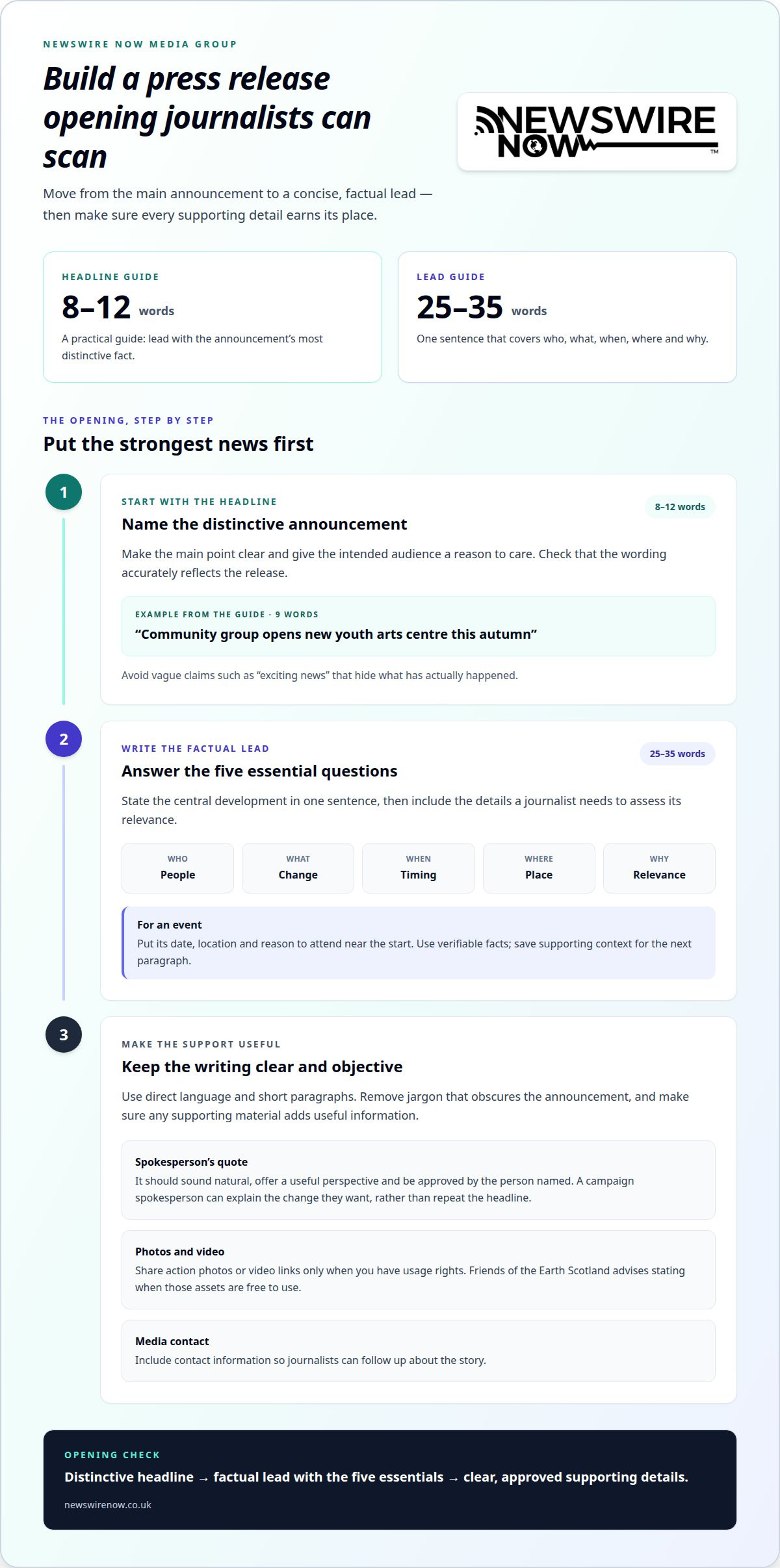
Lead with the announcement’s most distinctive fact, using 8 to 12 words as a practical guide. For example, “Community group opens new youth arts centre this autumn” states the change and who is behind it. Check that the wording reflects the release accurately and gives the intended audience a reason to care. Avoid vague claims such as “exciting news” that conceal the actual story.
-
Draft a factual lead
State the central development in one sentence, then give the essential details. Aim for 25 to 35 words, answering who, what, when, where and why. For an event, put its date, location and reason to attend near the start. Use verifiable facts, not a broad claim such as “a major breakthrough” without evidence. Keep supporting context for the next paragraph.
-
Keep the writing clear and objective
Use direct language and short paragraphs, and remove jargon that obscures the announcement. A spokesperson’s quote should sound natural, add a useful perspective and be approved by the person named. For example, a campaign spokesperson can explain the change they want, rather than repeat the headline. Include media contact information. Share action photos or video links only when you have usage rights; Friends of the Earth Scotland advises stating when those assets are free to use.
When a press release is newsworthy
A release earns attention when its announcement matters to a defined audience, not simply because an organisation wants publicity. Test the story’s relevance, evidence and timing before sending it.
- Identify a meaningful change. Lead with something that has happened, is about to happen or changes what people can do. A new service, research finding or campaign milestone gives journalists a specific development to assess. A routine update about internal activity needs a clear public consequence to become newsworthy.
- Connect the announcement to readers. Name the people affected and explain what changes for them. For example, a community project opening a new support service has a stronger local angle when the release explains who can use it and where. Cision reported that 68% of journalists receive too many irrelevant releases, while 75% cite irrelevance as their top frustration.
- Support the story with evidence. Use verifiable facts, named sources and a spokesperson who can explain the announcement’s importance. A campaign claim should include evidence for its central point, not just an organisation’s opinion. Clear support helps editors judge the story and distinguish information from promotion.
- Choose outlets that match the angle. Match your target audience with journalists and media outlets that cover the subject. A regional event may suit local news desks, while a sector development may interest specialist publications. Effective media relations begin with understanding each outlet’s coverage, not sending the same copy indiscriminately.
- Make the final newsworthiness test. Ask what an editor’s audience gains, what makes the announcement timely and what evidence supports it. If those answers are clear, prepare the release for targeted distribution. For a relevant announcement, arrange press release distribution to put it before media outlets.
Newswire Now Media Group: Single Press Release Distribution
Newswire Now Media Group is a practical next step when your release is ready for media distribution. Single Press Release Distribution includes editorial review and distribution to more than 500 trusted news outlets across 27 industry sectors and 37 professions. Its independent network includes over 40 owned publications reaching millions of readers worldwide.
For one announcement, this service connects your prepared release with a wider media network. Multi-release Distribution Bundles suit organisations planning several announcements. Media Pickup Reporting includes a comprehensive report within 48 hours, alongside guaranteed placements.
Contact Newswire Now Media Group to discuss distribution for your press release.
Put your next announcement into motion
Knowing how to issue a press release statement gives your organisation a repeatable way to communicate important developments. Treat each release as part of a wider communications plan: decide what response you want, identify the audience that matters, and consider how the announcement supports your organisation’s priorities. This focus keeps future releases purposeful rather than turning every update into a media pitch.
Before your next announcement, set a clear internal review process. Ask colleagues closest to the subject to check the facts, then have someone unfamiliar with the draft read it for clarity. Once it’s ready, decide whether to distribute it yourself or use a press release distribution service to reach media outlets. The right route depends on your campaign, intended reach and available time.
If you’re preparing a release for distribution, contact Newswire Now Media Group to discuss the next step. A well-focused announcement can give your communications a clear start.
Frequently Asked Questions
When should you send a press release?
Send the release when journalists have time to act on the news and before its relevance expires. For an embargoed announcement, coordinate the release time with recipients and make the embargo terms unmistakable. For an event, allow enough notice for listings and planning. Above all, wait until the facts, spokesperson and media contact are ready. Good timing can’t make up for a release sent before its details are settled.
How do you write a lead paragraph that journalists can use?
Give the reader a self-contained account of the development, naming the organisation and including the most useful detail. For example: “Northbridge Food Bank has opened a community kitchen to provide weekly meals for local families.” A journalist can quickly see what has changed and who is involved. Follow with context, evidence or a spokesperson’s explanation instead of repeating the announcement in different words.
How do you write a quote that sounds like a real person?
Ask the spokesperson what the announcement means in practical terms, then shape their answer without changing its meaning. A natural quote adds a perspective or explains a consequence instead of repeating the headline. For example: “People have asked for a place to meet and learn to cook together. This kitchen gives us a way to make that happen.” Confirm the wording with the speaker before including it.
What does a press statement example look like?
A simple example might begin: “Northbridge Food Bank opens community kitchen for local families.” The first paragraph would state the opening and explain its purpose. The next could add a verified project detail, followed by a quote from its organiser. A short background note and media contact information complete the example. Treat this as a format demonstration, not a real announcement or factual claim.
What do who, what, where, when and why mean?
These are prompts to check whether readers can understand the announcement without extra context. “Who” identifies the people or organisation; “what” states the development; “where” gives its location; “when” explains its timing; and “why” shows its relevance. For a service launch, name the provider, describe the service, say where and when it begins, and explain whom it is intended to help.
How do you write a press release headline and opening paragraph?
Write the headline after identifying the most important development, then check that the opening delivers what the headline promises. Use a specific subject and action instead of a slogan: “Community group opens new advice centre” is clearer than “A brighter future starts today”. Read both lines together. If the announcement or its importance remains unclear, replace abstract wording with the concrete change and the audience it affects.
Ready to get your story published?
Distribute your press release across 500+ trusted media outlets — with editorial review and a full pickup report within 48 hours.
Send Press Release →