
How to Build Links with Relevant Press Release Coverage

A press release can earn backlinks when journalists, bloggers or news outlets cover its announcement and link to your website. Building backlinks with press releases means creating news relevant publishers want to share, not simply distributing a release and expecting links. Links in press releases are often nofollow, so they may not pass direct SEO value, but they can still bring referral traffic and wider coverage.
It’s understandable to want a clear route from a release to greater online visibility. Focus on relevance and genuine news value, and use distribution to put a useful story before potential publishers, rather than treating it as a guarantee of links.
This guide explains how press release link building works, how to shape an announcement for the right audience, and what to consider when choosing a distribution service. You’ll also learn how to track links, referral traffic and media coverage, so you can assess what a release achieved beyond its initial publication.
Key Takeaways
- Think of press releases as a route to relevant media coverage, where publishers may choose to link to your site, rather than as a guaranteed source of SEO value.
- Lead with a genuinely newsworthy announcement, clear facts and useful context for the audience you want to reach.
- Assess distribution services by how well their reach aligns with your industry and intended readership.
- Track media pickups, earned backlinks and referral traffic to understand how your release performs beyond publication.
What is Press Release Link Building?
Syndication links appear on sites that republish a distributed release, often with little editorial input. Earned media backlinks come from publishers that independently choose to cover the announcement and link to a relevant page.
The main risk is expecting every published link to improve search rankings: press release links are often nofollow and don’t pass direct SEO value. Irrelevant or repetitive announcements can also reduce a release’s appeal to journalists and readers.
- Set a coverage goal. Treat building backlinks with press releases as an effort to earn attention, not to place links everywhere. For a new research report, for example, aim to reach publishers whose readers would find its findings useful.
- Choose a link-worthy destination. Link to a relevant page that gives readers useful context, such as the research itself or details of a product launch. A homepage may be less useful when the announcement is about a specific resource.
- Make the story easy to assess. Explain what happened, who it affects and why it matters. Include a clear spokesperson quote or supporting data where available, so journalists can evaluate the announcement and develop their own coverage.
- Find suitable prospects. Use online link-building tools to identify relevant, authoritative websites and see which sites link to similar organisations. Assess each prospect’s subject matter and audience before deciding whether the release is a good fit.
- Separate distribution from editorial coverage. Record syndicated copies and independent articles separately. Review each referring page, its link and any referral visits to see whether the release reached its intended audience beyond basic republication.
Press release content quality and relevance
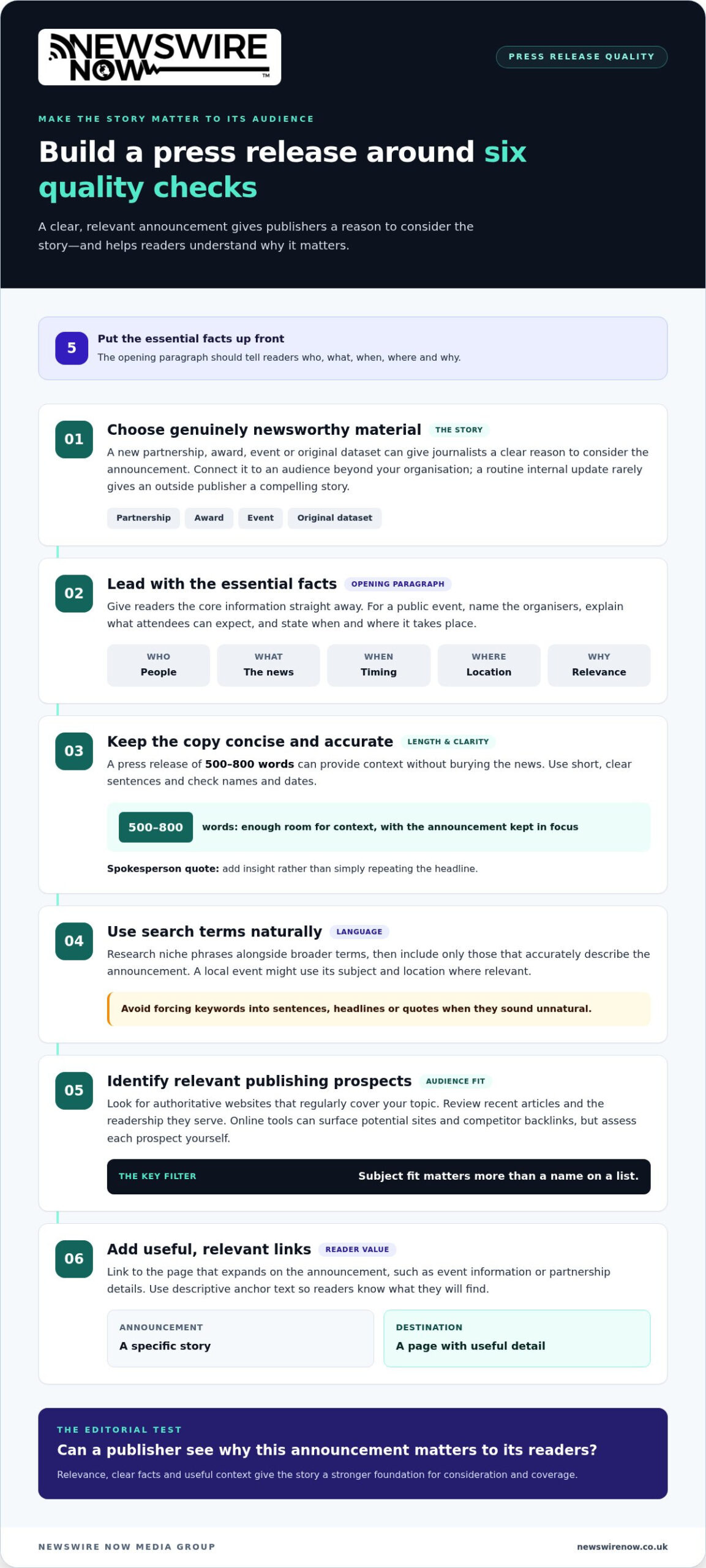
- Choose a genuinely newsworthy announcement. A new partnership, award, event or original dataset gives journalists a clear reason to consider your release. Connect the announcement to an audience beyond your organisation. A routine internal update rarely gives an outside publisher a compelling story.
- Lead with the essential facts. Put who, what, when, where and why in the opening paragraph. For a public event, name the organisers, explain what attendees can expect, and say when and where it takes place. Readers should understand the announcement without searching later paragraphs.
- Keep the copy concise and accurate. A press release of 500 to 800 words can provide context without burying the news. Use short, clear sentences, check names and dates, and include a spokesperson quote that adds insight rather than repeating the headline.
- Use search terms naturally. Research niche phrases alongside broader terms, then include only those that describe the announcement. For example, a local event might use its subject and location where relevant. Don’t force keywords into sentences, headlines or quotes where they sound unnatural.
- Identify relevant publishing prospects. Search for authoritative websites that regularly cover your topic, then review their recent articles and intended readership. Online tools can reveal potential sites and competitor backlinks, but assess each prospect yourself. A publication’s subject fit matters more than its name on a list.
- Add useful, relevant links. Link to the page that expands on the announcement, such as an event information page or partnership details. Use descriptive anchor text that tells readers what they’ll find. If your release is ready for targeted reach, consider a focused press release distribution route.
Tracking backlinks, referral traffic and media coverage
- Set a baseline before distribution. Record organic visits, search visibility and enquiries for the relevant landing page. Use the same analytics view afterwards and compare results with that starting point. For example, track a report page separately from your homepage to see how the announcement relates to audience activity.
- Build a backlink record. For each placement, note the publication, article title, referring page, destination URL and anchor text. Record whether the link is followed or nofollow, and distinguish an independently written article from a syndicated copy. This creates a clear inventory for assessing relevance and link quality.
- Measure referral visits. In your analytics platform, review visits attributed to each publishing domain and the landing pages they reach. Compare engagement and next actions, such as viewing a product page or submitting an enquiry. A link that brings interested readers can be valuable even without direct SEO benefit.
- Separate organic and targeted traffic. Organic traffic shows visits from search, while referral traffic identifies visits from other sites. To assess targeted traffic, consider whether visitors match the release’s intended audience, using relevant landing-page behaviour or enquiry details. Compare these measures with the announcement’s purpose, rather than treating every visit alike.
- Maintain a media coverage log. Capture each outlet, publication date, headline and article topic. Note whether coverage accurately reflects the announcement and reaches the intended sector. This helps distinguish meaningful editorial attention from simple republication and shows which story angles attracted publishers’ interest.
- Review results as a group. Compare backlinks, referral activity, organic traffic, targeted visits and media coverage together. Domain authority can offer another comparative indicator, but don’t use it alone to judge success. If a release earns coverage but little traffic, refine the destination page or story relevance for the next campaign.
Press release distribution services
- Define the audience before comparing reach. A UK technology announcement needs different outlets from a regional charity event. Identify the industry, location and reader group first. Then judge whether a service’s distribution network aligns with those priorities, rather than choosing it based only on the largest reach claim.
- Ask how distribution works. Find out whether a service sends releases to relevant news outlets, publishes them across its own network, or uses both routes. These channels can produce different outcomes. A syndicated copy is not the same as independent reporting by a journalist who chooses to cover your announcement.
- Check the audience and sector fit. Compare the service’s stated industry coverage and publication types with your story. For example, a professional services announcement needs access to outlets serving business readers. Broad distribution without subject relevance may generate copies, but fewer useful visits or editorial opportunities.
- Understand the editorial process. Check what review takes place before distribution and whether the release is assessed for clarity, accuracy and suitability. Editorial review can help identify confusing wording or missing context. It doesn’t make an announcement newsworthy, so you remain responsible for its substance and supporting information.
- Compare reporting, not just reach. Establish what evidence you’ll receive after distribution. A useful report should help identify media pickups and where coverage appeared. Combine that information with your own backlink and referral tracking, separating syndicated placements from independent articles to understand the result.
- Choose a distribution model that matches your schedule. A single announcement may suit one-off distribution, whilst a sequence of planned updates may call for a multi-release arrangement. Set the release’s audience and measurement goals first, then distribute your press release through a route aligned with them.
Newswire Now Media Group: Single Press Release Distribution
Newswire Now Media Group can help put a newsworthy announcement in front of relevant media outlets through Single Press Release Distribution. Its network includes over 40 owned publications and distribution to more than 500 news outlets across 27 industry sectors and 37 professions. Editorial Review gives releases an additional check before distribution.
Use a single release when you have one announcement to share and want to build visibility beyond your own channels. Media Pickup Reporting provides a record of coverage, helping you review where the release appeared and assess any resulting backlinks and referral traffic. The service includes guaranteed placements and a comprehensive pickup report within 48 hours, useful for documenting distribution outcomes alongside your own analytics.
For a planned series of announcements, Multi-release Distribution Bundles provide an alternative distribution option. To discuss distribution for your announcement, contact Newswire Now Media Group.
Make your next announcement count
Use your next release to build an ongoing relationship with relevant publishers, not just promote a single update. A disciplined approach to building backlinks with press releases starts with an announcement that matters to its audience, followed by a useful destination for readers and careful measurement. Each campaign can also show which subjects and publications deserve attention next.
For distribution support, Newswire Now Media Group offers Single Press Release Distribution for a one-off announcement, or Multi-release Distribution Bundles for planned communications. Editorial Review is also available to help prepare a release for distribution. Choose the option that fits your upcoming plans and the media audience you want to reach.
Contact Newswire Now Media Group to discuss your press release distribution. A clear story and a focused next step can help turn your announcement into a stronger media opportunity.
Frequently Asked Questions
Do press release backlinks help SEO rankings?
Press releases can support SEO indirectly, but a link from a release alone isn’t a reliable route to higher rankings. Many release links are nofollow, so they don’t pass direct SEO value. Independent coverage can still introduce your organisation to readers, attract referral visits and lead to further editorial attention. Assess each link’s quality and relevance rather than judging a campaign by link volume alone.
How do you build backlinks with press releases step by step?
Start with a genuinely reportable announcement, then identify publications whose readers would care about it. Prepare accurate copy, a clear headline and a relevant destination page. Distribute the release to suitable media contacts or through a distribution service, then record syndication separately from independent coverage. Review each resulting link and referral source, and use the findings to refine the audience and angle of your next announcement.
How much does press release distribution cost in the UK?
The cost depends on the distribution option, intended reach and whether you need a single release or a planned series. For Newswire Now Media Group, pricing is provided after a quote request. The relevant factors include the distribution package and the scope of the campaign. Compare what each option covers, such as editorial review and reporting, rather than assessing cost by outlet count alone.
Which UK press release distribution services offer editorial coverage?
Some UK distribution services include editorial review, but review is different from independent editorial coverage. Newswire Now Media Group includes Editorial Review with press release distribution. This helps prepare the release before distribution, while independent coverage remains the publisher’s decision. If your objective is journalist-written reporting, assess pickup evidence separately from placements that simply republish distributed copy.
How can you write a press release journalists are likely to link to?
Give journalists a specific reason to develop the story, such as original findings, a clear public impact or a useful expert perspective. Make supporting evidence easy to assess, and link to a page with the full source material, not just a general homepage. Tailor the angle to each publication’s readership: a business outlet and a consumer publication may need different context.
How do you measure SEO results from press release campaigns?
Compare the campaign’s target page with its earlier performance, then review organic visits, search visibility, referral sessions and relevant enquiries. Record new referring domains and check whether each link comes from an independent article or syndicated copy. For example, a rise in visits from a publisher’s article can show audience value, even if search rankings have not changed.
Ready to get your story published?
Distribute your press release across 500+ trusted media outlets — with editorial review and a full pickup report within 48 hours.
Send Press Release →