
Press release SEO: earn editorial links and reach readers
A press release can earn attention without automatically earning SEO value from a link. The most effective press release SEO strategies in 2026 focus on newsworthy stories, relevant branded and long-tail searches, and genuine editorial coverage, rather than treating distribution as a shortcut to rankings. They also make the announcement clear enough for readers and answer engines to understand and cite.
If you’re weighing whether a release can help your search visibility, the key is what happens beyond publication: whether the story reaches the right audience, earns independent coverage and supports useful content on your website. A release can contribute to those outcomes, but it shouldn’t be treated as a replacement for a wider SEO strategy.
This guide explains how to target searches that fit your news, improve the chance of editorial pickup, measure performance and prepare releases for answer engines. It also shows how to keep content useful and credible after the announcement, so it continues to serve readers beyond launch day.
Key Takeaways
- Choose branded and long-tail searches that directly match your announcement, rather than forcing broad keywords into the release.
- Build for genuine editorial coverage and relevant readers; distribution alone isn’t a reliable shortcut to authoritative backlinks.
- Track referral visits and search impressions so you can see what your release contributes and where content needs refreshing.
- Make the news easy for people and answer engines to understand with clear facts, useful structure and credible context.
Branded and long-tail keyword targeting
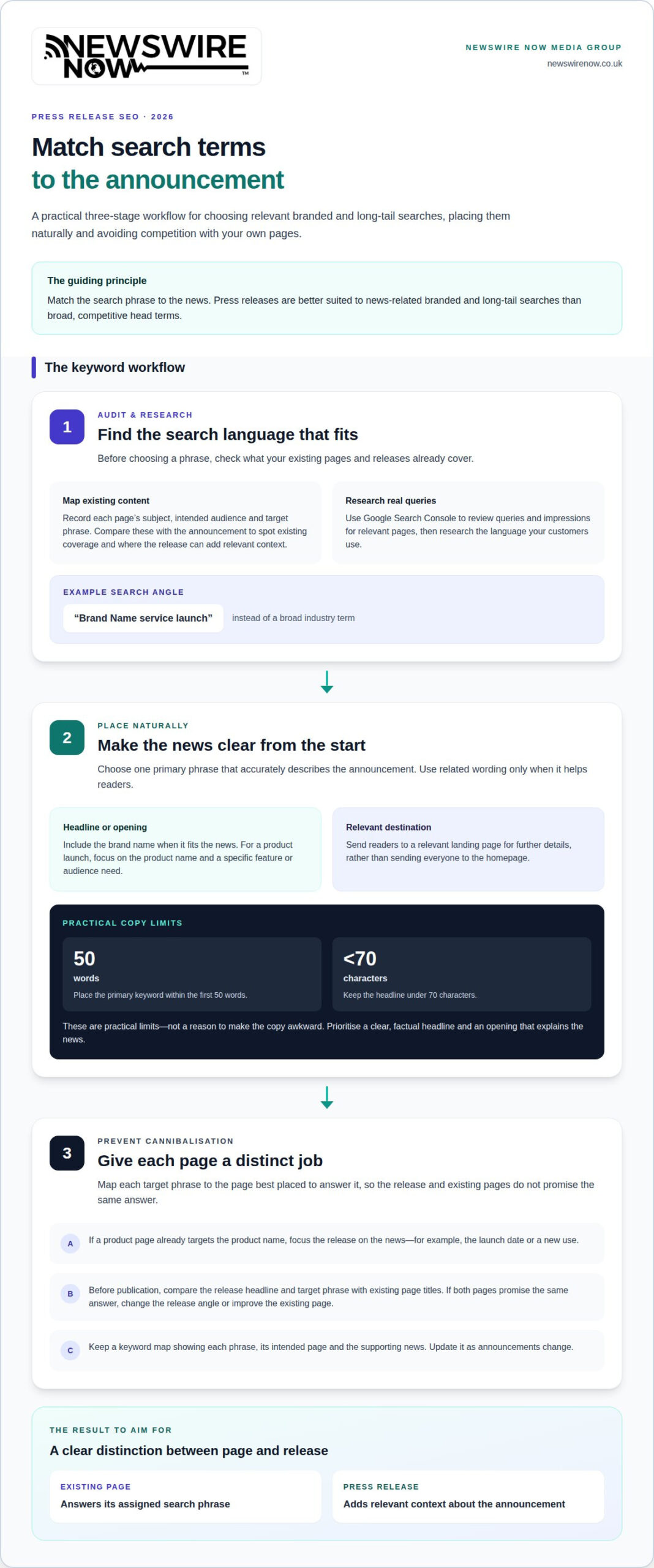
For press release SEO strategies in 2026, match search terms to the announcement rather than chasing broad rankings. Use the steps below to identify relevant phrases, place them naturally and avoid competing with your own pages.
-
Audit content and research keywords
Before choosing keywords, audit your existing pages and releases. Record each page’s subject, intended audience and target phrase, then compare them with the news you plan to announce. This reveals which topics your site already covers and where a release could add relevant context.
Use Google Search Console to review queries and impressions for relevant pages, then research the language your customers use. For example, a business announcing a new service might target “Brand Name service launch” rather than a broad industry term. Press releases are better suited to news-related branded and long-tail searches than competitive head terms.
-
Place branded and long-tail keywords
Choose one primary phrase that accurately describes the announcement, and include related wording only when it helps readers. Add the brand name to the headline or opening when it fits the news. A product launch release, for example, can focus on the product name and a specific feature or audience need.
Put the primary keyword within the first 50 words, and keep the headline under 70 characters. These are practical limits, not a reason to make the copy awkward: prioritise a clear, factual headline and an opening that explains the news. Use a relevant landing page for further details, rather than sending every reader to the homepage.
-
Prevent keyword cannibalisation
Map each target phrase to the page best placed to answer it. If a product page already targets the product name, focus the release on the news, such as the launch date or a new use. This distinction helps readers and search engines understand how the pages differ.
Before publication, compare the release headline and target phrase with existing page titles. If both pages promise the same answer, change the release angle or improve the existing page. Keep a keyword map showing each phrase, its intended page and the supporting news, and update it as announcements change.
Editorial pickup and authoritative backlinks
Prioritise independent editorial coverage over links created solely through distribution. Relevant coverage can build visibility, referral traffic and authority, but results depend on the story and the publication.
-
Earn editorial pickup
Shape the release around a story an editor can develop, such as original research, a meaningful launch or expert commentary. Make the evidence and spokesperson clear, then offer relevant context instead of relying on promotional claims. Track coverage by publication and audience. Three or four genuine pickups at tier-two publications can move rankings; one pickup at a tier-one publication can have greater impact.
-
Consider backlink attributes and SEO impact
Use nofollow for press release links intended to manipulate PageRank, following Google’s July 2013 advisory; paid placements should use an appropriate sponsored or nofollow attribute. Treat distributed backlinks mainly as referral routes, not a dependable ranking lever. Their value can include visits and brand exposure, while rankings are more likely to benefit when independent editors choose to cover the story.
- Extend a credible announcement into other relevant formats to reach audiences beyond search. For example, offer a subject expert for a podcast, contribute insight to an industry video or publish original findings on a research platform. Prioritise platforms whose readership matches the announcement, rather than collecting mentions without a clear connection.
- Connect earned coverage to a useful website destination and strengthen the surrounding topic. Include one to three natural links to relevant pages, such as a product announcement linking to its dedicated information page. Then link that page to related articles, research or expert commentary on your site. Clear connections help readers explore the subject and give search systems stronger context about your expertise.
If editorial distribution is part of your campaign, consider Single Press Release Distribution as one route to getting the announcement in front of relevant outlets.
Content freshness and performance monitoring
Measure each release’s contribution, and refresh supporting content when facts or reader needs change. Google Analytics and Google Search Console show different parts of the performance picture.
- Use Google Analytics to track referral visits and see whether coverage brings readers to your website. Compare visits to the page linked from the release and review what visitors do next. Readers arriving at a product announcement, for example, may continue to its specifications or enquiry page. This shows whether the coverage attracts useful audience activity, not just links.
- Use Google Search Console to monitor keyword impressions and assess how pages appear for relevant searches. Review queries associated with the announcement and its destination page. If impressions come from a phrase the page answers clearly, strengthen that explanation. If unrelated searches dominate, refine the page’s focus instead of adding keywords unnaturally.
- Refresh content when the announcement changes, not simply to make a page look new. Update a launch page if availability, product details or supporting evidence changes. Keep the original release accurate as a record of what was announced, and direct readers to current information where appropriate. This maintains clarity for readers and search systems.
- Use the findings to connect marketing activity with reader behaviour. If a release brings visits but readers do not explore related material, improve the next step on the landing page. If a relevant search query gains impressions, make sure the page answers it directly. Share substantial updates through suitable channels, such as email marketing or social media, to help interested audiences find them.
- Record each release’s destination page, target topic, referral activity and search impressions in one tracking document. This makes it easier to compare announcements aimed at different audiences. Before publishing a release on a related subject, review earlier pages, update overlapping details, add relevant links and keep each page’s purpose distinct. That way, new coverage supports the wider site.
Press releases and answer engine optimisation
Make each release easy to understand, verify and summarise. In 2026, clear answers and credible context help readers and AI assistants interpret the announcement.
For UK releases, distinguish promotional material from independent reporting, substantiate claims and handle regulated-sector statements carefully. Requirements depend on the claim and format, so general guidance should not be treated as a complete legal test.
Google issued an advisory in July 2013 that press release links intended to manipulate PageRank should be nofollowed. Major wire services had moved most press release links to nofollow by 2016.
- Answer the core questions near the start: who, what, when, where and why. Keep the answers within the first 60 words, then add evidence and useful context. For a new service, identify the organisation, what it offers, when it launches, who it serves and why the change matters.
- Make content easy to summarise without flattening the story. Use a descriptive headline, informative subheadings and short paragraphs, then answer likely reader questions directly. A clear explanation of who benefits from a launch gives an AI assistant a useful passage to summarise.
- Build trust with clear signals of expertise: name the author or spokesperson, include relevant credentials, and distinguish verified facts from opinion. First-hand insight, original research and transparent authorship help readers assess claims and systems identify their source.
- Support the release with accurate technical details on its webpage. Add NewsArticle structured data only when its fields match the visible content, including the headline, author and publication date. Check that the page loads, works on mobile and has a clear canonical URL. Structured data clarifies page information, but does not guarantee an AI citation.
- Where relevant, extend the announcement with other useful formats. Add descriptive alt text to meaningful images, provide a transcript for a related video, and use a concise FAQ to address spoken-style queries. Keep every asset consistent with the release so readers encounter the same facts across formats.
Newswire Now Media Group: Single Press Release Distribution
Newswire Now Media Group can help when your announcement is ready for distribution and needs a clear route to relevant news outlets. Single Press Release Distribution includes editorial review and placement across more than 500 trusted outlets, spanning 27 industry sectors and 37 professions. Its independent network also includes over 40 owned publications reaching readers worldwide.
Use distribution to extend the reach of newsworthy content, not as a substitute for editorial interest or a wider SEO plan. Newswire Now Media Group distributes releases across its media network and provides a pickup report to help you assess coverage. For recurring announcements, multi-release distribution bundles provide a practical way to plan distribution.
If your announcement is ready for distribution, contact Newswire Now Media Group or visit newswirenow.co.uk.
Make your next announcement more discoverable
The strongest press release SEO strategies for 2026 treat each announcement as a chance to learn, not a one-off visibility exercise. Use audience response to sharpen the next story: which angle attracted attention, which questions remained unanswered, and what evidence would make the news more useful? That learning can shape future announcements and strengthen the connection between your news, your expertise and the people you want to reach.
Give your next release a clear purpose before distribution. Decide which audience matters, what you want readers to understand and where they should go for the full story. Then align the announcement, destination page and follow-up activity around that purpose. A disciplined approach keeps communications relevant and makes each campaign easier to evaluate.
If you’re preparing an announcement and want support with distribution, contact Newswire Now Media Group to discuss the next step. A well-positioned story gives your organisation a stronger foundation for reaching readers and building visibility.
Frequently Asked Questions
What is Press Release SEO?
Press release SEO is the practice of making an announcement clear, relevant and discoverable through search. It connects the news with suitable search topics and useful pages on your website. For example, a charity announcing a new programme can help readers find the announcement alongside detailed information about eligibility, dates and participation, rather than relying on the release alone.
How to Use Keywords Effectively?
Choose terms that reflect the announcement and what its intended readers may want to know. A new appointment, for instance, could relate to the executive’s name, role and organisation rather than a broad industry phrase. Make sure each term fits naturally in the release, then use relevant website pages to provide further detail.
Is there any SEO value in paid wire distribution?
Paid wire distribution can provide exposure and referral visits, but it should not be treated as a reliable way to buy ranking improvements. The SEO benefit of paid wire distribution was approaching zero by 2020. Consider whether the distribution reaches audiences relevant to your announcement, and assess visits or editorial coverage separately from the number of sites carrying syndicated copy.
What are the most effective press release SEO strategies for 2026?
Effective press release SEO strategies in 2026 combine a genuinely useful announcement with clear, verifiable details and a relevant destination page. For example, a company sharing new research can explain its method, identify who conducted it and publish the findings in an accessible format. This gives journalists, readers and answer systems specific material to assess and reference.
How do you write SEO-friendly press release headlines and meta descriptions?
Write a headline that states the central news, using the organisation or subject where it helps readers judge relevance. Make the meta description a concise, accurate preview of the page, not a string of search terms. For a research launch, summarise the finding and who it affects, then ensure the page provides the promised detail.
How should keywords be used in a press release without keyword stuffing?
Use a keyword only when it describes the news naturally, and choose related wording to provide context. Read the release aloud: remove or replace repeated phrases that sound unnatural. After naming a new service, for example, refer to it as “the service” where the meaning remains clear. Reader understanding comes first.
Ready to get your story published?
Distribute your press release across 500+ trusted media outlets — with editorial review and a full pickup report within 48 hours.
Send Press Release →