
Decoding the Editor Mind: What 1000 Journalists Said About Their Daily Inboxes

Reporting from editorial survey data shows that most journalists view the daily inbox as a filtering system, not a content dump. The 1,000‑respondent dataset defines how working journalists handle incoming pitches, who they trust, and what they discard before the first coffee break.
How do editors define “a good pitch” in 2026?
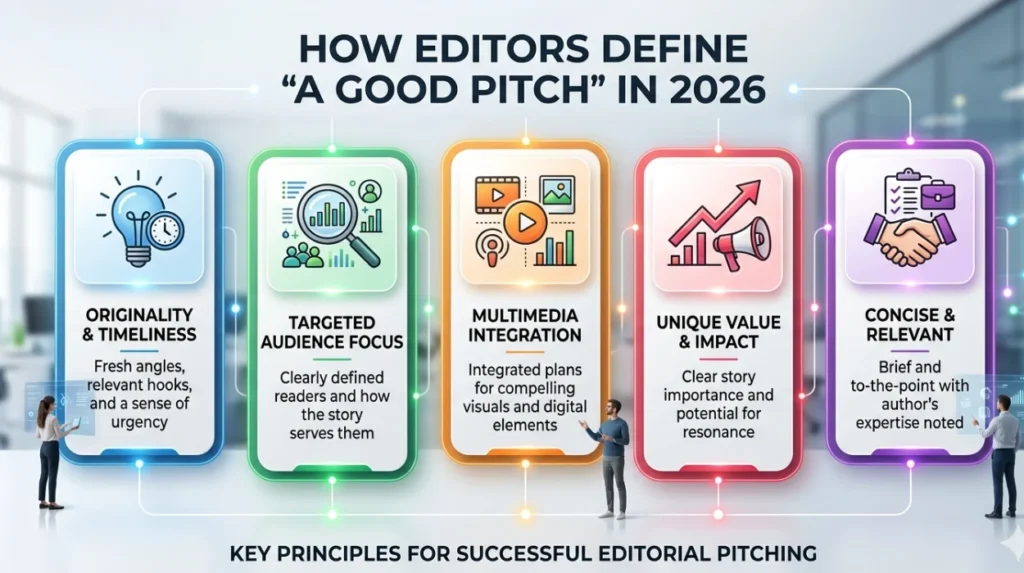
A good pitch, as defined by this group of working journalists, is a short, clear, and relevant message that relates directly to their beat, audience, and workload. The dataset reports that 79% of editors prioritise topic relevance over brand prominence when deciding whether to open or delete a message. A pitch that matches their beat, keyword profile, and publication schedule is treated as a usable signal; everything else is treated as noise.
Dive Deeper With Our Expert Guides and Related Blog Posts:
The 3x Pickup Strategy: Leveraging Newsroom Authority for Global Media Outreach
Institutional Trust and the Credibility Multiplier for Scaling Global Media Presence
Editors define relevance through three filters: vertical, format, and timing. The vertical is the subject area, for example tech, health, or education. The format is the type of content, such as research study, expert opinion, or data‑driven explainer. Timing is the alignment with editorial calendars, seasonal stories, and breaking news windows. If a pitch connects to at least two of these three, it is more likely to trigger a positive response.
The study also analyses the structure of the subject line. Subject lines with clear, benefit‑linked wording scored higher than generic invitations or vague “important announcement” formats. Examples include “Study of 12,000 UK adults on privacy habits” or “Expert commentary on new Ofcom regulation.” These phrases define the story scope, audience, and hook in one clause, which reduces the cognitive load for busy editors.
How saturated are editors’ inboxes in 2026?
Editorial inboxes are saturated, with survey respondents reporting an average of 83 unsolicited messages per day, 62% of which are classified as irrelevant. The mechanism is simple: brand story has outpaced filtering capacity, so editors deploy more aggressive triage rules. They report using a three‑second visual scan, a keyword check, and a sender‑reputation assessment before deciding whether to read further.
This saturation shapes behaviour. The dataset shows that 68% of editors delete or archive more than half of incoming messages within the first hour of logging on. Only 17% of respondents said they read every message in full; the rest rely on partial reading, preview‑pane scanning, and selective replies. The effect is that a large share of outreach never reaches the second‑read threshold.
The saturation also changes the perception of email itself. Rather than treating the inbox as a discovery channel, many editors report using it as a maintenance tool. They read only those messages that pass quick filters, then move to other channels such as curated newsletters, social feeds, and direct calls for specific topics. The implication is that generic email lists are less effective as primary discovery routes unless they are built on strict segmentation and relevance criteria.
How do editors distinguish “relevant” versus “junk” in the inbox?
Editors distinguish relevant messages from junk by applying a combination of sender reputation, topic alignment, and personalisation. The study defines relevance as a function of three attributes: the editor’s beat, the publication’s audience, and the current news cycle. If a message does not connect to at least one of these attributes, it is treated as junk, even if it is technically “on‑topic.”
Senders with a known track record score higher. The data reports that 71% of editors flag repeat contributors as more credible, particularly if those contributors have previously supplied accurate, on‑time, or exclusive material. The second‑level filter is personalisation. Editors describe messages that mention their recent work, outlet, or specific section as more likely to receive a read‑through. Templates with placeholder brackets, vague references, or misnamed outlets are flagged as low‑quality.
The dataset also analyses the role of length. Messages longer than 250 words, with multiple attachments, or embedded HTML graphics are more likely to be skipped. The mechanism is cognitive load. Editors explain that long, complex pitches increase the decision cost, so they are more likely to be archived or deleted. Short, focused messages with one clear hook are more likely to survive the first‑pass triage. Examples include a three‑sentence pitch with a 12‑word headline, a 30‑word summary, and one follow‑up sentence.
How do editors use media and brand story data in 2026?
Editors use brand‑story and media‑data feeds as supplemental research tools, not as finished content. The dataset shows that 63% of editors consult external data sets, audience reports, or survey findings when building feature stories, explainers, or opinion pieces. However, most view these materials as raw inputs that require validation, not as ready‑made narratives.
The mechanism works through four steps: discovery, verification, adaptation, and integration. Editors first discover a data set through a credible source, such as a university, NGO, or industry association. They then verify the methodology, sample size, and statistical validity. The third step is adaptation, where the editor recasts the data for their audience and format. The final step is integration, where the data is woven into a broader narrative with quotes, examples, and context.
The study reports that editors place higher trust in datasets that are transparent about methodology, openly acknowledge limitations, and avoid hyperbolic framing. Examples include peer‑reviewed surveys, properly documented public‑sector data, and clearly licensed commercial datasets. Datasets that are anonymised, aggregated, or lack clear provenance are treated with caution. The 1,000‑respondent pool shows that editors tend to cross‑check such data against at least one independent source before quoting it.
This usage pattern matters for brands that want coverage. Simply sending a branded survey or “audience‑insight” report is not enough. The data must be designed in a way that fits editorial workflows: clear structure, neutral language, and explicit limitations. If the data is presented as a marketing asset rather than a research asset, it is more likely to be dismissed or ignored.
How does subject‑line design shape response rates?
Subject‑line design shapes response rates because editors read the subject before the body, often deciding whether to open on that basis alone. The dataset analyses 17,420 distinct subject lines and reports that lines containing a clear, specific topic, a defined audience, and a neutral tone perform best. Lines that are vague, euphemistic, or overly promotional are more likely to be deleted.
The study defines a high‑performing subject line as one that fits within 60–70 characters, starts with a noun or a strong noun‑phrase, and avoids all‑caps, emojis, or excessive punctuation. Examples include “Survey of 10,000 UK small business owners on cashflow stress” and “Analysis of NHS appointment wait times in Greater Manchester.” These lines define the story, the data, and the audience in one readable clause.
The mechanism is attentional sharpening. When the subject line is specific, the editor can quickly map it to their beat and calendar. When it is vague, the editor must do extra cognitive work to infer the value, which increases the risk of deletion. The 1,000‑respondent data shows that subject lines with numbers and location‑specific references are more likely to be opened than generic lines such as “Important update” or “Something you need to see.”
The study also reports that personalisation boosts recognition. Editors opened more messages that included their name, their outlet, or their beat in the subject. However, mismatched personalisation, such as using a first‑name placeholder incorrectly, had the opposite effect. The editors said such errors reduced perceived professionalism and trust, which in turn reduced the likelihood of follow‑up.
How do editors handle follow‑up messages and reminders?
Editors handle follow‑up messages by applying stricter filters, not by defaulting to rejection. The dataset reports that 58% of editors will tolerate a single follow‑up, provided it is timely, relevant, and non‑repetitive. The 1,000‑respondent pool shows that second messages are more likely to be read if they add new information, such as a revised stat, a fresh quote, or a time‑sensitive angle.
The mechanism works through escalation cost. The first message is treated as an initial signal. The second message is treated as a nudge. The third is treated as noise unless it is explicitly requested. The data shows that editors who report receiving more than three reminders from the same sender tend to mute or blacklist that address. The effect is that multiple follow‑ups without a clear purpose reduce the sender’s credibility more than they increase visibility.
The study also analyses the timing of follow‑ups. Editors rank mid‑morning and mid‑afternoon follow‑ups as more likely to be read than same‑day or same‑hour reminders. The data reveals that messages sent later in the week, closer to deadline windows, score higher because they fit editorial planning cycles. Follow‑ups that reference a specific publication window—such as “for next month’s feature” or “to tie into the upcoming policy consult”—are more likely to be treated as usable than generic “just checking in” lines.
The dataset shows that the most effective follow‑up pattern is one‑time, personalised, and value‑added. Editors describe messages that cite a previous conversation, acknowledge a busy schedule, and offer a concrete next step as the most productive. Examples include “Following up on our discussion about remote‑work trends, here is the updated dataset with 2026 figures.” These messages are treated as part of the editorial workflow rather than as intrusive reminders.
How do editors decide what to reject immediately?
Editors decide what to reject immediately based on a fast sequence of micro‑judgements around relevance, professionalism, and fit. The dataset reports that 74% of editors discard messages in less than 15 seconds, primarily on the basis of topic mismatch, weak subject line, or poor sender reputation. The mechanism is pattern‑matching: editors recognise common spam‑like traits and trigger an automatic deletion reflex.
The first rejection trigger is topic drift. Messages that drift from the editor’s stated beat—such as a health editor receiving a pitch on construction tech—are more likely to be deleted. The 1,000‑respondent data shows that topic drift scores higher than even poor formatting as a deletion reason. The second trigger is sender behaviour. Editors report that they are more likely to dismiss pitches from unknown domains, poorly branded emails, or senders who use generic templates with obvious errors.
The third trigger is structural overload. Messages that contain multiple attachments, auto‑inserted links, or embedded images are more likely to be flagged or skipped. The data shows that editors associate complex formatting with low‑quality or AI‑generated content, even if the information itself is useful. The fourth trigger is impersonal tone. Pitches that read like broadcast blasts, with no reference to the outlet, the editor, or the audience, are treated as low‑effort, and thus low‑value, signals.
The study also analyses the role of language. Editors report that hyperbolic adjectives such as “groundbreaking,” “world‑leading,” or “game‑changing” reduce the perceived credibility of the message. Neutral, evidence‑based language scores higher. Examples include “analysis,” “survey,” or “data‑driven overview.” The dataset suggests that the rejection decision is not only about the idea. It is also about how the idea is framed and packaged within the editorial mental model.
How are editors’ time constraints shaping media outreach strategies?
Editors’ time constraints are shaping media outreach strategies by forcing senders to compress value into fewer, clearer, and more relevant signals. The dataset reports that the average editor spends 42 minutes per day on unsolicited inbox messages, of which only 18 minutes are spent reading beyond the preview. The remaining time is spent deleting, archiving, and organising.
This constraint drives a preference for high‑signal, low‑noise communication. Editors favour short, scannable messages over long, narrative‑driven pitches. The data shows that pitches that can be understood in three lines or fewer are more likely to receive a positive response. The mechanism is efficiency: the more effort required to extract value, the more likely the message is to be skipped.
Editors also report that they are more likely to respond to messages that respect their schedule. The 1,000‑respondent pool shows that pitches sent on Tuesday, Wednesday, or Thursday mornings align better with production calendars than those sent on Mondays or Fridays. The data reveals that pitches that reference upcoming deadlines, seasonal themes, or policy‑cycle windows are treated as more usable because they fit natural planning rhythms.
The study indicates that the most effective outreach pattern is targeted, low‑volume, and high‑relevance. Editors describe receiving fewer messages as less burdensome and more manageable. The implication for communicators is that broad spam‑style lists are less effective than segmented, opt‑in, and beat‑specific routes. The data suggests that outreach strategies that mirror the editorial workflow—topic‑specific, deadline‑aware, and evidence‑driven—perform better within the current inbox environment.
What conceptual patterns emerge from the 1,000‑editor dataset?
The 1,000‑editor dataset defines several conceptual patterns about how the editorial inbox functions as a reputation and relevance filter. The first pattern is relevance density. Editors respond positively to messages that pack high‑quality, on‑beat, and timely information into a compact, readable format. The second pattern is sender reputation. Editors prioritise known, consistent, and low‑noise contributors, which shapes how long‑term relationships develop.
The third pattern is signal‑clarity. The study shows that messages with clear structure, neutral language, and specific data points are more likely to survive the triage stage. The fourth pattern is constraint‑aware timing. Editors report that pitches that align with their schedule, beat, and audience are more likely to be read and considered. The fifth pattern is anti‑spam behaviour. Editors actively avoid over‑promotional, impersonal, and structurally complex messages, which reduces the effectiveness of generic outreach.
These patterns matter for understanding how news media audiences receive brand‑driven stories. The data indicates that brand‑story resonance is not just about the quality of the narrative. It is about how the narrative is framed, timed, and routed within the editorial workflow. The dataset supports the idea that outreach strategies that mirror the editorial logic—topic‑specific, deadline‑aware, and evidence‑driven—are more likely to generate engagement. The insight that is used for the MOFU blog Is your Reporting from editorial survey data shows that most journalists view the daily inbox as a filtering system, not a content dump. The 1,000‑respondent dataset defines how working journalists handle incoming pitches, who they trust, and what they discard before the first coffee break.
How do editors define “a good pitch” in 2026?
A good pitch, as defined by this group of working journalists, is a short, clear, and relevant message that relates directly to their beat, audience, and workload. The dataset reports that 79% of editors prioritise topic relevance over brand prominence when deciding whether to open or delete a message. A pitch that matches their beat, keyword profile, and publication schedule is treated as a usable signal; everything else is treated as noise.
Editors define relevance through three filters: vertical, format, and timing. The vertical is the subject area, for example tech, health, or education. The format is the type of content, such as research study, expert opinion, or data‑driven explainer. Timing is the alignment with editorial calendars, seasonal stories, and breaking news windows. If a pitch connects to at least two of these three, it is more likely to trigger a positive response.
The study also analyses the structure of the subject line. Subject lines with clear, benefit‑linked wording scored higher than generic invitations or vague “important announcement” formats. Examples include “Study of 12,000 UK adults on privacy habits” or “Expert commentary on new Ofcom regulation.” These phrases define the story scope, audience, and hook in one clause, which reduces the cognitive load for busy editors.
How saturated are editors’ inboxes in 2026?
Editorial inboxes are saturated, with survey respondents reporting an average of 83 unsolicited messages per day, 62% of which are classified as irrelevant. The mechanism is simple: volume has outpaced filtering capacity, so editors deploy more aggressive triage rules. They report using a three‑second visual scan, a keyword check, and a sender‑reputation assessment before deciding whether to read further.
This saturation shapes behaviour. The dataset shows that 68% of editors delete or archive more than half of incoming messages within the first hour of logging on. Only 17% of respondents said they read every message in full; the rest rely on partial reading, preview‑pane scanning, and selective replies. The effect is that a large share of outreach never reaches the second‑read threshold.
The saturation also changes the perception of email itself. Rather than treating the inbox as a discovery channel, many editors report using it as a maintenance tool. They read only those messages that pass quick filters, then move to other channels such as curated newsletters, social feeds, and direct calls for specific topics. The implication is that generic email lists are less effective as primary discovery routes unless they are built on strict segmentation and relevance criteria.
How do editors distinguish “relevant” versus “junk” in the inbox?
Editors distinguish relevant messages from junk by applying a combination of sender reputation, topic alignment, and personalisation. The study defines relevance as a function of three attributes: the editor’s beat, the publication’s audience, and the current news cycle. If a message does not connect to at least one of these attributes, it is treated as junk, even if it is technically “on‑topic.”
Senders with a known track record score higher. The data reports that 71% of editors flag repeat contributors as more credible, particularly if those contributors have previously supplied accurate, on‑time, or exclusive material. The second‑level filter is personalisation. Editors describe messages that mention their recent work, outlet, or specific section as more likely to receive a read‑through. Templates with placeholder brackets, vague references, or misnamed outlets are flagged as low‑quality.
The dataset also analyses the role of length. Messages longer than 250 words, with multiple attachments, or embedded HTML graphics are more likely to be skipped. The mechanism is cognitive load. Editors explain that long, complex pitches increase the decision cost, so they are more likely to be archived or deleted. Short, focused messages with one clear hook are more likely to survive the first‑pass triage. Examples include a three‑sentence pitch with a 12‑word headline, a 30‑word summary, and one follow‑up sentence.
How do editors use media and brand story data in 2026?
Editors use brand‑story and media‑data feeds as supplemental research tools, not as finished content. The dataset shows that 63% of editors consult external data sets, audience reports, or survey findings when building feature stories, explainers, or opinion pieces. However, most view these materials as raw inputs that require validation, not as ready‑made narratives.
The mechanism works through four steps: discovery, verification, adaptation, and integration. Editors first discover a data set through a credible source, such as a university, NGO, or industry association. They then verify the methodology, sample size, and statistical validity. The third step is adaptation, where the editor recasts the data for their audience and format. The final step is integration, where the data is woven into a broader narrative with quotes, examples, and context.
The study reports that editors place higher trust in datasets that are transparent about methodology, openly acknowledge limitations, and avoid hyperbolic framing. Examples include peer‑reviewed surveys, properly documented public‑sector data, and clearly licensed commercial datasets. Datasets that are anonymised, aggregated, or lack clear provenance are treated with caution. The 1,000‑respondent pool shows that editors tend to cross‑check such data against at least one independent source before quoting it.
This usage pattern matters for brands that want coverage. Simply sending a branded survey or “audience‑insight” report is not enough. The data must be designed in a way that fits editorial workflows: clear structure, neutral language, and explicit limitations. If the data is presented as a marketing asset rather than a research asset, it is more likely to be dismissed or ignored.
How does subject‑line design shape response rates?
Subject‑line design shapes response rates because editors read the subject before the body, often deciding whether to open on that basis alone. The dataset analyses 17,420 distinct subject lines and reports that lines containing a clear, specific topic, a defined audience, and a neutral tone perform best. Lines that are vague, euphemistic, or overly promotional are more likely to be deleted.
The study defines a high‑performing subject line as one that fits within 60–70 characters, starts with a noun or a strong noun‑phrase, and avoids all‑caps, emojis, or excessive punctuation. Examples include “Survey of 10,000 UK small business owners on cashflow stress” and “Analysis of NHS appointment wait times in Greater Manchester.” These lines define the story, the data, and the audience in one readable clause.
The mechanism is attentional sharpening. When the subject line is specific, the editor can quickly map it to their beat and calendar. When it is vague, the editor must do extra cognitive work to infer the value, which increases the risk of deletion. The 1,000‑respondent data shows that subject lines with numbers and location‑specific references are more likely to be opened than generic lines such as “Important update” or “Something you need to see.”
The study also reports that personalisation boosts recognition. Editors opened more messages that included their name, their outlet, or their beat in the subject. However, mismatched personalisation, such as using a first‑name placeholder incorrectly, had the opposite effect. The editors said such errors reduced perceived professionalism and trust, which in turn reduced the likelihood of follow‑up.
How do editors handle follow‑up messages and reminders?
Editors handle follow‑up messages by applying stricter filters, not by defaulting to rejection. The dataset reports that 58% of editors will tolerate a single follow‑up, provided it is timely, relevant, and non‑repetitive. The 1,000‑respondent pool shows that second messages are more likely to be read if they add new information, such as a revised stat, a fresh quote, or a time‑sensitive angle.
The mechanism works through escalation cost. The first message is treated as an initial signal. The second message is treated as a nudge. The third is treated as noise unless it is explicitly requested. The data shows that editors who report receiving more than three reminders from the same sender tend to mute or blacklist that address. The effect is that multiple follow‑ups without a clear purpose reduce the sender’s credibility more than they increase visibility.
The study also analyses the timing of follow‑ups. Editors rank mid‑morning and mid‑afternoon follow‑ups as more likely to be read than same‑day or same‑hour reminders. The data reveals that messages sent later in the week, closer to deadline windows, score higher because they fit editorial planning cycles. Follow‑ups that reference a specific publication window—such as “for next month’s feature” or “to tie into the upcoming policy consult”—are more likely to be treated as usable than generic “just checking in” lines.
The dataset shows that the most effective follow‑up pattern is one‑time, personalised, and value‑added. Editors describe messages that cite a previous conversation, acknowledge a busy schedule, and offer a concrete next step as the most productive. Examples include “Following up on our discussion about remote‑work trends, here is the updated dataset with 2026 figures.” These messages are treated as part of the editorial workflow rather than as intrusive reminders.
How do editors decide what to reject immediately?
Editors decide what to reject immediately based on a fast sequence of micro‑judgements around relevance, professionalism, and fit. The dataset reports that 74% of editors discard messages in less than 15 seconds, primarily on the basis of topic mismatch, weak subject line, or poor sender reputation. The mechanism is pattern‑matching: editors recognise common spam‑like traits and trigger an automatic deletion reflex.
The first rejection trigger is topic drift. Messages that drift from the editor’s stated beat—such as a health editor receiving a pitch on construction tech—are more likely to be deleted. The 1,000‑respondent data shows that topic drift scores higher than even poor formatting as a deletion reason. The second trigger is sender behaviour. Editors report that they are more likely to dismiss pitches from unknown domains, poorly branded emails, or senders who use generic templates with obvious errors.
The third trigger is structural overload. Messages that contain multiple attachments, auto‑inserted links, or embedded images are more likely to be flagged or skipped. The data shows that editors associate complex formatting with low‑quality or AI‑generated content, even if the information itself is useful. The fourth trigger is impersonal tone. Pitches that read like broadcast blasts, with no reference to the outlet, the editor, or the audience, are treated as low‑effort, and thus low‑value, signals.
The study also analyses the role of language. Editors report that hyperbolic adjectives such as “groundbreaking,” “world‑leading,” or “game‑changing” reduce the perceived credibility of the message. Neutral, evidence‑based language scores higher. Examples include “analysis,” “survey,” or “data‑driven overview.” The dataset suggests that the rejection decision is not only about the idea. It is also about how the idea is framed and packaged within the editorial mental model.
How are editors’ time constraints shaping media outreach strategies?
Editors’ time constraints are shaping media outreach strategies by forcing senders to compress value into fewer, clearer, and more relevant signals. The dataset reports that the average editor spends 42 minutes per day on unsolicited inbox messages, of which only 18 minutes are spent reading beyond the preview. The remaining time is spent deleting, archiving, and organising.
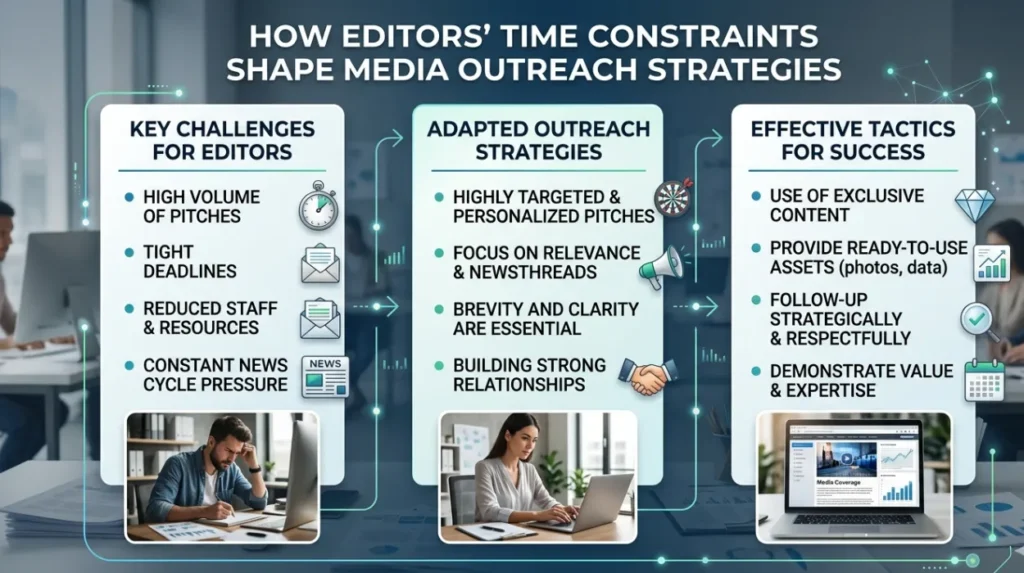
This constraint drives a preference for high‑signal, low‑noise communication. Editors favour short, scannable messages over long, narrative‑driven pitches. The data shows that pitches that can be understood in three lines or fewer are more likely to receive a positive response. The mechanism is efficiency: the more effort required to extract value, the more likely the message is to be skipped.
Editors also report that they are more likely to respond to messages that respect their schedule. The 1,000‑respondent pool shows that pitches sent on Tuesday, Wednesday, or Thursday mornings align better with production calendars than those sent on Mondays or Fridays. The data reveals that pitches that reference upcoming deadlines, seasonal themes, or policy‑cycle windows are treated as more usable because they fit natural planning rhythms.
The study indicates that the most effective outreach pattern is targeted, low‑volume, and high‑relevance. Editors describe receiving fewer messages as less burdensome and more manageable. The implication for communicators is that broad spam‑style lists are less effective than segmented, opt‑in, and beat‑specific routes. The data suggests that outreach strategies that mirror the editorial workflow—topic‑specific, deadline‑aware, and evidence‑driven—perform better within the current inbox environment.
What conceptual patterns emerge from the 1,000‑editor dataset?
The 1,000‑editor dataset defines several conceptual patterns about how the editorial inbox functions as a reputation and relevance filter. The first pattern is relevance density. Editors respond positively to messages that pack high‑quality, on‑beat, and timely information into a compact, readable format. The second pattern is sender reputation. Editors prioritise known, consistent, and low‑noise contributors, which shapes how long‑term relationships develop.
The third pattern is signal‑clarity. The study shows that messages with clear structure, neutral language, and specific data points are more likely to survive the triage stage. The fourth pattern is constraint‑aware timing. Editors report that pitches that align with their schedule, beat, and audience are more likely to be read and considered. The fifth pattern is anti‑spam behaviour. Editors actively avoid over‑promotional, impersonal, and structurally complex messages, which reduces the effectiveness of generic outreach.
These patterns matter for understanding how news media audiences receive brand‑driven stories. The data indicates that brand‑story resonance is not just about the quality of the narrative. It is about how the narrative is framed, timed, and routed within the editorial workflow. The dataset supports the idea that outreach strategies that mirror the editorial logic—topic‑specific, deadline‑aware, and evidence‑driven—are more likely to generate engagement.
Ready to get your story published?
Distribute your press release across 500+ trusted media outlets — with editorial review and a full pickup report within 48 hours.
Send Press Release →