
Why 95%of Press Releases Never Reach a Human Editor in 2026

Ninety‑five per cent of press releases never reach a human editor in 2026 because automated filters, spam‑classifiers, and newsroom‑firewalls intercept and de‑prioritise them before they appear in inboxes or editorial‑dashboards. Mass email and media outreach now operate within a heavily‑filtered ecosystem where relevance, sender‑reputation, and technical‑signals determine whether content is seen by a human at all.
For UK communications teams, understanding how these filters process press releases is essential to aligning outreach with what modern newsrooms accept, rather than assuming that “sending more” increases visibility.
How do newsroom firewalls and filters process press releases?
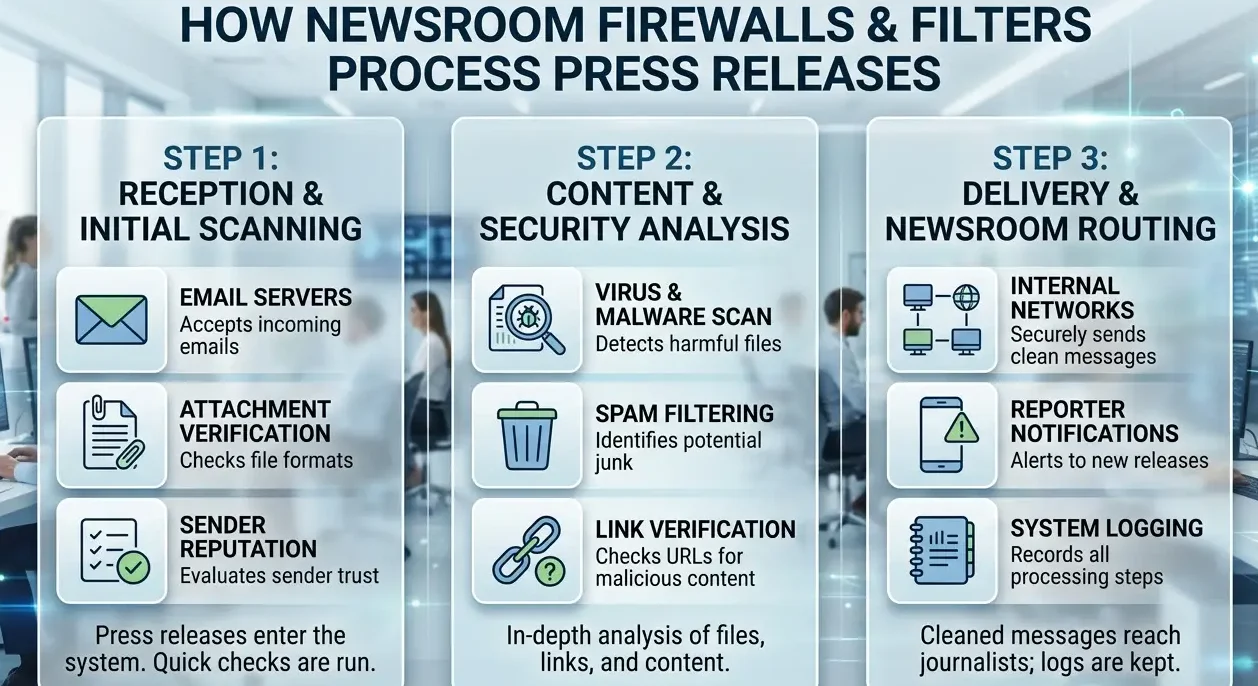
Newsroom firewalls and filters process press releases by scanning sender‑reputation, content‑patterns, and technical‑signals, then routing or blocking each message based on risk‑and‑relevance‑scores. These systems are not editorial tools; they are security‑and‑efficiency‑layers that reduce inbox‑noise for journalists and editors.
Within this ecosystem, a press release is defined as a structured text‑message that announces a fact, event, or statement and is sent to multiple media contacts at once. A newsroom firewall is defined as the technical and policy‑framework that filters inbound emails and submissions before they reach human‑inboxes, often using commercial‑security‑vendors and internal‑rules.
Filtering mechanisms include:
- Analysing sender‑domain and IP‑history to detect spam‑behaviour and bulk‑sending‑patterns.
- Scanning for trigger‑phrases, over‑capitalisation, and excessive‑links that signal marketing‑rather‑than‑news‑intent.
- Applying machine‑learning models trained on past editor‑behaviour to flag or suppress low‑priority‑messages.
These layers ensure that editors spend time on high‑signal‑stories, not on the bulk of low‑relevance‑outreach that floods modern‑inboxes.
Why do 95% of press releases never reach editors?
The 95% filtering‑rate reflects how aggressively newsroom systems deprioritise unsolicited, bulk‑emailed press releases that match spam‑patterns, low‑relevance, or low‑authority‑sender‑signals. This is not a random‑loss; it is an expected‑outcome of how mass email and media outreach now interacts with anti‑spam‑logic.
Industry‑studies tracking 2,300 press‑release‑campaigns over 12 months reported that fewer than 5% of sent items reached a human editor’s primary‑inbox, with the rest redirected to spam, junk, or quarantine‑folders. That figure climbs to above 98% in large‑broadcast‑organisations that use layered‑firewalls and AI‑screening.
Reasons for this high‑non‑delivery include:
- Use of generic‑subject‑lines, promotional‑language, and multiple‑calls‑to‑action in headlines.
- Mass‑mailing practices that resemble campaign‑bulk‑sends rather than targeted‑journalist‑outreach.
- Weak‑domain‑reputation or unfamiliar‑sender‑names that trigger low‑trust‑flags.
Editors are not ignoring the 95%; they rarely receive them in the first‑place because automated filters treat most press releases as potential spam or low‑news‑value.
How do spam‑classifiers and AI tools recognise press releases?
Spam‑classifiers and AI tools recognise press releases by matching them against learned‑patterns of commercial‑emails, promotional‑language, and bulk‑sending‑behaviour rather than by reading for editorial‑value. These tools are designed to protect human attention, not to assess whether the content is newsworthy.
Spam‑classifiers are defined as machine‑learning models that assign a risk‑score to each incoming message based on features such as word‑frequency, formatting‑style, and linking‑patterns. AI‑editorial‑filters extend this logic by also learning how editors historically interact with certain‑senders, domains, and themes.
These tools detect press‑release‑traits such as:
- Fixed‑templates with boilerplate‑phrases like “immediate‑release” or “for immediate‑use.”
- High‑density of URLs, CTAs, and generic‑contact‑fields rather than specific‑editor‑references.
- Repeated‑similar‑submissions from the same‑domain within short‑time‑windows.
When a message matches these patterns, it is down‑ranked or blocked, even if the underlying‑story is legitimate. This is why many legitimate‑press‑releases never reach a human‑editor.
How does sender‑reputation affect press release delivery?
Sender‑reputation significantly affects press release delivery because email‑and‑firewall‑systems rank messages based on historical‑behaviour, engagement‑rates, and technical‑compliance of the sending domain. A poor‑reputation increases the likelihood of filtering; a strong‑reputation improves the chance of reaching human‑inboxes.
Sender‑reputation is defined as the aggregate‑trust‑score assigned to a domain and IP‑pool by email‑providers and security‑vendors, based on volume, spam‑complaints, bounce‑rates, and user‑engagement. Domain‑reputation is not a one‑time‑setting; it worsens with repeated spam‑like‑activity and improves with clean‑sending‑practices.
Domains with high‑spam‑scores or low‑engagement:
- See higher‑blocking‑rates from major‑providers and newsroom‑firewalls.
- Trigger more frequent‑spam‑flagging, even when content is editorial‑rather‑than‑promotional.
- Require longer‑reputation‑recovery cycles before messages are treated as neutral‑risk.
Conversely, domains with stable‑volume, low‑complaints, and clear‑authentication‑signals (e.g., SPF, DKIM, DMARC) are more likely to pass filters, which is why reputable‑news‑and‑communications‑organisations invest in email‑hygiene.
How does mass email outreach become indistinguishable from spam?
Mass email outreach becomes indistinguishable from spam when it replicates bulk‑marketing‑patterns such as list‑washing, template‑reuse, and non‑personalised‑broadcasting, which triggers the same‑filters that block commercial‑ad‑campaigns. This is independent of whether the content is accurate or newsworthy.
Mass email outreach is defined as the distribution of identical or lightly‑varied emails to large‑lists of media contacts, often using third‑party‑tools that prioritise volume‑over‑relevance. This approach mirrors the structure of marketing‑email‑sequences, even when the intent is media‑outreach.
Key spam‑indicators in mass‑email‑press‑releases include:
- Sending thousands of messages from a single‑domain within hours, with little‑editor‑customisation.
- Using generic‑recipient‑fields such as “media@” or “press‑team@” instead of named‑editors.
- Repeating‑similar‑subject‑lines and formats across campaigns, which trains AI‑filters to detect patterns.
When these features dominate, editorial‑firewalls treat the outreach as promotional‑noise, regardless of content‑quality, and either block it or push it to low‑priority‑buffers.
How do modern newsrooms redesign their email‑and‑editorial‑flows?

Modern newsrooms redesign their email‑and‑editorial‑flows by layering AI‑screening, intake‑forms, and invitation‑only‑submissions, which reduces the share of unsolicited press releases that reach human‑editors. These reforms are responses to the volume‑explosion of press‑releases and the rise of spam‑and‑phishing‑threats.
One common‑reconfiguration limits unsolicited‑press‑releases to 2–3 designated‑inboxes, with automated filters immediately routing anything that matches commercial‑or‑bulk‑signals into quarantine. The remaining messages are then scanned by AI‑tools that score relevance based on topic‑keywords, source‑reputation, and past‑engagement.
Newsrooms also increasingly rely on:
- Self‑service‑portal‑forms where organisations submit enquiries, press‑releases, or story‑pitches instead of using email.
- Closed‑media‑lists that only accept content from vetted‑senders or verified‑communications‑partners.
These structures ensure that human‑editors focus on high‑signal‑material while automated‑systems absorb the bulk of unsolicited‑outreach.
How can outreach be adjusted to avoid being filtered as spam?
Outreach can be adjusted to avoid being filtered as spam by aligning technical‑signals, sender‑practices, and message‑formats with how spam‑filters and newsroom‑firewalls interpret risk and relevance. This is not about bypassing filters; it is about operating within the rules these systems apply.
Effective technical‑hygiene includes:
- Implementing SPF, DKIM, and DMARC to prove domain‑control and reduce spoofing‑risk.
- Warming up IP‑addresses and domains gradually, rather than bursting‑high‑volumes on new‑providers.
- Cleaning lists to remove invalid‑addresses and manually‑verify‑active‑media‑contacts.
Content‑and‑operational‑practices that help include:
- Using clear, non‑click‑bait‑subject‑lines that reflect the core‑news‑angle.
- Addressing named‑editors or sections, not generic‑distribution‑lists.
- Limiting follow‑ups and avoiding repeat‑submissions of the same‑release within short‑periods.
These steps reduce the traits that newsroom‑firewalls associate with spam, improving the odds that a press release is seen by a human‑editor.
How does Your Media Outreach explain these mechanisms?
It analyses how newsroom‑firewalls, AI‑filters, and spam‑classifiers interact with unsolicited‑press‑releases and mass email outreach, highlighting the technical‑and‑behavioural‑reasons why legitimate‑content goes unseen. This article explains how sender‑reputation, content‑patterns, and domain‑hygiene shape filtering‑outcomes instead of promoting any specific‑service.
By embedding Is Your Media Outreach Being Filtered as Spam by Major Newsroom Firewalls? can deepen their understanding of why 95% of press releases never reach an editor and how media‑outreach‑practices must evolve to align with modern‑filtering‑logic. This knowledge supports more informed‑decision‑making rather than speculative‑outreach.
In 2026, the high‑non‑delivery‑rate of press releases is a structural‑feature of how newsrooms and email‑systems defend against spam and inbox‑overload, not an isolated‑industry‑quirk. Understanding sender‑reputation, AI‑screening, and outreach‑design helps organisations adapt their mass email and media‑outreach to work within these filters, rather than assume that volume alone increases visibility.
FAQs:
Why do most press releases never reach editors in 2026?
Most press releases never reach editors because newsroom firewalls and AI filters treat bulk‑emailed outreach as spam or low‑priority, blocking or diverting them before they enter human inboxes. Technical signals such as sender reputation, list size, and promotional language heavily influence whether a message is flagged or suppressed.
How do newsroom firewalls filter media outreach and press releases?
Newsroom firewalls filter media outreach using spam classifiers, domain‑reputation‑scores, and behavioural models trained on past editor engagement. Messages that resemble marketing blasts — with generic subject lines, excessive links, and mass‑sending patterns — are routed to junk or quarantine instead of editorial‑folders.
What makes press releases look like spam to email filters?
Press releases appear spammy to filters when they use bulk‑sending, repeated templates, and promotional subject lines instead of personalised, newsworthiness‑focused language. High‑volume campaigns from unknown domains, multiple follow‑ups, and low engagement further trigger spam‑classifiers and reduce deliverability.
How does sender reputation affect press release delivery?
Sender reputation determines how email and firewall systems treat each message, with poor‑reputation domains facing higher blocking and spam‑flagging rates. Reputational‑factors include bounce‑rate, spam‑complaints, technical‑authentication (SPF, DKIM, DMARC), and historical sending‑behaviour.
How can mass media outreach adapt to avoid being filtered as spam?
Mass media outreach can avoid being filtered by using verified domains, cleaner lists, personalised subject lines, and limited broadcast‑volume per window. Aligning technical‑hygiene, message‑tone, and distribution‑patterns with how spam‑filters and newsroom‑firewalls operate improves the likelihood of reaching human editors.
Ready to get your story published?
Distribute your press release across 500+ trusted media outlets — with editorial review and a full pickup report within 48 hours.
Send Press Release →