
The Pros and Cons of Using Press Release Distribution Services
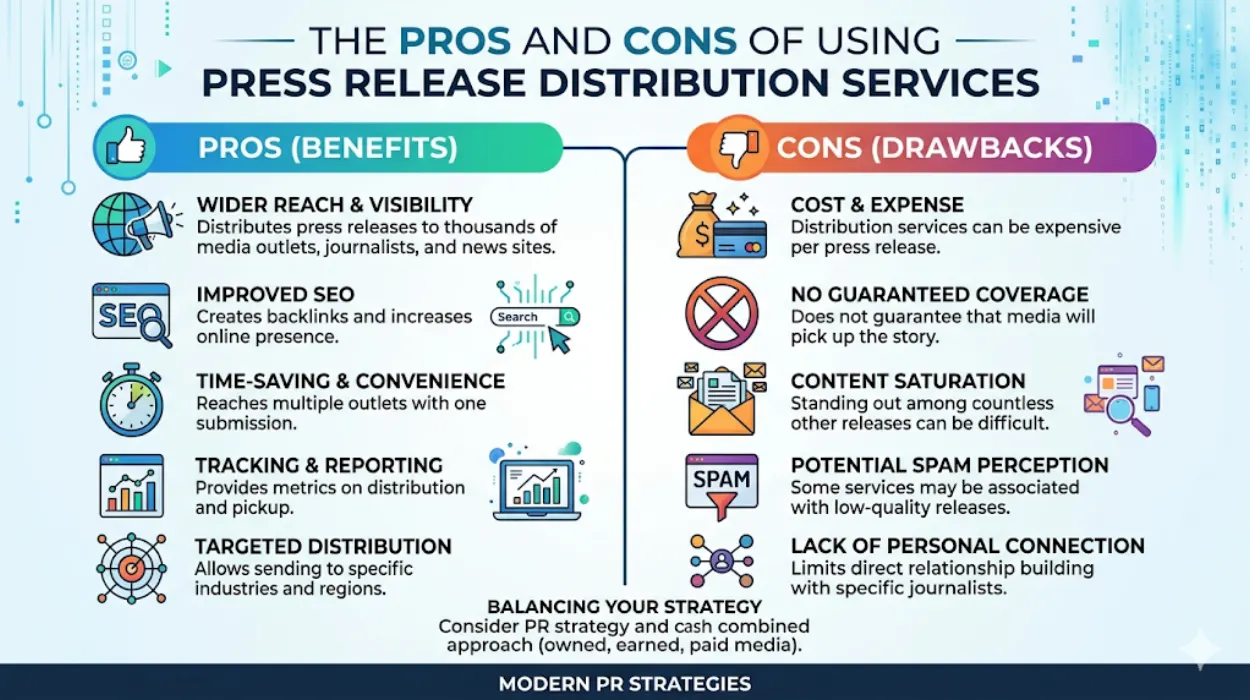
Press release distribution services expand content reach and increase visibility across media channels. They also introduce cost, control limitations, and variable impact depending on strategy execution.
These services function as amplification tools rather than guaranteed media placement solutions. Their effectiveness depends on targeting accuracy, timing, and alignment with broader communication objectives.
What advantages do press release distribution services provide?
Press release distribution services improve reach, indexing, and discoverability across digital ecosystems. They enable structured dissemination to journalists, aggregators, and search engines. These systems standardise formatting and accelerate publishing timelines. They also support measurable visibility through analytics dashboards.
A key advantage lies in multi-channel exposure. Distribution systems send releases to newsrooms, RSS feeds, and content networks simultaneously. This reduces manual outreach time. It also ensures consistent message delivery across platforms.
Another benefit involves search visibility. Distributed releases often appear on high-authority domains. This contributes to improved indexing and keyword association. For example, a release published across 150+ syndicated sites increases crawl frequency and SERP presence.
Distribution also supports scalability. Organisations can issue multiple releases per month without increasing operational complexity. This suits campaigns requiring sustained visibility. It also aligns with product launches or event-driven communication cycles.
Analytics integration provides measurable insights. Metrics include impressions, click-through rates, and geographic reach. These data points inform future optimisation decisions. They also support performance benchmarking across campaigns.
What limitations affect the effectiveness of distribution services?
Press release distribution services do not guarantee editorial coverage or audience engagement. They often result in passive exposure rather than active readership. This limits their effectiveness in generating direct conversions or meaningful media relationships.
One limitation involves content saturation. News aggregators publish thousands of releases daily. This reduces visibility per release. It also increases competition for attention within the same topic cluster.
Another constraint relates to targeting precision. Many services distribute broadly rather than selectively. This leads to irrelevant placements. For example, a fintech release appearing on general lifestyle feeds reduces contextual relevance.
Cost structure presents another limitation. High-tier distribution packages can exceed £600 per release. This impacts return on investment when engagement remains low. Smaller organisations may find this model inefficient.
There is also limited editorial control. Once distributed, content appears across third-party platforms. Formatting inconsistencies and truncation can occur. This affects message clarity and brand perception.
Finally, backlink value varies. Many distribution platforms apply nofollow attributes. This reduces SEO authority transfer. As a result, distribution alone does not replace link-building strategies.
How do distribution services compare with manual media outreach?
Press release distribution services prioritise scale, while manual outreach prioritises precision. Each approach serves different communication objectives. Distribution focuses on visibility. Outreach focuses on relationship-building and editorial placement.
Distribution offers speed and automation. A single submission can reach hundreds of outlets. This reduces time investment. However, it lacks personalisation.
Manual outreach requires targeted pitching. This involves identifying relevant journalists and tailoring messages. It increases response probability. It also improves chances of editorial coverage.
The following comparison highlights key differences:
- Increase scale – Distribute to 200+ platforms instantly
Example: A global announcement published across multiple regions within minutes - Improve targeting – Pitch to 15–20 relevant journalists
Example: A niche industry story sent directly to sector-specific editors - Control messaging – Use fixed formats in distribution systems
Example: Standardised press release templates across all platforms - Enhance engagement – Build direct journalist relationships
Example: Follow-up emails leading to feature articles or interviews - Measure outcomes – Track impressions in distribution dashboards
Example: Analytics showing 10,000 views but limited click-through
Manual outreach produces fewer placements but higher-quality coverage. Distribution produces broader exposure but lower engagement depth. A combined approach often delivers balanced results.
What trends are shaping the use of press release distribution services?
Press release distribution services are evolving through automation, data integration, and content personalisation. These trends reflect changes in digital media consumption and search behaviour. They also influence how organisations structure communication strategies.
One significant trend involves AI-assisted content optimisation. Distribution platforms now analyse headline structure, keyword density, and readability. This improves alignment with search algorithms. It also enhances discoverability.
Another development is audience segmentation. Advanced systems categorise recipients based on industry, geography, and interest. This improves targeting accuracy. It also reduces irrelevant distribution.
Multimedia integration is increasing. Modern releases include videos, infographics, and interactive elements. These formats improve engagement metrics. They also align with platform-specific content preferences.
Real-time analytics is also expanding. Dashboards now provide granular insights, including device type and referral sources. This enables immediate performance evaluation. It also supports iterative optimisation.
Regulatory compliance is becoming more prominent. Data privacy laws influence distribution practices. Platforms now include consent-based targeting and transparency features. This affects how audiences receive and interact with content.
These trends indicate a shift from static distribution to dynamic communication systems. They also highlight the need for strategic alignment rather than reliance on distribution alone.
When should organisations consider using distribution services?
Organisations should use press release distribution services when visibility and reach are primary objectives. These services suit announcements requiring rapid dissemination across multiple channels. They also support campaigns targeting broad awareness rather than niche engagement.
Distribution is effective for time-sensitive updates. Examples include product launches, financial disclosures, and event announcements. These scenarios require immediate publication. They also benefit from simultaneous multi-platform exposure.
It is also suitable for SEO support. Distributed releases contribute to keyword association and indexing frequency. This enhances search presence over time. However, it must align with a broader content strategy.
Organisations with limited media contacts benefit from distribution systems. These platforms provide access to established networks. This reduces dependency on existing relationships.
However, distribution should not replace targeted communication. For high-impact storytelling or thought leadership, manual outreach remains essential. Distribution complements these efforts rather than substituting them.
To evaluate suitability, organisations often integrate distribution into a broader communication framework. This includes combining analytics insights with strategic planning. For deeper evaluation, many businesses explore PR Strategy Consultation to align distribution with long-term objectives.
How do costs compare with potential returns?
Press release distribution services involve fixed and variable costs. These costs depend on geographic reach, word count, and additional features. Returns vary based on visibility, engagement, and downstream impact.
A standard distribution package costs between £120 and £600 per release. Premium packages exceed £1,000 when including international reach and multimedia integration. These costs accumulate over multiple campaigns.
Return on investment depends on measurable outcomes. These include impressions, website traffic, and lead generation. However, distribution primarily delivers visibility rather than direct conversions.
The cost-return relationship can be analysed through key factors:
- Assess reach – Evaluate number of platforms and audience size
Example: Distribution across 180 outlets generating 15,000 impressions - Measure engagement – Analyse click-through rates and time spent
Example: 2% CTR indicating limited audience interaction - Compare alternatives – Evaluate cost against manual outreach
Example: £300 distribution vs targeted pitching with higher conversion - Track long-term value – Monitor SEO impact over time
Example: Increased keyword ranking after repeated releases - Calculate efficiency – Determine cost per impression
Example: £0.02 per view compared to paid advertising benchmarks
Distribution provides predictable exposure but uncertain engagement. Its value increases when integrated with targeted strategies and performance analysis.
What role does distribution play in a broader PR strategy?
Press release distribution services function as one component within a multi-layered PR strategy. They support amplification but do not replace strategic planning or audience targeting. Their role is operational rather than strategic.
In a structured PR framework, distribution follows content development and targeting decisions. It ensures that messaging reaches intended channels. It also supports consistency across platforms.
Distribution complements other tactics such as media outreach, content marketing, and social amplification. Each element addresses different stages of audience engagement. Distribution focuses on awareness and discoverability.
It also contributes to data collection. Analytics from distribution platforms inform future strategy adjustments. This includes identifying high-performing topics and channels.
However, over-reliance on distribution creates imbalance. Without targeted engagement, visibility does not translate into influence. Effective PR strategies integrate distribution with relationship-building and narrative development.
Organisations that align distribution with strategic objectives achieve more consistent outcomes. This requires evaluating both advantages and limitations within a broader communication context.
Conclusion
Press release distribution services offer structured, scalable visibility across digital channels. They improve reach, indexing, and operational efficiency. However, they introduce limitations in targeting, engagement, and cost-effectiveness.
Their value depends on strategic integration rather than standalone use. When combined with targeted outreach and data-driven planning, they contribute to balanced communication outcomes.
A neutral evaluation shows that distribution is neither inherently effective nor ineffective. Its impact depends on execution, context, and alignment with broader objectives.
Ready to get your story published?
Distribute your press release across 500+ trusted media outlets — with editorial review and a full pickup report within 48 hours.
Send Press Release →