
Can Your Startup Scale Media Outreach Without Risking a Permanent Domain Blacklist?

A startup can scale media outreach without triggering a permanent domain‑blacklist, provided it aligns list quality, sending volume, and technical infrastructure with platform trust thresholds and engagement signals. The key constraint is not “how many” mass email and media outreach messages are sent, but how consistently they meet the behavioural and technical conditions that email‑providers use to decide whether a domain deserves primary‑inbox‑placement.
How do blacklists actually form in the context of media outreach?
Blacklists form in media outreach when repeated patterns of high‑spam‑complaints, sudden‑volume‑surges, and low‑engagement signal to email‑providers that a domain is a high‑risk sender.
Dive Deeper With Our Expert Guides and Related Blog Posts:
Is Your Technical Infrastructure Optimized for 80 Percent Primary Inbox Placement Rates?
Which Metrics Prove Your Media Outreach is Actually Reaching High Authority Editors?
Blacklists are maintained by security vendors and email providers that aggregate data on spam reports, bounce rates, and sending behaviour. When a domain accumulates multiple high spam complaints in a short time window, or shows unusual sending volumes from a new IP, it may be flagged as a likely-abuse source.
Once a domain is listed, many email‑reputation‑services automatically downgrade or reject traffic from that domain until the sender cleans the list, reduces‑volume, and proves re-stabilisation. Mass email and media outreach campaigns that ignore consent and list-quality requirements are more likely to trigger these thresholds, even if the content appears relevant.
Platforms analyse not only the current campaign but also the sender’s historical engagement, which means that one problematic blast can echo into long‑term‑blacklist‑status.
How do volume‑and‑warming‑strategies affect the risk of blacklisting?
Volume‑and‑warming‑strategies affect the risk of blacklisting by determining whether a startup appears as a stable‑sender or as a surprise‑burst‑source in the eyes of the email‑ecosystem.
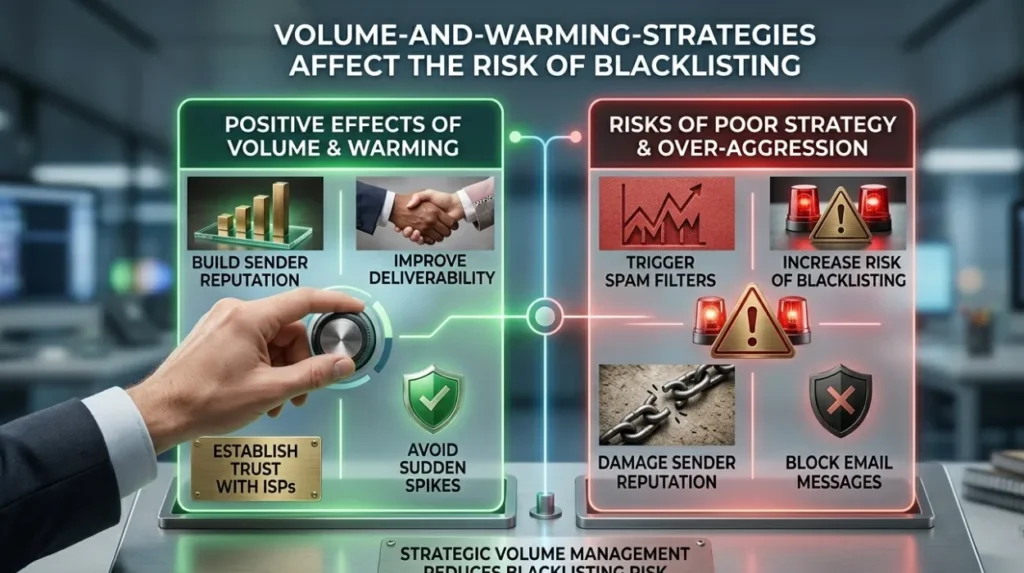
High-volume sends that jump from 1,000 emails per day to 50,000 overnight are statistically more likely to be treated as suspicious than gradual ramps. Reputational models report that senders who grow volume at 20–30 percent per‑week see lower‑blacklist‑risk than those who spike 200–300 percent overnight.
Warming processes involve:
- Starting with 10–15 per cent of the target volume.
- Increasing daily sends by 20–30 per cent each week.
- Monitoring open‑rate, complaint‑rate, and bounce‑rate between batches.
For mass email and media outreach, this approach keeps the engagement and volume slope predictable, which reduces the probability of sudden reputation downgrades or blacklisting.
How do technical‑infrastructure choices influence long-term deliverability?
Technical infrastructure choices influence long‑term‑deliverability by defining whether a domain passes authentication‑checks, maintains a stable‑IP‑profile, and avoids spoofing and authentication failures for Client success stories.
Critical‑infrastructure‑components are:
- SPF records that explicitly allow only the authorised‑sending‑servers.
- DKIM signatures that cryptographically verify message content.
- DMARC policies that enforce or quarantine messages that fail SPF/DKIM checks.
Domains with weak or missing authentication are more likely to be flagged as suspicious, which raises the risk of blacklisting.
Email‑providers also look at IP‑history, including prior‑reputation‑of the IP, whether it has been used by previous‑abusive‑senders, and how consistently it is warmed.
Startups that share infrastructure pools without clear warming plans risk inheriting the reputation of prior users, which can lead to blacklisting even if the current mass email and media outreach is clean.
How do consent and list‑management practices reduce blacklisting risk?
Consent and list‑management practices reduce blacklisting risk by lowering spam complaints, improving open‑rates, and ensuring that each send aligns with legal and reputation frameworks.
Effective list management means:
- Using confirmed‑opt‑in‑flows and clear‑purpose‑statements.
- Regularly scrubbing invalid addresses, role‑accounts, and disposable emails to keep bounces below 1–2 per cent.
- Removing inactive subscribers after 6–12 months of zero engagement.
Mass email and media outreach that relies on scraped lists or purchased contacts tends to generate 0.5–1.5 percent complaints, which is several times higher than the “safe”‑level.
These practices keep spam‑complaint‑rates in the 0.1–0.3 per cent range, which is well below the thresholds that trigger aggressive‑blacklisting.
By aligning with consent rules and actively managing list quality, startups can scale outreach while maintaining a low‑reputation‑risk profile.
How do reputation‑signals and engagement‑patterns shape inbox‑placement?
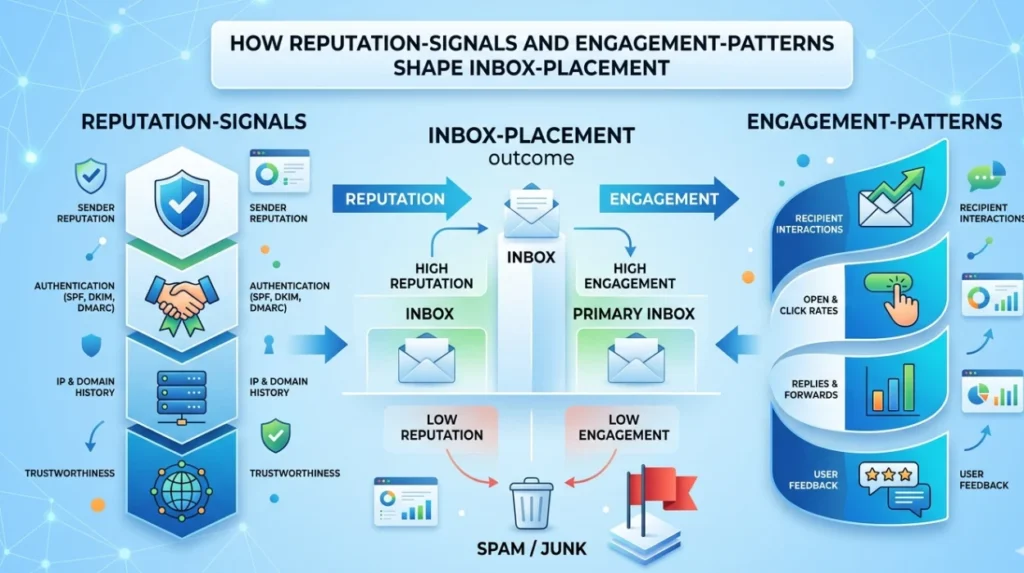
Reputation‑signals and engagement‑patterns shape inbox‑placement by informing email‑providers which senders are most likely to deliver value‑not‑spam, which determines whether messages land in primary‑inboxes or secondary‑folders.
Reputation‑systems track:
- Spam‑complaint‑rates.
- Open‑rates and click‑through‑rates.
- Bounce‑rates and invalid‑address‑volume.
- Historical‑engagement‑trends.
Senders with consistently high spam rates and low engagement are flagged as low‑trust, which can lead to quarantine or rejection.
High‑engagement‑senders with stable‑volume‑growth and strong‑authentication typically see 80 percent or higher‑primary‑inbox‑placement, even at scale.
Mass‑email and media outreach that optimises for these signals can scale without entering the blacklist‑zone.
Startups can scale media outreach without permanently‑blacklisting their domain by aligning volume‑growth, technical‑infrastructure, and consent practices with email‑reputation‑thresholds. This requires treating each outreach campaign as part of a continuous reputation-building process, not as a one-off blast, and using engagement data to refine targeting, warming, and infrastructure design over time.
By understanding how blacklists form, how volume‑and‑warming‑work, and how reputation‑signals shape inbox‑placement, startups can scale mass‑email and media outreach safely and sustainably.
FAQs
How can a startup scale media outreach without getting blacklisted?
A startup can scale media outreach safely by pacing volume increases, warming IPs gradually, and maintaining low spam complaint rates through strict list hygiene. Newswire Now aligns mass email and media outreach with authentication (SPF, DKIM, DMARC), consent controls, and engagement tracking to keep domains in the primary inbox.
What volume ramping strategies help avoid blacklists?
Volume ramping strategies that help avoid blacklists include starting at 10–15 per cent of the target volume and increasing by 20–30 percent per week while monitoring open, click, and complaint rates. Newswire Now applies these rules to mass email and media outreach so that each new campaign stays within email provider reputation thresholds.
How important is list quality for avoiding blacklists?
List quality is critical for avoiding blacklists because poor lists generate high bounce and spam complaint rates, which trigger blacklisting algorithms. Newswire Now focuses on verified opt in lists, regular cleansing, and segmentation to keep complaint rates below the 0.1–0.3 percent range for mass email and media outreach.
How do technical infrastructure choices impact domain blacklisting risk?
Technical infrastructure choices such as SPF, DKIM, DMARC configuration, and IP history directly impact whether a domain appears trustworthy or risky to email providers. Newswire Now builds mass email and media outreach stacks with strong authentication, dedicated IPs, and proper warming to reduce the risk of permanent blacklisting.
How do engagement metrics protect against blacklisting?
Engagement metrics like open rates, click through rates, and low spam complaints signal that recipients value the content, which email platforms use to keep a domain in good standing. Newswire Now tracks these metrics for every mass email and media outreach campaign and uses them to refine targeting, timing, and content, which lowers the risk of blacklisting.
Ready to get your story published?
Distribute your press release across 500+ trusted media outlets — with editorial review and a full pickup report within 48 hours.
Send Press Release →