
Press release timing in the UK: morning, afternoon or evening

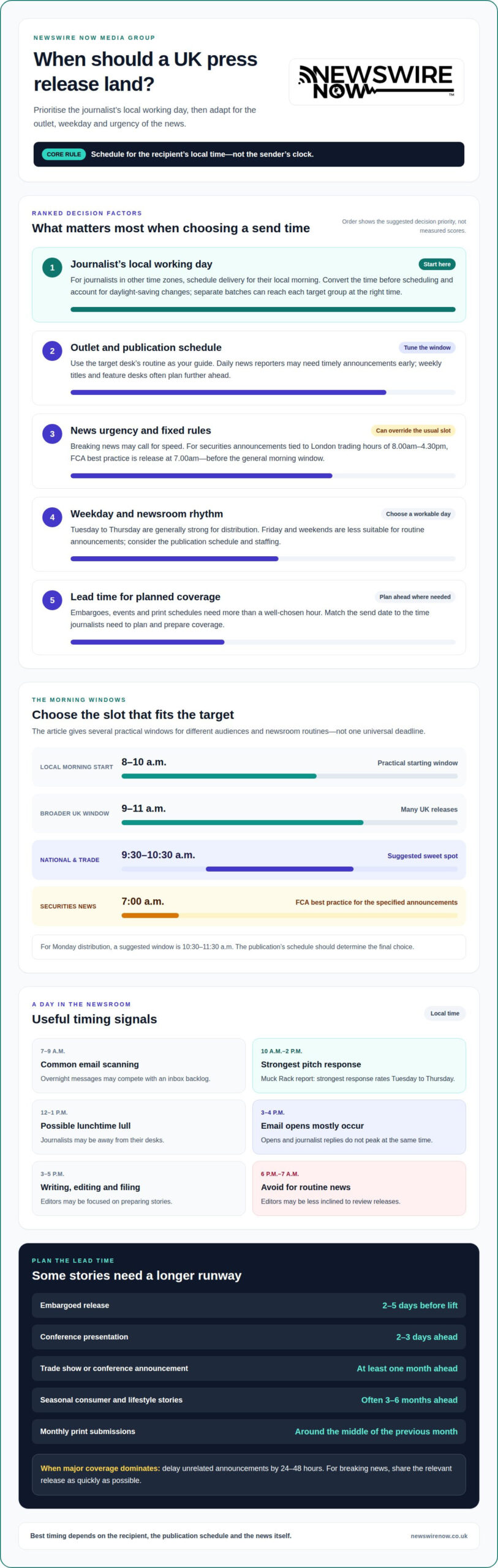
A morning send is usually the strongest starting point, but the journalist’s local clock matters more than yours. For the best time to send a press release in the UK, aim for 9:00–11:00 a.m. local time; for London-based national and trade media, 9:30–10:30 a.m. is the suggested sweet spot. These are practical windows, not universal deadlines.
It’s easy to focus on the announcement and overlook when it reaches a journalist’s inbox. Even a well-prepared release can arrive during a busy part of the working day. The right send time depends on the publication, the journalist’s schedule and whether the news is time-sensitive.
This article explains when to send a press release in the UK, how the strongest window can vary by day, and when an afternoon send may make sense. It also explains why you should use the journalist’s local time, especially when targeting media in different regions. You’ll have a clearer basis for planning distribution around your news and the people you want to reach.
Key Takeaways
- Use the journalist’s local time when planning distribution, particularly when your target publications work across different regions.
- For many UK releases, the morning is the strongest starting point; the best window can vary by outlet and day.
- For announcements related to securities with London trading hours of 8.00am–4.30pm, best practice is to release them at 7.00am, according to the Financial Conduct Authority.
- Consider the news cycle and publication schedule before choosing an afternoon or weekend send.
1. Adjusting send times to journalists’ local time
Set the send time against the journalist’s working day, not the sender’s clock. In the UK, a practical starting window is 8–10 a.m. local time, when editors are beginning to review incoming news. If distribution targets journalists in other time zones, schedule delivery for their local morning rather than sending to every contact simultaneously.
For example, if a UK team is targeting a journalist overseas, convert the intended local send time before scheduling. Account for daylight-saving changes too: the time difference can shift even when the planned UK launch time stays fixed. Distribution software can schedule separate batches so each target group receives the release during its own working day.
Journalists commonly scan emails between 7 and 9 a.m., but messages sent overnight compete with an accumulated inbox backlog. The 8–10 a.m. window can therefore balance early scanning with a fresh arrival. Avoid assuming every editor follows the same routine: a daily news reporter and a weekly publication’s features editor may organise their inboxes differently.
Email opens and journalist replies do not peak at the same time. Opens occur mostly from 3–4 p.m., while a Muck Rack report found the strongest pitch response rates between 10 a.m. and 2 p.m., Tuesday to Thursday.
Other parts of the day suit different newsroom rhythms. A 12–1 p.m. lull may mean journalists are away from their desks, while 3–5 p.m. is often used for writing, editing and filing. Professionals weigh the story’s urgency, outlet deadlines and the role of the contact before choosing a send time. For breaking news, speed may matter more than an ideal inbox slot.
For a weekly feature, allow time for planning rather than treating a morning send as a deadline. The best time to send a press release in the UK depends on the target journalist’s local working pattern, the publication schedule and the announcement itself.
2. What Is the Best Time to Send Out a Press Release?
Tuesday, Wednesday and Thursday are generally strong weekdays for press release distribution. Editors are working through the week’s news, and communications teams can plan coverage ahead of weekend deadlines. Tuesday is a useful starting point for a planned announcement, but the publication’s schedule should determine the final choice.
For national and trade media, schedule a morning send around 9:30–10:30 a.m. local time. A broader UK window is 9–11 a.m., giving journalists time to assess the announcement during the working day. Monday can also suit some releases; if Monday is necessary, a suggested window is 10:30–11:30 a.m.
The industry and release type also affect the decision. Daily news reporters may need timely announcements early, while weekly titles and feature desks often plan coverage further ahead. A professional distributor considers outlet deadlines, the news angle and whether the story needs advance preparation. Breaking news calls for speed; planned launches allow more control over the weekday and timing.
Friday and weekends are generally less suitable for routine announcements because newsroom schedules and staffing may differ. Avoid sending during the three days before Christmas Day, when holiday activity can crowd out planned coverage. If an announcement is tied to a fixed event or deadline, its relevance and the publication schedule matter more than a standard weekday preference.
There is a distinct timing rule for securities announcements. For announcements related to securities with London trading hours of 8.00am–4.30pm, the Financial Conduct Authority handbook says best practice is to release them at 7.00am. This specific timing takes priority over the general morning window.
For a campaign that needs coordinated placement across outlets, professional press release distribution can help align delivery with the selected weekday and target media.
3. Afternoon, evening, weekend and Monday timing
An afternoon send can suit publications with lunchtime editions. In that case, 2–3 p.m. may give editors material for later coverage. For routine news, avoid sending between 6 p.m. and 7 a.m., when editors may be less inclined to review releases. A weekend send is generally discouraged, unless the announcement is tied to breaking news.
There is no single closing time for UK newspapers, broadcasters and online newsrooms. Publication deadlines vary; business days commonly wind down around 5–6 p.m., when editors may be less receptive to new material. Plan around the target desk’s schedule rather than assuming every newsroom stops accepting submissions at the same hour.
Monday timing depends on the desired publication date. A release sent on Monday may lead to a story on Wednesday or Thursday, while weekend editors may be approached on Tuesday or Wednesday. For a Monday publication under embargo, sending the release the previous Monday can give journalists a week to plan and schedule the story.
For an embargoed press release, send it 2–5 days before the embargo lifts. A conference presentation may call for a similar lead time of 2–3 days, while an announcement about a trade show or conference should be sent at least one month before the event. These windows give journalists time to plan writing and coverage.
Monthly print publications need a different schedule: submissions may be due around the middle of the previous month for a first-week issue. Seasonal consumer and lifestyle stories need longer lead times, often 3–6 months before the relevant season. October onward can be crowded with holiday pitches, although the week between Christmas and New Year’s may be slower.
Breaking news changes the calculation. Share a release tied to current news as quickly as possible; delay unrelated announcements by 24–48 hours when major coverage dominates. For UK newspapers, broadcasters and online outlets, relevance and deadline pressure should guide the timing.
4. Best morning time to email a press release
For a planned UK announcement, start by scheduling delivery for 8:30–9:00 a.m. This can place the release in editors’ inboxes as they begin work, before the day’s writing and meetings gather pace. The best slot depends on the newsroom, so treat this as a practical starting point rather than a fixed rule for every reporter.
Morning email activity offers useful context, but opens and coverage are different outcomes. Email click-throughs occur more often between 8 and 9 a.m., while journalists’ schedules vary by role and publication. A specialist reporter may review messages early; an editor handling several desks may not reach new emails until later.
Build the send plan around the announcement. For a scheduled launch, coordinate the release with the moment the news becomes public and the target outlet’s working pattern. For urgent news, speed matters more than waiting for an ideal morning slot. Unless a deadline or embargo dictates otherwise, avoid sending so early that the email sits in an overnight backlog.
Thursday is sometimes associated with stronger email open rates, but that alone doesn’t establish the best day for every release. Professionals assess the outlet, the news angle and the intended coverage, then compare results across similar sends. Testing timing across 5–10 press releases can reveal when a specific group of journalists is more responsive.
Keep comparisons focused: use similar news, target comparable reporters and record send times alongside opens and replies. A morning slot that works for one weekly title may not suit a daily newsroom. This evidence-led approach helps refine future schedules without treating one high open rate as proof of wider editorial interest.
For a professionally coordinated send, arrange press release distribution around your chosen morning window.
Newswire Now Media Group: Single Press Release Distribution
Newswire Now Media Group’s Single Press Release Distribution is a practical next step when your announcement is ready and you want professional distribution. Releases are editorially reviewed and distributed to more than 500 news outlets across 27 industry sectors and 37 professions.
That support connects your chosen timing with a distribution process, rather than leaving delivery to individual email sends. Media Pickup Reporting records coverage after distribution, giving you a clearer view of where the release appeared.
For one announcement, choose Single Press Release Distribution; for several planned releases, Multi-release Distribution Bundles may suit your campaign. Contact Newswire Now Media Group to discuss distributing your press release.
Turn your timing plan into a coordinated release
Make timing part of the release brief, not a last-minute scheduling detail. Set the intended launch date, identify the publications that matter most and agree how the announcement should reach them. This gives distribution a clear purpose and helps keep the release aligned with your communications plan if the news or schedule changes.
The best time to send a press release in the UK is the window that fits both your announcement and the journalists you want to reach. Editorial review helps prepare the release for distribution, while a single-release option or a bundle can suit the scale of your campaign.
Newswire Now Media Group provides press release distribution and editorial review for organisations preparing announcements for media audiences. If you’re ready to plan your release, contact Newswire Now Media Group to discuss the next step. A clear timing plan gives your announcement a stronger start.
Frequently Asked Questions
What Is the Best Time to Send Out a Press Release?
Aim for the journalist’s morning working window, then adjust for the outlet and story. For a planned product launch, schedule delivery when the relevant desk can assess the news and act on it during the working day. For breaking developments, send promptly instead of waiting for a preferred slot. Careful timing supports delivery, but the story’s relevance and fit also shape editorial interest.
What is the best day and time to send a press release in the UK?
For a standard UK media announcement, choose a midweek morning and align the send with the publication’s editorial routine. A campaign aimed at a weekly title may need a different schedule from one targeting a daily news desk. Before setting distribution, match the release date to when the announcement becomes public and any relevant publication deadline, so journalists can assess it while it is timely.
Do UK journalists prefer press releases in the morning or afternoon?
Morning is usually the more practical choice for planned announcements, while an afternoon send can suit a specific newsroom schedule. For example, a release intended for a publication with a lunchtime edition may be more useful later in the day. The distinction is between being opened and being acted on: choose a slot that gives the relevant journalist time to consider the story.
Should press releases be sent on Mondays, Fridays or over the weekend in the UK?
Monday can work when it fits the announcement and the target publication’s planning cycle. Friday and weekend sends are less suited to routine news, so use them when timing is tied to a genuine event or urgent development. For a planned story, consider when the journalist will need the information and whether the timing leaves room for reporting, editing and publication.
How should UK bank holidays and public holidays affect press release timing?
Plan around the working schedules of the journalists and publications you are targeting. A bank holiday can change newsroom routines and make a standard weekday send less effective, so consider distributing before the holiday or after normal activity resumes. For a time-sensitive announcement, coordinate the release with its public date and the availability of the relevant editorial desk.
What is the best time to send a press release for maximum journalist response and media coverage?
To find the best time to send a press release in the UK, match the send to the journalist’s working hours, outlet deadlines and the news itself. Keep the distribution list relevant to the announcement, and make the key information clear at a glance. For an ongoing campaign, compare responses from similar sends to refine timing for that particular media audience.
Ready to get your story published?
Distribute your press release across 500+ trusted media outlets — with editorial review and a full pickup report within 48 hours.
Send Press Release →