
How to Set a Clear Word Limit for Your Press Release

A practical press release word count limit is usually 400 to 500 words, but there’s no strict maximum: the announcement should be long enough to explain the news and no longer. A straightforward update may need less, whilst complex news can require more. The aim is a complete, focused story, not a target number at any cost.
It’s easy to assume every part of a release is counted the same way. For a consistent working total, include the headline, subheadline, body, quotes and company boilerplate, along with any abstract or summary. If the recipient sets a separate limit for an element, follow its instructions.
This guide explains how to choose an appropriate length, count an abstract consistently and avoid formatting mistakes that make a release harder to scan. You’ll also learn how to trim repetition without cutting information readers need to understand the announcement.
Key Takeaways
- Set the length around the announcement: keep straightforward news focused and allow more space only when extra context is essential.
- Count the abstract consistently with the rest of the release, while keeping any separate recipient limits in view.
- Cut repeated context and unnecessary quotes, then check that the headline, paragraphs and boilerplate are easy to scan.
- Treat outlet requirements as the deciding factor when they provide a specific limit; otherwise, prioritise a clear, complete story.
Common press release length and formatting mistakes
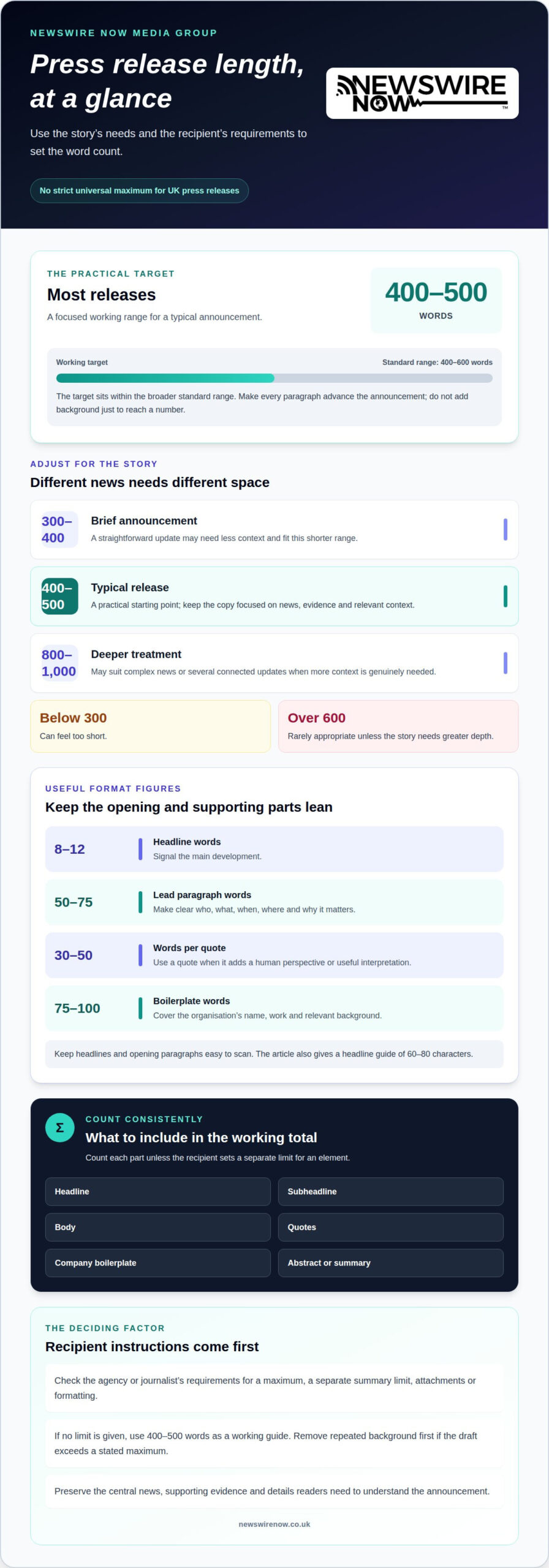
A standard release is generally 400 to 600 words, with 400 to 500 a practical target. Brief announcements may need 300 to 400 words; below 300 can feel too short, while over 600 is rarely appropriate.
-
Check the standard press release length
Start with a 400 to 500-word draft, then confirm every paragraph advances the announcement. A straightforward event update may fit 300 to 400 words because it needs little context. A complex launch may need more explanation. Avoid adding background merely to reach a target: readers need the news, evidence and relevant context, not repeated claims.
-
Set a recommended maximum text length
Keep the main release within 600 words unless the story genuinely needs greater depth. Journalists may spend less than one minute scanning a release, so place the key news early. Use a headline of 60 to 80 characters and a 50 to 75-word lead paragraph. A long headline, dense opening or crowded format can obscure the announcement before readers reach its supporting details.
-
Check agency and journalist word limits
Look for any word-count instruction provided by the receiving agency or journalist, then follow that limit. There is no strict universal maximum for UK press releases; the announcement and the detail required determine its length. If no limit is given, use 400 to 500 words as a working guide. Don’t assume one recipient’s format or requirements apply to every newsroom.
- Keep the boilerplate to 75 to 100 words, covering the organisation’s name, work and relevant background. Treat it as part of the total count unless a recipient specifies otherwise. Check that the boilerplate adds facts rather than repeating the lead. One or two focused quotes can add perspective; avoid using quotes to restate information already clear from the release.
Concise writing
A concise press release includes a headline, a lead, supporting details, a relevant quote and a short organisational background. Keep every part focused on the announcement so readers can identify the news and its significance without wading through repetition.
- Draft the lead first. State who is making the announcement, what has happened and why it matters. For example, a company announcing a new service should name it and explain who it serves. Move secondary background into the body rather than crowding the opening.
- Include only supporting details that clarify the news. Use a few paragraphs to explain timing, availability or evidence where relevant. Remove claims that don’t help readers understand the announcement, and avoid restating the lead in different words.
- Include a quote only when it adds a human perspective or useful interpretation. Keep each quote to 30-50 words, and make sure it contributes something the factual paragraphs cannot. A quote that simply restates the launch date or repeats a company claim is an easy cut.
- Write the boilerplate to provide context, not promotion. Include the organisation’s name and a clear description of its work, then remove broad slogans that don’t help identify it. Keep this background separate from the announcement.
- Make one editing pass for structure and another for wording. Check that the first paragraph carries the central news, then replace long phrases with direct alternatives. For example, change “is currently in the process of launching” to “is launching”.
- Review every sentence against the release’s purpose. If a detail doesn’t explain the announcement, support its importance or identify the organisation, cut or shorten it. This final check preserves essential facts while removing repetition and unnecessary scene-setting.
Recommended press release word count
Choose a working length that suits the announcement, then adjust it to the recipient’s requirements. There is no universal press release word count limit, and a target should support clarity rather than encourage extra copy.
-
Set the recommended word count
Start with 400 to 500 words for a typical press release. A focused announcement may need fewer words, while complex news or several connected updates can need more context. A release of around 800 to 1,000 words may suit that deeper treatment. Set your press release word count limit around what the story needs, not a number chosen simply to make every announcement the same length.
-
Set headline and opening paragraph lengths
Aim for a headline of about 8 to 12 words and an opening paragraph of 50 to 75 words. Use the headline to signal the main development. The opening should make clear who is involved, what has happened, when and where it applies, and why it matters. For example, a launch announcement can identify the organisation, the new service and its intended audience.
- Count the release consistently. Include the headline, subheadline, body, quotes and boilerplate in your working total. Add an abstract or summary if you include one, unless the recipient gives it a separate limit. This approach prevents confusion when the document moves between colleagues or recipients.
- Read the distribution terms before submitting. A service may set a submission limit or explain whether additional fees apply. Don’t assume every service uses the same rules. If your draft exceeds the stated maximum, remove repeated background first. Preserve the central news, supporting evidence and details needed to understand the announcement.
Do UK news agencies or journalists set press release word limits?
There’s no universal word limit for UK press releases. A journalist or agency may set its own submission requirements, so follow the recipient’s instructions.
- Check the submission instructions before sending your release. Look for a stated maximum, a separate limit for a summary, or rules about attachments and formatting. A journalist’s request for a short email pitch, for example, is different from a word limit for the full release.
- Separate the release from the covering message. Keep the email pitch focused on why the announcement may interest the journalist, then provide the full release as requested. Don’t assume a brief pitch means the complete release must meet the same limit. Use the recipient’s wording to distinguish the two.
- Adapt the material to the outlet’s stated format. If an agency requests a short summary, provide it separately and retain the essential facts in the full release. If there’s no separate limit, use a clear, self-contained version rather than cutting key context to meet an imagined rule.
- Resolve conflicting instructions before submitting. For example, if a contact asks for a concise email but the agency’s submission page gives a different limit, establish which instruction applies to the email and which to the release. Label each item clearly so the recipient can assess the announcement without guessing.
- Use the same recipient-specific approach when preparing distribution. Prepare your release for distribution with its intended audience and format in mind, and keep the central news clear across each version. A focused edit can remove repeated background without stripping out the details needed to understand the announcement.
Newswire Now Media Group: Single Press Release Distribution
Newswire Now Media Group distributes prepared releases once their length and format are ready for media review. Single Press Release Distribution suits one announcement, while Multi-release Distribution Bundles support organisations planning several releases.
Editorial Review provides an additional check before distribution, while Media Pickup Reporting gives you a record of coverage picked up. Together, these services support the next step after editing: distributing the release to media and reviewing its reach. They don’t replace clear, concise writing, but they can help move a finished announcement through distribution.
If your release is ready to send, contact Newswire Now Media Group to discuss distribution.
Make your next release ready to send
Before distribution, settle on one counting method and apply it to the release, summary and any versions prepared for different recipients. This gives your team a consistent reference point when editing, approving or adapting the announcement. A clear press release word count limit is most useful when everyone understands which material it covers.
Make the final review a decision, not another round of expansion. Confirm the central news remains prominent, each detail has a purpose and the release follows the recipient’s requirements. If the story changes during approval, review the wording and count together so the finished version stays coherent.
Once the release is ready, consider whether distribution support would help move it forward. Contact Newswire Now Media Group to discuss the next step for your announcement. A focused release gives your news a clear foundation for reaching its intended audience.
Frequently Asked Questions
How many words should a press release be?
A focused announcement usually works well at around 400 to 500 words. Treat that as a drafting guide, not a target to fill at any cost. For example, a simple appointment announcement may need less context than a technical launch. Keep the essential facts, explain why the news matters and remove material that doesn’t help readers understand it.
Is there a standard word count limit for a press release?
No, there isn’t one universal limit for every press release. The receiving journalist, publication or distribution service may set its own submission requirements. Distinguish any limit for an email pitch or summary from the full release. If you’re preparing one version for several recipients, follow the strictest relevant instruction or tailor copies to meet different requirements.
What is the recommended press release length in words?
For most single-announcement releases, use 400 to 500 words as a practical starting point. A straightforward update can be shorter, while a complex announcement may need more room to explain its context. If you draft a longer version, check whether every section adds a fact or explanation readers need. A word target should guide editing, not override clarity.
Does press release length affect whether journalists read or publish it?
Length can affect how easily a journalist identifies the story, but it doesn’t determine publication by itself. A concise release with a relevant angle and clear evidence is easier to assess than one that buries the news. Put the development and its significance near the top, then use the remaining paragraphs for supporting details.
How can you shorten a press release without losing key information?
Make a copy, then edit in passes. First remove repeated background; next cut adjectives and introductory phrases that add no factual detail. Keep the who, what, when, where and why, along with evidence supporting the announcement. If a quote repeats the lead, keep the stronger version. Reread the shorter draft to ensure each claim still has enough context.
What are the risks of sending a press release that is too long or too short?
A lengthy release can bury its central news beneath background or repetition. An overly brief one may omit context, evidence or practical details that help a journalist assess the story. For instance, announcing a new service without explaining who it serves can make the news harder to interpret. Edit for completeness and relevance, not length alone.
Ready to get your story published?
Distribute your press release across 500+ trusted media outlets — with editorial review and a full pickup report within 48 hours.
Send Press Release →