
How to write and place a press release boilerplate

A boilerplate should do more than repeat a slogan: it gives readers a concise, factual picture of the organisation behind a press release. Aim for around 100 words, and place it at the end of the release. A boilerplate template for a press release can help you cover the essentials without letting this short section overshadow the news.
It’s easy to treat the boilerplate as an afterthought, but clear, current company information gives readers and journalists useful context. This guide explains what to include, how to keep the wording focused and where the boilerplate belongs. You’ll also find a practical template to adapt and steps for keeping it accurate and consistent across your releases.
Key Takeaways
- Use a concise, factual company profile to give readers useful context about the organisation behind the news.
- Aim for around 100 words, adapting examples and details to your organisation’s audience and sector.
- Place the boilerplate at the end of the release, after the main news and before the media contact details.
- Use a simple template to shape the copy, then consider editorial review and distribution support for your finished release.
What Is a Press Release Boilerplate?
A boilerplate is a concise company profile at the end of a press release. It explains who is behind the announcement and gives readers relevant context.
Define the boilerplate
Think of the boilerplate as a reusable paragraph that introduces an organisation, not a summary of the announcement. Include relevant details such as what the organisation does, whom it serves, and its history, locations, expertise, awards or values. Choose information that helps readers understand its role. Avoid turning this section into a sales pitch or making claims the organisation cannot support.
Explain its purpose
Use the boilerplate to provide consistent background across press releases, media kits and other communications. A company profile helps journalists identify the organisation and understand its connection to the news. Keep it factual and suitable for reuse, while tailoring the release itself to each announcement. For example, a technology company can describe its product area and intended market without repeating launch details.
- Identify the organisation, what it does and whom it serves. Select details that clarify its relevance, such as a specialist service, sector or community. Keep the company boilerplate distinct from the announcement itself.
- Write a direct headline that states the main news, then use a subheading to add useful context. For example, a product launch headline can name what launched; the subheading can identify the intended users or explain a key development.
- Lead with the most important update. Summarise who is doing what, when and where, then explain why it matters. Put supporting details in the body, not before the central news.
- Use a quote to add a named spokesperson’s perspective. Attribute it with their name and role, and keep it relevant to the announcement. Don’t use a quote to repeat facts already covered in the opening.
- Keep claims factual and supportable; inaccurate or misleading statements can create legal and reputational risks. Seek legal advice about complex disclaimers or compliance statements. State the release date clearly. For an embargo, specify the release time and date, and agree the restriction with recipients.
Q: How long should a company boilerplate be?
Aim for around 100 words, organised as one paragraph of approximately five sentences. For a UK release, include the organisation’s name, what it does, the audience or market it serves, and relevant context such as its mission, expertise or history.
Identify key company details
Choose facts that explain the organisation’s identity to its intended audience. Start with a clear description of its work, then add useful details such as its sector, locations, capabilities, values or history. Ask: what does the organisation do, whom does it serve, and what distinguishes its work? Keep the writing concise, factual and free of unsupported superlatives.
Review relevant examples
Adapt the detail to the organisation, rather than copying another company’s format. A technology firm might identify its product category and business customers; a startup might explain its purpose and target market. For an international example, Ace Hardware says it has stores in approximately 60 countries and has served local communities since 1924. Timex Group says it has over 3,000 employees worldwide.
- Draft five short sentences, aiming for around 100 words in total. Make the opening sentence identify the organisation, explain its work and name its audience. Use the remaining sentences for relevant evidence, such as a founding date, locations, specialist areas or mission.
- Tailor examples to the organisation’s stage and reach. A startup can explain the need it addresses; an established technology company can describe its market and expertise. An international organisation can clarify its geographic scope without implying that it operates in places it doesn’t serve.
- Keep facts consistent across the boilerplate, headline, media kit and other communications. Review claims and contact details when business information changes, so outdated figures or a former spokesperson’s details don’t carry into a new release.
- For a release that needs professional preparation before distribution, consider editorial review as part of the process.
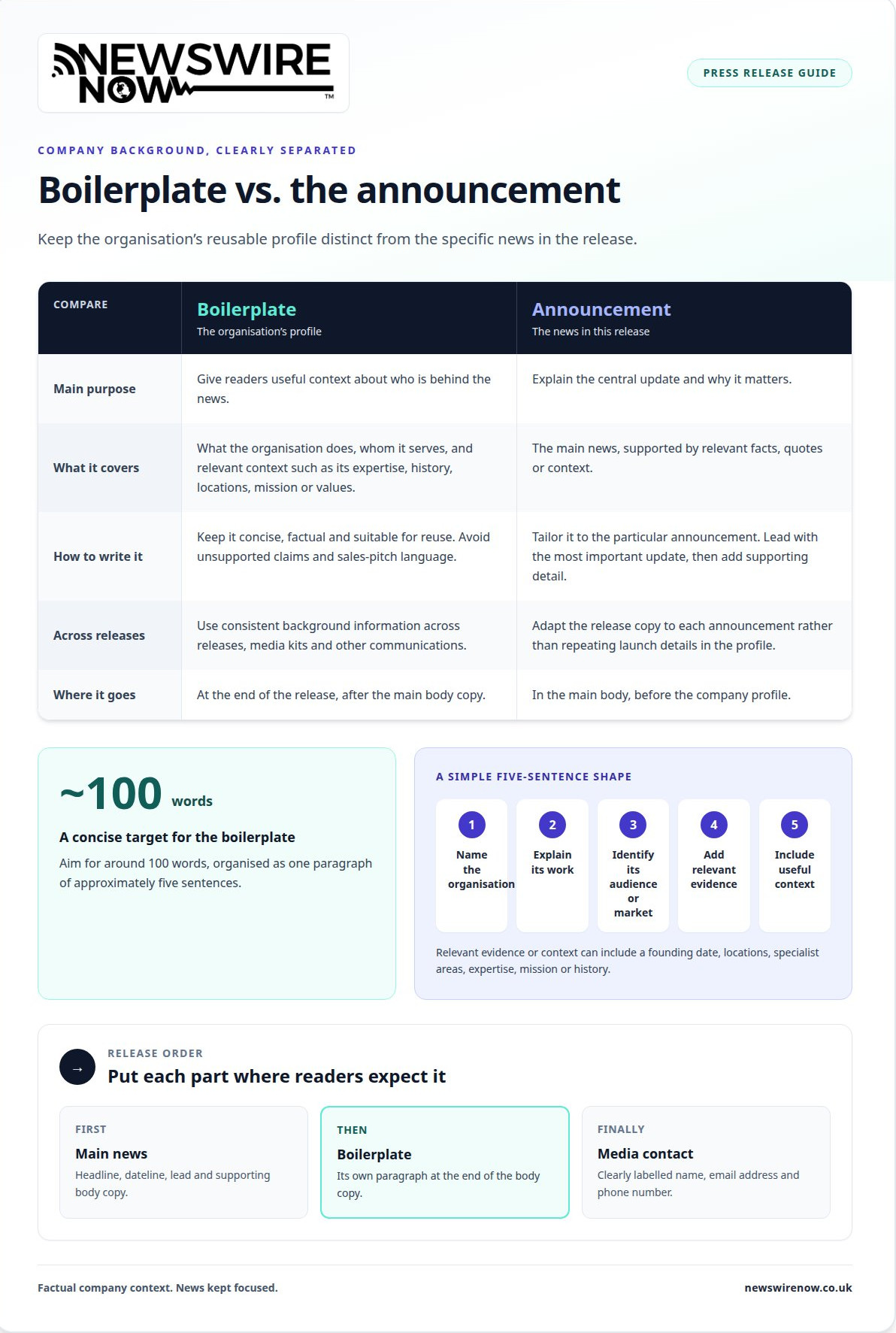
Boilerplate placement in a press release
Place the boilerplate after the release’s main news, so readers encounter the organisational overview once they understand the announcement. Keep the date, location and contact details in positions that make the release easy to scan.
Choose where to place the boilerplate
Place the boilerplate after the body copy, at the end of the press release. This separates the announcement from background information, giving readers a concise overview without interrupting the story. Keep it distinct from the final paragraph about the news, and make sure its details remain relevant to the organisation.
Position date, location and contact details
Place the dateline near the beginning, before the opening paragraph, to show the release date and relevant location. After the boilerplate, add media contact details, including the name, email address and phone number of a relevant spokesperson or media contact.
- Start with the headline, followed by the dateline and lead paragraph. Use the headline to identify the announcement, then give the release date and location before summarising the news. For a UK audience, use British English spelling and date conventions consistently.
- Develop the body in a logical order. Lead with the central update, then add supporting facts, quotes or context. This helps readers understand the announcement before they reach the organisation’s background information.
- Place the boilerplate after the body copy in its own paragraph, rather than blending it into the final news detail. When adapting a release for a new announcement, update relevant information without changing the boilerplate’s position.
- Finish with clearly labelled contact information. Include the relevant person’s name, email address and phone number so journalists can follow up. Keep these details separate from the boilerplate, even when both appear at the end.
- Review the full format, from headline to contact details. Confirm that the dateline includes the date and location, the announcement remains central, and the boilerplate provides background rather than introducing new news. Keeping these elements in consistent positions makes each release easier to scan.
Press release boilerplate template
Use a clear release structure, then add a reusable boilerplate that gives journalists concise organisational background. A template is a starting point, not a substitute for checking every fact.
Select a press release format
Build the release around a headline, dateline, lead paragraph, body, boilerplate and contact information. There is no set word count for the full release in this format, so keep each element focused on the announcement. Use the headline and opening to establish the news, then place the organisation organisation’s background after the body.
Use a boilerplate template
Adapt this scaffold by replacing each placeholder with accurate details. Keep the tone formal, write in the third person and remove any section that does not suit the organisation.
- Newswire Now Media Group is a digital media organisation that provides press release distribution and visibility services for public relations professionals and businesses.
- Its work focuses on global media outreach, digital PR strategies, and content syndication.
- Founded in 2015, it supports clients across multiple international locations and industry sectors.
- Its mission is to simplify media communication and connect organisations with relevant journalists.
- For more information, visit the official Newswire Now Media Group website.
Use only verifiable claims. For example, a technology company could name the type of software it develops and the organisations it serves, without making unsupported claims about market leadership. An international organisation should describe its reach accurately.
Find a free UK template
Create a free working template by copying the scaffold above into a document and tailoring it to your organisation. There is no need to download a separate file: use the standard release elements, British English and current contact details. Keep an editable master, then adapt relevant details for each announcement.
Before sending the release, read it as a journalist would. Confirm that the headline reflects the news, the boilerplate supplies background and the contact details support follow-up. This structure helps keep media communications clear and credible.
Newswire Now Media Group: Single Press Release Distribution
Newswire Now Media Group can distribute your release once the boilerplate and announcement are ready. Single Press Release Distribution suits a one-off announcement, while Multi-release Distribution Bundles support organisations planning several releases.
Submitted releases receive Editorial Review before distribution to more than 500 trusted news outlets across 27 industry sectors and 37 professions. The network also includes over 40 owned publications reaching millions of readers worldwide. Media Pickup Reporting gives you a record of coverage following distribution.
If your release is ready and you want support with distribution, contact Newswire Now Media Group to discuss the next step.
Put your next announcement into motion
A boilerplate is part of a wider communications system, not just a paragraph to paste unchanged into every release. Treat it as a maintained reference: when your organisation’s work, audience or priorities shift, review whether the background still represents it accurately. A boilerplate template for a press release gives you a useful starting point, but the details should reflect the organisation and announcement at hand.
Once your release is ready, choose the support that fits your next step. Newswire Now Media Group offers Editorial Review, Single Press Release Distribution and Multi-release Distribution Bundles, for a review, distribution of one announcement or support with multiple releases.
Contact Newswire Now Media Group to discuss your release and choose a practical next step. A clear, well-maintained company profile helps you present each announcement with confidence.
Frequently Asked Questions
How to write an effective boilerplate?
Start with a draft that describes the organisation in plain, specific language, then remove anything readers may not readily understand. A boilerplate template for a press release can help organise the first draft, but tailor the final wording to the organisation’s actual work. Read it alongside a recent announcement: company details should add context, not make the news sound like advertising.
What does the boilerplate mean in business?
In business, a boilerplate is approved wording an organisation can reuse to describe itself consistently. It gives colleagues a common reference when preparing company materials, rather than requiring each person to create a new description. For example, a communications team can use the same core profile in a media statement and an investor presentation, while adapting material written specifically for each audience.
What Is Meant by a Boilerplate?
A boilerplate is standard text prepared for reuse, rather than wording created from scratch for each document. Its meaning depends on context: in a press release, it usually means the organisation’s profile; in a form, it might refer to recurring explanatory wording. The key distinction is that reusable text stays broadly stable, while details tied to a particular announcement or document change.
What Is a Boilerplate Example?
Here’s a fictional example: “Northfield Systems develops inventory software for independent food producers. Its platform helps operations teams manage stock records and supplier information. The company focuses on practical tools for the food production sector.” This sample identifies an organisation, its work and its audience without claiming market leadership. Replace the fictional name and details with accurate information about the real organisation.
What is the standard structure of a press release template?
A standard press release template gives each part a clear purpose: the headline identifies the news, the dateline gives its date and location, and the opening states the key update. Supporting paragraphs develop the story; the boilerplate provides organisational context, and contact details enable follow-up. For a product launch, keep launch specifics in the main copy and reserve the profile for lasting company information.
Ready to get your story published?
Distribute your press release across 500+ trusted media outlets — with editorial review and a full pickup report within 48 hours.
Send Press Release →