
Writing a Quote for a Press Release: Where It Belongs

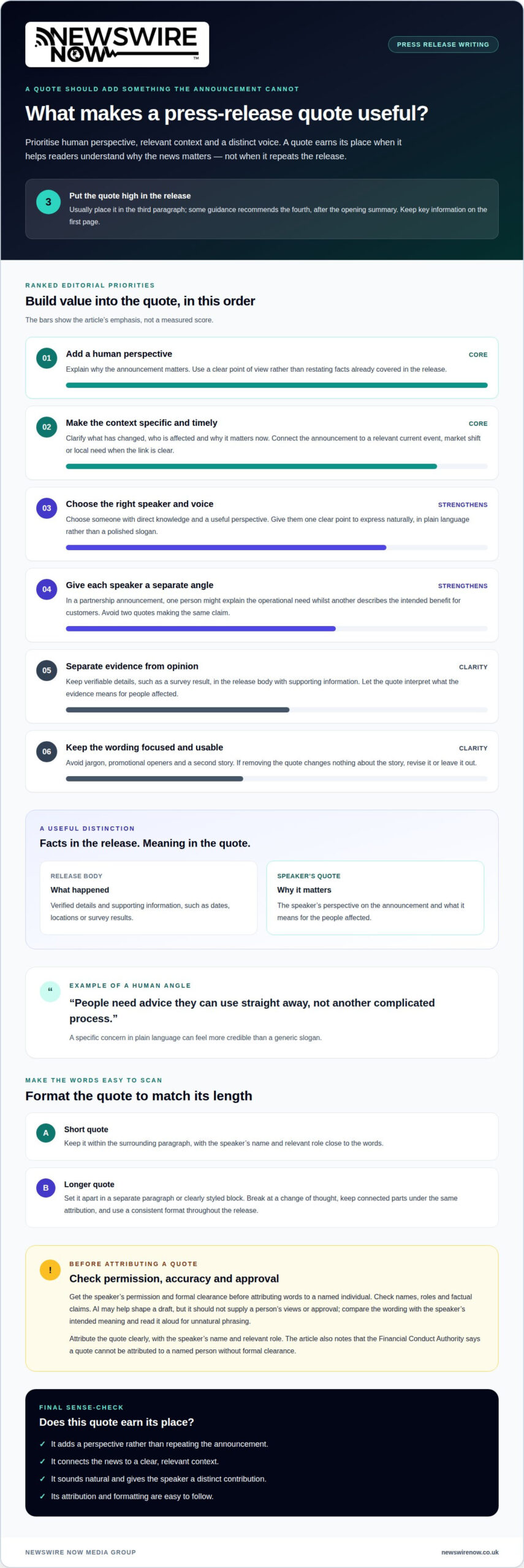
A quote that simply repeats the announcement misses the chance to add a human perspective. When writing a quote for a press release, place it high in the release, usually in the third paragraph; some guidance recommends the fourth, after the opening summary. Keep the key information on the first page, where it is easy to find.
Position matters, but a quote earns its place through what it adds. A clear point of view can explain why the announcement matters, while a generic line can make the release feel less distinctive. The wording should sound natural and offer journalists a useful perspective, rather than echoing facts already covered in the body.
This article explains how to choose the right place for a quote, give it a human angle and useful context, and format a longer quotation so readers can scan it easily. You’ll also learn how to keep the wording focused and make each speaker’s contribution distinct, so the quote supports the story instead of interrupting it.
Key Takeaways
- Place the quote where it supports the story’s flow, and connect the announcement to relevant current events or market context.
- Give the speaker a distinct perspective that explains why the news matters, rather than repeating facts from the release.
- Make a longer quotation easier to scan by separating it from the surrounding copy or breaking it into clear paragraphs.
- Keep the wording focused and natural, so the quote gives journalists a strong, usable line.
1. Press Release Quote Placement: Beginning, Middle or End?
Start with the news: the opening paragraph should summarise the story in one or two sentences. Put the quote high in the release, usually in the third paragraph; some guidance places it in the fourth. That gives journalists the announcement first, followed by a speaker’s perspective.
Before drafting, define one story and its timely angle. For example, a new service launch could connect to a current shift in customer behaviour if the release explains the link. Leave other announcements out: a second launch can distract from the main story and weaken its context.
Make the connection specific. Explain what has changed, who is affected and why the announcement matters now. For a community project, the context might be a local change or a particular need. Use the quote to interpret that connection, not to repeat the date, location or other facts already stated.
A press release quote differs from a media statement or interview quote in its purpose and setting. It is prepared for a particular announcement; a statement can respond to an issue, while an interview quote comes from a conversation and its context.
In the UK, get the speaker’s permission and formal clearance before attributing a quote to a named individual. The Financial Conduct Authority says a quote cannot be attributed to a named person without formal clearance. The University of Sussex advises against using quotation marks simply to draw attention to words.
Attribute the words clearly by placing the speaker’s name and relevant role beside the quotation. For example: “The project will bring local services closer to residents,” said Aisha Khan, project director. Check that the role accurately identifies the speaker.
Avoid opening with “We’re pleased to announce”, filling the quote with jargon or repeating the release’s figures. Don’t add a second story or use quotation marks for emphasis. These choices can make the speaker sound promotional and leave less room for useful context.
AI can help shape a draft, but it shouldn’t supply a person’s views or approval. Compare every sentence with the speaker’s intended meaning, verify names, roles and factual claims, then get clearance before attribution. Read the final quote aloud to catch robotic phrasing.
2. Adding a human angle and value to press release quotes
Choose a speaker with direct knowledge of the announcement and a useful perspective. A chief executive can explain a strategic decision, while a service manager may describe how a change affects daily operations. For a community project, a participating resident could offer a first-hand view an executive cannot.
To make the wording sound natural, give the speaker one clear point to express in their own voice. For example: “People need advice they can use straight away, not another complicated process.” This feels more credible than a polished slogan because it expresses a specific concern in plain language.
Add value with perspective, opinion or analysis that explains why the news matters. A quote about a new training programme could describe the problem it aims to address and what participants may gain. If removing the quote changes nothing about the story, revise it or leave it out.
Give each stakeholder a distinct contribution. In a partnership announcement, one speaker might explain the operational need, while another describes the intended benefit for customers. Two quotes making the same claim add length without adding interest. Assign each person a separate angle before drafting.
Keep factual information in the release body, where journalists can find and assess it. For instance, put a verified survey result with the supporting detail; the quote can interpret what that result means for people affected. Separate evidence from opinion, and make clear when a statement is the speaker’s view.
Once the quote and supporting context are ready, consider how the full story will reach its intended media audience through press release distribution.
3. Breaking up and formatting long quotes
A long quotation can sit within the body text or use dedicated quote formatting. Setting it apart helps journalists identify the speaker’s words at a glance, especially when scanning a release for an engaging line or possible headline.
For a short quote, keep it in the paragraph with the surrounding story. For example: “The new service gives residents a simpler way to access support,” said project lead Amina Patel. This compact format keeps the attribution close and the text easy to follow.
If a speaker makes several connected points, set the quotation apart from the main copy. Use a separate paragraph or a clearly styled block, then place the speaker’s name and role with the quote. This visual distinction helps readers see where the release’s reporting ends and the speaker’s words begin.
Break a long quote at a change of thought, not halfway through an idea. The first paragraph might explain the problem; the second could describe the response or its intended effect. Keep both parts under the same attribution so readers don’t mistake them for separate speakers.
Use double quotation marks to show the quoted words, and don’t use italics as a substitute. Keep the format consistent throughout the release: if the chief executive’s statement is set apart, present another speaker’s extended quote in the same way.
For example, a transport announcement might present a director’s remarks in two short paragraphs. The first could explain why a new route is needed; the second could describe what passengers should expect. Keep route details and supporting figures in the body, where they are easier to scan and distinguish from opinion.
Before finalising the layout, read the release from headline to closing details. Check that the quote is easy to find, its paragraphs follow a clear sequence and its attribution remains visible. If readers have to search for the speaker, or a sentence is separated from its meaning, adjust the formatting.
4. How long should a press release quote be?
A press release quote should be around 100-120 words, split into two punchy paragraphs. This gives an editor a concise line that could work as a headline and gives a reporter a strong opening for a story. Treat the range as a guide: keep only the words that add meaning or perspective.
Use the first paragraph to state the speaker’s main point. The second can explain its relevance or describe what happens next. For example, a statement about a new community service might first identify the need, then clarify how the service responds. Keep both paragraphs focused on that single message.
Check each sentence against the quote’s purpose. Does it offer a clear opinion, explain why the announcement matters or help readers understand its impact? If it only repeats a date, launch detail or statistic from the release, remove it. Readers can find those facts more easily in the main copy.
Trim polite openings and corporate language before counting the final words. Replace “We’re delighted to announce an exciting new initiative” with a direct statement about what will change. Read the result aloud in a natural speaking voice; awkward phrasing and repeated ideas are easier to spot.
Keep the strongest sentence near the start, where an editor can quickly identify a usable line. End with a specific next step only if it genuinely helps explain what follows. If the quote still exceeds the recommended range, remove supporting detail or move it into the release body rather than cutting so much that the speaker’s meaning becomes unclear.
Once the quote is focused, submit your press release for distribution with the quotation and its attribution clearly included.
Newswire Now Media Group: Single Press Release Distribution
Newswire Now Media Group provides Single Press Release Distribution when you have one announcement ready to reach media audiences. Its independent network includes over 40 owned publications, reaching millions of readers worldwide. Submitted releases can receive editorial review and distribution to more than 500 trusted news outlets across 27 industry sectors and 37 professions.
Once your quote is focused, attributed and ready to support the story, Media Pickup Reporting helps you review coverage after distribution. For organisations planning several announcements, Multi-release Distribution Bundles offer an option for distributing multiple releases.
Prepare the final release with its headline, story details, approved quotation and contact information together. To discuss distribution for your announcement, contact Newswire Now Media Group.
Put your announcement into motion
Once the wording is ready, consider the quote as part of the release’s wider communication plan. Decide what you want the announcement to achieve, who needs to hear it and which spokesperson can represent its message clearly. This alignment helps keep the quote relevant from approval through distribution.
Writing a quote for a press release is an opportunity to make the announcement sound distinctly human, not simply polished. Keep the speaker’s perspective central, and ensure the final version reflects what they are comfortable saying publicly. Treat writing a quote for a press release as part of a wider communications plan, with the message and spokesperson aligned from the outset.
If you’re ready to plan the next step for your announcement, contact Newswire Now Media Group to discuss distribution options. A well-prepared release gives your story a stronger foundation for reaching its intended audience.
Frequently Asked Questions
Press Release Quote Placement: Beginning, Middle or End?
Usually, place the quote in the middle, after the opening summary establishes the news. Readers then encounter the announcement before the speaker’s reaction. An end-position quote can work when it offers a final perspective, but readers may miss it if they stop after the main details. Choose the position that keeps the story easy to follow.
What makes a good quote in a press release?
A good quote gives the announcement a clear human consequence, not just a polished endorsement. For example, a school expansion quote could explain how additional classroom space will change the experience for pupils and teachers. The speaker’s role should make them credible on that effect. Remove any phrase that could appear unchanged in almost any company announcement.
How do you structure and format a quote in a press release?
Put the speaker’s complete statement inside quotation marks, then identify them by full name and relevant job title. For example: “This change gives our team more time to support customers,” said Priya Shah, operations director. Keep the attribution beside the words it identifies. If the statement moves to a new paragraph, make sure the speaker remains clear and the layout doesn’t suggest someone else is speaking.
Ready to get your story published?
Distribute your press release across 500+ trusted media outlets — with editorial review and a full pickup report within 48 hours.
Send Press Release →