
How to contact journalists with a press release in your region

A useful press contact list is built before the release is sent. The practical answer to how to contact journalists with a press release is to email a named reporter whose patch and beat fit your story, include the release in the email body and explain briefly why it matters now. A targeted approach gives the journalist a clearer reason to read on than a generic message.
Finding an email address is rarely the hardest part. The bigger challenge is making a relevant connection: understanding what reporters cover, showing how a story serves their readers and building contact through genuine networking.
This article explains how to identify the right journalist, shape a concise pitch and develop press contacts over time. You’ll learn practical ways to find reporters in your area, make your story’s local relevance clear and follow up professionally, so each approach is focused and useful to the person receiving it.
Key Takeaways
- Match your release to a reporter’s geographical patch and specialist beat to make the approach more relevant.
- Show why the story matters to local readers now, using clear language and useful supporting material.
- Build press relationships over time by networking through relevant events and organisations, not only when you have news to share.
- Use a focused distribution route when you need your release reviewed and sent to relevant media outlets.
1. How do I contact a journalist with a story?
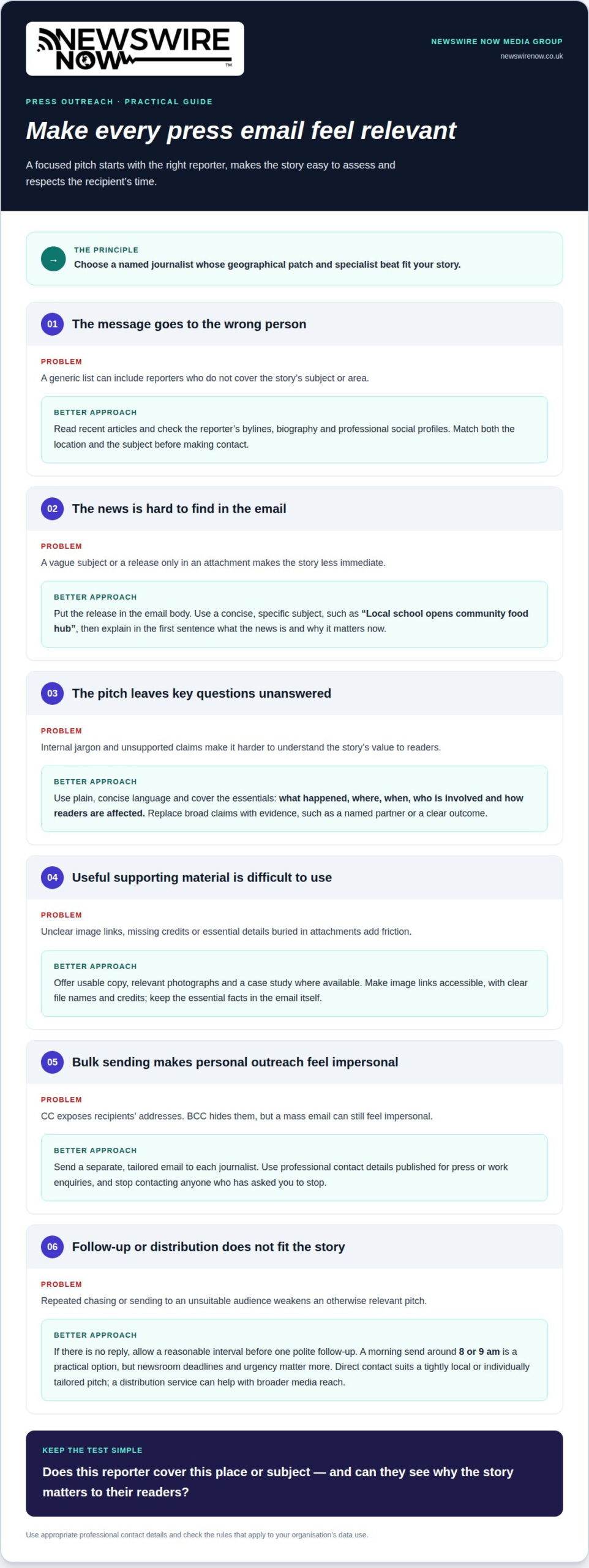
Start with a named journalist whose reporting matches your story and its location. Read their recent work, then send a targeted email explaining why you chose them. Put the release in the email body, not only in an attachment, and avoid phoning to ask whether it arrived. A personal contact form can also work when the journalist provides one.
For UK outreach, use professional contact details published for press or work enquiries, and keep your message relevant to the recipient’s role. Avoid copying personal details into unrelated outreach lists or continuing to email someone who has asked you to stop. These steps help keep contact appropriate, but do not replace checking the rules that apply to your organisation’s data use.
Keep the subject concise and specific, such as “Local school opens community food hub”. In the first sentence, state the news and why it matters now. Then give the key facts: what happened, where, when, who is involved and how readers are affected. Use plain language instead of internal terms such as “market-leading solution”. Offer usable copy, relevant photographs and a case study where available. Make image links easy to access, with clear file names and credits.
Send a separate email to each journalist rather than using CC, which exposes recipients’ addresses. BCC hides addresses but can still make a mass email feel impersonal; targeted messages are more useful. If there’s no reply, allow a reasonable interval before sending one polite follow-up. For a morning send, around 8 or 9 am is a practical option, but newsroom deadlines and the story’s urgency matter more than choosing a supposedly perfect day.
Direct contact suits a tightly local story or a pitch tailored to one reporter. A press release distribution service can help when you need broader media reach or want your release distributed beyond individually researched contacts. Either approach depends on relevance: sending the same announcement to journalists who don’t cover its subject or area weakens the pitch. Choose the method that fits your audience and coverage goals.
2. Finding local and regional reporters by geographical patch
Start with the publication, not a broad search for “local journalists”. Read its recent coverage and identify the places its reporters serve. A regional newspaper may divide coverage into distinct geographical patches, so a story about one town may not suit a reporter covering a neighbouring district. Match your announcement’s location to the publication’s actual coverage.
How can you find the right journalist for your story in the UK? Identify a publication serving the place connected to your news, then find a reporter whose patch and subject coverage match. Search the publication’s bylines and staff pages for local reporters, news editors and specialist correspondents.
Look for evidence of a reporter’s patch in their recent articles, biography and professional social profiles. A byline about community events in one town can point you to the journalist covering that area. If a local paper’s social account invites residents to share stories, respond only when your news fits the request. This can build a useful contact through a relevant contribution rather than a generic introduction.
Build a shortlist based on both geography and subject. For a community food project, that could include a reporter covering the neighbourhood, a regional correspondent writing about communities and a publication focused on local voluntary groups. Each has a different audience, so adapt the local angle instead of sending identical copy to everyone.
A journalist database can help organise relevant contacts by location, job title and contact type. Treat its results as a starting point: check each person’s publication and current patch before reaching out. Keep useful notes on their coverage and preferred contact method, then update them as roles or beats change. Consistent, relevant contact helps develop relationships beyond a single announcement.
3. Give journalists a clear reason to cover your story
Knowing how to contact journalists with a press release starts with understanding their readers’ interests. Match your pitch to a reporter’s specialist area, then explain what their audience gains. For example, a community food project may interest a reporter because it offers residents practical support, not simply because an organisation has launched a service. Make the editorial reason clear before the journalist opens the release.
Write an effective press release by putting its main point first, then covering what happened, when, where, who is involved, why it matters and how it works. Keep the writing concise and factual. Replace claims such as “industry-leading” with evidence, such as a named partner or clear outcome. Give the journalist something useful that is difficult to find elsewhere, such as first-hand experience, a relevant case study or access to someone affected.
Before pitching, review the journalist’s recent work and identify their specific beat. A reporter writing about education may welcome a school project with a clear community impact, but not an unrelated product announcement. If a publication invites story ideas on social media, respond only with a relevant suggestion and explain its value to readers. The best answer to how to contact journalists with a press release includes a tailored editorial angle, not just a suitable email address.
Make supporting material easy to use. Offer a relevant case study and clearly labelled, credited photographs; share high-resolution images through an accessible download link. Keep the email focused so the editor can assess the angle and find essential facts quickly. An attachment should support the story, not contain details missing from the message.
Measure distribution and coverage separately. Record which journalists received the release, any replies or interview requests, and resulting articles or broadcasts. Email analytics can indicate whether messages were opened; published coverage shows whether the story appeared. Assess mentions against your intended audience, publication and story angle, rather than treating every result as equally useful.
4. Develop a press contact list through networking
Press contacts grow through useful relationships, not just repeated pitching. Volunteer at a local event or organisation that works with journalists, such as a community festival, charity or business network. Take on a practical role, contribute reliably and speak with reporters covering the event. A genuine conversation gives you a relevant reason to follow up later.
Make each introduction specific. If you meet a local reporter at a council event, mention a story they covered or ask which community issues they follow. Don’t turn the first exchange into a sales pitch. Listen, learn their interests and offer a useful contact or fact when you can. That makes future conversations easier and gives both sides a clear reference point.
Keep a simple contact record after each conversation. Note the journalist’s name, publication, beat, preferred contact method and the event where you met. Add a short reminder of topics they’ve covered, such as housing or local business. Before pitching, use those notes to judge whether your news fits. Update the record when a journalist changes role or coverage.
Social media can help maintain the connection between events. Follow a reporter’s public professional account, engage thoughtfully with relevant stories and respond when they invite suitable ideas. A considered comment about their coverage is more valuable than sending an unsolicited direct message with a full release. Move to email for a formal pitch if that is their stated preference.
After sending a release, follow up only when you have a relevant reason, such as an important update or genuinely useful detail. Media Trust recommends a polite follow-up email if a journalist hasn’t responded after a reasonable amount of time. Keep it brief, refer to your earlier message and make the new information clear; don’t repeatedly forward the same pitch.
Build stronger media relationships with a focused press release distribution route when your announcement needs broader reach.
Newswire Now Media Group: Single Press Release Distribution
Newswire Now Media Group provides Single Press Release Distribution for organisations seeking a structured route to media coverage beyond individual journalist outreach. Releases are editorially reviewed and distributed to more than 500 trusted news outlets across 27 industry sectors and 37 professions, helping connect announcements with relevant media audiences. Its independent network also includes over 40 owned publications reaching millions of readers worldwide.
This option suits a single announcement that is ready for distribution. Editorial Review provides an additional check before release, while Media Pickup Reporting helps you track resulting coverage. Organisations planning repeated announcements can choose Multi-release Distribution Bundles instead.
To discuss distributing a press release, contact Newswire Now Media Group.
Turn your next announcement into a clear media plan
Before preparing your next pitch, decide what you want the announcement to achieve. A focused conversation with journalists may suit direct outreach, while a broader campaign can benefit from a defined distribution plan. That choice helps align your message, audience and follow-up from the outset.
If you’re weighing how to contact journalists with a press release, Newswire Now Media Group offers Single Press Release Distribution for one announcement and Multi-release Distribution Bundles for repeated activity. Editorial Review provides an additional check before distribution. Choose the option that fits your communications schedule and desired reach.
Take the next step with a plan that reflects your story and priorities. Discuss your press release plans with Newswire Now Media Group, and move forward with a focused approach to media outreach.
Frequently Asked Questions
How do I contact a journalist with a story?
Choose a journalist whose recent reporting matches the subject, then send a concise email through their published work contact. Make the connection clear: for example, explain why a new training scheme matters to people in the journalist’s coverage area. If the story needs a specialist voice, say who can speak and what they can add. A tailored approach is more useful than forwarding identical pitches to unrelated reporters.
How do I reach out to journalists?
Email is a practical first approach for most publications, but use the contact method the journalist asks people to use. Keep your introduction focused on the news and its relevance, then make it easy to reply by offering an interviewee or a specific detail. If you’ve met at an event, briefly refer to that conversation. Use social media to maintain a professional connection, not to send a long release unexpectedly.
How should I send my supporting images?
Share high-resolution images through a link journalists can open and download easily, rather than attaching a large batch of files. Media Trust recommends a resolution of 300 DPI for images intended to print clearly. Label each file with the subject and photographer’s credit, and include a short caption identifying people or places. For example, name a photo “Community garden opening, credit Jane Smith” so it’s straightforward to use.
Should I include an embargo?
Use an embargo only when a journalist needs information before it can be published, such as scientific findings shared ahead of a paper’s release. Agree on the arrangement with the recipient before sending the material, and state the publication date and time prominently. An embargo does not replace the journalist’s agreement. For routine announcements that can be published immediately, sending the release without an embargo is simpler.
What is a journalist database?
A journalist database is a searchable resource for finding and organising media contacts. Filters can help narrow results by job title, location and contact type, such as newspaper reporter or broadcast producer. Depending on the system, users can also build media lists, distribute releases and review email analytics. Treat database entries as leads: the contact’s current beat and publication still need to fit your story.
Where can you find UK journalists’ contact details?
Start with the publication’s staff page, article bylines and professional social media profiles. These can help identify the reporter responsible for a subject or geographical patch and show their preferred way to receive story ideas. A journalist’s own website may also provide a contact form. Trade organisations, event networks and journalist databases offer additional routes to building a relevant list of professional contacts.
Ready to get your story published?
Distribute your press release across 500+ trusted media outlets — with editorial review and a full pickup report within 48 hours.
Send Press Release →