
How to Earn Press Coverage Without Hiring a PR Agency

Yes, getting press coverage without a PR agency is possible. Clarify what your brand stands for, find a story that matters to readers, then pitch journalists who cover your field. A focused media list can start with 5 to 15 relevant journalists.
Getting press coverage without a PR agency takes more than sending a press release and hoping for a reply. Journalists need a clear reason to care, and your pitch is stronger when it suits their audience and recent coverage. You can build an effective in-house approach by sharpening your message, choosing a timely angle and personalising each pitch.
This guide covers practical ways to find newsworthy stories, research relevant journalists, write a concise pitch and follow up professionally. You’ll also learn how to prepare your business to respond when a journalist needs more information, keeping your outreach organised and aligned with your visibility goals.
Key Takeaways
- Define a clear brand message so journalists can quickly understand your expertise and why it matters to their readers.
- Find relevant journalist queries and shape your response around useful insight, evidence or a fresh perspective.
- Assess whether a story fits the outlet’s audience, then set a focused goal for your media outreach.
- Make pitches personal and concise, and follow up professionally; use press release distribution when you want a structured route to wider exposure.
Building a clear brand and defining its messaging
For UK-facing communications, keep factual claims accurate and distinguish sponsored content from independent editorial coverage. Never present paid promotion as a journalist’s independent endorsement.
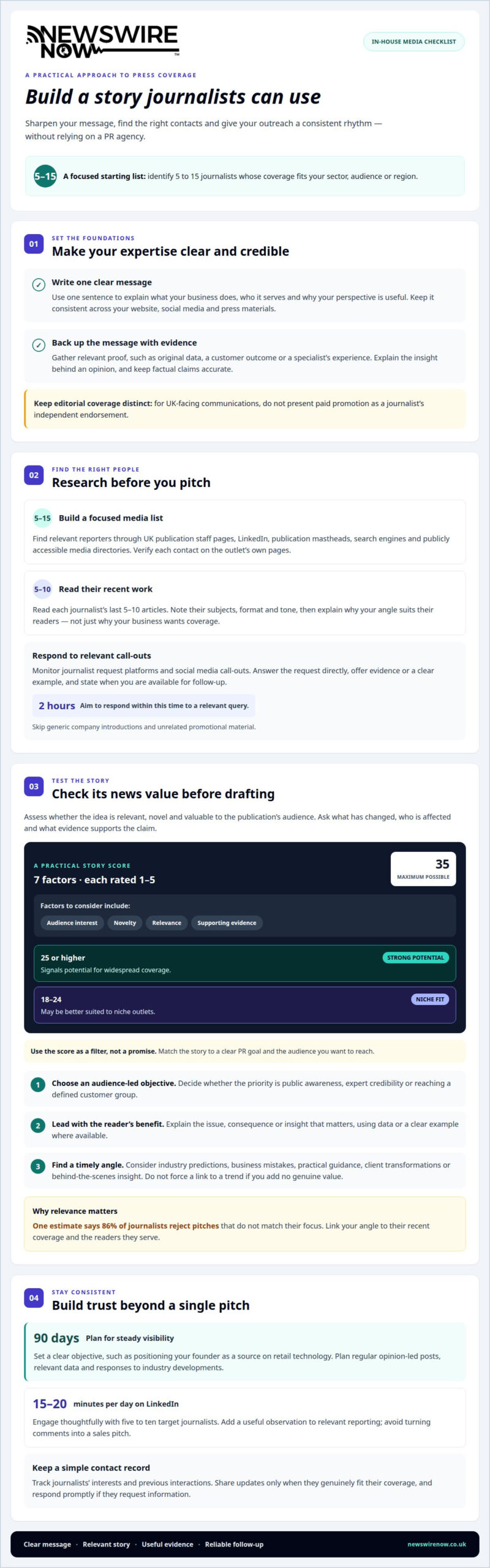
- Define one clear message. Write a sentence explaining what your business does, who it serves and what makes its perspective useful. For example: “We help independent retailers reduce food waste through better stock forecasting.” Use this statement consistently across your website, social media and press materials.
- Choose proof that supports your message. List the evidence behind your expertise, such as original data, a customer outcome or a specialist’s experience. A founder discussing supply-chain changes, for instance, should share the insight behind the opinion. Accurate, specific evidence builds credibility and gives journalists something useful to assess.
- Set a practical visibility plan. Map out a 90-day programme with a clear objective, such as positioning your founder as a source on retail technology. Plan regular opinion-led posts, relevant data and responses to industry developments. A consistent pattern helps brands demonstrate expertise beyond a single press announcement.
- Build relationships on LinkedIn. Spend 15 to 20 minutes per day engaging thoughtfully with five to ten target journalists. Comment on relevant reporting with a useful observation, not a sales pitch. If a journalist covers retail staffing, add a concise example from your field rather than asking them to promote your business.
- Maintain contact beyond the pitch. Track each journalist’s interests and previous interactions in a simple record. Share a genuinely relevant update when your expertise fits their coverage, and respond promptly if they request information. Over time, useful social media contributions and reliable answers can establish relationships that support future conversations.
How do journalists find stories?
Journalists look for stories that serve their audience, offer fresh information and fit their coverage. Find relevant contacts through call-outs, publication staff pages and targeted research, then explain clearly why your story matters.
-
Find journalist requests and call-outs
Monitor journalist request platforms and social media call-outs, responding only when your expertise fits the brief. Answer the request directly, provide evidence or a clear example, and say when you’re available for follow-up. Aim to respond within two hours of a relevant query being posted. Avoid generic company introductions and unrelated promotional material.
-
Find relevant journalists and publications
Search UK publication staff pages and LinkedIn for journalists covering your sector, audience or region. Build a focused list of 5 to 15 contacts, then read each journalist’s last 5-10 articles before pitching. Note their subjects, format and tone. A personalised email should explain why your story suits that journalist’s readers, rather than simply describing your business.
-
Use free media tools and directories
Use LinkedIn, search engines, publication mastheads and publicly accessible media directories to identify outlets and reporters. Search for your topic alongside terms such as “journalist”, “editor” or “contact”, then check the reporter’s recent bylines. Free tools can help you build an initial list, but verify each contact on the outlet’s own pages before pitching.
-
Assess newsworthiness and journalistic criteria
Before pitching, test whether the story is relevant, novel and valuable to readers. Ask what has changed, who is affected and what evidence supports the claim. One estimate says 86% of journalists reject pitches that don’t match their focus, so link your angle to their recent coverage. Build relationships by sharing useful expertise and responding reliably, not by repeatedly asking for visibility.
What Makes a Story Newsworthy?
Set a clear PR goal before choosing your angle. Then assess whether your story offers a target publication’s audience something timely, distinctive and useful.
Assess an announcement’s newsworthiness
Score the story before drafting press releases. Rate it from 1 to 5 across seven factors, considering audience interest, novelty, relevance and supporting evidence. A total of 25 or higher signals strong potential for widespread coverage; a score between 18 and 24 may suit niche outlets better. Treat this as a practical filter, not a promise of media coverage.
Connect the story to a specific PR goal. If you want to reach specialist buyers, prioritise an industry publication over broad exposure. A product launch alone can feel generic, so explain the customer problem it addresses, what has changed and why readers should care now.
Identify timely story angles
Look beyond the announcement for a timely angle. Consider industry predictions, business mistakes, practical how-to guidance, client transformations or behind-the-scenes insight. For example, a new energy-saving service could support commentary on growing demand for efficient buildings, provided the claim is backed by clear evidence.
Track relevant developments and prepare expert commentary when a story breaks. Newsjacking opportunities can be time-sensitive, so respond while the topic remains active. Avoid forcing a connection to a trending event if your information adds no genuine value.
- Choose an audience-led objective. Decide whether the priority is public awareness, expert credibility or reaching a defined customer group. This determines which publications and story angles deserve attention.
- Lead with the reader’s benefit. Replace “our company has launched” with the issue, consequence or insight that matters to readers. Use data or a clear example to make the angle concrete.
- Match the format to the story. Offer original insight for commentary, practical steps for a how-to, or a documented outcome for a client transformation. Keep claims accurate and the evidence easy to understand.
Pitch response and follow-up practices
A strong pitch makes the story easy to assess and act on. Keep the release accurate, the email relevant and every follow-up useful.
-
Personalise concise email pitches
Write a pitch of 100 to 150 words, with a subject line under 10 words. Refer to a specific recent article and explain how your information serves that publication’s audience. Offer a clear interview opportunity, useful data or a concise expert comment. For a press release, use a direct headline, an opening paragraph covering who, what, where, when and why, supporting detail, a company description and contact details. Add a relevant quote and explain the story’s public impact.
Send pitches Tuesday to Thursday between 9:00 AM and 11:00 AM. Keep the email focused on one feature angle, rather than attaching material that doesn’t support it.
-
Follow up on pitches
Record the date, journalist and angle for every email, then wait three to five days before following up. Send one brief message in the original thread, restating the story’s relevance and offering any extra detail that could help. For a breaking story or trending moment, follow up after 24 hours instead, while the subject remains current.
Give the journalist time to respond. If there’s no reply, don’t keep sending the same pitch. Move on and preserve the relationship for a genuinely relevant opportunity.
-
Avoid pitching mistakes and risks
Check every figure, quote and factual claim before sending. Don’t promise the same exclusive content to multiple publications at once, exaggerate evidence or present a sales announcement as independent news. A generic email to unrelated journalists gives them little reason to consider your story.
Keep follow-ups measured, with two as the recommended maximum. If the journalist declines or doesn’t respond, respect their time. Focus your next pitch on a different, relevant angle rather than resending the same material.
Once your announcement is accurate and ready, prepare it for press release distribution as a further route to media visibility.
Newswire Now Media Group: Single Press Release Distribution
Newswire Now Media Group’s Single Press Release Distribution offers a structured route for sharing a finished announcement when you want broader distribution beyond direct journalist pitching. Releases receive editorial review before distribution to more than 500 trusted news outlets across 27 industry sectors and 37 professions.
The service includes guaranteed placements and a comprehensive pickup report within 48 hours. Its independent media network also includes over 40 owned publications reaching millions of readers worldwide. This can complement your own outreach, particularly when you have a timely, accurate release ready to circulate and want reporting on media pickups.
For planned announcements, Multi-release Distribution Bundles can support a regular release schedule, while Editorial Review helps prepare your release for distribution. Contact Newswire Now Media Group to discuss your press release distribution needs.
Turn your next story into a clear media plan
Turn this approach into a repeatable media programme. Choose the announcement or expert insight that best supports your business priorities, then decide whether direct pitching alone offers the reach and reporting you need. Keep the angle focused on the audience, and use each journalist interaction to improve future outreach.
Newswire Now Media Group offers Single Press Release Distribution for standalone announcements, Multi-release Distribution Bundles for planned releases and Editorial Review for release material. These services can complement your journalist relationships, providing a defined distribution route as you continue developing direct media contacts. For businesses getting press coverage without a PR agency, distribution can be one part of a wider communications plan.
Choose the format that fits your next announcement, whether it’s a single timely story or a planned sequence of releases. Contact Newswire Now Media Group to discuss your distribution needs and take the next step with confidence.
Frequently Asked Questions
Can you get press coverage without a PR agency?
Yes, getting press coverage without a PR agency is achievable if you have a credible story and can manage outreach consistently. A specialist founder, for example, could offer informed commentary on a change affecting their sector. The work involves finding the right editorial fit, preparing useful supporting material and responding promptly to enquiries. You can also use a distribution service to circulate a prepared announcement.
What publications can I get featured in?
You can approach national newspapers, broadcasters, trade publications, professional titles and relevant online outlets. The best fit depends on your story and the readers you want to reach. A new food-waste initiative, for example, might interest hospitality trade media as well as broader sustainability publications. Look for outlets that regularly cover your subject and whose readers could act on your information.
When should I hire a PR agency instead of doing PR myself?
Consider agency support when media work requires specialist capacity your team cannot sustain, such as during a complex launch, a sensitive issue or a campaign involving several audiences and markets. In-house outreach can suit businesses with a clear spokesperson and time to manage press activity. Compare the proposed work with your goals, internal workload and need for strategic advice.
How can a UK business get press coverage without a PR agency?
Choose a spokesperson who can explain the issue clearly, then prepare a concise biography, approved images and supporting evidence. For example, an engineering firm could offer a technical expert and a customer case study to a journalist covering infrastructure. Keep these materials organised so your team can answer requests accurately and quickly, and record which angles and contacts you’ve already approached.
What makes a story newsworthy to UK media?
A story is stronger when it shows meaningful change, affects people beyond the business or offers evidence that challenges a familiar assumption. An employer’s training initiative may interest a publication if it demonstrates a wider workforce trend, not simply because a programme has launched. Journalists also consider whether claims are substantiated, the timing is relevant and an informed spokesperson is available.
How much does DIY media outreach cost compared with hiring a UK PR agency?
DIY outreach avoids agency fees, but still takes staff time for research, writing, pitching and follow-up. Other possible costs include photography, press materials and media-monitoring tools. Agency fees vary with the scope and duration of the work, so compare proposals with the time your team can commit and the expertise required. Assess the total investment, not just the quoted fee.
Ready to get your story published?
Distribute your press release across 500+ trusted media outlets — with editorial review and a full pickup report within 48 hours.
Send Press Release →