
Press Release for Winning an Award: Example Cases and Key Details

An award announcement earns attention through its evidence, not the trophy alone. A press release for winning an award should focus on one award, run to 300 to 500 words and state who won, what they won and which organisation granted it. A concise quote and concrete supporting facts help explain why the recognition matters.
It’s natural to want the achievement to speak for itself, but clear details help journalists understand its significance and report it accurately. This guide explains what to include in a press release for winning an award, how the awarding organisation and its judging process can shape coverage, and when to publish. You’ll also learn how to structure the announcement so the award, its evidence and its relevance are easy to find.
Key Takeaways
- Make the award’s news value clear by linking the achievement to a specific business outcome or industry insight.
- Explain who granted the award and how the judges selected the winner to give readers useful context.
- Plan publication around when the win becomes public, and make the announcement timely and relevant to journalists.
- Build a clear release structure, with a focused headline, supporting evidence and a quote that explains the award’s impact.
What Is an Award Announcement Press Release?
An award announcement press release turns recognition into a clear, usable news story. Keep it to one award and around 300 to 500 words, with the winner, award name and granting organisation near the start. A focused announcement helps editors identify what happened and why it may be newsworthy.
Use the award as evidence, then explain why it matters. Add one or two concrete facts about the work recognised, such as a product result or community project. Describe how the entry was judged when that detail gives readers useful context. Avoid broad claims of excellence that the announcement cannot substantiate.
Company example: A fictional engineering firm wins a sustainability award for a new production process. Its release names the award and explains the process’s environmental purpose. That gives trade editors a specific story, rather than a bare claim that the firm is a leader.
Employee example: An employee at a fictional design studio receives an industry award. The studio announces the achievement, describes the work recognised and gives the employee’s role. Editors get a named person and a clear account of the contribution behind the award.
Tailor the angle to the outlet. For local media, connect a company or employee’s achievement to nearby jobs or a community project. For national or trade media, foreground the industry impact, innovation or wider relevance. Keep the award facts consistent in every version.
Check the publication’s editorial calendar before choosing an angle. A technology award may suit an innovation feature, while a business award may fit a business section. Send the announcement while the win is timely and ahead of relevant coverage deadlines.
Structure the release with a headline of 70 to 80 characters, a direct opening, supporting detail and contact information. Use a short quote from the winner to explain the award’s impact, not simply their excitement. A named organiser’s quote can add context about the judging criteria; attribute both quotes accurately and obtain approval before publication.
How Important Is the Awarding Organisation in Media Coverage?
The awarding organisation helps journalists judge what an accolade signals. A recognised name, clear category and transparent selection process give an announcement useful context. For example, the Stevie Awards recognise achievement across more than 70 countries, so naming the organisation helps explain the award’s reach. That context is an opportunity to show why the achievement matters, rather than relying on the word “award” alone.
Explain the awarding organisation’s role and the award’s methodology in a clear section of the release. State whether entries were judged by an expert panel, through peer review, against a scoring system or against competitive benchmarks. Include the category and criteria, then explain how the winning work met them. Don’t present an award as an endorsement beyond what its stated criteria support.
The judging process gives the claim substance. The European Beer Challenge example describes an international jury of 100 experts judging entries. That detail helps readers understand who assessed the work and the scale of the panel. For a real announcement, name judges only when their identities are public and relevant; explain their expertise without implying they endorsed the business outside their judging role.
To verify details and avoid misleading claims, check the winner’s name, award title, category and result against the awarding organisation’s announcement or official records. Use the organiser’s exact wording for distinctions such as finalist, commendation or winner, and describe only the criteria it actually applied.
Show why the business won with evidence linked to the judging criteria. A fictional service company recognised for customer care could cite documented service improvements and explain how they align with the award’s published standards. This connects the judging to the company’s work and gives journalists a specific reason to cover the result.
For another example, IndieFEST Humanitarian Award winners are selected from hundreds of entries throughout the year. Naming the organisation and selection context helps readers understand the award’s scope, but it does not replace evidence about the winner. Once the award claim is precise, distributing the announcement to relevant media can be the next practical step.
Timing publication after the award ceremony
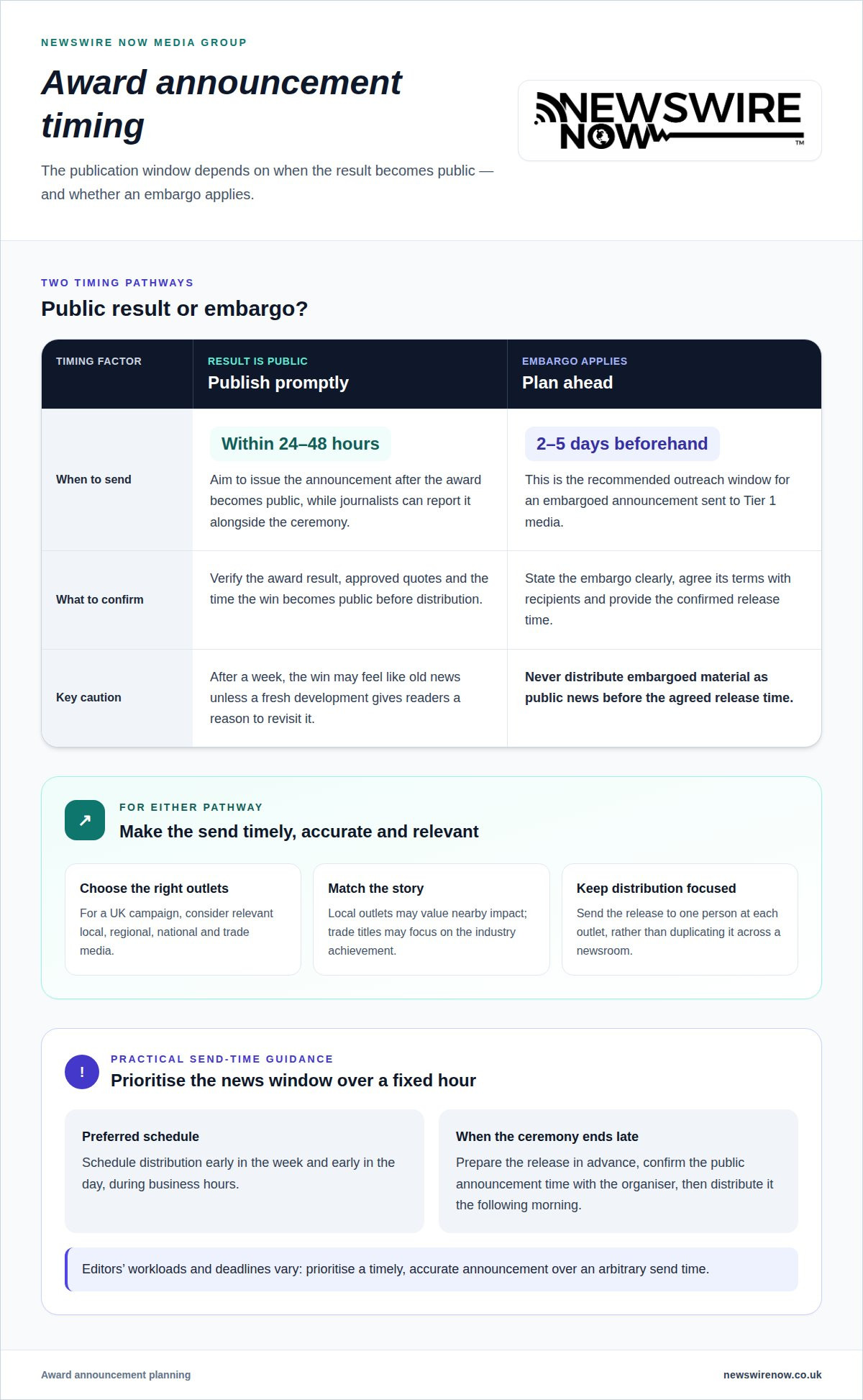
Publish while the result is still timely. Aim to issue the announcement within 24 to 48 hours of the award becoming public, when journalists can report the news alongside the ceremony. After a week, the win may feel like old news unless a fresh development gives readers a reason to revisit it.
If the organiser sets an embargo, plan outreach before the public announcement. The recommended window for sending an embargoed announcement to Tier 1 media is two to five days beforehand. State the embargo clearly, agree its terms with recipients and provide the confirmed release time. Never distribute embargoed material as public news before that time.
For a UK campaign, send the release to relevant local, regional, national and trade outlets. Match the story to each outlet’s readership: a local paper may value a nearby winner’s impact, while a trade title may focus on the industry achievement. Send it to one person at each outlet, rather than duplicating the email across a newsroom.
Schedule distribution early in the week and early in the day, during business hours. Editors’ workloads and publication deadlines vary, so prioritise a timely, accurate announcement over an arbitrary send time. Confirm the award result, approved quotes and release timing before distribution, particularly if the ceremony ends late.
Example: A fictional manufacturer wins an award at an evening ceremony. Its communications team prepares the release in advance, confirms the public announcement time with the organiser and distributes it the following morning. The result is a timely story with verified details, rather than a rushed draft sent before the winner is public.
In another scenario, a national charity learns its award will be announced at a scheduled event. It sends an embargoed release to selected national outlets two to five days ahead, then distributes the public version when the embargo lifts. This gives recipients time to prepare without disclosing the result early.
If an outlet hasn’t responded, follow up after a few days with one concise note and any relevant update. Keep the original recipient and quotes consistent, and make the public timing clear in each version.
Award press release structure
Structure the release so editors can identify the result, assess its relevance and find supporting detail. Apply those priorities throughout, from the opening claim to the contact details.
Use this order to keep the announcement focused:
- Headline: Name the winner and award, using direct wording rather than a slogan.
- Opening paragraph: State who won, what they received and which organisation granted it.
- Supporting detail: Explain the recognised work, the judging criteria and one or two relevant facts.
- Quote and close: Add a useful comment, then provide background and a media contact.
Each section should add information rather than repeat the recognition. For example, a second paragraph could explain how a product met the award criteria, followed by a measurable result or customer example. Put figures in context and attribute claims so readers can distinguish evidence from opinion.
Situation: A fictional Cardiff food producer wins a regional innovation award for a new production method. Action: Its release opens with the award, then explains the method and includes a quote about its practical impact. Result: Trade editors can quickly see both the news and its relevance to food manufacturing.
A quote should add insight, not simply repeat the headline. A winner might explain the challenge the team addressed; an award organiser could clarify what the judges valued. Attribute each statement to its speaker and use approved wording. This gives the winner a credible voice while respecting the organiser’s decision.
Before distribution, read the release as a reader would: check that the opening answers who, what and which award, then confirm each later paragraph adds evidence or context. A clear structure makes the recognition easier to understand. Prepare your award announcement for distribution once the details and quotes are ready.
Newswire Now Media Group: Single Press Release Distribution
Newswire Now Media Group distributes completed award announcements through its Single Press Release Distribution service. Editorial review is included with every package, and Media Pickup Reporting provides a record of reported pickups.
The network includes more than 40 owned publications and reaches millions of readers worldwide. Releases can also be distributed to more than 500 news outlets across 27 industry sectors and 37 professions. This can suit a business seeking coverage beyond its immediate locality, with its award story directed towards relevant media.
Choose a single release for one award announcement. For a planned series, Multi-release Distribution Bundles offer a way to distribute several releases. The right fit depends on your communications plan and how many distinct announcements you intend to publish.
Prepare your award details, approved quotes and final release for distribution. Contact Newswire Now Media Group to discuss distributing your award announcement.
Turn your award into a focused media opportunity
An award can open a conversation with customers, partners and industry peers. Make the recognition part of a wider communications plan, with a clear audience and purpose for each announcement. A press release for winning an award can support that plan when it presents the achievement accurately and gives readers a reason to care.
For one announcement, Newswire Now Media Group offers Single Press Release Distribution. Multi-release Distribution Bundles suit plans involving several announcements, while Editorial Review supports preparation before distribution. Choose the approach that fits your communications schedule and the story you want to share.
Ready to put your award announcement into motion? Contact Newswire Now Media Group to discuss your next release and take the next step with confidence.
Frequently Asked Questions
Can an Award Announcement Support Search Visibility Over Time?
Yes. An award announcement can support ongoing discovery when its details remain available on a relevant, accessible page. Use the official award name, the organisation’s name and the winner’s name naturally in the headline and copy. For example, a prospective customer researching an award or its category may find the announcement. This can aid visibility, but it doesn’t guarantee a particular search position.
How Can Award Announcements Be Reused After Distribution?
Adapt the core facts for channels that reach different audiences. A company could turn a release into a staff update, customer email or social post linking to the full announcement. A sales team might also use the recognition in a presentation, as long as the award’s category and status remain accurate. Give each channel a fresh angle instead of copying the release word for word.
Is It Better to Announce One Award or Group Multiple Awards Together?
Use separate announcements when awards recognise different work, audiences or business units. This gives each achievement room for its own context and evidence. Group awards when they share a clear theme, such as several recognitions for one product at the same event. For example, a company could present related design honours together, while an employee’s individual award may deserve its own story.
What Tone Should Be Used When Writing Press Releases?
Use a confident, factual tone and let the evidence carry the achievement. Replace claims such as “the best in the industry” with precise descriptions of the recognised work and its relevance. A fictional software firm might explain how its accessibility feature addressed a user need without calling itself revolutionary. Keep the language measured, attribute opinions to named speakers and distinguish demonstrated results from future ambitions.
Why Do Award Announcements Matter to the Media?
A well-supported award story gives journalists a timely development to assess, especially when it connects to a wider industry issue. The recognition can introduce a business or employee as a source with direct experience. For example, a company honoured for sustainable packaging could offer practical insight into material choices. The useful media angle is the expertise and evidence behind the award, not the trophy alone.
Award announcement press release headline and opening examples
Use a direct headline naming the winner and award. In the opening, state who won, what they received and which organisation granted it.
Ready to get your story published?
Distribute your press release across 500+ trusted media outlets — with editorial review and a full pickup report within 48 hours.
Send Press Release →