
What Makes a Story Newsworthy: Audience, Impact and Emotion

Your announcement can matter to your organisation and still not be a news story. What makes a story newsworthy for journalists is its relevance to an audience, the scale or consequence of its impact, its timing and a clear reason for people to care. Prominence, novelty and human emotion can strengthen the case, but they don’t replace evidence.
That’s why journalists judge a story by more than how important it feels to the people involved. They consider who it affects, why it matters now and whether the angle suits their audience. A personal story or familiar subject can also draw interest when there is a fresh development and the facts support the pitch.
This article explains how audience impact, emotional connection and prominence shape news value, and how timeliness, relevance and a fresh angle can help a story stand out. You’ll learn what to assess before contacting journalists and how to present a credible, useful reason for coverage.
Key Takeaways
- Show the human consequence behind an announcement to give readers a reason to connect with it.
- Make clear who is affected and why the story matters to the publication’s audience.
- Prominence can attract attention, but a relevant angle and solid evidence give a story substance.
- Assess timing, impact and freshness before pitching, then shape the strongest angle for the intended outlet.
Human interest and emotional connection
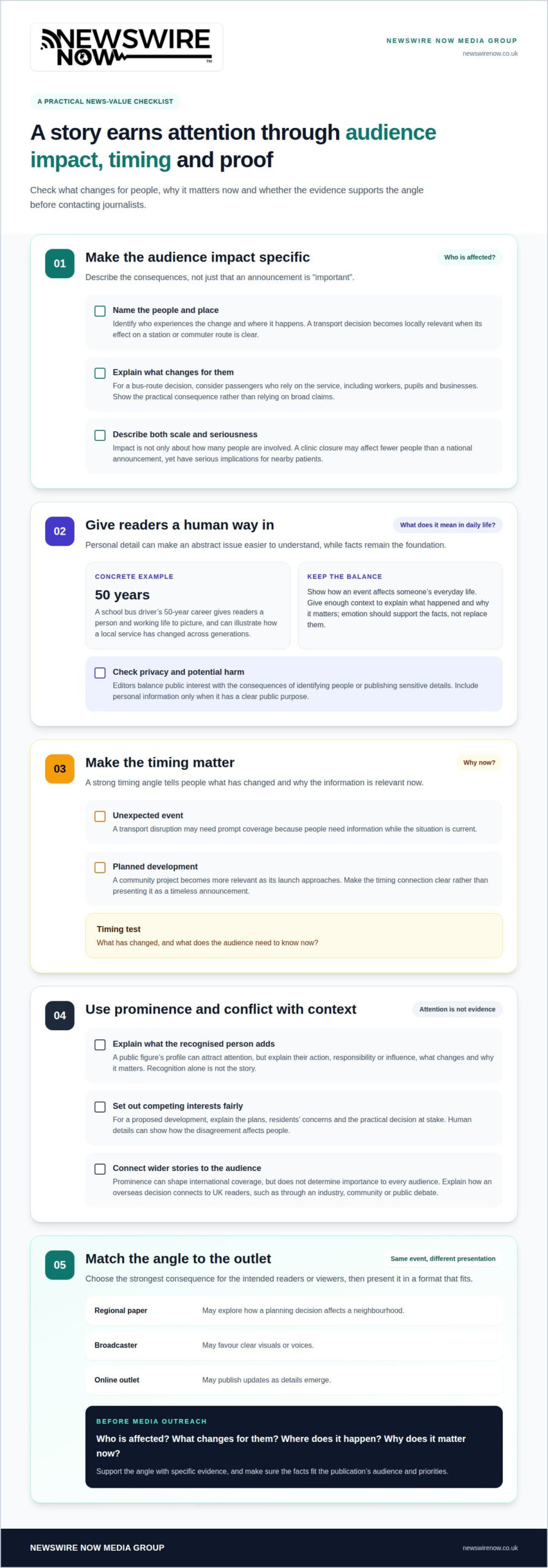
A human story can make an abstract issue easier to understand. A school bus driver who worked for 50 years, for example, gives a reader a person and a working life to picture.
Human-interest storytelling
Human-interest storytelling centres on a person’s experience, rather than presenting an issue only through figures or institutional statements. The school bus driver’s 50-year career could illustrate how a local service has changed across generations. For readers, that personal detail provides a concrete way into a wider subject. Editors may also use human-interest stories to balance other coverage, giving a publication a range of perspectives.
Emotional connection
Human-interest elements create an emotional connection by showing how an event affects someone’s daily life. A story about a new community service, for instance, becomes more tangible when it explains what changes for a named resident. That personal perspective may engage readers beyond those directly involved. Emotion should support the facts, not replace them: give readers enough context to understand what happened and why it matters.
Timeliness matters because readers want information that is relevant now. An unexpected event, such as a transport disruption, may need prompt coverage; a planned community project becomes more relevant as its launch approaches. A strong timing angle explains what has changed and why the audience needs to know now.
Conflict and controversy can raise news value by exposing competing interests, while human-interest details show how the disagreement affects people. A dispute over a service, for example, becomes more meaningful when coverage explains who relies on it and what each side says.
Editors balance public interest, privacy and potential harm. They weigh a story’s importance against the consequences of identifying people or publishing sensitive details. In a report about a family affected by an incident, context may help readers understand the issue, while unnecessary personal information could cause further distress. Include details only when they have a clear public purpose.
Impact on a specific audience
A story’s impact depends on who experiences the change and what follows. A decision affecting bus routes, for example, matters to passengers who rely on those services. Wider effects may include changes to journeys for workers, pupils and businesses. Naming the affected groups makes the consequences clear, rather than relying on vague claims about importance.
Newspapers, broadcasters and online outlets assess audience impact through different formats and editorial priorities. A regional paper may explore how a planning decision affects a neighbourhood; a broadcaster may favour clear visuals or voices; an online outlet may publish updates as details emerge. The same event may suit each, but its angle and presentation should fit the intended readers or viewers.
Proximity matters because people often care most about events that affect their area. A national transport announcement becomes locally relevant when a reporter explains its effect on a railway station or commuter route. Specific evidence, such as a named project or affected service, connects the wider issue to residents’ daily lives.
Audience impact is about consequences, not just the number of people involved. A change affecting a small group may still matter if it alters access to a vital service. A clinic closure, for instance, may affect fewer people than a national policy announcement but have serious implications for nearby patients. Explain both the scale and the nature of the effect.
Conflict can sharpen an angle, but audiences need more than opposing statements. For a proposed development, explain the plans, residents’ concerns and the practical decision at stake. This context may connect a local story to a national discussion about housing, without suggesting that one dispute represents the whole country.
Before outreach, match the story’s strongest consequence to the publication’s audience. Identify who is affected, what changes for them, where the impact occurs and why it matters now. After coverage, media pickup reporting can help show where a story appeared, adding a practical view of its reach.
Prominent people and elite countries
Prominence can bring a story into wider view, but it does not explain its full importance. A strong angle shows why the person or place matters to the audience.
Prominent people
Prominent people are those whose public roles or established profiles attract attention. News involving celebrities, influencers and politicians may prompt coverage because readers recognise their names. A politician announcing a policy, for example, may interest people beyond those directly affected. But recognition alone is not the story: explain what the person has done, what changes and why it matters now.
Prominence of people involved
The people involved can raise an event’s profile when their role connects it to a wider issue. A campaign led by a well-known public figure, for example, may attract interest beyond its usual supporters. Ask not only who is involved, but what their involvement adds. Their expertise, responsibility or influence should clarify the event’s significance, not replace evidence.
What makes a person or event prominent enough to be newsworthy? Public recognition, relevance and influence all contribute. A senior politician’s decision may affect public services, while a celebrity’s involvement may bring attention to a cause. Either way, the pitch needs to explain the decision, action or consequence behind the name.
Prominence also shapes international coverage. Events involving influential countries may attract more attention than comparable events in developing countries. That pattern can affect which stories are covered, but it does not determine their importance to every audience. For UK readers, explain the connection: a policy decision abroad might affect a UK industry, community or public debate.
Novelty can strengthen a story about a prominent person. A familiar politician making an unexpected announcement combines recognition with a fresh development. By contrast, routine activity by a well-known figure may offer little new information. Before outreach, identify what has changed and why this person or event helps readers understand it. Prominence attracts attention; relevance and evidence give that attention substance.
Assessing news value before media outreach
News values help journalists judge which events merit coverage and how prominently. Galtung and Ruge’s model, developed in 1973, offers one framework for assessing a story’s appeal. For anyone asking what makes a story newsworthy for journalists, the practical test is whether its strongest angle matters to a defined audience.
Novelty and surprise
Novelty is the new or unusual element that distinguishes a story from familiar coverage. A meaningful development gives readers a fresh reason to pay attention. Journalists consider whether an event is unexpected, rare or significantly different from what came before. A routine council meeting may offer little news value, while an unexpected decision affecting a service provides a clearer angle.
Surprise and unusualness add value when they reveal something significant, not simply because an event seems strange. Ask what has changed, what evidence supports the claim and why readers should care now. A fresh insight into a familiar issue may be more useful than an unusual detail with no wider consequence. To assess what makes a story newsworthy for journalists, identify the new information and explain its relevance.
Digital metrics and news value
Digital metrics, such as sharing and discussion, can signal online attention. They may help journalists spot topics gaining interest, but attention alone does not establish public importance or verify a claim. A widely shared post is not automatically reliable news, so reporting should distinguish reach from evidence.
Social media can offer leads, eyewitness accounts and public responses. Journalists still need to establish what happened and assess the evidence. Posts about a road closure, for example, may point to a developing story; its cause and consequences determine the substance.
Before contacting journalists, assess the story’s evidence, timing, impact, relevance and freshness. Then summarise the strongest angle and support it with observable facts. If the claim rests only on online attention, add verified details or focus on what the discussion reveals.
Use social media marketing to support informed discussion around a story, while keeping its news value grounded in evidence and relevance.
Newswire Now Media Group
Newswire Now Media Group helps organisations move a well-supported story from news-value assessment to media distribution. When your announcement has a clear audience, timely angle and evidence behind its claims, Single Press Release Distribution can place it before media outlets. Editorial Review adds a review before distribution, and Media Pickup Reporting shows where the release has appeared. For several announcements, Multi-release Distribution Bundles offer another distribution option.
These services support media outreach, but they do not determine whether journalists will cover a story. News value still depends on relevance, impact, timing and credible information. If your story is ready for distribution, contact Newswire Now Media Group to discuss the next step.
Turn a strong story into your next step
A well-founded story gives you a clearer basis for media outreach. Before proceeding, make sure its central claim is supported, its angle is easy to explain and its relevance to the intended audience is clear. Understanding what makes a story newsworthy for journalists helps you focus on substance instead of relying on attention-grabbing language.
When your story is ready to share, Newswire Now Media Group offers Single Press Release Distribution and Multi-release Distribution Bundles. Editorial Review is part of the process. These services help organisations prepare announcements for media distribution, with the story’s evidence and relevance at the centre.
Take the next step with a clear account of what has happened, who it matters to and why now. Contact Newswire Now Media Group to discuss your media distribution needs and move your story forward with confidence.
Frequently Asked Questions
What is newsworthy?
A story is newsworthy when its facts give the public a meaningful reason to know about an event or development. A factory closure, for example, may merit reporting if it affects local employment and supply chains. A routine internal appointment may have little wider relevance unless it signals a major organisational change. The distinction is public significance, not simply an organisation’s desire for attention.
What are the main news values journalists use to judge a story?
Common news values include timeliness, relevance, impact, proximity, prominence, conflict and novelty. They are editorial considerations, not a fixed scoring system. A court ruling may be timely and consequential, while a newly uncovered detail adds novelty. Journalists also consider whether claims are supported and the story can be explained clearly to the intended audience.
How do impact and the number of people affected influence news coverage?
The number of people affected indicates a story’s reach, but journalists also weigh the seriousness of the consequences. A change to a widely used payment system could disrupt many customers; a single case may also matter if it reveals a wider failure. Explain who experiences the effects, what they are and whether they extend beyond those directly involved.
Ready to get your story published?
Distribute your press release across 500+ trusted media outlets — with editorial review and a full pickup report within 48 hours.
Send Press Release →