
Press Release vs Media Advisory: Which Format Should You Use in 2026?

The longer announcement isn’t always the one that needs a press release. In the press release vs media advisory decision, start with the action you want journalists to take: understand and report a story, or attend an event. Choose the wrong format and useful information can become too detailed to scan or too brief to explain why it matters.
If you’re deciding what to send, match the format to the job. A product launch, research finding or leadership announcement needs enough context to stand on its own, whilst an event invitation should make the essential details easy to find. Timing matters too. Distribution can help circulate a release, but it doesn’t guarantee independent editorial coverage.
This guide explains how the formats differ in purpose, structure, detail and timing, so you can match your message to the response you’re seeking. You’ll learn when to use an advisory, when a full press release is the stronger choice, and how distribution and follow-up fit into a practical media plan.
Key Takeaways
- In the press release vs media advisory decision, focus on the journalist’s next action: report a complete story or attend an event.
- Match the format to your communication need, then adjust the detail and timing accordingly.
- Use a straightforward decision process: set your objective, identify the requested action and select the right format.
- Before sending, check accuracy, contact details, audience relevance and approvals so your communication is ready for journalists.
- Distribution can support a complete press release and provide placement reporting, but placements are distinct from independent editorial coverage.
Press release vs media advisory: what does each format do?
A press release sets out the full news story; a media advisory invites journalists to take an action, usually attending or covering an event. Both are media communications, but they serve different needs. A release gives a reporter context to assess and develop a story. An advisory explains why an opportunity is worth their time and how to take part.
So, the press release vs media advisory choice isn’t simply about how important or large an announcement is. Consider what you’re announcing, which journalists you want to reach and what you want them to do next. If the story can be understood without anyone attending an event, a release may fit. If its value lies in being there to see, hear or experience something, an advisory is more direct.
What is a press release?
A press release is a structured account of an announcement prepared for media consideration. It typically includes a headline, key facts, context, supporting details and contact information. The Press release overview describes its role as a formal communication to the media. In practical terms, a well-organised release gives journalists enough information to assess the news without needing to attend an event.
For example, an organisation announcing published research can use a release to explain the findings, why they matter and who can provide further information. The document should make sense as a complete account, even if a journalist later investigates further or reports only selected details.
What is a media advisory?
A media advisory is a concise notice about a media opportunity, such as a launch event, demonstration, briefing or interview. It prioritises practical details: what is happening, when and where it will take place, and why journalists may want to attend. Include a clear contact route for questions or attendance arrangements.
Unlike a release, an advisory isn’t designed to tell the entire story. Its job is to prompt a response or attendance. A short invitation to a product demonstration, for instance, should make the event’s value and logistics clear without burying them in background information.
Keep the distinction clear: a release supplies the story; an advisory points to an opportunity to cover it. Sending either format, directly or through a distribution service, doesn’t determine an editor’s independent decision to report. Distribution can deliver material to outlets or provide placement reporting, but those outcomes are distinct from independent editorial coverage.
Press releases vs media advisories: timing and content
The difference is clearest in what each document makes easy for a journalist to do. A release provides facts and context to assess a story; an advisory makes an opportunity and its logistics quick to evaluate. TEAM LEWIS offers practical guidance on the timing and content of different media materials, but your schedule should reflect the announcement and the access journalists need.
| Factor | Press release | Media advisory |
|---|---|---|
| Purpose | Explain a substantive announcement. | Invite journalists to an event or media opportunity. |
| Length | Long enough to give a complete, focused account. | Concise, with essential information easy to scan. |
| Detail | Key facts, context and supporting information. | Event details, participants, access and reason to attend. |
| Timing | Share once the announcement and its facts are ready. | Send with enough notice for journalists to consider and plan attendance. |
| Requested action | Assess, develop or report the news. | Respond, request access or attend. |
A release explains the news; an advisory explains the opportunity to cover it, and neither guarantees independent editorial coverage. There’s no universal send-by deadline. Consider when information can be shared, how much preparation the opportunity involves and when the intended audience is most likely to act. A scheduled event may need advance notice; a standalone announcement should be timed around its readiness and relevance.
What belongs in a press release?
Lead with the most newsworthy fact, then explain why it matters. Add supporting detail, relevant context and attributable comments where available. Identify a media contact who can respond to enquiries. Keep claims precise and support factual statements. Promotional filler can obscure the information a journalist needs to assess the story.
What belongs in a media advisory?
Put the opportunity first, followed by its date, time and location or access details where relevant. Name the people involved and explain why the event may interest the media. Make the next step unmistakable: say whether journalists should attend, request access or reply to register, and provide a clear response route. Keep background brief, so it doesn’t crowd out practical details.
Once a complete release is ready, press release distribution can support its delivery to media. Distribution and placement reporting can document delivery outcomes; independent editorial decisions remain separate.
Which format fits your announcement: press release or media advisory?
Choose based on the communication task, not the organisation’s size. Ask whether journalists need the substance of the news explained, or whether they need an invitation and practical details to take part. That distinction makes the press release vs media advisory decision clearer across different announcement types.
A useful test: if the announcement still makes sense without an event, prepare a release. If its value depends on journalists being present, an advisory is usually more direct. A campaign may need both when an event provides access to a substantive story.
When is a press release the better choice?
Use a release for news that benefits from facts, background and explanation. Examples include a new product launch, an organisational change or a significant business development. Journalists should be able to understand what has happened, why it matters and who can provide further information from the document itself. For more on how distribution fits into this process, see this UK press release distribution guide.
A release is especially useful when the announcement has several relevant details or implications that a short invitation cannot convey. Keep the focus on the news and use supporting facts to help media assess its relevance.
When is a media advisory the better choice?
Choose an advisory when attendance or access is central to the opportunity. A press conference, public event, media briefing or interview session all call for clear logistics and a reason to respond. Put the date, time, location or access instructions, participants and media contact where they’re easy to find. A journalist should quickly understand what they can cover and how to arrange attendance.
Some announcements call for a coordinated approach. If an event includes a major organisational announcement, for example, an advisory can invite journalists to attend, whilst a separate release provides the fuller account for those who cannot. Keep each document focused on its job rather than sending two versions of the same message.
- Need to explain the news? Use a press release.
- Need journalists to attend or respond? Use a media advisory.
- Need to explain the news and offer an event opportunity? Use both, with distinct purposes.
Distribution can support a complete release when broader delivery is part of the communication plan, but it doesn’t determine whether an editor reports the story. Choose a format that makes the news or opportunity easier to assess, rather than implying a particular editorial outcome.
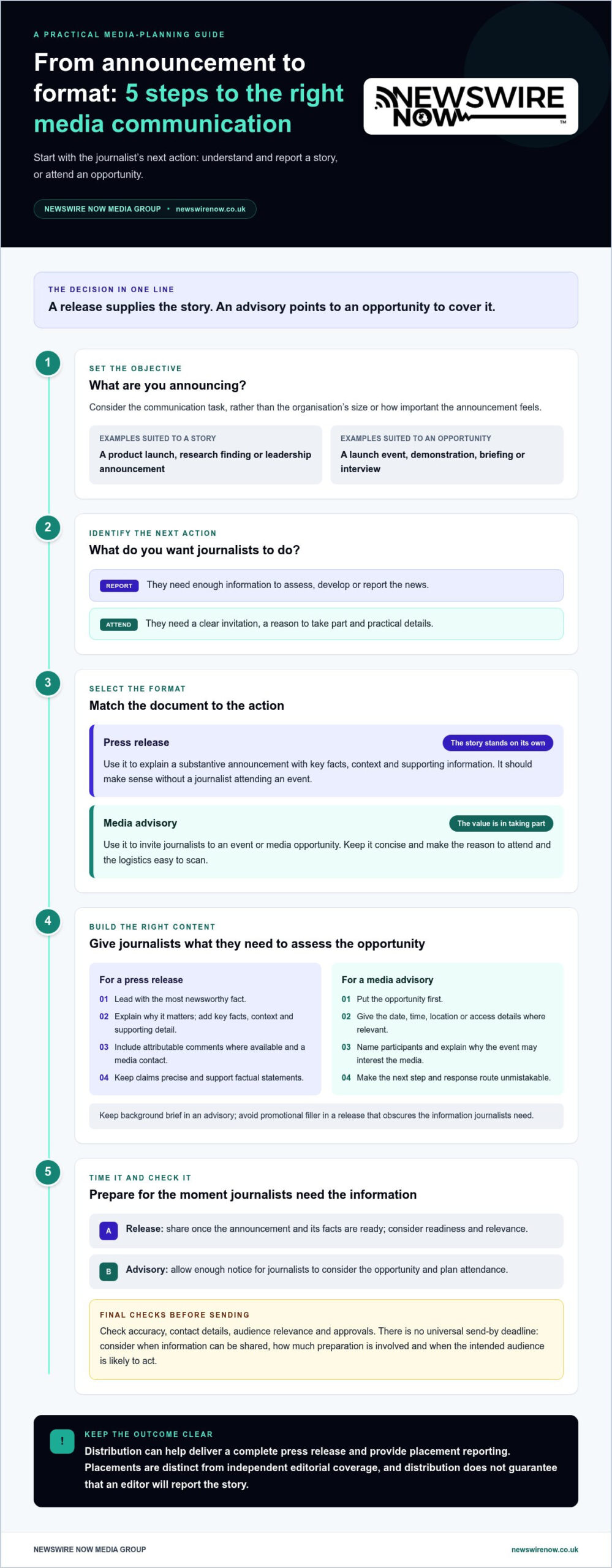
How to choose and prepare the right media format
Use a short decision process to choose the format, then check that the finished material serves its intended audience. This keeps the press release vs media advisory decision focused on the outcome, rather than habit or document length.
- Define the objective. Decide whether you need to communicate news, attract media attendance or achieve both.
- Identify the action. Should journalists assess and report information, attend an event, request access or respond to an invitation?
- Assess the detail. If the story needs background, evidence or explanation to make sense, prepare a release. If logistics and access are the priority, an advisory may be clearer.
- Set the timing. Work back from the announcement or event, allowing enough time for review, preparation and a response.
- Select the format. Choose the document that makes the requested next step unmistakable. If the campaign has two distinct aims, consider separate materials for each.
Use press release templates and examples for structural inspiration, but treat a template as a framework, not a substitute for checking that the message fits the announcement.
A practical format-selection checklist
Before sending, ask whether the priority is informing journalists about news or securing attendance and a media response. Check that the story includes enough background and evidence to be understood, and that the format makes the next step obvious to its intended media audience. An advisory shouldn’t become a shortened release packed with background; a release shouldn’t read like an event invitation with the story missing.
- Are names, dates, figures and claims accurate and supported?
- Is there a clear media contact with current contact details?
- Is the information relevant to the intended audience?
- Have the right people reviewed and approved the material?
Timing, follow-up and common mistakes
Plan around the announcement or opportunity. An event may need advance notice so journalists can consider attendance; a standalone release should be ready when its facts can be shared. Avoid a one-size-fits-all deadline. Follow up with a relevant, factual point or clarification, and don’t assume a journalist has seen the original message. For broader outreach context, read this guide to getting news coverage.
Once your announcement is ready as a full release, explore press release distribution as a practical way to support its delivery.
When distribution supports a press release: and what it cannot promise
Distribution can support a communication plan when you have a complete press release and want to circulate it beyond your direct media contacts. It can extend delivery across a network and provide placement information, making it a practical option for a standalone announcement. It doesn’t replace choosing the right format: an advisory invites media to an opportunity, whilst a release carries the fuller account.
What distribution can and cannot achieve
Keep three outcomes separate: distribution means sending the material; a placement means it appears in a publication; independent reporting means an editor or journalist chooses to cover the story. Distribution can deliver placements and reporting, but it can’t guarantee that a journalist will find the announcement relevant, investigate it or publish independent coverage. Editors retain control over their coverage decisions.
This distinction matters when weighing up press release vs media advisory. A release is suited to distribution as a complete account of news. An advisory serves a different purpose, prompting journalists to attend, request access or respond. Sending either document can support media outreach, but neither dictates the editorial outcome.
A distribution route for a finished press release
For an announcement that’s ready as a full release, Newswire Now Media Group provides editorial review and distribution through an independent network of more than 40 owned publications and more than 500 trusted news outlets across 27 industry sectors and 37 professions. The service includes guaranteed placements, a pickup report within 48 hours and a money-back guarantee. These service guarantees are distinct from independent editorial endorsement or reporting.
Editorial review is part of preparing a release for distribution. It doesn’t mean that the distributor creates the announcement or that an outlet will publish independent reporting. A clear, accurate release remains essential: distribution can carry it through a network, whilst relevance and editorial decisions shape whether it becomes a story.
If your announcement is ready as a press release, explore press release distribution as a practical next step.
Choose your format, then move your announcement forward
The key to the press release vs media advisory decision is the action you want from journalists. Use a press release when your news needs context and a complete account; choose an advisory when attendance, access or a timely response is the priority. If an event also carries a substantial announcement, each format can serve a distinct role.
Once your announcement is ready as a full release, distribution can support its delivery, but it doesn’t determine whether an editor chooses to report independently. Newswire Now provides editorial review and distributes through an independent network of more than 40 owned publications and more than 500 trusted news outlets across 27 sectors and 37 professions. A pickup report is provided within 48 hours.
Ready to take the next step with your announcement? Explore press release distribution and put your finished release on a clear path to media outlets. With the right format and a focused message, you can make your next communication more purposeful.
Frequently Asked Questions
What is the main difference between a press release and a media advisory?
A press release tells the full story of an announcement, whilst a media advisory invites journalists to attend or respond to a media opportunity. A release provides key facts and context so the news can be assessed on its own. An advisory prioritises practical details, such as what is happening, when and where. In the press release vs media advisory choice, focus on the response you want from journalists.
When should you send a media advisory instead of a press release?
Send a media advisory when journalists need to attend, request access or respond to an upcoming opportunity. It suits a press conference, event, briefing, demonstration or interview session where being present adds value. Include the essential logistics and a clear reason to take part. If the announcement also needs background and supporting facts to make sense, a release may be more suitable, either alongside the advisory or separately.
Can you send a press release and a media advisory together?
Yes, you can use both when they have distinct jobs. An advisory can invite journalists to an event, whilst a press release provides the full account of the announcement being made there. For example, send an advisory to explain the event and how to attend, then share a release with the substantive news and supporting context. Avoid repeating the same material in both documents without giving each a clear purpose.
Is a media advisory shorter than a press release?
Usually, yes. An advisory is designed to be concise, with the event or opportunity, timing, location or access information, participants and response details easy to scan. A press release generally needs more room to explain the announcement, give context and present supporting facts. There’s no need to add background to an advisory simply to make it resemble a release; include only what helps journalists decide whether and how to respond.
Does distributing a press release guarantee media coverage?
Distribution sends a release through a network, and a placement records where material appears; neither is the same as independent editorial reporting. Journalists and editors retain control over whether to investigate or cover a story. Newswire Now provides editorial review, distribution, guaranteed placements and a pickup report within 48 hours. Treat the report as information about pickups, not proof that an outlet independently endorsed or reported on your announcement.
Should an event announcement be a press release or a media advisory?
Use a media advisory if the main goal is to get journalists to attend or respond to the event. Make the date, time, location or access arrangements and reason to attend prominent. If the event includes substantive news that needs explanation, prepare a press release as well. The advisory handles the invitation; the release gives the announcement its fuller context for journalists who attend and those who don’t.
How far in advance should a media advisory be sent?
Choose timing according to the event, the preparation journalists may need and how much notice is practical. For an event with planned attendance, sending the advisory around five to seven days beforehand can provide a useful window, though this isn’t a universal deadline. Complex access arrangements or a time-sensitive opportunity may call for a different schedule. Make sure the date and response details are confirmed before sending.
Ready to get your story published?
Distribute your press release across 500+ trusted media outlets — with editorial review and a full pickup report within 48 hours.
Send Press Release →