
Crisis Communication Press Release Template: A 2026 Guide

A crisis statement doesn’t need to explain everything. It needs to establish what’s verified, what your organisation is doing and what happens next. A practical crisis communication press release template gives you a clear structure when pressure to respond is high, without encouraging you to fill gaps with assumptions.
You may need to communicate before every detail is known, while taking care not to publish inaccurate or insensitive wording. The aim isn’t to rush out a complete account. It’s to share a careful update that acknowledges the situation, explains immediate action and sets expectations for further information.
This guide provides an adaptable statement structure and a process for checking facts, agreeing approvals and preparing distribution. You’ll also learn how to signal what remains under review and when to share another update. Once a statement is approved, press release distribution can support a wider communications plan, but it doesn’t replace speaking directly with affected people.
Key Takeaways
- Use a crisis communication press release template to organise confirmed facts, response actions, a spokesperson and the next update.
- Choose a format that fits the audience: a public press release serves a different purpose from a holding statement, internal message or direct response.
- Adapt the information you lead with to the incident, whether it involves a service disruption, product concern, data incident or workplace issue.
- Set an approval sequence that includes the accountable decision-maker and relevant subject experts before the statement is circulated.
- Use clear placeholders, remove any detail that can’t be verified or approved, then choose distribution channels that fit the audience.
What is a crisis communication press release, and when should you use one?
A crisis communication press release is an approved public update about a significant incident. It gives journalists and other audiences a consistent account of what the organisation can verify, what it is doing and where further information will appear. It’s one tool within a broader response, not a complete record of events or a substitute for action.
Crisis communication covers how an organisation shares information and responds during a crisis. A press release is distinct from a holding statement, which is a brief initial acknowledgement used while facts are being checked. An internal message is for staff or another defined group, while a direct response addresses the needs of affected people individually. These formats can work alongside one another, but they serve different audiences.
When is a public crisis statement appropriate?
Use a public release when journalists or a wider group of stakeholders need an attributable update, such as confirmation that a service has been disrupted or that an organisation is investigating a reported product concern. One approved statement can help prevent conflicting accounts across public channels. If the issue affects only a defined group, a targeted message may be more useful than a public announcement.
Choose the timing and channel according to the incident, audience and facts available. A release can clarify confirmed information, response actions and the next update, but it must not delay emergency response, direct contact with affected people or specialist advice. Where a matter has legal, safety or technical implications, communications should support the relevant response, not replace it.
What should the first response achieve?
The first response should be accurate, clear and considerate. Acknowledge the situation without dramatic or promotional language, state what’s known and identify material details that remain under investigation. For example, if a service interruption is confirmed but its cause isn’t, communicate the interruption and the steps underway without presenting an unverified cause as fact.
- Show concern: recognise the impact on people affected.
- Describe action: explain what the organisation has done or is doing.
- Set expectations: say how further information will be shared.
Only promise a specific time for the next update if the organisation can meet it. A crisis communication press release template can organise these elements, but it can’t verify facts or decide what should be shared. Keep the first statement focused. Publish a fuller account when reliable information is available and approved.
What should a crisis communication press release template include?
A useful crisis communication press release template gives readers a reliable order for essential information without forcing the organisation to claim more than it knows. Keep the statement concise, factual and focused on the people affected. Avoid dramatic wording, blame, speculation and promotional language.
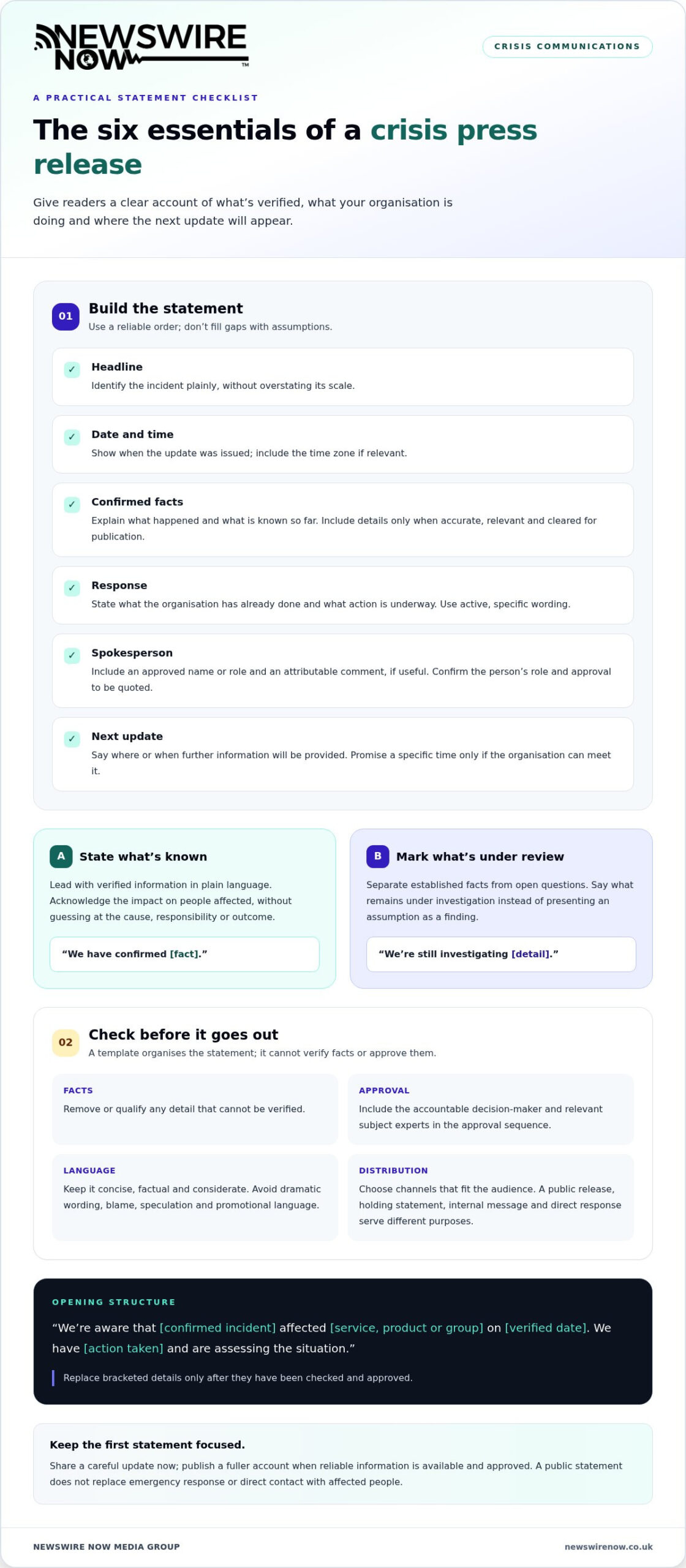
Build the release around these components:
- Headline: identify the incident plainly, without overstating its scale.
- Date and time: show when the update was issued, including the time zone if relevant.
- Confirmed facts: describe what happened and what is known so far.
- Response: state the action already taken and what is underway.
- Spokesperson: include an approved name or role and an attributable comment, if useful.
- Next update: tell readers where or when further information will be provided, if that commitment is realistic.
The opening should quickly identify the incident and the organisation’s response. For example: “We’re aware that [confirmed incident] affected [service, product or group] on [verified date]. We have [action taken] and are assessing the situation.” Replace each bracketed detail only after it has been checked and approved.
How do you write the opening and confirmed facts?
Start with the clearest confirmed information, using plain language rather than internal terminology. Separate established facts from open questions: “We have confirmed [fact]. We’re still investigating [detail].” This tells readers what’s known without presenting an assumption as a finding. Include dates, times, quantities or locations only when they’re accurate, relevant and cleared for publication.
Acknowledge impact without guessing at the cause, responsibility or eventual outcome. For instance, recognise that customers experienced an interruption, but don’t attribute it to a technical fault until that cause is verified. A holding statement is an initial update issued while facts develop. It can confirm awareness, outline immediate action and explain how further information will be shared without trying to answer every question.
How should the response and next update be worded?
Use active, specific language to describe the response: “We have paused [activity] while we review [issue]” is clearer than “The matter is being dealt with.” Name a spokesperson only after confirming their role and approval to be quoted. If naming an individual isn’t appropriate, an approved role-based attribution can still provide accountability.
Choose a next-update channel or time the organisation can meet. If the timing is uncertain, explain where updates will appear rather than promising a deadline. Once the statement has passed fact-checking and approval, professional editorial review and press release distribution can support its planned publication. Press release distribution is a communications step, not a substitute for internal verification or direct contact with affected people.
How should you adapt the crisis press release template to the incident?
Keep the structure of your crisis communication press release template consistent, but adapt the details to the evidence, the people affected and the action underway. A service issue calls for practical customer guidance; a workplace incident needs particular care with personal information. Use the table to identify what belongs in the first public update, then include only facts verified and authorised for release.
| Incident | Audience | First confirmed information | Response action | Update need |
|---|---|---|---|---|
| Service disruption | Customers and other affected users | Which service is affected and its known status | Steps underway to respond or restore service | Where to find practical guidance and further updates |
| Product concern | Customers, partners and relevant stakeholders | The concern reported and what has been verified | Assessment or review steps in progress | How confirmed findings and actions will be shared |
| Data incident | Those affected and wider stakeholders, as appropriate | Only information cleared for public release | Approved response steps, without exposing sensitive details | Where authorised information will be provided |
| Workplace incident | Staff, affected people and wider stakeholders, as appropriate | A concise, approved account that protects identities | Immediate response actions that can be shared publicly | How further information will be communicated |
What changes for a service disruption or product concern?
For a disruption, lead with the affected service, its current status and any confirmed customer guidance. Don’t publish an estimated restoration time unless it has been verified and approved. For a product concern, distinguish the report from established findings. Explain what is being assessed and what steps are underway, without making unsupported safety assurances or claims about the scale of impact.
Keep the language useful and specific. If the cause remains unclear, say it’s under review rather than guessing. Avoid implying that every customer or product is affected unless that scope has been established.
What changes for a data or workplace incident?
These incidents may involve personal or sensitive information, an active investigation or people who could be identified from small details. Share only what has been authorised for public release. Describe response actions at an appropriate level, but don’t expose operational details that could compromise the response or individuals’ privacy.
Don’t speculate about causes, the number of people affected or investigation findings before they’re verified. If a detail can’t be responsibly confirmed for publication, leave it out of the public statement and use the organisation’s authorised channels for appropriate direct communications. The template provides order; careful review determines what should be disclosed.
How do you check, approve and prepare a crisis statement for release?
A clear approval process reduces the risk of publishing assumptions as facts or sending different versions to different audiences. Set the roles before circulating the draft: name one accountable decision-maker, identify the operational lead who can verify what happened, and involve communications and relevant subject experts. For sensitive matters, include authorised specialist review in the organisation’s process. This guidance isn’t legal advice.
Use a disciplined sequence:
- Gather facts: record what’s confirmed, what remains unknown and who can verify each point.
- Draft: structure the statement around the incident, response and information readers need next.
- Verify: check every factual claim against a reliable source or responsible expert.
- Approve: obtain sign-off from the accountable decision-maker and required reviewers.
- Choose channels: align publication with direct stakeholder messages and the organisation’s communications plan.
- Monitor: review questions and coverage to identify material gaps for a later update.
Who should review and approve the statement?
Give one person clear authority to approve the final wording. Operational leads should validate incident details and response actions; communications colleagues should check clarity, tone and consistency. Involve authorised specialists where the subject calls for it, while keeping responsibility for the final decision clear.
Before release, check names, dates, figures, links, quotations and contact details. Confirm that quoted words are approved and links lead to the intended information. Editorial checks can help identify unclear phrasing and inconsistencies; see this guide to press release editorial review. Keep a record of the approved version, who authorised it and its publication time, so teams can refer to one authoritative copy.
How do you choose channels and monitor the response?
Match distribution to the audiences who need the information. A public press release may support a broader update, while people directly affected may need a coordinated direct message as well. Keep wording and timing aligned across the release, the organisation’s own channels and stakeholder communications. Distribution should follow verification and approval, not stand in for either.
After publication, track incoming questions and media coverage. Separate misunderstandings from genuine information gaps, then use material, verified questions to shape the next update. A structured crisis communication press release template supports consistency, but disciplined review and distribution complete the process. Explore press release distribution as a considered step once your statement is approved.
Crisis communication press release template: fill it in and distribute responsibly
Use this crisis communication press release template as a framework, not a script. Replace each placeholder with information that has been verified and approved. Remove any field you can’t substantiate or that isn’t suitable for public release, then adapt the wording to your organisation’s voice and the people who need the update.
What does a usable crisis statement template look like?
Headline: [Organisation] responds to [confirmed incident] on [date]
Date and time issued: [Date, time and time zone]
Confirmed event: [In plain language, state what happened and when. Include only details approved for public release.]
Who may be affected: [Identify the affected group only if verified and appropriate to share.]
Response: [Describe actions already taken and any response currently underway. Don’t speculate about the cause or outcome.]
Spokesperson: “[Insert an approved quote that acknowledges the impact and explains the organisation’s response.]” [Name and role, or approved role-based attribution]
Further information: [Approved contact route or information page, if appropriate.]
Next update: [State the update channel or time only if authorised and realistic.]
Before publication, check every placeholder. Delete anything that can’t be verified, approved or responsibly shared. Remove all bracketed prompts from the final statement. A template helps organise information, but the finished release should sound specific to the organisation and incident, not copied mechanically.
What should happen after the statement is approved?
Choose distribution according to the audience, the purpose of the message and the wider response plan. Coordinate publication with direct updates to affected people and the organisation’s own channels. For practical guidance on aligning social channels with a news announcement, see amplifying news on social media.
Once the statement is approved, editorial review and press release distribution can support a considered publication plan. Newswire Now Media Group provides editorial review, distribution and a pickup report within 48 hours. Distribution is an optional next step, not a replacement for fact-checking, approval or direct communication with affected people. Explore press release distribution as part of your wider communications plan.
Be ready to communicate with clarity
A crisis communication press release template gives your team a practical starting point, but trust depends on what you put into it: verified facts, clear response actions and a realistic plan for further updates. Adapt the wording to the incident and audience, then make sure the right people have checked and approved it before publication.
Once the statement is approved, distribution can help extend its reach as part of a wider communications plan. Newswire Now Media Group distributes through an independent network of more than 40 owned publications and to more than 500 news outlets across 27 sectors and 37 professions. Editorial review and a pickup report within 48 hours support the distribution process, while fact-checking and direct communication with affected people remain essential.
Explore press release distribution as a considered next step for an approved statement. With a clear process in place, your organisation can share updates with greater confidence and keep communication focused when it matters most.
Frequently Asked Questions
What should a crisis communication press release include?
A crisis communication press release should state the incident, the date, what the organisation has verified and what it’s doing in response. Include a headline, an approved spokesperson or role, a suitable contact route and details of where or when readers can expect another update. Keep the opening direct and factual. Leave out any claim that hasn’t been checked, even if it seems likely.
How do you write a crisis press release when all the facts are not known?
Write only what’s confirmed, and be clear about what’s still being investigated. For example, state that a service has been disrupted if that’s verified, but don’t guess at the cause or restoration time. You can acknowledge the issue, describe immediate response actions and explain where updates will be shared. A brief, accurate statement is more useful than a detailed account built on assumptions.
Can you use a standard press release template for every crisis?
Use a consistent structure, but adapt the content to the incident and audience. A service disruption may call for current status and practical customer guidance, while a workplace incident requires particular care with people’s privacy. A data incident may need wording reviewed by authorised specialists. Treat the template as a framework for organising information, not fixed copy to publish unchanged in every situation.
How quickly should an organisation issue a crisis press release?
Issue an update when you have enough verified information to communicate accurately, with timing shaped by the incident, the people affected and the organisation’s response plan. If details are still emerging, an initial holding statement can acknowledge the situation and say what’s being done. Don’t wait for a complete account if a clear update is needed, but don’t publish unverified claims to appear faster.
What should you avoid saying in a crisis statement?
Avoid speculation about causes, blame, unsupported assurances and predictions about outcomes. Don’t minimise the impact, use promotional language or describe unverified information as fact. Take care with personal or sensitive details that could identify someone or affect an active investigation. Check names, dates, figures and quotes before publication, and remove any wording the organisation can’t substantiate or approve.
Should a crisis press release include an apology?
Include an apology when it honestly reflects the organisation’s position and has been appropriately reviewed and approved. Acknowledge the impact on affected people without defensive or conditional wording that could sound dismissive. Pair concern with a clear account of actions being taken. Don’t use an apology to speculate about responsibility or cause; keep those statements grounded in verified information and authorised judgement.
How can an organisation distribute a crisis press release responsibly?
Complete fact-checking and internal approval first, then choose channels that reach the intended audience and fit the wider response plan. Coordinate the release with direct updates for affected people and information on the organisation’s own channels. Monitor questions and coverage to identify gaps for follow-up. If using a distribution service, editorial review and media pickup reporting can support publication, but they don’t replace direct communication or verification.
Ready to get your story published?
Distribute your press release across 500+ trusted media outlets — with editorial review and a full pickup report within 48 hours.
Send Press Release →