How to Increase Company Search Visibility with a Credible News Strategy

What should your company do first to become easier to find in search? A burst of activity may create noise without building lasting discoverability. To increase company search visibility, start with the foundations: useful pages that answer real customer questions, a technically sound website and a clear picture of how people search for your expertise.
If you’re unsure whether to prioritise content, technical SEO or media coverage, that uncertainty is understandable. News can help people encounter and verify your brand, but a press release isn’t a shortcut to higher organic rankings. Its value depends on relevance, credible pickup and how that visibility supports your wider search presence.
This article sets out a practical order of action to increase company search visibility, from strengthening your search foundations and publishing helpful content to using news coverage as one part of a broader strategy. You’ll also learn which signals to track, including coverage outcomes, so you can distinguish measurable progress from assumptions.
Key Takeaways
- Clarify which search channels matter to your audience, and measure organic listings, paid adverts, local results and news coverage separately.
- Use an ordered checklist to increase company search visibility, starting with whether search engines can access and understand your most important pages.
- Match each channel to its purpose: your website builds owned resources, editorial coverage can extend reach, and paid search provides a separate route to visibility.
- Set a baseline, choose relevant queries and review results consistently to see whether your changes are making a difference.
- Before distributing company news, check that the story is newsworthy, relevant to the intended audience and supported by clear reporting.
What does increasing company search visibility actually mean?
Search visibility is how readily relevant audiences can discover a company in results for queries connected to its name, products, services or expertise. To increase company search visibility, assess the different ways your business can appear rather than treating one ranking as the whole picture. Search engine optimisation (SEO) helps improve a site’s relevance and accessibility in organic results. See this overview of search engine optimization (SEO) for background on the discipline.
Visibility isn’t the same as ranking, traffic, leads or brand recognition. A ranking describes a page’s position for a particular query. Traffic records visits, while leads measure actions such as enquiries. Brand recognition is broader: people may know a company without finding it in search. Visibility indicates opportunities to be seen, not whether someone clicks, converts or remembers the brand.
Which search results can make a company easier to find?
Search results can include organic listings, paid adverts, local results and news coverage. A company might appear in organic results for a service query, in a paid placement for a targeted term, or in a news result after relevant coverage is published. Branded searches, which include the company’s name, can also show how easily people find official pages and other mentions.
The layout varies according to the query, device, location and user context. A company can be discoverable through several result types, but those appearances serve different purposes. Record them separately where possible rather than combining them as if they were the same channel. Businesses seeking support to balance these diverse channels effectively often turn to digital marketing specialists such as digital-agency.ae to coordinate their search and advertising presence.
How to establish your current search visibility baseline
Before changing marketing activity, write down priority queries in two groups: branded searches, such as the company name, and non-branded searches, such as the service or expertise a potential customer may look for. Keep the list focused on relevant topics. This gives you a consistent starting point for checking whether the right pages are appearing.
Use Google Search Console to review impressions, clicks, click-through rate and average position for those queries and their associated pages. Impressions indicate that a result was shown; clicks show visits from search. Click-through rate compares clicks with impressions, while average position summarises ranking position across reported appearances. Treat these as related but distinct signals.
Save the date range, query list and observations so later reviews use a comparable basis. Record what the data shows, then keep explanations separate: a change in impressions, for example, doesn’t by itself prove that a particular campaign caused it. A baseline is a reference point for informed decisions, not a promise of future performance.
Build the search foundations that make company content discoverable
Before adding more pages or promoting company news, make sure your important website pages can be found and understood. Google needs to access a page and interpret its content before it can consider that page for relevant results. Technical accessibility lets search engines reach a page; content relevance gives that page a clear reason to appear.
Work through these foundations in order. The Google SEO Starter Guide offers further guidance on making pages easier for search engines to find and interpret.
- Crawlability: Check that key pages load and aren’t unintentionally blocked from search engines.
- Useful pages: Give each priority audience need a focused, worthwhile page.
- Clear structure: Organise related information logically, with descriptive page titles, headings and URLs.
- Internal links: Link relevant pages together so visitors and search engines can follow the connections.
- Measurement: Monitor indexing and search performance, then investigate issues before deciding what to change.
Make important company pages easy to find and understand
Start with the pages that explain what the company does, who it serves and what it knows. Check that each loads correctly on mobile as well as desktop, and review whether settings or technical errors are preventing search engines from accessing it. Use descriptive titles and headings that accurately summarise the page, rather than repeating keywords without context.
Clear navigation helps people reach key information, while contextual links connect related pages. For example, a service page could link to a relevant explanation of the process or a supporting case study. Google Search Console can help identify indexing and performance issues to investigate. A warning is a prompt to check the page, not automatic proof of the cause or the fix.
Create useful content around real search needs
Map genuine audience questions to the right page type: a focused service page for someone comparing options, an expertise page explaining how a process works, or supporting information that answers a practical question. Each page should have a defined business purpose and offer a useful response, not exist solely to target a phrase with search volume.
Strengthen explanations with original evidence, such as relevant examples or documented experience, and name contributors where their expertise supports the information. Avoid thin pages that add little beyond what’s already covered, and remove repetitive keyword use that makes copy harder to read. A smaller set of clear, connected pages is a stronger foundation than a large collection of near-duplicates.
Once these foundations are in place, consider how relevant news might complement them by directing attention to useful company information. If distribution fits your plan, explore press release distribution options as one channel, not a replacement for accessible, valuable website content.
How news distribution can support company search visibility
News distribution can extend a company’s reach beyond its own website. A relevant announcement may appear in news results or lead audiences to discover a company through a publisher’s coverage. That creates additional opportunities for people to encounter the brand, but distribution alone doesn’t guarantee higher organic rankings, more website traffic or valuable backlinks.
Each channel has a different role and should be measured on its own terms:
- Owned website content: The company controls the pages and can build lasting resources around audience needs. Review organic impressions, clicks and relevant on-site actions.
- Earned editorial coverage: A publisher decides whether and how to cover a story. Coverage can introduce the company to new readers and create discoverable mentions. Track confirmed coverage and referral activity where measurable.
- Paid search: The advertiser pays for placements and has more control over targeting and ad copy. Assess paid impressions, clicks and campaign outcomes separately from organic and editorial visibility.
A mention isn’t automatically an endorsement, and a placement doesn’t necessarily include a link. Even when a link appears, its presence alone doesn’t establish a ranking benefit. Treat coverage as a communications outcome first, then assess any search changes using your wider performance data.
What press release distribution can and cannot do
Press release distribution provides a route for sharing company news with relevant outlets and audiences. Its usefulness depends on the announcement having genuine news value and reaching publications whose readers are likely to care. A product development, research finding or significant company update may be more relevant to a particular audience than a routine promotional claim. Organisations operating in regulated or specialist fields, such as healthcare, should also consider whether the distribution network is suited to their sector; a guide to choosing a healthcare news wire service and what to look for in a distribution partner can help clarify the right questions to ask.
Separate what’s confirmed from what’s hoped for. A placement report can document where coverage appeared; it can’t, by itself, prove that rankings improved or that the release caused a change in traffic. Check those outcomes independently. Distribution supports discovery, but it doesn’t replace useful website pages, technical SEO or editorial judgement.
Connect coverage with your wider search strategy
Make sure the pages people may visit after seeing coverage explain the company’s work clearly, provide useful context and offer an appropriate next step. If you share verified coverage through company channels, identify it accurately. Syndicated or distributed content shouldn’t be presented as independent editorial endorsement if it isn’t.
Review coverage alongside relevant brand searches, website activity and the questions your audience is asking. This helps show whether news is contributing to discovery without overstating its effect. For a broader view of how credible coverage can shape perception, consult the article on increasing brand authority with news.
A practical workflow for improving and measuring search visibility
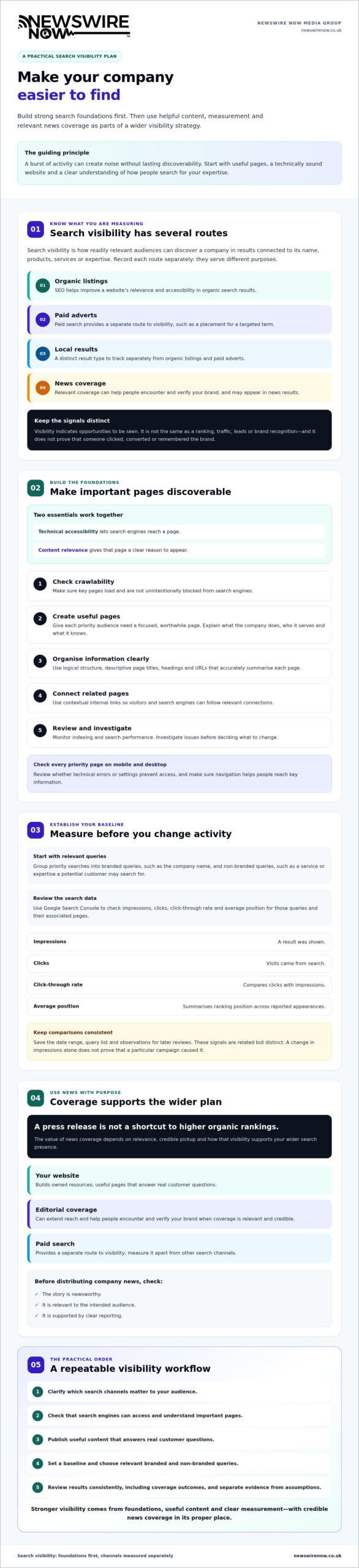
A repeatable process makes it easier to decide what to improve next and assess whether activity is helping. To increase company search visibility, connect each action to a specific audience need and record what changes. Timing alone doesn’t prove cause and effect.
- Choose queries: Select a focused set of branded and non-branded searches that reflect your services, expertise and audience questions.
- Improve pages: Match each query group to the most relevant page. Strengthen its usefulness, clarity and links to related information before creating something new.
- Publish: Record when updated or new content goes live and which audience need it is intended to serve.
- Distribute relevant news: Share news with an appropriate audience when there’s a credible, newsworthy announcement. Log the distribution date separately from website changes. If you plan to extend your announcement’s reach across platforms, understanding social media press release distribution and how it works alongside traditional channels can help you give each channel a clear role.
- Review and refine: Compare results with your starting baseline over a consistent review period, then choose the next action based on the evidence.
Set the baseline before making changes. Choose a review period that suits your publishing and reporting cycle, and keep it consistent for meaningful comparisons. There’s no universal timeframe in which a visibility change should appear.
Choose goals, queries and measures before publishing
Decide what progress means at three levels. For discovery, monitor search impressions, clicks, branded queries and relevant news mentions. For engagement, review click-through rate and referral visits to useful pages. For business outcomes, track meaningful enquiries separately. These measures answer different questions, so don’t treat more impressions as proof of more leads.
Use the same date ranges when comparing periods, and annotate when pages are changed, content is published or news is distributed. A simple activity log helps you interpret patterns later, especially if several marketing changes happen close together.
Review results and refine the next action
Use Google Search Console to examine impressions, clicks, queries and page performance for your selected topics. Where analytics are available, review referral visits and subsequent engagement; tagged links can help distinguish visits from specific distribution or sharing activity. If you receive a media pickup report, use it to verify coverage outcomes, not as evidence of ranking gains.
Measurement rule: Report the observed change, the dates compared and the relevant activity. Don’t assign a cause unless the evidence supports it. Search visibility can shift alongside seasonality, technical changes, other publishing and wider marketing activity. Note these factors, compare cautiously and use the findings to guide the next test rather than claiming certainty.
If a relevant announcement is part of your plan, explore press release distribution as one way to share it with an appropriate audience.
Use credible news coverage as one part of a stronger visibility plan
News coverage is most useful when it supports a wider plan: accessible website pages, helpful content and consistent measurement. It can help people discover a company, but no distribution service or media mention guarantees higher search rankings. Before choosing a provider, assess whether the announcement deserves attention, whether the intended outlets suit its audience and what the service will actually report.
Use this checklist to decide whether distribution is a sensible fit:
- Newsworthiness: Is there a clear announcement, development or finding that offers information of genuine interest, rather than only a sales message?
- Audience fit: Do the outlets and sectors align with the people you want to reach? Ask how distribution choices relate to your subject and intended audience.
- Editorial review: Find out what the review covers and whether it assesses the release before distribution.
- Placement terms: Clarify what any placement guarantee means in practice. Review its scope and conditions, and read any refund terms before relying on them in a purchasing decision.
- Reporting: Ask what the pickup report records, how placements are identified and when you’ll receive it. A report verifies coverage outcomes, not ranking improvements.
Assess whether a distribution service fits your announcement
Newswire Now Media Group distributes editorially reviewed press releases through an independent network of more than 40 owned publications and over 500 trusted news outlets. The outlets span 27 industry sectors and 37 professions. Those figures indicate the network’s stated scale, but scale alone doesn’t establish that a particular release will reach the right readers. Check the relevant sector coverage against your announcement’s subject and audience.
The service includes guaranteed placements and a money-back guarantee, and states that a pickup report is provided within 48 hours. Review the current terms of any guarantee before making a decision, including its scope and conditions. A confirmed placement may support discovery, but it doesn’t guarantee search visibility gains.
Turn coverage into a useful audience journey
Give readers who encounter a story a useful next step. Check that the relevant company page answers likely questions clearly, explains the announcement in context and makes related information easy to find. Share verified coverage through suitable company channels, label it accurately and note referral activity separately from organic search performance.
If concerns about inaccurate or damaging brand information extend beyond a single announcement, an online reputation management decision guide may help frame the wider evaluation. Before deciding whether distribution belongs in your plan to increase company search visibility, compare the announcement, audience fit, editorial process and reporting terms.
Make your next visibility step count
To increase company search visibility, begin with pages that answer real audience questions, then measure how people find and engage with them. Treat credible news coverage as a supporting channel, not a shortcut to higher rankings. Its value depends on audience relevance, the quality of the announcement and what you learn from the results.
Newswire Now Media Group operates an independent network of more than 40 owned publications and distributes releases to over 500 trusted news outlets across 27 sectors and 37 professions. A pickup report is provided within 48 hours. A report can help assess coverage, but it doesn’t prove search ranking gains.
If your announcement has genuine news value and the distribution audience fits, explore Newswire Now Media Group’s press release distribution service to see whether it complements your wider search plan. Build visibility methodically, track what changes and let evidence guide your next move.
Frequently Asked Questions
How can I increase my company’s visibility on Google?
To increase company search visibility, make sure Google can access your key pages, then ensure each page clearly answers a relevant audience need. Use descriptive page titles and headings, organise related information logically and link connected pages together. Track priority branded and non-branded queries in Google Search Console, including impressions, clicks and average position. Useful content and credible coverage can support discovery, but neither guarantees improved rankings or enquiries.
Can press releases improve company search visibility?
Press releases can support discovery by sharing genuinely newsworthy information with relevant outlets and audiences. Coverage may create a searchable mention or introduce readers to your company, but distribution itself doesn’t guarantee higher organic rankings or website visits. Measure confirmed placements separately from search performance, and ensure the page readers land on gives useful context. Consider distribution as one channel alongside accessible website pages and relevant content.
How long does it take to increase search visibility?
There’s no universal timeframe for a change in search visibility. Results can depend on factors such as whether pages are accessible, the competition for relevant queries and how search engines process updated content. Record a baseline before making changes, then review comparable date ranges consistently. Track when pages were updated or news was distributed, but don’t assume that a change observed afterwards was caused by that activity alone.
What should a company measure to track search visibility?
Measure discovery, engagement and business outcomes separately. In Google Search Console, review impressions, clicks, click-through rate, average position, relevant queries and page performance. Use analytics to assess referral visits and engagement where available, and monitor meaningful enquiries as a separate business measure. Compare branded and non-branded searches. Keep date ranges consistent and note site updates or campaigns, so your reporting describes observed changes without overstating what caused them.
Do backlinks from press releases improve Google rankings?
A link in a press release or news placement doesn’t guarantee a ranking improvement. Some coverage may include no link, and a link’s value depends on its context and how it is presented. Don’t treat every placement as a ranking signal or make link acquisition the sole reason to distribute news. Assess coverage for its relevance, audience reach and referral activity, while continuing to build useful pages and sound technical foundations.
Is SEO enough to make a company easier to find?
How do I know whether news coverage brought visitors to my website?
Use your analytics platform to review referral visits around the coverage date, and tagged links where you control the link shared. Compare visits and engagement with your baseline, and check whether the outlet link points to a relevant company page. A media pickup report can confirm coverage, but it doesn’t prove that coverage generated visits or improved rankings. Record other marketing activity and site changes before drawing conclusions.
Ready to get your story published?
Distribute your press release across 500+ trusted media outlets — with editorial review and a full pickup report within 48 hours.
Send Press Release →