
Social Media Press Release Distribution: What It Is and How It Works

What if your announcement reaches social feeds but never reaches the journalists who could turn it into news coverage? Social media press release distribution brings two different channels together, but they do different jobs. Press release distribution puts company news before media outlets; social posts help audiences discover, discuss and share it.
If you’re unsure whether to distribute a release, post it on social media, or do both, that confusion is understandable. A release isn’t simply a longer social post, and sharing a link once doesn’t make a coordinated campaign. The value comes from giving each channel a clear role and keeping the facts consistent.
This article explains how PR distribution and social media can work together, what each can realistically achieve, and how to plan an announcement people can understand and share. You’ll also learn what to publish on social channels after the news breaks, and how to assess results using measures such as media pickups, referral traffic and goal-related responses, rather than relying on likes and views alone.
Key Takeaways
- Understand how social media press release distribution can put news before media outlets, while social posts speak directly to your channel audiences.
- Coordinate an announcement by checking facts and approvals, then preparing social content suited to each channel.
- Compare owned social publishing, media outreach and paid promotion by audience, editorial involvement, control and useful measures.
- Use a practical checklist to decide whether your news has enough relevance and evidence for a press release or is better shared as a social update.
- Before choosing a distribution service, check outlet relevance, editorial review, placement definitions, reporting and applicable terms.
What does social media press release distribution mean?
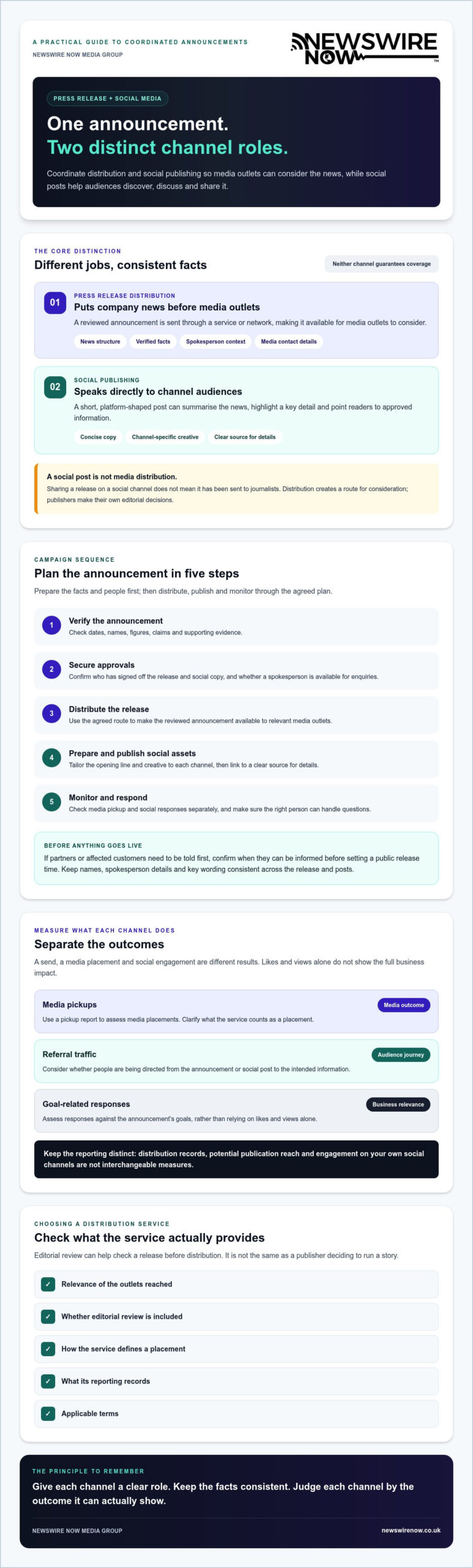
Social media press release distribution is the coordinated use of press release distribution and social channels to share company news with media outlets and online audiences. Each channel has a distinct role: distribution services send an editorially reviewed announcement to media outlets, while social posts communicate directly with people following or discovering a brand on a platform.
Sharing a release on LinkedIn, Instagram or another social channel may extend its visibility, but it doesn’t mean the news has been sent to journalists. Nor does posting or distributing it guarantee that an independent publisher will cover the story. Distribution gives the announcement a route to be considered; publishers make their own editorial decisions.
How is a social media press release different from a social post?
A press release follows a news structure: it states the announcement, supports it with verified facts, adds relevant spokesperson context and provides media contact details. This builds on the traditional press release format, adapted for clear and efficient use by media professionals.
A social post is shorter and shaped for its platform and audience. It can summarise the news, highlight a key detail and direct interested readers to approved information, such as the full announcement on the organisation’s website. Keep the core facts consistent, but don’t simply paste the release into every channel.
What does distribution actually deliver?
Distribution is the process of sending an announcement through a service or network that makes it available to media outlets. Editorial review can help check a release before distribution, but it isn’t the same as a publisher deciding to run a story. Before choosing a service, clarify what it means by a placement and what its reporting records.
Measure outcomes separately. A release being sent or placed, the audience a publication may reach and the engagement a social post receives are different results. A pickup report can help assess media placements; social analytics can show responses on your own channels. Neither measure, on its own, establishes the full business impact of the announcement.
For a closer look at how distribution services work, see this UK press release distribution guide. Use it to understand the distribution process before deciding how social channels should support your announcement.
How press releases and social media work together across a campaign
A coordinated campaign gives each channel a clear role and keeps the announcement consistent from release to social post. Social media press release distribution works best as a planned sequence, not as one post copied across every platform. Coordinated channels can serve media contacts and social audiences in different ways, but they don’t guarantee extra reach or coverage.
Build the sequence around your news, stakeholder needs and any publication coordination. If the announcement involves partners or affected customers, confirm when they can be told before setting a public release time. A schedule helps prevent one channel from revealing details before the approved announcement is ready.
- Verify the announcement: check dates, names, figures, claims and supporting evidence.
- Secure approvals: confirm who has signed off the release and social copy, and whether a spokesperson is available for enquiries.
- Distribute the release: use the agreed route to make the reviewed announcement available to relevant media outlets.
- Prepare and publish social assets: tailor the opening line and creative to each channel, then link to a clear source for details.
- Monitor and respond: check media pickup and social responses separately, and make sure the right person can handle questions.
What should happen before the announcement goes live?
Settle the facts and approvals before anything is sent or scheduled. Prepare concise social copy, suitable visuals and a destination page with current, approved information. Check that company names, spokesperson details and key wording match across the release and each post. Guidance on how to plan a credible social media press release campaign can help teams work through the preparation process.
How should the release be adapted for social channels?
Lead with the central news point, then shape the post for its intended audience. A LinkedIn update might foreground business relevance; Instagram may suit a visual announcement; Facebook or X may be appropriate where those channels are already part of the organisation’s communications. These are options, not requirements. Avoid pasting the full release everywhere. Use a concise summary and direct readers to the full announcement or supporting source.
Before selecting a distribution route, review what the service includes and how editorial review and reporting work. Organisations considering an external option can explore editorially reviewed press release distribution as part of their campaign planning.
Social media promotion versus press release distribution: what should you compare?
Choose channels by the outcome you need, not by assuming they provide the same kind of visibility. Owned social publishing gives your organisation control over its own message. Media outreach puts an announcement before publishers, who make independent editorial decisions. Paid social promotion buys distribution of content to a selected platform audience, but it isn’t editorial coverage.
| Approach | Audience | Control | Editorial involvement | Typical output | Useful measures |
|---|---|---|---|---|---|
| Owned social publishing | Followers and people who discover the post | High over copy, timing and creative, subject to platform rules | None from an independent newsroom | Platform-specific posts and updates | Impressions, interactions, shares and referral activity |
| Media outreach or distribution | Journalists, editors and relevant outlets | Control over the submitted release, not publication decisions | Publisher decides whether and how to cover the news | Release distribution and any resulting media pickup | Distribution records and verified pickups |
| Paid social promotion | Platform users reached through paid placements | Control over campaign settings and supplied creative, within platform rules | No independent newsroom review is implied | Sponsored content or adverts | Impressions, clicks, interactions and goal-related actions |
These options can support the same announcement, but they are not interchangeable. Social media press release distribution should be assessed by what the service actually includes. A distribution service may send a release to outlets, but that doesn’t mean it also publishes posts on your social accounts. Check the service description rather than assuming social posting or engagement is included.
A placement guarantee, where offered, is not a guarantee of positive editorial coverage, virality or conversions. Read the terms to understand what counts as a placement and what the provider commits to deliver. For a framework to assess credibility, see this brand authority distribution checklist.
Which channel gives a business more control?
Your organisation can generally choose the wording, timing and creative for its own social posts, while still following the platform’s rules. A distribution service provides access and delivery to outlets; it doesn’t give a business control over a third-party newsroom. A publisher may select, edit or decline a story according to its own editorial judgement.
How can you assess reach and results fairly?
Keep reporting separate. Compare distribution records and media pickups with social impressions, interactions and referral activity, then judge each against its purpose. For a brand-awareness objective, visibility and relevant engagement may matter; for a response or sales objective, assess goal-related actions rather than treating views as business impact.
Use consistent campaign links and reporting periods so referral activity can be interpreted alongside other results. Clear goals set before launch make it easier to distinguish delivery, audience response and outcomes, without claiming that one channel alone caused a conversion.
How to plan a credible social media press release campaign
Credibility starts before publication. Define what the announcement is, who needs to know and what evidence supports it. Then decide whether a press release, social update or combination of both fits the news. A clear plan helps keep claims accurate and gives each channel a useful role in your social media press release distribution campaign.
Use this checklist before anything goes live:
- News value: identify what is genuinely new and why it matters beyond the organisation.
- Audience: specify who needs the information, including media contacts, customers, employees or partners.
- Evidence: check facts, figures, dates and claims against reliable sources. Avoid presenting promotional language as independent news.
- Approvals: confirm sign-off from relevant decision-makers and agree who can respond to media enquiries. Include a clear, current media contact.
- Timing: coordinate publication with stakeholders and any relevant partners, and allow time to check the final materials.
- Channel roles: decide what belongs in the release, what each social post should highlight and where readers can find approved detail.
How do you decide whether news is suitable for a release?
If discoverability is a campaign objective, consider how the announcement fits a wider company search visibility news strategy. Keep the underlying information accurate and useful, rather than adding claims simply to attract attention. Organisations in regulated sectors, such as healthcare, should also consider whether their distribution partner understands sector-specific requirements; a healthcare news wire service with appropriate editorial review and audience targeting can help ensure announcements reach the right outlets.
What should the campaign measurement plan include?
Set separate objectives for distribution, editorial pickup, social interaction and referral activity. Record a baseline and choose a reporting period before launch so you can compare like with like. Use consistent tracking links where appropriate, and define which actions matter for the campaign, such as visits to an announcement page or enquiries.
A straightforward report should show what was distributed, which outlets picked up the news, how social audiences responded and whether referral activity supported the stated objective. Treat these as distinct indicators, not proof that one channel caused a business result.
Once the news value, evidence and channel roles are clear, explore press release distribution options to assess whether an external route to media outlets suits your plan.
When to use a press release distribution service for social media campaigns
Your own social channels may be enough for a routine update aimed at existing followers. A distribution service can be relevant when an announcement has wider news value and you want it made available to media outlets as well as shared through your organisation’s channels. The two routes serve different audiences. Distribution doesn’t automatically include social posting or guarantee engagement.
What should you ask a distribution provider?
Get clear answers before selecting a service. Ask which outlets or sectors may receive the release, and what the provider means by a “placement”. Check what editorial review covers, what the pickup report records and when it’s supplied. If a guarantee or refund is advertised, read the current terms to understand its scope, eligibility and exclusions.
Keep the outcomes distinct: distribution confirms delivery according to the service terms; a recorded pickup indicates publication or placement under the provider’s definition; positive editorial coverage, social sharing and business conversions are separate outcomes. A placement guarantee should never be read as a promise of favourable coverage, virality or sales. Clear definitions help you compare services fairly and interpret reporting accurately.
How can distribution support your wider communications?
Earned media distribution can sit alongside owned social content, giving your team a route to media outlets while your channels address followers directly. Social activity remains a separate part of the campaign, so confirm whether any provider’s social media marketing is relevant to your needs and what it includes. Don’t assume it is bundled with release distribution.
Newswire Now Media Group provides editorially reviewed press release distribution through its independent media network of more than 40 owned publications and distribution to more than 500 news outlets across 27 industry sectors and 37 professions. Its service includes guaranteed placements and a pickup report within 48 hours. Check the placement definitions and applicable terms against your campaign requirements. Distribution can support the media side of a wider communications plan, but doesn’t promise social engagement.
Once you’ve assessed outlet relevance, the review process and the reporting you need, explore press release distribution as a possible route for your announcement.
Make your next announcement work across channels
Effective social media press release distribution depends on giving each channel a distinct role. A release makes verified company news available to media outlets; social content adapts the announcement for your own audiences. Neither guarantees coverage, engagement or conversions, so define what success means before launch and assess distribution, pickups, social response and referral activity separately.
Choose a release when the news is genuinely relevant beyond your organisation and supported by evidence. Coordinate approvals, timing and channel-specific copy, then review provider terms carefully, including what counts as a placement and what the reporting includes.
Newswire Now Media Group operates an independent media network of more than 40 owned publications that reach millions of readers worldwide. Its releases are distributed to more than 500 trusted news outlets across 27 industry sectors and 37 professions. Confirm the applicable service terms before choosing a distribution route.
If your announcement needs structured access to media outlets, explore press release distribution options. With clear news, accurate claims and a realistic measurement plan, you can build a more credible campaign across media and social channels.
Frequently Asked Questions
What is social media press release distribution?
Social media press release distribution combines two distinct ways of communicating company news. A distribution service sends an editorially reviewed release to media outlets, while social posts share a tailored version directly with audiences on your channels. The release provides structured information for media consideration; the posts can point people to the full announcement. The term doesn’t mean distribution automatically publishes content on your social accounts.
Can you distribute a press release directly to social media?
You can publish or share a press release on your organisation’s social channels, but that’s different from distributing it to media outlets. Prepare a shorter, platform-appropriate post that highlights the news and links to the full announcement or another approved source. Check what a distribution service includes before using it, as media distribution and social publishing are separate activities unless the service explicitly says otherwise.
How do press releases and social media work together?
A press release gives journalists and publishers a structured announcement to consider, while social content communicates the news directly to your followers and other platform users. Coordinate approvals and timing, then adapt the key message for each channel rather than copying the release in full. For example, a post can highlight a confirmed partnership and link to the announcement for supporting details. Keep facts consistent across every version.
Does press release distribution guarantee social media coverage?
No. Distribution makes an announcement available through the provider’s stated channels, but it doesn’t guarantee that a journalist or publisher will cover it, or that social users will share or engage with it. Publishers make independent editorial decisions, and social responses depend on audience behaviour and platform conditions. Treat delivery, media pickup and social engagement as separate outcomes, and check exactly what any placement commitment covers before relying on it.
Should I post the full press release on social media?
Usually, it’s more effective to write a concise post for the platform and link to the full release or an approved information page. Lead with the main news, add a relevant detail and make the next step clear. A lengthy release may be difficult to scan in a social feed and may not suit the channel’s format. Keep names, dates and claims aligned with the approved announcement.
How do you measure a social media press release campaign?
Measure each channel against a defined objective. Record distribution activity and media pickups separately from social impressions, interactions, shares and referral visits. If the goal is to drive visits, use consistent tracked links and review referral activity over a set reporting period; if it’s awareness, assess relevant visibility and engagement. These measures show different parts of the campaign and don’t, on their own, prove that a channel caused a business outcome.
Is social media press release distribution suitable for small businesses?
It can suit a small business if the announcement has clear news value, a relevant audience and evidence to support its claims. The decision should depend on the story and the organisation’s communication goals, not size alone. A routine update may be better suited to owned social channels, while a significant announcement may justify distribution alongside social posts. Consider the provider’s outlet relevance, service terms and reporting before choosing a route.
Ready to get your story published?
Distribute your press release across 500+ trusted media outlets — with editorial review and a full pickup report within 48 hours.
Send Press Release →