
How Textile Manufacturing Companies Improve Production and Innovation
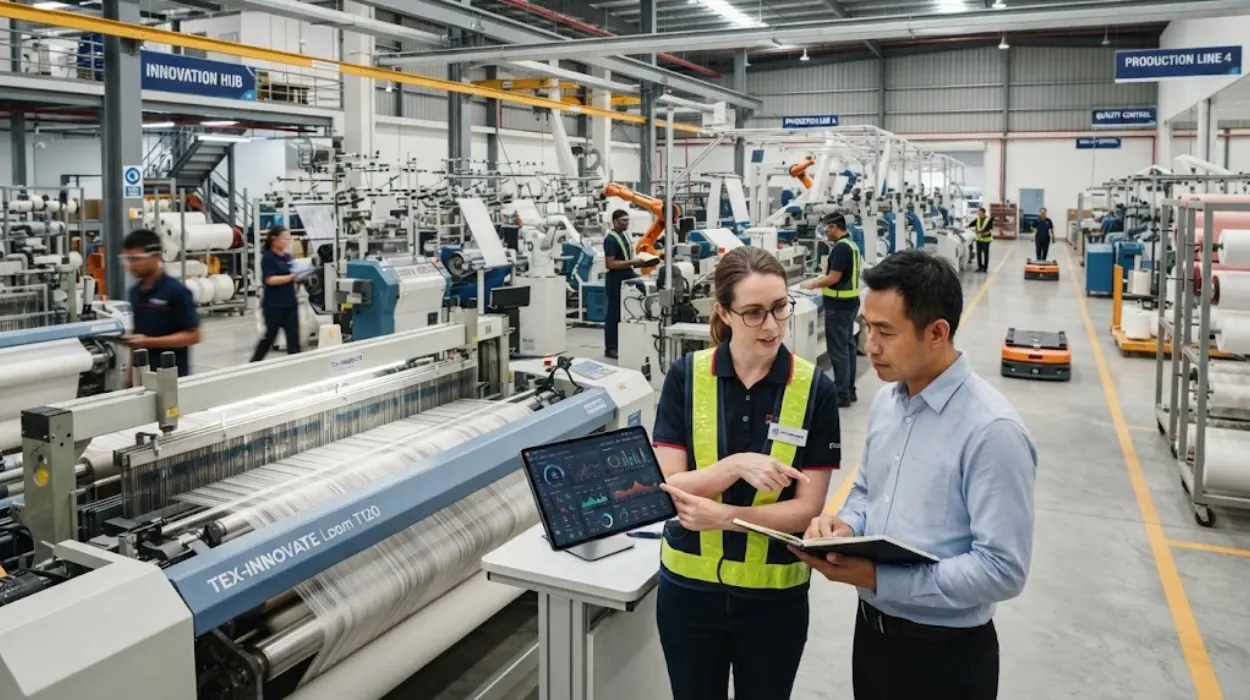
Textile manufacturers improve production and innovation by combining process modernisation with structured evaluation of methods before adoption. The strongest results come from matching a specific method to a specific operational constraint, not from copying a competitor’s approach wholesale.
Manufacturers weighing these decisions typically start broad, understanding what keeps a factory relevant, before narrowing into method-level comparisons. Those building that foundation can review the practices covered in Stay Competitive in Modern Markets for context on baseline positioning.
Which production method increases output faster: automation or lean manufacturing?
Automation increases output faster in high-volume, repetitive processes, while lean manufacturing improves output more reliably in variable, mixed-product lines. Automated systems such as robotic cutting arms and automated weaving looms raise throughput by removing manual bottlenecks in single-product runs. Lean manufacturing, by contrast, reduces waste and idle time across changeovers, which matters more when a factory produces varied SKUs.
A denim manufacturer running one fabric type at scale gains more from automation than from lean restructuring. A garment factory producing 12 different product lines per season, such as a mixed apparel exporter, gains more from lean sequencing than from a single automated cell.
Consider the following when choosing between the two:
- Assess production variety before committing capital; automation suits low-variety runs.
- Measure changeover frequency across a typical month; frequent changeovers favour lean methods.
- Calculate capital payback period for automated equipment against labour cost savings.
- Audit floor layout for lean feasibility, including named techniques like 5S and Kanban scheduling.
Automation typically demands higher upfront capital, often exceeding £150,000 for a mid-sized automated line, while lean manufacturing requires lower capital but higher management discipline. Factories with unstable order volumes tend to favour lean first and automate specific stations later.
Which innovation approach delivers better ROI: in-house R&D or external partnerships?
In-house R&D delivers better long-term ROI for proprietary fabric development, while external partnerships deliver faster ROI for adopting existing innovations. Building an internal R&D team allows a manufacturer to own intellectual property on new fibre blends or finishing techniques. External partnerships, such as licensing agreements with material science firms, shorten the time between concept and market by 6 to 18 months on average.
In-house R&D suits manufacturers targeting differentiation through unique materials, such as a technical textile producer developing flame-resistant blends. External partnerships suit manufacturers prioritising speed to market, such as a fast-fashion supplier adopting recycled polyester blends already validated by a materials partner.
The trade-off centres on three factors:
- Compare time-to-market between building capability internally versus licensing it externally.
- Evaluate IP ownership terms in any partnership agreement before signing.
- Review team retention costs, since in-house R&D specialists command higher salaries than production staff.
Manufacturers with over 500 employees more commonly sustain in-house R&D units, while smaller manufacturers under 100 employees rely more heavily on supplier or university partnerships to access innovation without the fixed overhead.
Which quality control system reduces defects more effectively: statistical process control or AI-based inspection?
AI-based inspection reduces surface and pattern defects more effectively than statistical process control, but statistical process control remains more effective for process-level variance tracking. AI-based visual inspection systems scan fabric at line speed and flag defects such as slubs, holes, or colour variance with detection rates reported above 95% in controlled trials. Statistical process control (SPC) instead tracks measurable variables across time, such as yarn tension or dye bath temperature, catching drift before it produces visible defects.
A knitwear manufacturer facing frequent surface flaws benefits more from AI-based cameras positioned along the finishing line. A dyeing facility facing inconsistent colour batches benefits more from SPC charts tracking temperature and pH across each dye lot.
Manufacturers should weigh these differences before selecting a system:
- Identify the defect category first, since surface defects and process variance require different detection methods.
- Estimate implementation cost, as AI-based systems require camera hardware alongside software licensing.
- Confirm workforce readiness to interpret SPC charts, since this method depends on trained quality staff.
Many manufacturers combine both, applying SPC to upstream processes like spinning and dyeing while applying AI-based inspection to downstream finishing and packing stages.
Which sourcing strategy improves material innovation: vertical integration or supplier collaboration?
Vertical integration improves material innovation control, while supplier collaboration improves material innovation speed and variety. Vertically integrated manufacturers, those owning fibre production through to finished fabric, control every input variable and can trial new blends without external approval delays. Manufacturers relying on supplier collaboration instead gain access to a wider pool of pre-developed materials, such as recycled fibres or bio-based finishes already commercialised by specialist suppliers.
A manufacturer producing performance sportswear may vertically integrate to control moisture-wicking fibre composition precisely. A manufacturer producing seasonal fashion lines may prefer supplier collaboration to access new sustainable materials, such as Tencel or Piñatex, without building production capacity for each.
Key considerations include:
- Map current supply chain depth to determine how much control already exists.
- Test supplier innovation pipelines, reviewing what new materials a supplier has launched in the past 24 months.
- Calculate integration cost against the flexibility lost by committing to fixed fibre production.
Vertical integration suits manufacturers with stable, high-volume demand for a narrow material range. Supplier collaboration suits manufacturers needing to rotate materials frequently in response to shifting buyer specifications.
Which digital tool improves production visibility more: ERP systems or IoT sensor networks?
IoT sensor networks improve real-time production visibility more, while ERP systems improve cross-departmental planning visibility more. IoT sensors installed on looms, dyeing machines, and cutting tables report machine status, output count, and downtime in real time, often refreshing data every 30 seconds. ERP systems consolidate that data alongside procurement, inventory, and order information into a single planning view, but typically update on daily or shift-based cycles rather than continuously.
A factory manager tracking machine downtime on the floor benefits more from IoT dashboards showing live status per machine. A production planner scheduling raw material procurement across three factories benefits more from ERP reporting that links inventory levels to open orders.
When evaluating these tools:
- Define the decision timeframe needed, since IoT suits minute-by-minute decisions and ERP suits weekly or monthly planning.
- Check integration compatibility between existing machinery and new IoT sensor hardware.
- Review reporting depth an ERP system provides across procurement, production, and finance modules.
Most manufacturers scaling past two production sites eventually adopt both, using IoT for floor-level control and ERP for company-wide coordination. Manufacturers evaluating which combination fits their scale can review structured options at Services for Textile Manufacturing.
What should a textile manufacturer prioritise when choosing an improvement strategy?
A textile manufacturer should prioritise the method that matches its current production variance, capital availability, and defect profile, rather than the method with the highest reported industry adoption. No single approach outperforms every other across all factory types. Automation suits volume; lean suits variety. In-house R&D suits differentiation; partnerships suit speed. AI inspection suits surface defects; SPC suits process drift. Vertical integration suits control; supplier collaboration suits flexibility. IoT suits floor-level response; ERP suits planning.
Manufacturers evaluating multiple methods simultaneously often start with a diagnostic step, mapping where defects, delays, or material gaps actually originate before committing budget. This diagnostic approach reduces the risk of adopting a method built for a different production profile. A full breakdown of how these methods apply to specific factory configurations is available through textile manufacturing services.
The comparisons above are not exhaustive, and most manufacturers combine two or three methods rather than choosing one exclusively. What remains consistent across every case is that the method must fit the constraint it is meant to solve, not the trend it is meant to follow.
Ready to get your story published?
Distribute your press release across 500+ trusted media outlets — with editorial review and a full pickup report within 48 hours.
Send Press Release →