
How to Use Press Releases to Push Negative Articles Down in Google Search
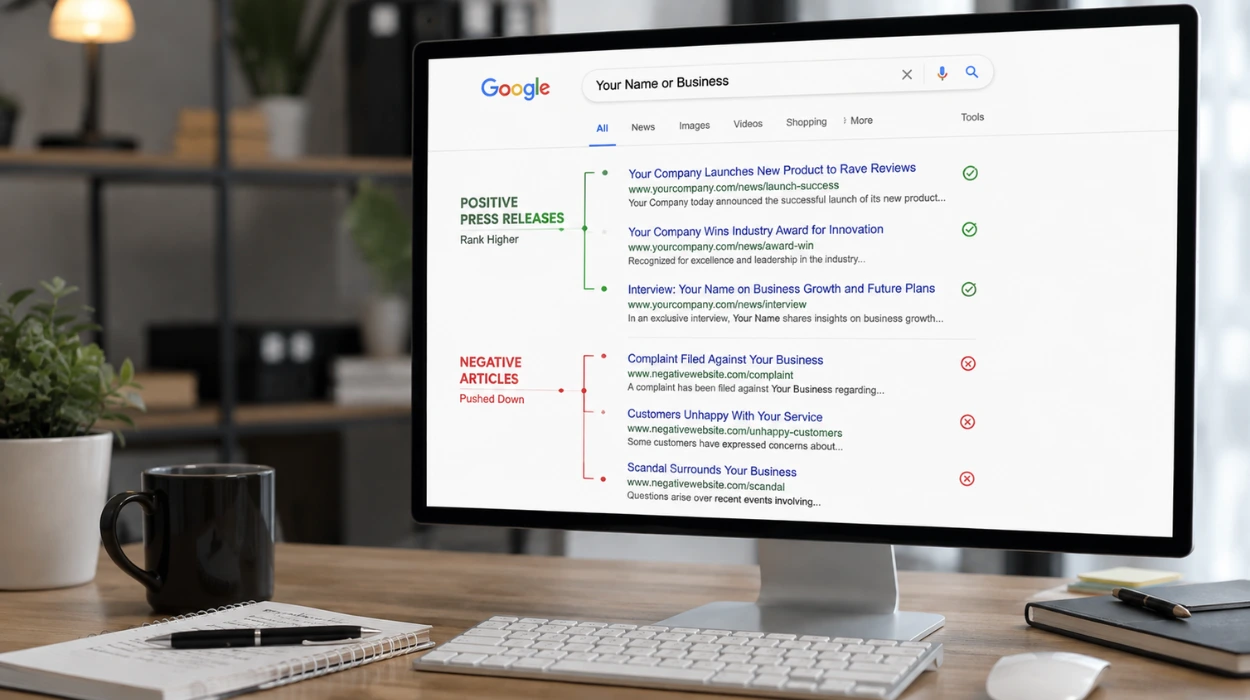
Press releases can help push negative articles lower in Google Search by creating credible, relevant pages that compete for branded search visibility.
The strongest approach combines newsworthy releases, legitimate media coverage, on-page SEO, and sustained publishing rather than relying on one release.
How do press releases affect negative articles in Google Search?
Press releases influence search visibility by adding new, relevant pages that compete with negative articles for branded queries.
Press releases can influence Google Search results by introducing relevant, authoritative pages around a brand name. When those pages earn legitimate coverage, links, engagement and indexing, they can occupy search positions that previously exposed negative articles.
A press release does not directly remove a negative article from Google. Google evaluates each page independently. A new release therefore competes for visibility rather than deleting an existing result. The effect becomes stronger when the release is genuinely newsworthy and published on indexed media websites.
The process starts with search-result analysis. Review the negative URL, its ranking position, page authority, content type and search intent. Then identify the branded queries where the negative page appears. This establishes which terms the new content must address naturally.
A company should also understand what shows up when someone Googles your name or business before choosing a content strategy. The analysis identifies whether negative coverage dominates the first page or appears alongside neutral and positive results. It also shows which content formats already perform well.
Press releases work best as part of a broader search-visibility strategy. A single release creates one content asset. Several legitimate announcements can create a larger group of relevant pages across different publication dates and media sources.
Which press release distribution method creates broader search coverage?
Syndicated distribution creates broader page coverage, while targeted journalist outreach can create fewer but more distinctive editorial results.
Syndication distributes one press release across multiple publishing destinations, while direct journalist outreach seeks independent editorial coverage. The two methods differ in scale, control, originality, publication speed and the type of search-result footprint they create.
Syndication prioritises distribution breadth. The same announcement can appear across multiple participating publications. This can create several indexed URLs associated with the same event, company or topic.
Direct pitching follows a different model. A journalist receives a tailored story angle rather than simply republishing the supplied release. If accepted, the resulting article can contain original reporting, quotations and editorial context.
Compare the two approaches across these factors:
- Evaluate syndication for broad distribution, such as a product announcement appearing across multiple outlets.
- Assess journalist outreach for original coverage, such as a technology reporter independently covering a software launch.
- Measure indexed URLs rather than publication counts, because multiple copies do not represent equivalent editorial value.
- Review source diversity, such as coverage from business, technology and regional publications.
Syndication can produce speed and volume. Direct outreach can produce stronger editorial differentiation. Neither approach guarantees that a particular result will outrank a negative article.
Search engines can also treat duplicate or near-duplicate versions differently. A large number of syndicated copies therefore does not automatically produce the same number of independent ranking signals. Search visibility depends on the individual pages, their relevance and their authority.
Is publishing positive press releases faster than removing negative search results?
Publishing legitimate positive coverage is generally faster than changing the underlying negative page, because suppression depends on new content earning search visibility.
Positive press releases can create new search results without altering the original negative article. Removing, deindexing or correcting negative content requires a separate basis, while suppression relies on building stronger and more relevant pages around the same search queries.
Negative content can disappear from Google for several reasons. A publisher may remove or update the article. A page can become unavailable. A valid legal or policy-based removal process can also apply in specific circumstances.
Press releases follow another route. They create additional content that can become visible for branded searches. The objective is not to manipulate the search engine but to establish a broader and more accurate body of information.
Timing depends on several measurable factors. These include crawl frequency, indexing, domain authority, content relevance and competition for the query. A release published on an established news website can enter search results faster than a newly created website page.
A crisis also changes the required timing. The first 48 hours can determine how much accurate information is available while a developing story attracts searches and media attention. A structured first 48 hours of a PR crisis plan therefore evaluates communication, verification and publication alongside reputation considerations.
Speed still does not equal ranking strength. A newly indexed page can remain below an established negative article. Search performance must therefore be monitored after publication rather than assumed from indexing alone.
Which type of press release content is most suitable for search-result suppression?
Newsworthy announcements with strong branded relevance are more suitable than promotional releases because they provide a legitimate reason for media publication and search relevance.
Search-result suppression works best when press releases introduce substantial, verifiable information about a person, organisation, product or event. Newsworthy announcements create stronger relevance than repetitive promotional statements designed only to influence search rankings.
A release should contain a genuine news event. Examples include a leadership appointment, funding announcement, product launch, research publication or major partnership. The information should be specific enough for journalists and readers to understand its significance.
Repetition weakens the strategy. Publishing several releases that restate the same corporate message creates little additional information. Search engines and readers gain more value from distinct developments that expand the organisation’s public information footprint.
Content quality also affects editorial usefulness. A release should contain a clear headline, factual introduction, relevant quotations and supporting details. Names, dates and figures should remain consistent across the release and associated media coverage.
Use these content checks before distribution:
- Verify every factual claim, such as a funding figure or launch date.
- Explain the news event, such as a new product entering a defined market.
- Attribute quotations to named executives or authorised representatives.
- Differentiate each announcement, such as separating a funding release from a later product launch.
The purpose is to create useful information rather than manufacture search results. Genuine news gives publications a reason to carry the story and gives search engines a relevant page to evaluate.
Does Google News visibility matter when pushing negative articles down?
Google News visibility can expand the reach of positive coverage, but standard Google Search rankings remain the primary consideration for branded-result suppression.
Google News and Google Search serve different discovery functions. News visibility can increase exposure to fresh coverage, while organic search determines which pages appear for branded queries. A reputation strategy should therefore evaluate both surfaces separately.
Google News focuses heavily on news content and freshness. Google Search covers a much broader range of pages and search intents. A story appearing in a news environment does not automatically rank prominently for every branded query.
Fresh coverage can still influence the wider search ecosystem. Readers may discover the announcement through news surfaces, journalists may reference it, and other websites may publish related stories. These secondary effects can expand the number of relevant pages associated with the brand.
Search optimisation should therefore avoid treating Google News indexing as the entire objective. The relevant question is whether the resulting coverage appears for the searches that matter.
Monitor separate indicators:
- Track branded search positions, such as a company name plus “reviews”.
- Monitor news visibility, such as appearances in Google News for a company announcement.
- Record indexed URLs, such as coverage published by named news websites.
- Compare negative-result positions before and after each campaign phase.
This distinction prevents inflated performance reporting. Ten news appearances do not necessarily mean ten pages are competing effectively against a negative article. Search position, relevance and source quality remain separate measurements.
Is a press release alone enough for long-term reputation management?
A press release alone is rarely sufficient for sustained reputation management because search-result composition changes continuously.
Long-term reputation management requires continuous monitoring, new factual content, legitimate media coverage and measurement of search positions. A single press release creates temporary visibility, while sustained reputation work maintains a broader and more current information footprint.
Search results change as new pages are published and older pages gain or lose authority. A negative article can therefore regain visibility after initially moving down. Continuous monitoring identifies these changes before they become persistent.
A long-term strategy should connect public relations with search analysis. Track branded queries, ranking positions, negative URLs, positive coverage and newly indexed pages. Review the data at defined intervals rather than relying on occasional manual searches.
The strategy should also distinguish suppression from correction. If a negative article contains inaccurate information, contacting the publisher may address the underlying problem. If the content is accurate, publishing factual positive information is a different objective.
Reputation management can combine several legitimate activities. These include monitoring, media outreach, content development, review management and search-result analysis. Each activity addresses a different reputation signal.
A structured approach should:
- Monitor branded searches, such as a company name and executive name.
- Identify negative URLs, such as an outdated article ranking on page one.
- Publish genuinely newsworthy developments, such as a verified expansion announcement.
- Measure ranking changes, such as movement from position 4 to position 9.
- Review the result set, such as the first 10 Google results after each campaign stage.
This makes the strategy measurable. It also separates genuine reputation improvement from temporary changes in search visibility.
How should businesses evaluate press release strategies for negative search results?
Businesses should evaluate relevance, editorial quality, distribution breadth, indexing, ranking movement and sustainability rather than counting press release placements alone.
The strongest evaluation framework measures whether new coverage earns search visibility against negative results. Placement volume alone cannot establish success. Businesses should compare ranking positions, indexed coverage, source diversity, content relevance and changes over defined periods.
Start with a baseline. Record the first 10 results for each important branded query before publishing anything. Identify which results are negative, neutral, owned or third-party.
Next, classify the distribution model. A syndication service creates a different footprint from direct journalist outreach. Owned-media publishing creates another type of result because the publisher controls the domain and content environment.
Then measure outcomes against the baseline. A negative article moving from position 3 to position 8 represents a different outcome from gaining 20 syndicated copies that never enter the first page.
A practical evaluation framework includes:
- Record baseline rankings, such as positions 1–10 for a branded search.
- Compare distribution models, such as syndication versus direct journalist pitching.
- Measure indexed coverage, such as five distinct media URLs.
- Analyse source diversity, such as business, regional and technology publications.
- Track durability, such as rankings measured after 7, 30 and 90 days.
This approach avoids treating publication volume as the primary performance metric. It also recognises that Google determines ranking independently from the publisher or business.
What should a press release strategy avoid when negative articles rank highly?
A reputation strategy should avoid deceptive claims, duplicate announcements, artificial reviews and attempts to manipulate search results through low-value publishing.
Press releases should provide accurate, newsworthy information rather than serve as manufactured ranking assets. Duplicate releases, unsupported claims and artificial engagement can weaken credibility while failing to create durable search visibility.
The first risk is factual inconsistency. Contradictory figures, dates or statements can create additional reputation problems. Every release should therefore pass a factual review before publication.
The second risk is excessive duplication. Repeating the same announcement across multiple releases adds little informational value. Distinct news events create a stronger editorial basis for continued coverage.
The third risk is confusing search visibility with reputation repair. Moving a negative result lower does not resolve a legitimate customer complaint, regulatory issue or factual dispute. The underlying issue still requires an appropriate response.
A sound strategy keeps the communication factual. It also respects editorial independence. Journalists decide whether a story is relevant, while search engines decide which pages rank for a query.
The result is a more sustainable search presence. Positive coverage can coexist with accurate criticism. The objective is to ensure that users encounter a balanced and current set of information rather than a search page dominated by one negative narrative.
Press releases can contribute to pushing negative articles down Google Search when they create legitimate, relevant and indexable coverage. Distribution breadth, editorial originality and search relevance should be evaluated separately. Syndication provides scale, while direct journalist outreach can produce more distinctive editorial coverage.
The most useful measurement is movement in the actual search results. Track positions, indexed URLs, source diversity and durability over 7, 30 and 90 days. A press release is one component of reputation management, not a mechanism for deleting negative information. The strongest strategy builds a broader, factual information footprint while addressing the underlying reputation issue through appropriate channels.
Ready to get your story published?
Distribute your press release across 500+ trusted media outlets — with editorial review and a full pickup report within 48 hours.
Send Press Release →