
Media placements for building networks and measuring conversions

A media placement is more than a mention: it can open the door to lasting professional relationships. It puts your organisation, expertise or message in front of an audience through editorial coverage or a paid media slot. Learning how to leverage media placements means using each appearance to build relevant connections, reach journalists with targeted pitches and track what happens after publication.
Visibility matters, but a placement delivers more value when it supports a clear business goal and gives people a reason to engage. Securing coverage is only the start: identify relevant publications and journalists, tailor your approach, share coverage with the right networks and measure outcomes such as referral visits, enquiries and conversions. This guide explains placement types, practical ways to build professional networks and make journalist outreach relevant, and how to assess results. It also shows how to extend coverage’s value beyond publication, so each placement can strengthen relationships as well as awareness.
Key Takeaways
- Choose traditional or digital placements to match your audience, message and campaign goal, rather than treating every channel as interchangeable.
- Use media coverage to start relevant professional conversations and keep relationships active beyond the publication date.
- Research journalists’ beats and tailor each pitch to their recent coverage, making your outreach more useful and specific.
- Track referral visits, enquiries and conversions alongside reach to understand whether coverage is contributing to business goals.
- Extend a placement’s value by sharing it through suitable channels and giving interested audiences a clear next step.
1. What is Placement in Digital Marketing?
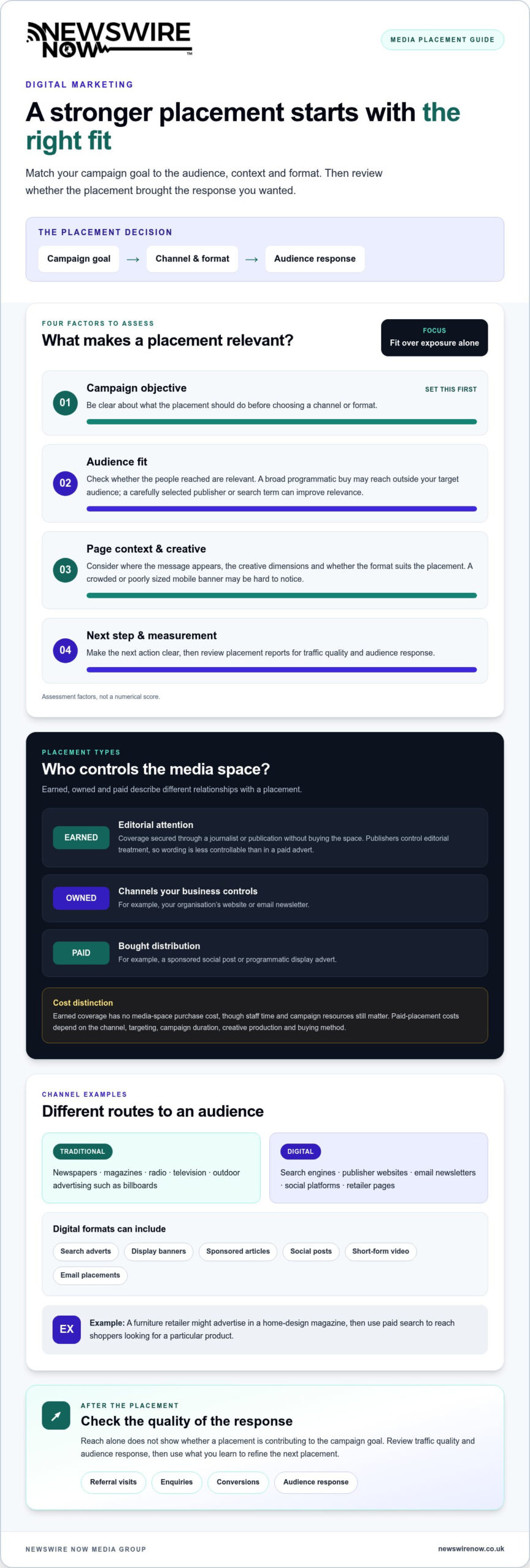
A media placement is where a message appears and how it reaches an audience. In digital marketing, that could mean a paid search result, a display advert on a news site or a sponsored social post. The placement affects who sees the creative, its context and the action someone can take next.
Traditional channels include newspapers, magazines, radio, television and outdoor advertising such as billboards. Digital channels include search engines, publisher websites, email newsletters, social platforms and retailer pages. For example, a furniture retailer might advertise in a home-design magazine, then use paid search to reach shoppers looking for a particular product.
Earned, owned and paid media describe different relationships with a placement. Earned coverage is editorial attention secured through a journalist or publication without buying the space. Owned media appears on channels a business controls, such as its website or email newsletter. Paid media buys distribution, such as a sponsored social post or programmatic display advert.
UK paid-placement costs depend on the channel, audience targeting, campaign duration, creative production and buying method. Earned coverage has no media-space purchase cost, though staff time and campaign resources still matter. There is no single rate that applies to both approaches.
Digital formats shape how people encounter advertising. Common examples include search adverts, display banners, sponsored articles, social posts, short-form video and email placements. A retailer can also place adverts on its homepage, search results, category pages or product pages, matching exposure to different points in the shopping journey.
Placement decisions involve more than choosing a platform. A broad programmatic buy may generate exposure but reach people outside the target audience; a carefully selected publisher or search term can improve relevance. Compare audience fit, page context, creative dimensions and the next step available, then test a focused placement before expanding it.
Digital placement challenges include competing messages, unsuitable page context, irrelevant audiences and weak measurement. For instance, a mobile banner may be hard to notice if its creative is crowded or poorly sized. Set a campaign objective first, choose formats suited to it, and review placement reports for traffic quality and audience response.
For sponsored content, advertorials and influencer placements, make the commercial relationship clear to readers as a practical transparency measure. According to the Financial Conduct Authority, a UK social media communication can count as a financial promotion if it invites or induces people to engage in financial activity. Review claims carefully: negative coverage can affect reputation, while inaccurate claims may mislead audiences. Publishers control their editorial treatment, so earned coverage offers less control over wording than a paid advert.
2. Building professional networks through media coverage
A published story gives your organisation a shared reason to connect with journalists, customers, suppliers and industry peers. Treat the placement as the start of a conversation, not a campaign endpoint. For example, if a trade publication quotes your product lead, thank the journalist, share the article with relevant colleagues and note who engaged with it.
Make each follow-up relevant to its recipient. A customer may value an article explaining how your service addresses a familiar problem, while a supplier may want to see how the story reflects a wider industry change. Send a short note linking to the specific coverage and explaining why you thought it mattered. Avoid sending the same message to everyone.
Use coverage to build internal connections, too. A communications manager can create a weekly email featuring positive media coverage alongside relevant competitor or industry news. Sales, customer service and leadership teams can then discuss how those stories affect their own conversations. This shared context helps colleagues give consistent answers when a consumer asks about the company’s announcement.
To repurpose coverage, share the story promptly on social media, feature the media outlet’s logo linked to the article on your homepage, and include it in a relevant customer newsletter. Sales teams can add authorised print copies to prospect-meeting or trade-show materials, obtaining reprint permission first.
Choose a channel based on the relationship you want to strengthen. A LinkedIn post can invite professional discussion, while an email can give existing customers more context. If the article includes an expert comment, contact relevant industry peers with a concise note and a specific question. Give them a reason to reply beyond simply acknowledging the placement.
Monitor engagement after sharing. Record comments, replies, referral visits and follow-up conversations, then note which audience and channel produced useful responses. If a trade association newsletter drives meaningful enquiries, prioritise similar audiences in the next campaign. If a post attracts attention but little relevant discussion, adjust its framing or audience before repeating it.
Make the follow-up personal and measured. Thank journalists for accurate coverage, respond constructively to reader comments and keep a record of contacts who show interest. A media pickup report can help organise coverage records, making it easier to share relevant stories with colleagues and professional contacts.
3. Journalist research and personalised outreach
Start with the story, then find journalists whose coverage reaches your intended audience. A company launching a cybersecurity service, for example, should look for reporters covering technology, business security or relevant industries. Search recent articles, identify the writer and note the subjects they return to. A journalist’s published work is a stronger indicator of relevance than a broad job title alone.
Use publication websites, search engines and professional social media platforms to build a focused contact list. Search for recent reporting on the topic, then record each journalist’s name, outlet, beat and preferred contact route. An example technology-contact search returned 2881 contacts, which shows why filtering matters: narrow results by subject and recent articles before preparing outreach.
Personalise each pitch with a specific reference to the journalist’s work. Mention an article they wrote, explain how your news adds a useful angle and state why their audience may care. For example, a renewable-energy business could offer a project case study to a journalist covering UK energy policy. Keep the opening direct and make the news value clear.
Prepare a media kit with a concise organisation description, spokesperson biographies, approved images, contact details and substantiated background facts. Lead the press release with the news, explain its relevance, include attributable quotes and provide a media contact. Check names, dates, figures and claims before sending, so journalists can assess the story efficiently.
Choose the channel that fits the journalist’s stated preferences. If a reporter shares work and contact guidance on LinkedIn, follow those details rather than sending an identical message by email and social media. Record the pitch date, angle and response. Journalists may need to see a pitch more than once before responding, so follow up thoughtfully without repeating the same message.
Make every follow-up add value. A new customer example, a clear response to a question or an updated announcement can give the journalist a fresh reason to consider the story. Avoid pressuring them for coverage. If the subject is no longer timely, update your contact record and move on instead of sending repeated messages about the same news.
After publication, thank the journalist and share the article through suitable platforms. Monitor referral traffic, social media engagement and enquiries to see which coverage reaches your intended audience. Use the results to refine future pitches: if a trade publication drives relevant visits, identify other reporters covering the issue and develop a distinct angle for each.
4. Measuring placement success and conversions
Set a measurement plan before a placement goes live. Match each metric to its purpose: brand awareness needs reach and attention indicators, while a sales campaign needs qualified visits, enquiries or purchases. For a product launch, record the publication date, campaign link and intended audience. This gives your team a baseline for comparing results across channels.
Separate exposure from action. An impression shows that an advert appeared; a click records a response, and a conversion means the visitor completed a defined action. That might be an enquiry form, a booked demonstration or an online purchase. Track each stage to find where audiences engage and where they leave.
Use benchmarks as context, not as a substitute for your own campaign data. Google Search Ads average a 2.35% click-through rate and a 4.12% conversion rate. Video adverts on platforms such as YouTube and Hulu average a 0.65% click-through rate and a 2.10% conversion rate. Influencer placements average a 3.20% conversion rate.
Compare like with like. A native placement blends with surrounding content, whilst a display advert appears in a more distinct advertising space. Native adverts attract 53% more user impressions than traditional adverts and generate click-through rates 5-10 times higher than standard display adverts. Those averages don’t establish which placement will best serve your audience or campaign objective.
Connect placements to outcomes with tagged links and consistent conversion definitions. For example, use separate campaign tags for a publisher article, a social post and an email newsletter. In your analytics platform, compare referral visits, time on relevant pages, completed actions and returning visits. This helps distinguish traffic that contributes to business goals from clicks without meaningful engagement.
Include placement quality in the report. Record the publication, format, audience relevance, message accuracy and whether the link worked. Many impressions may support awareness, but a smaller placement can produce more relevant enquiries. For rewarded adverts, users who watch are six times more likely to make in-app purchases, a format-specific signal rather than a universal prediction.
Review results against the original objective, then make one clear adjustment. If a display placement attracts visits but few enquiries, refine the landing page or call to action. If an influencer placement drives conversions, examine its audience and message before adapting the approach. A concise report should show reach, engagement, conversion activity and the next decision, giving each media placement a measurable role.
5. How can businesses leverage media placements to increase brand awareness and sales?
Give every placement a second life after publication. Share the article promptly on your organisation’s social channels, while the story remains timely. Add a short comment explaining its relevance to customers, then direct readers to a related product, service or resource. This turns coverage into a practical route from awareness to action.
Make the outlet’s credibility visible on your website. Feature its logo on the homepage and link directly to the story, so visitors can read the original coverage. A dedicated news or press page can collect placements, helping prospective customers find third-party recognition alongside useful information about your organisation.
Use email to reach people with a reason to care. Send a relevant placement to customers, suppliers or professional contacts, explain why you’re sharing it and thank them for their support. For example, a manufacturer could share a trade-publication article with distributors, then link to a product page for readers seeking more detail.
Equip sales teams with coverage that supports real conversations. Include authorised print copies in prospect-meeting or trade-show materials, obtaining reprint permission first. A salesperson discussing a new service can use an article as independent context, then explain how the service addresses the prospect’s needs. Coverage should support the conversation, not replace a clear sales case.
Invite useful engagement where the publication allows it. If an online story has sharing tools or comments, encourage interested readers to join the discussion. Respond to relevant comments with accurate information and share follow-up details through your own channels. This helps turn a single appearance into an ongoing exchange with potential customers.
Connect each placement to a next step suited to its audience. A consumer feature might link to a product page, while a specialist trade article could direct readers to a technical resource or enquiry form. Use distinct tracking links for separate channels, then compare visits and completed actions. This shows which placements support sales activity, rather than relying on impressions alone.
Keep the message consistent each time you reuse coverage. Check the published wording, preserve the article’s context and avoid presenting editorial coverage as an endorsement. If a story is critical or contains an error, respond through the appropriate editorial route and share accurate updates. Careful reuse protects trust while helping the placement reach relevant audiences.
Plan your distribution around the coverage you want to amplify. Explore press release distribution options when a release could support a wider media campaign and give you coverage to share with customers and prospects.
Newswire Now Media Group: Single Press Release Distribution
Newswire Now Media Group helps organisations extend a news announcement through Single Press Release Distribution, with editorial review and Media Pickup Reporting. It’s a practical next step when you have a release ready and want it distributed beyond your owned channels. Releases can be distributed to more than 500 trusted news outlets across 27 industry sectors and 37 professions, helping you target relevant media audiences.
After distribution, a comprehensive pickup report within 48 hours shows where the release appeared, giving your team coverage to review and share. For a continuing announcement programme, Multi-release Distribution Bundles offer an option for distributing more than one release. Consider how the intended audience and campaign timing fit your goals, then contact Newswire Now Media Group to discuss distribution.
Turn media attention into your next opportunity
The strongest media strategy treats each placement as part of an ongoing relationship with your audience. Decide what you want people to do next, then make that action clear across your communications. Review the response, learn which messages resonate and use those insights to shape your next campaign. That’s how to leverage media placements as an ongoing part of business development, rather than a one-off announcement.
When an announcement needs wider distribution, Newswire Now Media Group offers single press release distribution, multi-release distribution bundles and editorial review. These services can support a focused announcement or a planned sequence of releases, with editorial review included.
Choose the approach that fits your communications plan and next objective. Contact Newswire Now Media Group to discuss distributing your release and building a considered route to greater visibility. Each well-planned placement can create a useful starting point for what comes next.
Frequently Asked Questions
What are media placements and why do you need them?
Media placements put a message before an audience through editorial coverage, advertising or a business’s own channels. They can introduce an organisation to people who may not already follow it, add context to an announcement and create material for future customer conversations. For example, a specialist manufacturer might use a trade article to explain a technical change, then share it with distributors considering the same issue.
What is placement in digital marketing?
In digital marketing, a placement is the specific online location where an advert or sponsored message appears. Examples include a search result, a publisher’s article page, a social feed or a retailer’s product page. Placement matters because the surrounding content and audience intent differ. A search advert can reach someone actively looking for a solution, while a social placement may introduce an idea earlier in their decision process.
What are media placements and how do they work?
Media placements connect a message with a publication, platform or audience. For editorial coverage, an organisation offers a timely story or expert perspective, and an editor decides whether it suits their readers. For paid placements, the advertiser selects a format and audience, then supplies approved creative. For instance, a recruitment firm might pitch a workforce trend to a trade editor or sponsor a relevant newsletter feature.
How do you find and pitch journalists, publications and broadcasters in the UK?
Build a shortlist by searching UK outlets for recent reporting on your subject, then identify the journalist or programme team responsible. Read several pieces to understand their focus and preferred format. Pitch one clear angle, explain why it matters to that audience, and offer an appropriate spokesperson or evidence. A local business story, for example, may suit a regional broadcaster better than a national finance desk.
How do you measure the reach, referral traffic, leads and ROI of media placements?
Measure reach using the outlet’s available audience or distribution data, then use tagged links to distinguish referral visits by placement. Define a lead before launch, such as a completed enquiry form, and record which source generated it. To assess ROI, compare attributable value with campaign spend and internal costs over the same period. This makes it easier to see how to leverage media placements for business outcomes.
Ready to get your story published?
Distribute your press release across 500+ trusted media outlets — with editorial review and a full pickup report within 48 hours.
Send Press Release →