
What Shows Up When Someone Googles Your Name or Business? Here’s How to Find Out
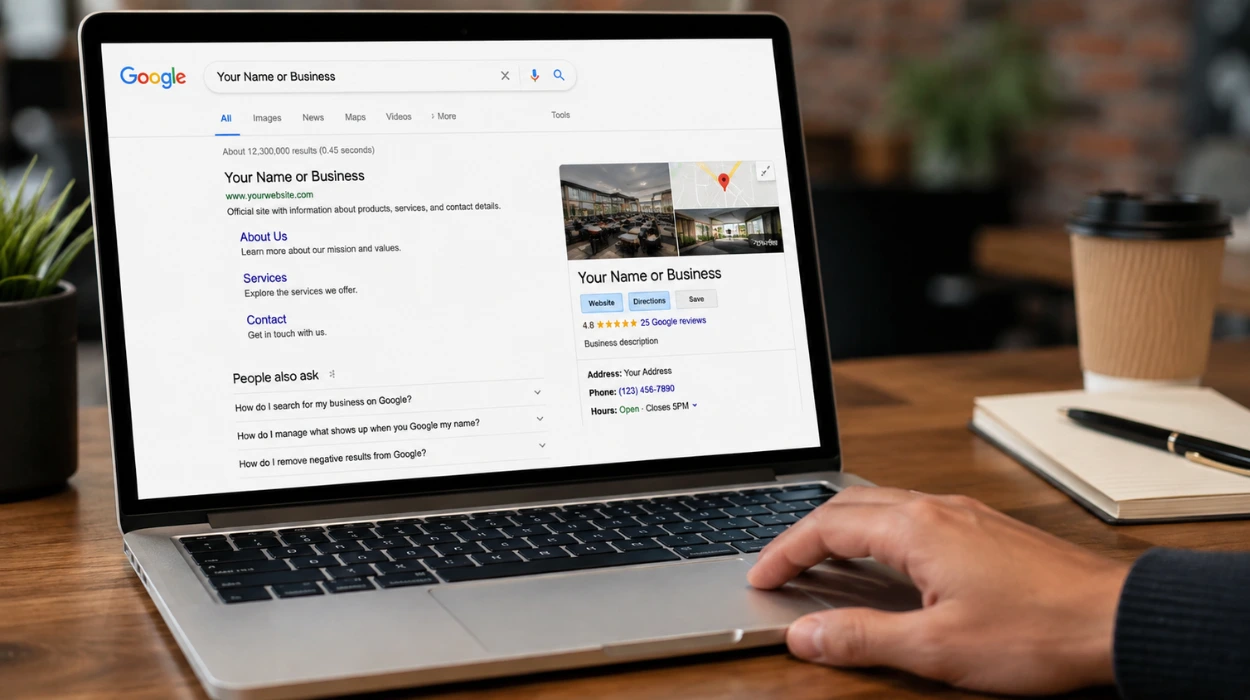
The results that appear when someone Googles your name or business form a visible snapshot of your public reputation. You can find out what appears by searching your name, business name, key executives, branded phrases, Google News results, images, and related searches.
What does Google show when someone searches your name or business?
Google shows a combination of webpages, news coverage, business profiles, images, videos, social profiles, and other indexed information associated with the searched entity. Search results are assembled from Google’s index, which stores information discovered through crawling publicly accessible webpages. The displayed results depend on the query, indexed content, relevance signals, location, language, device, and other search context.
A branded search is a query containing a person’s name, company name, product name, or another identifiable entity. Google analyses the words in the query and retrieves indexed pages that provide information connected with those terms. News articles, press releases, company websites, interviews, social profiles, review pages, and directory listings can all become part of the visible result set.
Google News provides a separate environment for news-related content. A search involving a business name can therefore produce standard Google Search results alongside news stories and other media references. The appearance of a page in Google Search does not automatically mean that Google News has accepted it as a news publication.
How can you check your current Google results?
You can check your search presence by running structured searches for your exact name, business name, executives, products, and branded terms. Start with the exact phrase inside quotation marks to identify pages containing that specific wording. Then repeat the search without quotation marks to observe broader associations and related results.
Search the business name together with terms such as “news”, “press release”, “reviews”, “complaints”, and the names of key products or services. Check the first three pages of standard Google results because information outside the first page still forms part of the indexed reputation landscape. Review the News tab separately to identify published articles, syndicated releases, interviews, and other media references.
Use Google Images and Google Videos to inspect visual results connected with the same entity. Search the names of senior executives separately because personal results can become associated with searches for a business. Repeat the process periodically so newly indexed coverage and older pages remain visible in the monitoring process.
Which types of content appear in a branded search?
Branded searches can display any relevant indexed content that Google considers useful for the query. Company-owned webpages often appear alongside third-party publications, social profiles, business directories, reviews, interviews, press releases, and news articles. The mixture depends on what has been published publicly and indexed.
Company-controlled content
Company-controlled content includes official websites, newsroom pages, investor-relations pages, corporate announcements, executive biographies, and published press materials. These pages provide first-party information about the organisation and its activities. Search engines crawl these pages and add eligible content to their indexes.
Third-party media coverage
Third-party coverage includes reporting from newspapers, specialist publications, trade journals, broadcasters, and online news organisations. A journalist’s article provides an independent publication context that differs from a company-owned announcement. Media coverage therefore becomes an important component of the public information environment surrounding an organisation.
Distributed press releases
Press releases provide structured announcements containing information intended for journalists, publishers, and audiences. Distribution networks can deliver the same release to multiple publications or news databases, depending on the selected distribution system. Some publishers republish or syndicate release content, while others independently report on the announcement.
Social and directory profiles
Social profiles and business directories can also appear for branded searches. Platforms such as LinkedIn, Facebook, YouTube, and X maintain publicly accessible pages that search engines can crawl and index. Directory profiles provide additional references containing names, locations, services, contact information, or business descriptions.
How do negative articles become visible in Google results?
Negative articles become visible when search engines discover, crawl, index, and rank publicly accessible pages containing information associated with a person or business. A critical article published by a recognised news outlet can therefore become part of the search results for the organisation or individual named in that article. Its visibility depends on the article’s indexing status and relevance to subsequent searches.
The publication date also affects how the result appears in news-related searches. Fresh coverage can receive visibility in news surfaces shortly after publication, while older articles remain indexed in standard search results. A page can therefore continue appearing after the original news cycle has ended.
Search visibility is not determined solely by whether a business agrees with the article. Google’s systems evaluate the content available on the web rather than treating a company’s preferred narrative as the authoritative version. Reputation monitoring therefore begins with identifying what has already been published and indexed.
How does Google index press releases and news coverage?
Google indexes press releases and news coverage by discovering accessible pages, crawling their content, processing the information, and adding eligible pages to its search index. Publication on a website does not guarantee immediate indexing because crawling and indexing are separate processes. Google’s systems decide whether a discovered page is useful and eligible for inclusion.
Publishers can support discovery through internal links, XML sitemaps, clear page structures, canonical signals, and accessible content. News publishers also use structured data such as NewsArticle to communicate information about an article. Structured data helps machines interpret content but does not guarantee a particular search position.
Google News uses automated systems and publisher-specific criteria to identify news content. Publishers must follow Google’s policies for news and general search content. Technical accessibility, clear authorship, publication information, original reporting where applicable, and transparent publisher practices contribute to a credible news environment.
How does news syndication affect what people see?
News syndication distributes published content from an originating source to additional publishers, databases, or media platforms. A syndicated press release can therefore appear on more than one website without representing separate independent reporting. The relationship between the original publisher and the republishing outlet determines how the material is presented.
Syndication can create multiple indexed URLs containing substantially similar information. Search engines process those pages individually and use canonicalisation and other signals to understand relationships between duplicate or near-duplicate content. Not every syndicated copy receives the same search visibility.
Media distribution therefore differs from guaranteed editorial coverage. A distributed release communicates an announcement across a network, while independent journalism involves a publisher or journalist researching and producing an editorial story. Understanding this distinction prevents inflated assumptions about what a search result represents.
How do journalists use press releases as information sources?
Journalists use press releases as sources of announcements, facts, quotes, dates, names, and contact information that can support editorial research. A release gives a journalist a structured description of an event or development. The journalist then decides whether the information fits the publication’s audience, editorial standards, timing, and news agenda.
Journalist outreach adds another layer to this process by connecting relevant information with reporters covering specific subjects. Reporters working for outlets such as Reuters, the BBC, Financial Times, and specialist trade publications follow defined editorial processes before publishing information. A press release can provide a starting point without becoming the final article.
Strong releases therefore present verifiable facts rather than promotional claims disguised as reporting. Clear headlines, accurate dates, attributable statements, relevant data, and direct contact information help journalists evaluate the material. The quality and relevance of the underlying announcement determine its usefulness as a source.
What role do publication timing and embargoes play?
Publication timing determines when a release becomes available for distribution, while an embargo specifies when selected recipients can publish the information. An embargo gives journalists advance access to information while establishing a defined publication time. The agreed date and time must be communicated clearly to every recipient.
Wire distribution systems schedule releases according to the publisher’s selected release time and timezone. Timing matters because journalists work against publication deadlines and news cycles. A release issued after a major event or outside relevant working hours can enter a different editorial environment from one distributed at an appropriate time.
Embargoes also require coordination between the issuing organisation, journalists, publishers, and distribution channels. Once an embargo expires, authorised recipients can publish the information according to their editorial processes. The embargo itself does not guarantee publication or search visibility.
How can you identify whether negative coverage is still indexed?
You can determine whether negative coverage remains indexed by searching the exact article title, URL, organisation name, and distinctive phrases from the article. A direct URL search can establish whether Google recognises the page, while an exact-title search can reveal copies or references elsewhere. Searching the organisation name with the publication name provides another way to identify continuing visibility.
Check both Google Search and Google News because the same article can have different visibility across these surfaces. Review cached references cautiously because search displays change as Google’s systems recrawl and reprocess pages. The absence of a result for one query does not prove that the underlying page has disappeared from Google’s index.
For ongoing monitoring, record the article URL, publisher, publication date, headline, search query, and observed position. This creates a repeatable record for measuring changes in search visibility. Monitoring also helps distinguish newly published coverage from older indexed material.
Can new positive coverage change a business’s search environment?
New authoritative coverage can add fresh indexed information to the search environment surrounding a business or person. Publishing legitimate announcements, research findings, executive commentary, interviews, and other newsworthy material creates additional public references. These pages enter the same broader information ecosystem that contains existing coverage.
The objective is not to alter search results through artificial manipulation. Instead, organisations can publish accurate information that deserves editorial attention and establish a stronger, more complete public record. Over time, newly published material can become part of the set of pages users encounter when researching the entity.
This process explains why reputation work often examines the full search-result landscape rather than one isolated article. A business name can connect to corporate announcements, independent journalism, regulatory information, reviews, social profiles, and older publications. Understanding those relationships provides a clearer picture of what an external searcher actually sees.
What should you record when monitoring your search reputation?
You should record the exact search query, result URL, publication, headline, publication date, content type, and observed search position. This information creates a consistent baseline for comparing search results over time. It also separates factual monitoring from subjective impressions about whether a result appears favourable or unfavourable.
Record results from standard Google Search, Google News, Google Images, and relevant branded queries separately. Identify whether each result represents first-party content, independent editorial coverage, syndicated material, a social profile, or another type of indexed page. Classifying results makes the overall search environment easier to analyse.
For negative coverage specifically, document the publication, article title, date, URL, factual subject, and current visibility. Do not treat removal, suppression, or de-indexing as automatic outcomes of publishing new material. Search engines control indexing and ranking systems, while publishers control their own editorial pages.
How does reputation management use search-result monitoring?
Reputation management uses systematic monitoring to understand, assess, and respond to information associated with an individual or organisation across public search and media environments. The process begins by identifying existing coverage and determining which sources contribute to the visible search landscape. It then evaluates the accuracy, relevance, recency, and prominence of that information.
Press releases, journalist outreach, media coverage, and digital PR can contribute new factual material to the public record. The resulting content enters an ecosystem that includes both company-controlled and independent sources. Monitoring measures how that information appears rather than assuming publication automatically produces a specific ranking outcome.
When negative articles occupy prominent positions, organisations often investigate legitimate methods for pushing negative articles down by publishing useful, authoritative information and earning relevant media coverage. This approach focuses on adding credible information rather than manipulating search systems. The same monitoring framework applies before and after new coverage is published.
What is the key mechanism behind what appears when someone Googles you?
What appears in a branded Google search reflects the indexed public information that Google’s systems consider relevant to the query. Press releases, news reports, syndicated content, interviews, company pages, social profiles, and other public sources can all contribute to that information environment. Crawling, indexing, relevance processing, publication timing, and search context influence what users see.
Reputation management therefore begins with observation rather than assumption. Searching exact names, reviewing news coverage, identifying source types, checking indexing status, and recording changes creates a factual picture of the current search environment. New legitimate media and public information then become additional elements within that environment.
The underlying mechanism remains straightforward: publicly available information is published, discovered, indexed, and retrieved in response to relevant searches. Understanding that sequence makes it easier to interpret search results, distinguish editorial coverage from syndicated releases, and evaluate how an individual’s or organisation’s public information develops over time.
Ready to get your story published?
Distribute your press release across 500+ trusted media outlets — with editorial review and a full pickup report within 48 hours.
Send Press Release →