
How to Create a Professional Press Kit for Your Brand
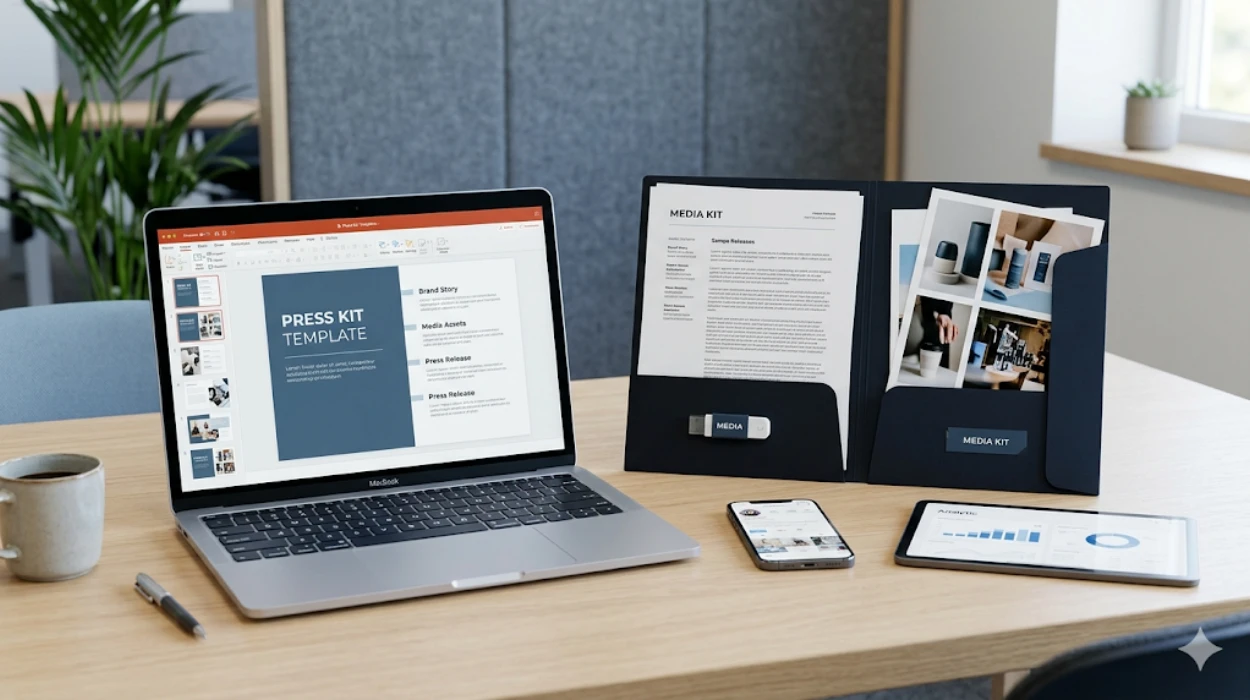
A professional press kit is a structured collection of brand information designed for media use.
It presents verified facts, visuals, and narratives in a format that enables accurate reporting.
What is a professional press kit and why does it matter?
A professional press kit is a curated media resource that defines a brand’s identity, achievements, and communication assets in one accessible format.
A press kit matters because it standardises how information is shared with journalists and publishers. It reduces misinterpretation by providing verified data points. It improves efficiency by eliminating repeated information requests. It establishes consistency across all public-facing narratives. It also enables faster media coverage during announcements and campaigns.
What elements define a complete press kit?
A complete press kit includes structured components that explain the brand clearly and accurately.
A press kit contains a company overview that defines mission, history, and scope. It includes leadership bios that present factual career timelines. It provides high-resolution media assets such as logos and product imagery. It lists verified contact information for media enquiries. It also includes recent press releases and factual milestones to support credibility.
How do you structure a professional press kit?
A professional press kit is structured by organising information into clearly labelled sections that prioritise accessibility and logical flow.
A structured press kit begins with an overview section that summarises the brand in 50 to 80 words. It follows with detailed company information presented in chronological order. It includes a dedicated media assets section with downloadable files in standard formats such as PNG and PDF. It adds a press coverage section that lists dated mentions. It concludes with a contact section that includes direct communication channels.
What format works best for a press kit?
A digital format works best because it enables easy distribution and real-time updates.
A digital press kit exists as a hosted webpage or downloadable document. It ensures accessibility across devices including desktop and mobile. It allows immediate updates without redistribution delays. It supports multimedia integration such as images and videos. It also improves discoverability through search indexing when hosted online.
What information should be included in a press kit?
A press kit includes factual, verifiable, and relevant information that supports media reporting.
A press kit contains a company description that defines core operations. It includes key statistics such as founding year and employee count. It presents leadership profiles with specific roles and achievements. It provides media-ready assets including logos and images. It also includes a timeline of major developments with exact dates.
How do you write an effective company overview?
An effective company overview defines the brand using concise and factual language.
An overview begins with a single sentence that explains what the organisation does. It follows with a sentence that defines its market or audience. It includes a sentence that highlights measurable achievements. It avoids descriptive language that lacks data. It ends with a sentence that reinforces its core purpose or function.
How do you optimise a press kit for search visibility?
A press kit is optimised by aligning its structure and language with semantic SEO principles.
Search optimisation begins with using the primary keyword in headings and body text. It includes related terms that expand topical relevance. It ensures structured formatting using headings and subheadings. It incorporates internal linking to related resources such as PR & Press Release Distribution strategy guide, which supports deeper topical authority. It also uses descriptive file names and metadata for media assets.
What role does semantic SEO play in press kits?
Semantic SEO defines how search engines interpret meaning and relationships between topics.
Semantic SEO improves press kit visibility by connecting related concepts such as brand identity, media relations, and press releases. It enhances contextual understanding through structured content. It reduces ambiguity by using precise terminology. It also improves indexing by aligning with search intent. This results in higher discoverability for relevant queries.
What are the pros and cons of using press release distribution?
Press release distribution provides structured communication but introduces limitations in control and effectiveness.
Press release distribution enables wide dissemination of information across media channels. It increases visibility by reaching journalists and publishers simultaneously. It standardises messaging across multiple platforms. However, it reduces control over how content is interpreted. It also introduces competition with other distributed releases.
What are the advantages of press release distribution?
Press release distribution offers measurable benefits in reach and consistency.
- Expand reach – example: distributing to 500 media outlets increases exposure.
- Maintain consistency – example: identical messaging ensures uniform reporting.
- Improve efficiency – example: one release replaces 50 individual pitches.
- Enable tracking – example: analytics tools measure impressions and engagement.
What are the disadvantages of press release distribution?
Press release distribution introduces challenges related to control and differentiation.
- Reduce uniqueness – example: identical content competes with similar releases.
- Limit editorial control – example: journalists interpret content independently.
- Create noise – example: high volume reduces individual visibility.
- Require precision – example: inaccurate data spreads quickly across platforms.
How do you design a press kit for clarity and usability?
A press kit is designed by prioritising readability, navigation, and visual consistency.
Design begins with a clean layout that separates sections clearly. It uses consistent typography for headings and body text. It includes white space to improve readability. It ensures all files are labelled accurately for quick access. It also maintains a logical sequence that guides users through the content.
What design elements improve press kit usability?
Specific design elements enhance usability and accessibility.
Usability improves with clear headings that define each section. It increases with clickable navigation for digital formats. It benefits from high-resolution images that maintain clarity. It requires consistent formatting across all sections. It also depends on fast loading times for digital access.
How do you maintain and update a press kit?
A press kit is maintained by regularly updating its content to reflect accurate and current information.
Maintenance involves reviewing data at fixed intervals such as every 90 days. It includes updating leadership profiles when roles change. It requires adding new press releases and milestones. It ensures outdated information is removed promptly. It also involves verifying contact details for accuracy.
Why is regular updating essential?
Regular updating ensures reliability and relevance of the information.
Up-to-date content prevents the spread of outdated facts. It maintains credibility with journalists and publishers. It reflects current organisational status accurately. It supports ongoing media engagement. It also aligns with search engine preferences for fresh content.
How does a press kit support media relations?
A press kit supports media relations by providing structured and reliable information for journalists.
It simplifies the research process by offering verified data in one place. It reduces communication delays by answering common queries מראש. It ensures consistent messaging across different media channels. It enables faster publication of accurate content. It also strengthens trust through transparency and clarity.
What makes a press kit effective for journalists?
Effectiveness depends on clarity, completeness, and accessibility.
An effective press kit provides concise and factual information. It includes all necessary assets in usable formats. It ensures quick navigation between sections. It avoids unnecessary complexity in language. It also maintains a logical structure that aligns with journalistic workflows.
How does a press kit differ from a press release?
A press kit is a comprehensive resource, while a press release is a single announcement document.
A press kit contains multiple sections covering all aspects of a brand. A press release focuses on one specific update or event. A press kit remains static with periodic updates. A press release is time-sensitive and distributed at specific moments. Both serve complementary roles in media communication.
When should each be used?
Each serves a distinct purpose based on communication needs.
A press kit is used when providing background information. A press release is used when announcing news. A press kit supports long-term media engagement. A press release drives immediate attention. Together, they form a complete communication strategy.
Conclusion
A professional press kit defines a structured and reliable method of presenting brand information for media use. It integrates clear organisation, factual content, and semantic optimisation to improve accessibility and visibility. Its effectiveness depends on accuracy, usability, and consistent updates.
Ready to get your story published?
Distribute your press release across 500+ trusted media outlets — with editorial review and a full pickup report within 48 hours.
Send Press Release →