
Reputation Management vs. Crisis PR: Understanding the Difference When Things Go Wrong

Reputation management and crisis PR are distinct disciplines for handling negative events, even though they both respond to issues that threaten public perception. Reputation management is continuous and systemic, whereas crisis PR is reactive and event‑driven.
When problems arise, one approach manages long‑term reputation signals and SERP visibility, and the other deploys urgent communications, spokespeople, and short‑term media strategies around a single incident.
What is the core difference between reputation management and crisis PR?
The core difference between reputation management and crisis PR is that reputation management is a long‑term system for structuring, monitoring, and controlling how information appears, ranks, and is interpreted, while crisis PR is a short‑term, event‑based communication response. One aligns with search and platform ecosystems; the other focuses on media cycles and public statements.
Reputation management operates by:
- Continuously tracking mentions, reviews, and SERP composition for an entity and its related topics.
- Optimising and publishing content that competes for ranking and narrative authority rather than just visibility.
- Adjusting sentiment distribution and authority signals over months and years, not just in response to spikes.
Crisis PR operates by:
- Deploying spokespersons, press releases, and media‑outreach campaigns when a specific scandal, product failure, or regulatory issue erupts.
- Managing headlines, broadcast coverage, and social‑media reaction during the 24–72-hour window when attention is highest.
- Protecting the brand from the worst‑case escalation of the incident, even if long‑term reputation mechanisms remain unchanged.
In practice, reputation management is the underlying infrastructure; crisis PR is the tactical response executed on top of that infrastructure when something goes wrong.
How does each approach handle search visibility and reputation signals?
Reputation management handles search visibility and reputation signals by structuring how SERPs, reviews, and news references are weighted, indexed, and displayed over time. Crisis PR, in contrast, rarely focuses on SERP control, instead aiming to shape headlines, broadcast coverage, and immediate public dialogue.
Reputation management influences search visibility through:
- Content‑creation and ranking optimisation of balanced, authoritative pages that occupy top‑position slots for key queries.
- Strategic suppression of harmful content by promoting healthier reputation signals and controlling sentiment distribution.
- Continuous monitoring to ensure that SERP composition reflects factual, evolving information rather than outdated or crisis‑driven narratives.
Crisis PR influences visibility through:
- News‑driven messaging designed to dominate immediate media cycles rather than to reorder search results.
- Boilerplate responses, statements, and interviews that aim to steer public sentiment during the acute phase.
- Limited concern for long‑term indexing or ranking, treating the article, broadcast, or interview itself as the primary artefact.
Because reputation management is embedded in how search engines interpret and rank content, it shapes how stakeholders encounter the entity over months or years, while crisis PR shapes the first‑impression narrative in the first minutes or days.
How do timing and duration of action differ between reputation management and crisis PR?
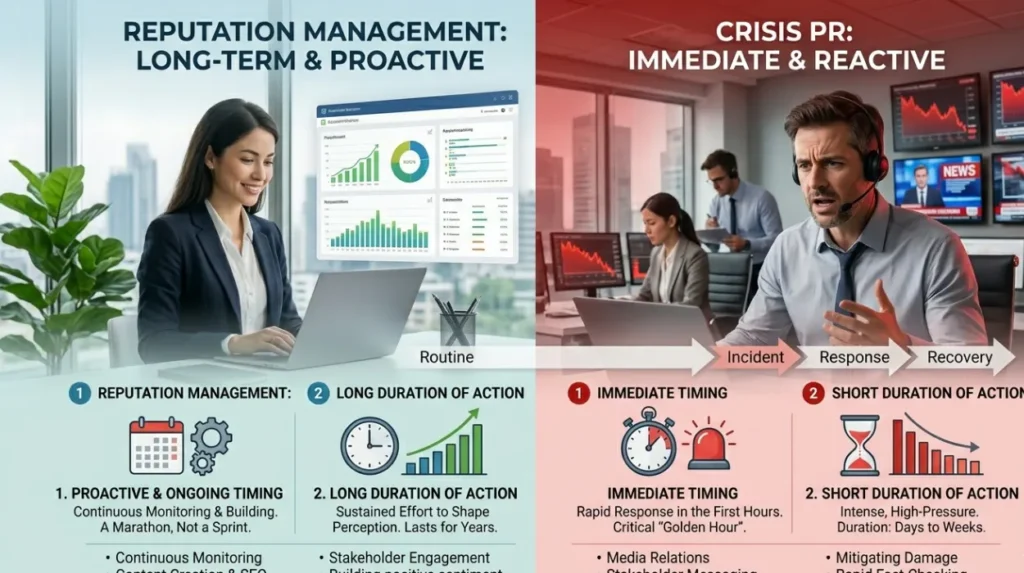
Timing and duration of action differ between reputation management and crisis PR because reputation management is designed to operate continuously, whereas crisis PR is triggered by specific events and has a defined active window. One is a standing system; the other is a project‑based intervention.
Reputation management functions on an ongoing basis by:
- Applying monitoring and ranking‑control protocols that start before problems arise and continue afterward.
- Measuring changes in sentiment distribution, SERP composition, and visibility over quarterly or annual cycles.
- Embedding long‑term defensibility into the digital footprint rather than waiting for crises to occur.
Crisis PR operates within narrower time boundaries by:
- Activating response protocols immediately after an incident, often following a 24‑hour or 48‑hour escalation plan.
- Maintaining peak activity for days or weeks while the issue is in the news cycle.
- De‑escalating once the story fades, leaving the underlying reputation‑signal architecture unchanged.
When viewed together, reputation management is the background layer that absorbs damage or amplifies recovery, and crisis PR is the foreground‑layer response that attempts to control the narrative in real time.
How do each approach’s methods compare in controlling public perception?
Reputation management and crisis PR compare in their capacity to control public perception by operating at different layers of the information ecosystem. Reputation management exerts continuous influence over how search engines interpret and rank material, while crisis PR shapes the initial media‑driven narrative through direct communication channels.
Reputation management controls perception through:
- Structuring the digital footprint so that balanced, authoritative content answers search intents rather than isolated negative episodes.
- Influencing sentiment distribution and SERP real‑estate shares so that users encounter a more stable, fact‑based view of the entity.
- Adjusting technical and content‑based signals that search systems interpret as evidence of credibility and stability.
Crisis PR controls perception through:
- Direct outreach to journalists, broadcasters, and editors to shape how the incident is framed in headlines and coverage.
- Public statements and interviews that attempt to change the narrative within the current media cycle.
- Social‑media and owned‑channel messaging that targets immediate audiences rather than the long‑term indexing layer.
Reputation management is effective over time and at scale, where search and platform systems cascade the same signals to thousands of users. Crisis PR is effective in the short term and in specific channels, where a single statement or interview can shift public sentiment for a brief period.
How do cost, scalability, and long‑term value differ between the two approaches?
Cost, scalability, and long‑term value differ between reputation management and crisis PR because each model is built on different assumptions about duration, scope, and technical‑platform integration. Reputation management is more scalable and defensively efficient; crisis PR is more labour‑intensive and project‑specific.
Reputation management is typically:
- Structured as an ongoing investment, with fixed‑fee or retainer‑based models that align with continuous monitoring, content creation, and SERP‑control work.
- Highly scalable, since a single content‑management and ranking‑optimisation workflow can protect multiple products, brands, or individuals under one entity.
- More valuable over the long term, because it reduces the frequency and severity of reputation shocks, lowering the need for repeated crisis‑PR interventions.
Crisis PR is usually:
- Project‑based, with fees tied to the specific incident, staffing, and media‑outreach workload rather than long‑term infrastructure.
- Less scalable, as each new crisis often requires a fresh round of planning, media‑targeting, and spokesperson coordination.
- High‑value in the immediate term when an incident could escalate badly, but less effective at preventing future occurrences unless paired with underlying reputation‑management work.
Organisations that treat Best Reputation Management Companies in the UK as a standing discipline can reduce their dependence on reactive crisis PR while still having PR tools available for acute events.
Reputation management and crisis PR are distinct but complementary responses to events that threaten public perception. Reputation management is a continuous, evidence‑driven system that shapes search visibility, sentiment distribution, and SERP composition over time, while crisis PR is an urgent, event‑based communication strategy that aims to control headlines and immediate narratives. Understanding this difference helps organisations allocate resources wisely, using reputation management as a foundational layer of protection and crisis PR as a targeted, time‑bound response when things go wrong.
FAQs:
What is the main difference between reputation management and crisis PR?
Reputation management is a continuous, systematic approach to shaping how search engines, reviews, and news articles interpret and rank information about an entity, while crisis PR focuses on reactive communication and media management during a specific incident.
How does reputation management protect businesses compared with crisis PR?
Reputation management protects businesses by structuring their digital footprint, controlling SERP visibility, and stabilising sentiment distribution over time, which reduces the impact of future incidents. Crisis PR protects the brand during acute events but does not change the underlying reputation signals, making it a complementary rather than a replacement strategy.
When should a business use reputation management versus crisis PR?
Businesses should use reputation management as an ongoing, background discipline to maintain stable search visibility, review health, and trust signals, starting before any crisis occurs. Crisis PR should be activated when a specific scandal, regulatory issue, or media‑driven event demands immediate spokesperson, press, and public‑statement responses.
How does timing differ between reputation management and crisis PR responses?
Reputation management operates on a monthly or quarterly timescale, focusing on long‑term SERP control, content optimisation, and reputation‑signal alignment. Crisis PR operates on a 24‑ to 72‑hour timescale, concentrating on rapid media outreach, press releases, and social‑media messaging during the peak of the incident.
How do reputation management and crisis PR work together in a PR strategy?
Reputation management and crisis PR work together by providing a long‑term reputation‑control infrastructure and a short‑term incident‑response capability. When a crisis occurs, crisis PR handles the urgent media and public‑relations response, while reputation management ensures that SERP composition, review signals, and online narratives recover and stabilise afterward.
Ready to get your story published?
Distribute your press release across 500+ trusted media outlets — with editorial review and a full pickup report within 48 hours.
Send Press Release →