
The Essential Guide to Press Release Formats and Templates
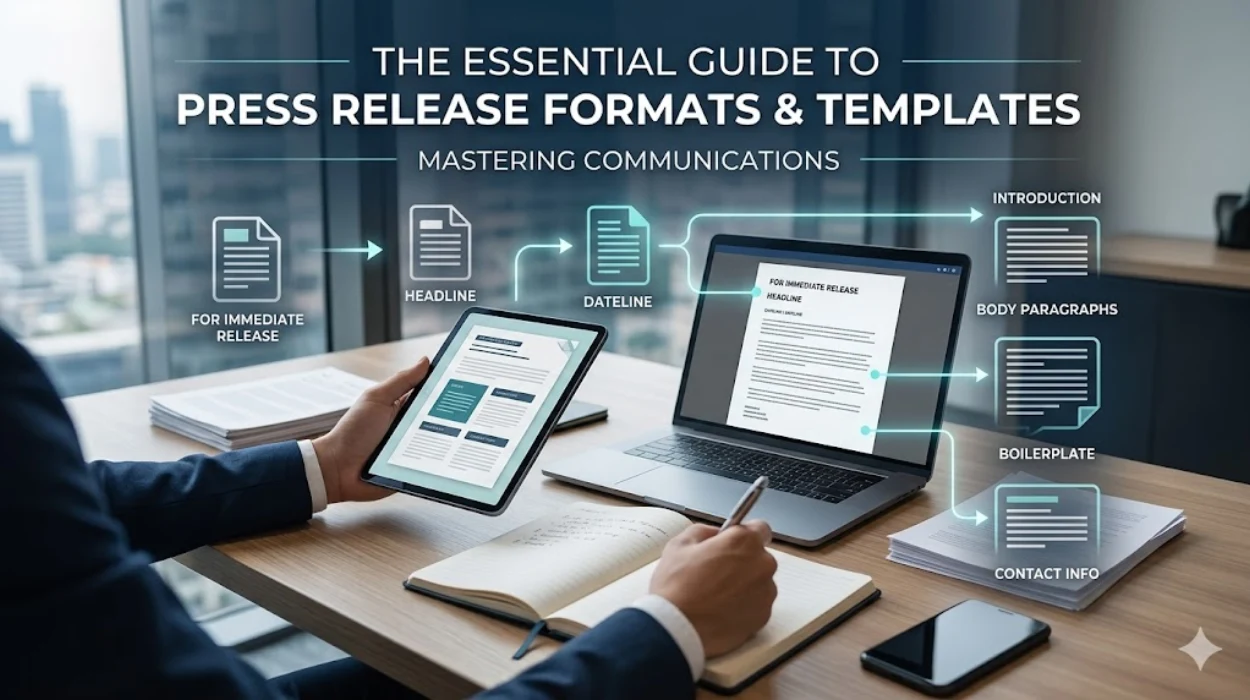
A press release format is a structured framework used to communicate news to media professionals clearly and consistently. It defines how information is organised, presented, and prioritised for journalistic use.
Press release templates standardise this structure by providing reusable layouts that ensure accuracy, readability, and editorial relevance across announcements.
What is a press release format?
A press release format is a predefined structure that organises news content into a logical, media-ready document. It ensures clarity, credibility, and consistency for journalists reviewing the material.
A press release format defines the arrangement of headline, dateline, introduction, body, boilerplate, and contact details. It follows a top-down information hierarchy where the most critical facts appear first. This structure aligns with journalistic conventions such as the inverted pyramid model. Each section performs a specific function within the document. The format reduces ambiguity by enforcing standard placement of information. It supports editorial efficiency by allowing journalists to scan key facts quickly.
A standard press release format includes:
- Write a headline – Example: “Government Announces £2 Billion Infrastructure Investment”
- Add a dateline – Example: “London, 14 April 2026”
- Deliver a lead paragraph – Example: “The Department for Transport reports…”
- Expand in body paragraphs – Example: Provide statistics, timelines, and statements
- Include a boilerplate – Example: Organisation background summary
- Provide contact details – Example: Media relations email and phone number
How does a press release template improve consistency?
A press release template improves consistency by standardising formatting, tone, and structure across all communications. It ensures uniformity regardless of the author or subject matter.
A template defines fixed sections that guide content creation. It eliminates structural errors by pre-setting headings and paragraph order. It enforces consistent tone by aligning language with editorial standards. Templates reduce production time by removing formatting decisions. They also support scalability when producing high volumes of releases. Consistency enhances credibility because journalists recognise familiar formats.
A template typically includes placeholders for headline, subheading, date, introduction, quotes, and contact details. These placeholders function as prompts that maintain structural integrity. The use of templates ensures that every release adheres to the same editorial logic. This uniformity simplifies media processing and increases usability.
What are the key components of a press release?
The key components of a press release are the headline, dateline, lead paragraph, body, boilerplate, and contact information. Each component serves a distinct informational purpose.
The headline defines the core message in under 12 words. The dateline establishes the location and timing of the announcement. The lead paragraph summarises the news using the “who, what, when, where, why” framework. The body paragraphs expand with verified facts and structured explanations. The boilerplate provides a factual overview of the issuing entity. Contact information enables journalists to request further details.Each component contributes to clarity and completeness. The absence of any element reduces the document’s usability. The structure ensures that information flows logically from summary to detail. This alignment supports editorial decision-making and accurate reporting.
Why is the inverted pyramid structure used in press releases?
The inverted pyramid structure is used because it prioritises the most important information at the beginning of the document. This allows immediate comprehension and efficient editing.
The inverted pyramid begins with the most critical facts in the lead paragraph. It then moves into supporting details and contextual explanations. The final sections contain background information and supplementary data. This structure enables journalists to truncate content without losing essential meaning. It aligns with newsroom workflows that prioritise speed and clarity.
The structure also supports digital readability. Readers scan content quickly, and early placement of key facts improves engagement. This method reduces cognitive load by presenting information in decreasing order of importance. It ensures that even partial reading delivers value.
What formatting rules define a professional press release?
Professional press release formatting follows strict rules related to layout, language, and spacing. These rules ensure readability, credibility, and editorial compatibility.
A press release uses left-aligned text with single spacing and clear paragraph separation. Headlines appear in bold and use sentence case or title case consistently. Paragraphs contain 5 to 7 sentences with one idea per sentence. Quotes are enclosed in quotation marks and attributed clearly. Dates follow the format “Day Month Year” in UK style. The document avoids excessive punctuation and promotional language.
Formatting also includes word count discipline. A standard press release ranges from 400 to 600 words. This length ensures depth without overwhelming the reader. Consistent formatting signals professionalism and increases the likelihood of media usage.
How do press release templates differ by purpose?
Press release templates differ based on the type of announcement they are designed to communicate. Each purpose requires specific structural adjustments and content emphasis.
A product announcement template emphasises features, specifications, and release dates. A financial report template prioritises numerical data and performance metrics. An event announcement template highlights dates, locations, and participation details. A crisis communication template focuses on clarity, accountability, and verified facts.
Each template modifies the core structure to suit the informational priority. The headline and lead paragraph reflect the primary purpose. Supporting paragraphs expand on relevant details specific to the announcement type. This variation ensures that the format aligns with the intended message.
What is the difference between press release and media outreach?
A press release is a structured document that delivers news in a standardised format, while media outreach is a strategic process of directly engaging journalists. The two serve different roles in communication.
Press releases define information through formal structure and editorial conventions. Media outreach involves personalised communication such as emails, pitches, and follow-ups. Press releases provide the content, while outreach distributes and contextualises it. The press release remains static, whereas outreach adapts to the journalist’s interests.
Press release vs media outreach analysis shows that one focuses on content standardisation and the other on relationship-building. Both functions operate together but maintain distinct mechanisms. For deeper contextual understanding, refer to Press Release vs Media Outreach as the anchor text used for [Mofu] blog, which connects strategic communication layers with structural content formats.
How does language impact press release effectiveness?
Language impacts press release effectiveness by determining clarity, neutrality, and factual accuracy. Precise language ensures that the message is understood without ambiguity.
A press release uses declarative sentences to present facts directly. It avoids subjective adjectives and promotional phrases. Verbs such as “reports,” “confirms,” and “announces” define actions clearly. Numerical data is presented with exact figures to eliminate uncertainty. Terminology remains consistent throughout the document.
Clear language supports accurate interpretation by journalists. It reduces the risk of misrepresentation. Consistent terminology enhances coherence and readability. This linguistic precision aligns with editorial standards and improves usability.
What role do quotes play in press releases?
Quotes provide authoritative statements that add context and credibility to the information presented. They represent official perspectives within the structured format.
A quote is attributed to a named individual with a defined role. It expands on the factual content by offering interpretation or emphasis. Quotes are placed after the lead paragraph or within the body. They are written in natural speech while maintaining formal tone. Each quote serves a specific informational purpose.
Quotes also humanise the content without introducing subjectivity. They provide insight into intent, significance, or impact. Proper attribution ensures accountability and transparency. This function enhances the overall depth of the press release.
How should a boilerplate be structured?
A boilerplate is a standardised paragraph that provides background information about the issuing entity. It appears at the end of the press release and remains consistent across documents.
A boilerplate defines the entity’s purpose, history, and key activities. It uses factual language without promotional claims. The length ranges from 50 to 100 words. It includes foundational details such as establishment date and operational scope. The content remains unchanged except for factual updates.
The boilerplate supports context without interrupting the main narrative. It allows journalists to understand the source quickly. Consistency ensures recognisability across multiple releases. This section functions as a reference point within the document.
What are common mistakes in press release formatting?
Common mistakes in press release formatting include structural inconsistencies, unclear language, and missing components. These errors reduce readability and credibility.
Incorrect headline length disrupts clarity and focus. Missing datelines create ambiguity about timing and location. Overly long paragraphs reduce readability and hinder scanning. Promotional language conflicts with journalistic standards. Inconsistent formatting weakens professionalism.
Avoiding these mistakes requires adherence to defined structure and rules. Each component must be present and correctly formatted. Language must remain factual and precise. Consistency across documents ensures reliability and usability.
Conclusion
Press release formats and templates define how information is structured, presented, and interpreted within media communication. Their standardised approach ensures clarity, consistency, and editorial alignment across all announcements.
Ready to get your story published?
Distribute your press release across 500+ trusted media outlets — with editorial review and a full pickup report within 48 hours.
Send Press Release →