
Why Was My Press Release Rejected? Common Reasons and Practical Fixes

If you’re asking why my press release was rejected, a vague note or no explanation can make it hard to know whether the problem was the writing, the release’s eligibility or its fit for a publication. A rejection is a decision point, not necessarily a dead end.
Before spending time revising or sending the announcement elsewhere, identify who made the decision. An editor declining a release isn’t the same as a distribution service flagging it, and neither automatically means every route to visibility is closed.
This guide helps you diagnose likely causes with practical checks, from news value and factual support to formatting, targeting and submission rules. You’ll learn how editorial decisions differ from distribution reviews, and how to decide whether to revise, resubmit or consider a distribution service. Distribution can put a release before relevant outlets, but it doesn’t guarantee independent newsroom coverage. Knowing which decision you’re facing is the first step towards choosing your next move.
Key Takeaways
- To work out why my press release was rejected, check who made the decision and what the notice says before changing the copy.
- Compare the outcome with submission records and pickup evidence to distinguish a formal rejection from silence or distribution without coverage.
- Use the stated reason to guide revisions: verify claims, strengthen the news angle and check the recipient’s requirements.
- Before resubmitting, assess the announcement’s news value, audience fit, accuracy and supporting evidence.
- Choose direct pitching or a distribution service based on the control, workflow and reporting you need, not on an assumption of guaranteed editorial coverage.
Why was my press release rejected? First identify which decision was made
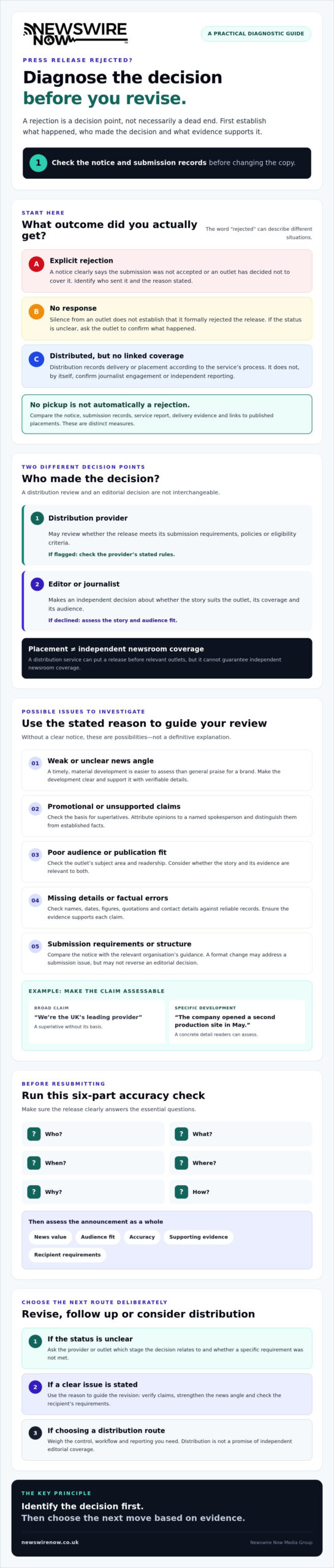
“Rejected” can describe several different outcomes, so the wording alone doesn’t tell you what happened. A formal rejection is an explicit decision not to accept or publish your submission. It may come from a distribution provider during its submission review, or from an editor or journalist making an independent decision about coverage.
These stages aren’t interchangeable. A distributor may decide whether a release meets its submission requirements; a newsroom decides whether it wants to report on the story. Distribution placement means the release was sent or published through a distribution route. It doesn’t mean an independent newsroom has chosen to cover it.
Was it rejected by a distributor, editor or journalist?
Start with the sender and the exact wording. Check whether the notice came from the distribution service, a named publication, an editor or a journalist. Look for a stated policy, eligibility requirement or editorial concern, and note whether the decision refers to the release as a whole or just one outlet.
If the notice is unclear, ask which stage the decision relates to and whether a specific requirement was not met. A submission issue may call for checking the provider’s rules, while an editorial decision may reflect that outlet’s judgement about the story or its audience.
Also check what material you submitted. If the concern appears to involve structure, compare your document with a standard professional format for press releases, but don’t assume a format change will reverse an editorial decision.
Does no media pickup mean the release was rejected?
No. Distribution confirms delivery or placement according to the service’s process; it doesn’t, by itself, confirm that a journalist read the release, engaged with it or published independent reporting. Check what the service report actually records. Look for evidence of delivery, links to published placements and any reported journalist engagement. Treat these as distinct measures, not interchangeable results.
A report showing distribution without a linked article is different from an explicit notice that a submission was declined. Likewise, no response from an outlet doesn’t establish that it formally rejected the release. If the records don’t make the status clear, ask the provider or outlet to confirm what happened.
No pickup is not automatically a rejection. To answer “why my press release was rejected”, first establish whether there was an explicit decision. Then identify who made it and what evidence supports that interpretation. This gives you a reliable starting point before deciding whether to revise, follow up or try another route.
Common reasons a press release is rejected by an editor or distributor
Without the rejection notice, you can’t know the exact cause. Treat the issues below as possibilities to investigate, not a definitive explanation. Publications and distribution providers may apply different editorial standards, submission rules and eligibility criteria, so compare the stated reason with the relevant organisation’s guidance before revising.
Weak news value, promotional language or poor audience fit
An announcement is more likely to interest an editor if it reports a timely, material development rather than offering general praise for a brand. A new product, research finding or business milestone may provide a story angle, but the release needs clear, verifiable details to support it. The angle also needs to matter to the intended readership.
For example, compare a broad claim such as “we’re the UK’s leading provider” with a specific, substantiated statement: “The company opened a second production site in May.” The first uses a superlative without showing its basis; the second gives readers a concrete development to assess. Attribute opinions to a named spokesperson and distinguish them from established facts.
Audience fit matters too. A technical announcement sent to a general lifestyle desk may not suit its coverage, even if the information is accurate. Check the publication’s subject area and readership, then assess whether the story and its evidence are relevant to both.
Missing information, unclear claims or submission problems
A release can lose credibility if readers can’t establish what happened or verify the details. Check that it clearly answers who, what, when, where, why and how. Confirm names, dates, figures, quotations and contact details against reliable records, and make sure the evidence supports each claim. Accuracy doesn’t replace news value, but errors can undermine an otherwise relevant story.
Before resubmitting, check practical requirements as well as the copy. These may include the outlet’s word limit, formatting, image specifications and rights, or its rules for embargoes. Don’t assume one provider’s requirements apply to another.
Use this quick review:
- Claims: Replace vague praise with specific facts and identify the basis for comparisons or performance statements.
- Evidence: Confirm figures, quotations and dates, and keep supporting documentation to hand.
- Submission: Review the recipient’s current instructions, including requirements for images or embargoes.
If the release makes advertising-style claims, consider whether they need review against applicable ASA or CAP Code guidance. This is a prompt to check the relevant standards, not legal advice. If the reason for rejection remains unclear, learn about editorial review and press release distribution as options to assess before choosing your next step.
Rejection, no response or no cover: compare the outcomes
The status of your release determines what the evidence can tell you. Use this comparison to distinguish an explicit decision from silence, distribution activity and a published placement.
| Outcome | Likely meaning | Evidence to check | Next action |
|---|---|---|---|
| Explicit rejection | A distributor or outlet has directly declined the submission. | Notice sender, stated reason, affected outlet and any resubmission instructions. | Clarify an unclear reason, then address any specific, correctable issue. |
| No response | The recipient hasn’t replied, but silence alone doesn’t establish a decision. | Submission record, delivery confirmation and any follow-up correspondence. | Follow the recipient’s stated process for enquiries; don’t treat silence as acceptance or rejection. |
| Distribution confirmed, no pickup | The release was delivered or placed, but there’s no confirmed independent newsroom coverage. | Service report, delivery or placement records, and links to any reported coverage. | Ask what the report measures, then decide whether targeted follow-up or another route is appropriate. |
| Published placement | A page or outlet has published the release or related coverage. | Live link, publication name and whether the content is a distributed release or independent reporting. | Record the placement accurately and distinguish syndication from a journalist’s own coverage. |
Your next step depends on the decision stage. A distributor’s submission review, an editor’s refusal and a report of successful delivery are different records of what happened. Check the source before deciding why my press release was rejected.
How to read a rejection notice or pickup report
Read the notice closely. Identify who sent it, the reason given, which outlet or submission it refers to, and whether it offers a remedy or resubmission instructions. In a pickup report, distinguish delivery or placement records from evidence of independent editorial coverage. If terms such as “pickup” or “publication” aren’t defined, ask the provider what the report records before drawing conclusions.
When to query, revise or move on
Query politely when a notice raises a specific point that seems unclear or factually incorrect. If it identifies an actionable problem and the announcement is still timely, revise the relevant material rather than sending an unexplained new version. If the outlet confirms its decision is final, or the story no longer fits its readership, move on and assess a more suitable outlet or distribution route. Keep your enquiry focused on the decision and the evidence, rather than asking an editor to reconsider without new information.
How to fix a rejected press release before resubmitting it
A useful revision starts with the reason given, not a complete rewrite. If you’re still asking why my press release was rejected, use the notice to identify what needs attention, then make focused changes. Reworking the copy without a diagnosis can change the story without addressing the issue that stopped it.
A practical five-step revision checklist
- Record the decision. Save the rejection notice and note whether it came from a distributor or a specific outlet. Record the stated reason and any instructions for corrections or resubmission.
- Recheck the story. Confirm that the announcement contains a relevant development for its intended audience, rather than relying on general brand claims.
- Verify the details. Check names, dates, figures, quotations and supporting evidence against reliable records. Correct or remove anything you can’t substantiate.
- Sharpen the opening. Rewrite the headline and first paragraph to state the verified development clearly. Keep the essential who, what and why prominent, and attribute opinions to their source.
- Check and proofread. Review the recipient’s submission requirements, including formatting and any instructions about images or embargoes. Proofread the complete release, not just the sections you changed.
Change only what addresses the identified issue. If the notice points to a missing source for a claim, add or clarify the evidence. Avoid unrelated edits that could create new errors or obscure the announcement.
How to resubmit without repeating the same problem
Follow any stated waiting period, correction process or resubmission instructions. If none are provided, ask the recipient how it prefers a revised version to be handled. Don’t repeatedly resend unchanged copy: that won’t resolve the issue and may make your follow-up less effective.
Be transparent about the history. In a brief note, identify the previous submission and explain any material changes, such as a corrected figure, added evidence or a clearer news angle. Don’t disguise a previously rejected release as a new submission, or imply that an outlet has agreed to publish it unless it has explicitly confirmed this.
Keep a simple record of each version, its submission date, the recipient or contact, the response and the next action. This makes it easier to track corrections and avoid sending an outdated draft. If you want an additional check before distribution, explore editorial review for your press release.
Prevent avoidable rejection and choose the right distribution route
A focused pre-submission check can catch preventable issues, but it can’t guarantee an editor will publish your story. If you’re weighing up why my press release was rejected, use what you’ve learned to improve the next submission’s fit and accuracy. Then choose a route that matches your audience and reporting needs.
Check the release before submission
- News value: Is there a specific, timely development, rather than general company promotion?
- Audience: Does the story suit the publication or sector you’re targeting?
- Accuracy and evidence: Are names, dates, figures and quotations correct, with support for factual claims?
- Requirements: Have you checked the outlet’s current instructions for formatting, images, embargoes and submission eligibility?
Then choose how to reach the intended audience. Direct pitching gives you control over which editor or journalist receives the story and how you tailor the approach, but you’ll manage outreach and follow-up yourself. A distribution service can provide a defined submission workflow and reporting, but coverage still depends on independent editorial decisions.
For more context on evaluating routes, read the UK press release distribution guide and the UK guide to distribution and pricing.
What to check before selecting a distribution service
Ask what the editorial review covers and which issues can lead to a submission being declined. If a provider describes placements as guaranteed, check exactly which placements qualify and what the written terms promise. Confirm what the pickup report records, when it is provided and how delivery, placement or coverage are defined. A provider’s review or placement terms do not guarantee independent newsroom coverage.
How Newswire Now Media Group fits into the decision
Newswire Now Media Group provides editorial review and distribution through an independent network of more than 40 owned publications that reach millions of readers worldwide, alongside distribution to more than 500 trusted news outlets across 27 industry sectors and 37 professions. Its service information states that a pickup report is provided within 48 hours. Before choosing a service, confirm the report’s scope and the precise terms that apply to any placement commitment. These details describe distribution and reporting, not a promise that an independent newsroom will cover your announcement.
Once you’ve assessed your audience, workflow and reporting priorities, review Newswire Now Media Group’s press release distribution service to decide whether it fits your requirements.
Make your next press release submission a considered one
If you’re still asking why my press release was rejected, start with the decision notice: identify who made the decision, check the evidence and revise only what addresses the stated issue. No response or distribution without independent pickup isn’t automatically a formal rejection. A stronger news angle, accurate claims and a clear fit with the intended audience can help you make a more informed next move.
If you’re considering distribution, check what the service’s editorial review covers and confirm the applicable criteria. Newswire Now Media Group states that its network includes more than 40 owned publications and over 500 outlets. Its pickup report is stated to arrive within 48 hours; confirm what it records, and review the precise terms of any placement guarantee before proceeding. Distribution or placement does not guarantee independent newsroom coverage.
Assess whether the workflow and reporting suit your needs, then review Newswire Now’s press release distribution service. A clear diagnosis and a targeted plan can help you choose an appropriate route for your announcement.
Frequently Asked Questions
Why was my press release rejected?
Your press release may have been declined because it lacked a clear news angle, didn’t fit the intended audience, contained claims that were difficult to verify or failed to meet submission requirements. The exact reason depends on the editor’s or distributor’s criteria. Check who sent the notice and what it says before revising. If the explanation is missing or unclear, ask which decision stage it refers to and what issue needs addressing.
Can a press release be rejected after a distribution service has accepted it?
Yes. A distribution service’s acceptance or editorial review doesn’t require each independent newsroom to publish or report on the release. An outlet may make a separate editorial decision based on its audience, coverage priorities and assessment of the story. Check whether the notice concerns the distributor’s submission review or an outlet’s decision. Also review the service report to distinguish confirmed distribution or placement from independent editorial coverage.
What happens if my press release gets no response?
No response doesn’t confirm acceptance, rejection or journalist interest. Check your submission records and any delivery confirmation, then follow the recipient’s stated process for enquiries or follow-up. If you used a distribution service, ask what its report records and whether it shows delivery, placements or other activity. Keep the status accurate in your records: silence is not a formal rejection unless the recipient explicitly says it has declined the submission.
How do I improve a press release after rejection?
Start with the rejection reason and make focused changes that address it. Verify names, dates, figures, quotations and evidence; strengthen the news angle; and make the headline and opening state the development clearly. Check that the story fits the intended outlet and review its submission requirements before resending. Keep a copy of each version and briefly explain material changes. Avoid rewriting without a diagnosis or repeatedly resending unchanged copy.
Does guaranteed press release distribution mean guaranteed news coverage?
No. Distribution means a release is sent or placed through the service described; it doesn’t guarantee that an independent journalist will write about it. If a provider offers guaranteed placements, check the written terms to see which placements qualify and what the commitment covers. Also confirm what the pickup report measures. Distribution, placement on a network and independent editorial coverage are distinct outcomes, so assess them separately.
Should I send a rejected press release to another outlet?
You can consider another outlet if the story remains timely and is relevant to its readership, but first address any specific, correctable issue identified in the rejection. Tailor the angle and evidence to the new outlet’s subject area and follow its submission guidance. Don’t imply that the first outlet endorsed the release or agreed to publish it. If the original decision was final, a better-matched recipient may be the more practical route.
Ready to get your story published?
Distribute your press release across 500+ trusted media outlets — with editorial review and a full pickup report within 48 hours.
Send Press Release →