
How Textile Manufacturers Develop Products for Different Industries
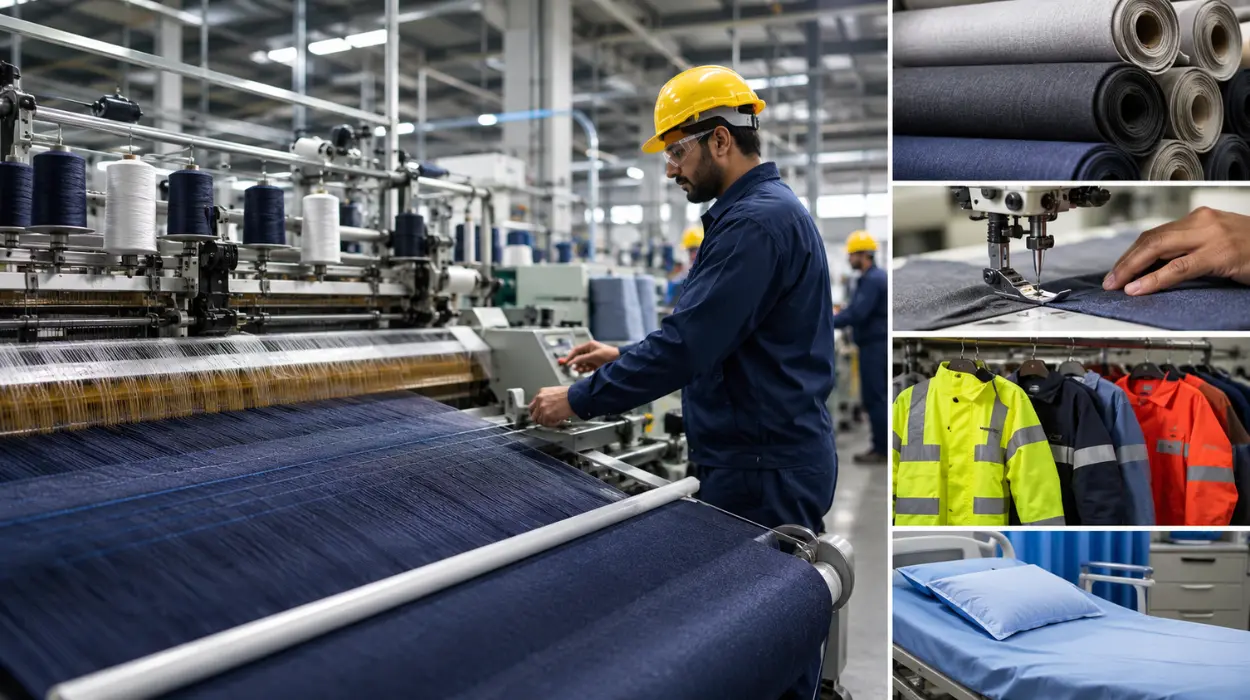
Textile manufacturers develop products for different industries by adapting fibres, structures, finishes, performance specifications and testing requirements to each end use.
They evaluate the target industry’s functional demands before selecting materials, production methods and quality standards.
How do textile manufacturers adapt products to different industries?
Manufacturers adapt textile products by starting with the functional requirements of the target industry. A textile designed for healthcare requires different properties from one developed for automotive interiors or construction. Manufacturers analyse durability, weight, moisture control, thermal performance, chemical resistance and safety requirements. They then select suitable fibres, fabric structures, coatings and finishing processes. Product development also considers regulatory standards and customer specifications. This approach separates application-specific textile engineering from general-purpose fabric production.
Textile manufacturers develop industry-specific products by analysing end-use requirements, selecting appropriate fibres and structures, applying functional finishes, and testing performance against technical, regulatory and customer specifications before commercial production.
What factors determine product specifications?
Manufacturers typically evaluate:
- Analyse end-use conditions, such as healthcare exposure or automotive heat.
- Select fibres according to strength, flexibility, absorbency or resistance requirements.
- Engineer fabric structures for the required mechanical and functional performance.
- Apply finishes that provide properties such as flame resistance or water repellence.
- Test finished products against defined industry standards.
A medical textile, for example, can require breathability, fluid resistance and controlled barrier performance. An automotive textile can instead prioritise abrasion resistance, dimensional stability and resistance to sunlight. Construction textiles require structural performance, weather resistance and long service life. The product therefore changes according to the environment in which it operates.
Which textile materials suit different industrial applications?
No single textile material suits every industry because fibre selection directly affects product performance. Cotton provides comfort and moisture absorption, while polyester offers strength, dimensional stability and resistance to many environmental conditions. Polyamide provides high tensile strength and abrasion resistance. Polypropylene offers low density and chemical resistance. Advanced applications can also use aramid, carbon, glass and high-performance polymer fibres.
Fibre selection differs across industries because cotton, polyester, polyamide, polypropylene, aramid, carbon and glass fibres provide distinct combinations of strength, comfort, resistance, weight and thermal performance for specialised textile applications.
How does fibre selection change by application?
Manufacturers compare the required properties with the capabilities of each material.
| Industry | Common product priorities | Suitable material characteristics |
|---|---|---|
| Healthcare | Hygiene, fluid control, comfort | Absorbency, barrier performance, breathability |
| Automotive | Durability, safety, appearance | Abrasion resistance, dimensional stability |
| Construction | Strength, weather resistance | Tensile performance, durability |
| Agriculture | Protection, permeability | UV resistance, controlled porosity |
| Sports | Comfort, flexibility, moisture management | Lightweight construction, stretch and breathability |
| Filtration | Particle separation, durability | Controlled pore structure and chemical resistance |
Technical textiles demonstrate this difference particularly clearly. A filtration fabric cannot be evaluated using the same criteria as clothing fabric because particle retention, permeability and pressure performance become central specifications.
Which product development approach provides greater customisation?
Application-specific development provides greater customisation because manufacturers can engineer the textile around defined performance requirements. Standard products provide faster access to established specifications and production processes. Custom products require additional research, sampling, testing and production validation. They also create more opportunities to modify fibre blends, fabric construction and finishing treatments. The choice depends on whether the buyer needs an established specification or a textile engineered for a specialised application.
Custom textile development enables manufacturers to modify fibres, fabric construction, coatings and finishes around specific industry requirements, while standard products rely on established specifications and generally require fewer development stages.
How does standard development compare with customised development?
Standard development suits applications where established performance requirements already exist. A manufacturer can reproduce a proven fabric specification with controlled variations in weight, colour or finish. Custom development follows a more detailed engineering process. The manufacturer may create laboratory samples before moving into pilot production. Testing then determines whether the product meets the target specification.
For example, an established polyester fabric can serve several apparel applications with limited modification. A technical filtration textile may require a different pore structure, fibre blend and surface treatment for each filtration environment. Customisation therefore increases development complexity while improving application alignment.
Which testing approach is most important for industry-specific textiles?
Performance testing becomes more important as textile products move into safety-critical or technically demanding applications. Apparel products can focus on colourfastness, shrinkage, strength and comfort. Medical textiles require controlled testing for properties such as fluid resistance and breathability. Automotive textiles require testing for abrasion, dimensional stability and environmental exposure. Construction textiles require strength and durability testing. Testing validates whether the product performs according to its intended application rather than merely meeting a general fabric specification.
Industry-specific textile testing measures whether a product delivers its intended performance under defined conditions, including strength, abrasion, moisture, thermal behaviour, chemical exposure, permeability and dimensional stability.
What does testing reveal during product development?
Testing identifies performance gaps before large-scale manufacturing. Manufacturers can compare laboratory results with technical specifications and customer requirements. If a fabric fails a required test, the development team can modify its composition or construction. Testing can therefore influence fibre selection, fabric density, coating formulation and finishing methods. It also creates documented evidence for quality control and regulatory compliance.
Technical textiles often require multiple testing stages because performance depends on several interacting properties. A material can achieve high strength but fail permeability requirements. Another fabric can provide excellent flexibility but lack sufficient resistance to heat or chemicals. Product development must therefore evaluate the complete performance profile.
Which development method is more suitable for technical textiles?
Technical textile development requires a more application-led process than conventional textile development because performance is central to the product’s purpose. Manufacturers begin by identifying the technical problem that the textile must solve. They then define measurable performance requirements. Research and development teams select materials and production technologies that address those requirements. Prototype testing follows before the product enters commercial production. This method differs from fashion-led development, where appearance, seasonal trends and consumer preferences often have greater influence.
Technical textile development follows an application-led process that identifies a functional problem, defines measurable performance requirements, develops prototypes, conducts testing and validates production before commercialisation.
How does technical textile development differ from conventional textiles?
Conventional textile development often balances appearance, comfort, price and production efficiency. Technical textiles prioritise measurable functionality. A medical textile must perform a defined healthcare function. A geotextile must interact effectively with soil, drainage or structural systems. An automotive textile must withstand the operating environment of a vehicle. These requirements demand closer collaboration between textile engineers, material specialists and industry users.
The Indian technical textile sector illustrates the breadth of this application model. Technical textiles serve areas including agriculture, healthcare, automotive, construction, industrial safety and other specialised fields. Industry development programmes also distinguish segments such as medical, protective, geosynthetic and industrial textiles.
Which production method supports greater product flexibility?
Flexible production methods support greater variation because manufacturers can adjust fabric construction, finishing and processing parameters for different specifications. Large-scale standardised production improves consistency and efficiency when demand remains predictable. Smaller production runs support sampling and specialised orders. Manufacturers therefore balance production volume against the level of customisation required. Equipment capability also influences how quickly a textile producer can introduce new specifications.
Flexible textile production supports product variation by allowing manufacturers to adjust construction, finishing and processing parameters, while standardised production prioritises consistency, efficiency and repeatable specifications at larger volumes.
How do manufacturers balance flexibility and efficiency?
Manufacturers can separate development from mass production through laboratory trials and pilot batches. This approach allows technical teams to validate a product before committing substantial production capacity. Once specifications are approved, manufacturers can standardise the process for repeat production.
The balance becomes more complex when products serve several industries. A manufacturer producing coated fabrics, for example, may need different coating formulations for construction, automotive or protective applications. Production planning must account for material changes, equipment settings, testing requirements and cleaning procedures between specifications.
Which approach creates stronger product differentiation?
Application-specific innovation creates stronger differentiation when the textile solves a clearly defined industry problem. Standard fabrics compete largely through price, availability, quality and consistency. Specialised textiles compete through measurable functionality and application performance. Manufacturers can differentiate through new fibre combinations, engineered structures, advanced coatings, smart textiles or improved sustainability characteristics. Research and development therefore becomes a central part of product positioning in specialised textile markets.
Industry-specific textile innovation creates differentiation by combining specialised materials, engineered structures, functional finishes and measurable performance characteristics that address defined problems across healthcare, automotive, construction and other sectors.
How does innovation affect market opportunities?
Manufacturers can expand into new industries by adapting existing technologies to different applications. A material developed for one technical purpose can sometimes be redesigned for another sector. For example, engineered fibres and nonwoven structures can support applications involving filtration, acoustic performance and thermal management. Recent technical textile developments demonstrate how engineered fibres can address several functional requirements across different industrial applications.
This strategy requires market research alongside technical development. Manufacturers must understand the customer’s operating environment before adapting an existing textile. They also need to evaluate testing requirements, production feasibility and commercial demand. Product innovation therefore combines engineering decisions with industry-specific market analysis.
How should manufacturers evaluate competing textile development strategies?
Manufacturers should evaluate development strategies against application fit, technical performance, testing requirements, production flexibility, development cost and commercial scalability. Standardised products provide repeatability and established manufacturing processes. Customised products provide greater alignment with specialised requirements. Technical textiles demand deeper testing and engineering involvement. Flexible production supports experimentation but can increase operational complexity. The most appropriate approach depends on the product’s intended application and commercial requirements.
Textile development strategies should be evaluated through application fit, material performance, testing requirements, production flexibility, development complexity and scalability rather than through product cost alone.
What should a manufacturer compare before selecting an approach?
Manufacturers can compare:
- Define the industry’s functional requirements before selecting materials.
- Compare standard and customised specifications against the intended application.
- Measure performance through relevant laboratory and industry tests.
- Evaluate production capability against required volumes and product variation.
- Calculate development and manufacturing requirements against commercial demand.
- Validate prototypes before approving full-scale production.
This evaluation prevents product development from becoming a purely material-focused exercise. The strongest process connects material science, manufacturing capability, testing and end-user requirements. It also recognises that the same textile technology can require substantial modification when transferred between industries.
How can textile product development support stronger brand visibility?
Product development can support brand visibility when manufacturers communicate measurable innovation through credible industry information. New materials, technical improvements and application-specific solutions provide substantive subjects for earned media. Industry publications can evaluate innovations through technical specifications and market relevance. Press releases can report verified product developments, certifications, launches and partnerships. Digital PR can then connect these developments with the industries that use them.
Textile manufacturers can strengthen brand visibility by communicating verified product innovations, technical developments, certifications and industry applications through relevant earned-media and digital PR channels.
Manufacturers that communicate product development should distinguish technical evidence from promotional claims. A statement about improved durability, for example, should identify the tested performance measure rather than use an unsupported superlative. This creates more useful information for journalists, buyers and industry audiences.
A broader discussion of building brand visibility through earned media can explain how manufacturers turn substantive business developments into media-relevant stories. The same principle applies to textile innovation: the product development itself provides the evidence, while the distribution strategy determines how relevant audiences encounter that information.
For manufacturers evaluating PR approaches, promoting products through news distribution can provide the next consideration-stage link between product development and external media communication. A product story becomes more useful when its technical relevance, industry application and supporting evidence are clearly presented.
What should textile manufacturers consider when developing products for multiple industries?
Manufacturers should align every product with its specific application, measurable performance requirements and production capabilities. Different industries impose different expectations for durability, safety, comfort, resistance and functionality. Material selection must therefore follow the application rather than precede it. Testing should verify the properties that matter to the target industry. Production methods must support the required degree of customisation and scale. Communication should report verified technical developments without replacing evidence with promotional language.
The evaluation ultimately involves several connected decisions rather than one universal development model. Standard textiles can provide efficiency and consistency. Customised textiles provide application-specific performance. Technical textiles require deeper engineering and testing. Flexible manufacturing supports variation, while standardised production supports repeatability. Manufacturers that compare these factors systematically can determine which development model fits each industry, product specification and commercial objective.
Ready to get your story published?
Distribute your press release across 500+ trusted media outlets — with editorial review and a full pickup report within 48 hours.
Send Press Release →