
Press Release Distribution for Product Launches: A 2026 Guide
A product launch can reach hundreds of outlets and still miss the people most likely to care. Press release distribution for product launches works best as a planned route to a defined audience, not a one-off announcement. Choosing relevant sectors, professions and readers matters as much as getting the news out. It also helps to distinguish a distribution placement from independent media coverage.
Before a launch goes live, set clear expectations about what distribution can deliver. A guaranteed placement means publication through a distribution network; it is not the same as a journalist independently choosing to cover the product. Newswire Now Media Group’s editorially reviewed distribution reaches more than 500 trusted news outlets across 27 industry sectors and 37 professions, alongside an independent network of over 40 owned publications. This guide covers how to define your audience, plan timing, understand placements and use pickup reporting to assess results.
Key Takeaways
- Set one clear launch objective, such as trade visibility or directing readers to product information, before choosing where to distribute.
- For press release distribution for product launches, prioritise audiences and sectors relevant to your product rather than reach alone.
- Schedule distribution around announcement readiness, product availability details, approvals and any embargo arrangements.
- Assess results against your objective by reviewing pickup records, outlet relevance and publication context, not just the number of placements.
- Newswire Now Media Group’s editorial review and distribution network can support a structured product announcement.
Why product launch press release distribution needs a clear objective
Product launch distribution sends an announcement through selected media and publication networks. The aim is not simply to send a release as widely as possible. It is to put the news in front of relevant audiences and explain why it matters now. Start by understanding the format and purpose of a press release, then decide what you need the announcement to achieve.
Set your objective before choosing distribution reach. A launch might aim to build general awareness, reach trade buyers and industry professionals, attract investor attention or direct potential customers to detailed product information. Each goal calls for a different audience and different measures of progress. Trying to pursue all of them equally can make a campaign unfocused and its results difficult to interpret.
Distribution puts an announcement in front of selected networks; earned media happens when journalists independently choose to report on it. A placement is not evidence of independent editorial interest, and distribution alone cannot promise coverage or sales. Keep the distinction clear when setting expectations and reviewing results.
- Awareness: Review delivery evidence and activity in relevant publications.
- Trade visibility: Look for placements in outlets serving the product’s professional market.
- Investor attention: Track relevant enquiries or engagement with investor information.
- Product information: Assess visits to the product page and other intended reader actions.
Which product launches justify a press release?
A genuinely new product, a useful innovation or a change with a clear effect on its market can give editors a reason to consider an announcement. A minor update or routine promotional claim may have little news value on its own. Ask what has changed, who will care and why the information matters now. A specific news angle helps editors assess relevance instead of asking them to infer it from sales language.
Set a measurable launch objective before distribution
Choose one primary outcome and supporting indicators before the release goes live. At the announcement stage, the priority might be awareness among a defined audience. Once the product is available, you might focus on visits to product information or relevant enquiries. A market expansion could centre on visibility in appropriate trade sectors. These measures do not prove distribution caused a sale, but they give you a clearer basis for assessing activity.
Define success in observable terms, then make sure the release and its destination support that aim. For broader guidance on planning reach and distribution in the UK, see the UK press release distribution guide. With an objective in place, you can select audiences and outlets more deliberately.
How to target product launch distribution to relevant outlets
A launch announcement is more useful when its route to readers reflects who needs to hear the news. For press release distribution for product launches, start with the product’s intended use and your launch objective, then narrow the audience before choosing distribution reach. A large outlet count may look impressive, but it does not show whether the announcement reached readers who can understand, use or influence adoption of the product.
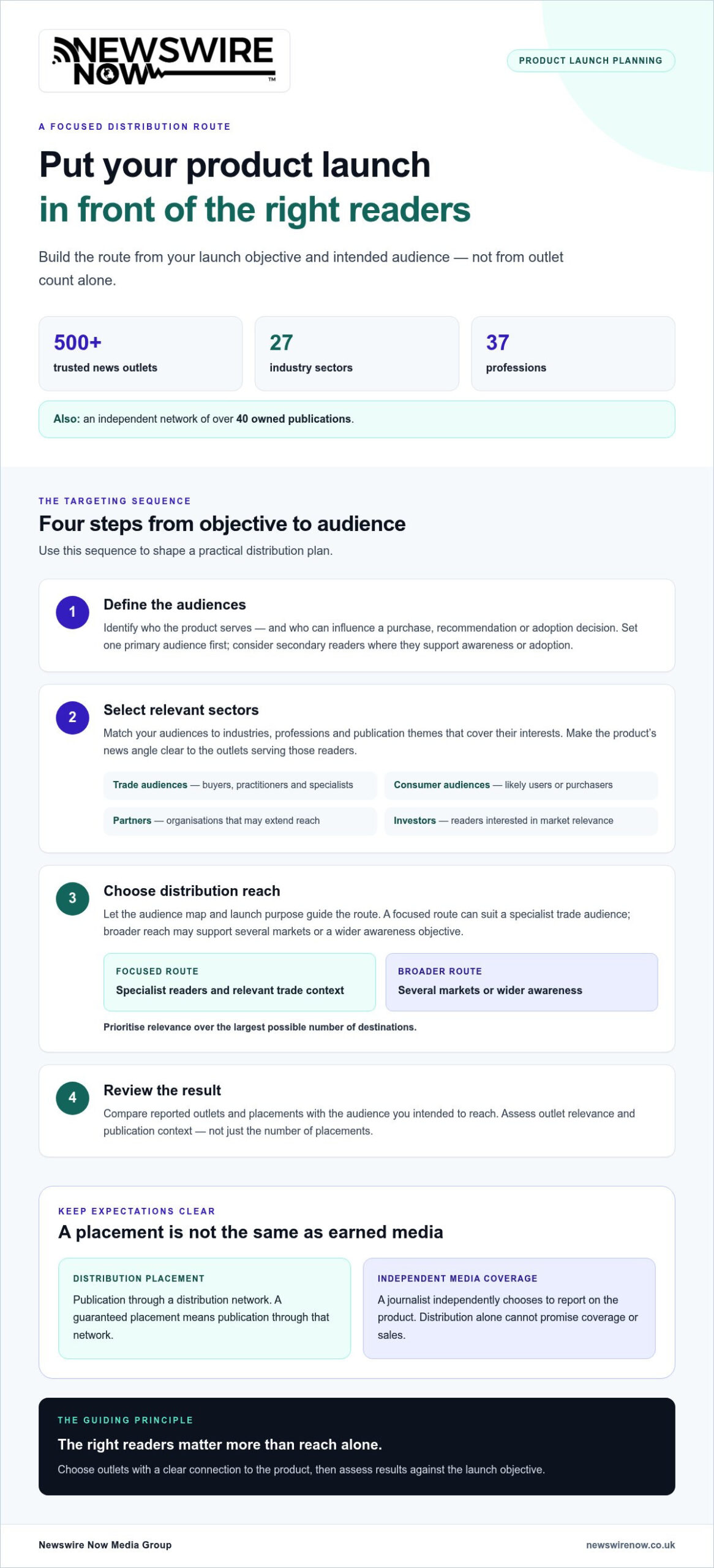
Use this sequence to turn your objective into a practical distribution plan:
- Define the audiences. Identify who the product serves and who can influence a purchase, recommendation or adoption decision.
- Select relevant sectors. Match those audiences to industries, professions and publication themes that cover their interests.
- Choose distribution reach. Prioritise focused sector relevance or broader visibility according to the launch’s purpose.
- Review the result. Compare reported outlets and placements with the audience you intended to reach.
Build the launch audience and sector map
Start with the product’s use case. A new workplace tool, for example, may be most relevant to a particular professional group, while a consumer product may suit publications aimed at its likely users. Treat these as separate audience paths, not interchangeable lists. Identify the primary audience first, then consider secondary readers such as partners or industry commentators who may support awareness or adoption.
Group potential readers before distribution:
- Trade audiences: buyers, practitioners and specialists in the product’s sector.
- Consumer audiences: people likely to use or purchase the product.
- Partners: organisations that may support or extend its reach.
- Investors: readers for whom the product’s market relevance may matter.
Not every group will suit every launch. Prioritise readers with a clear connection to the product, and make the release’s news angle easy for the outlets serving them to recognise.
Choose distribution reach that fits the launch
A focused distribution route can suit a launch aimed at a specialist trade audience. Broader reach may better support a product intended for several markets or a wider awareness objective. Let the audience map guide this choice rather than defaulting to the largest possible number of destinations. Publication relevance matters: a placement in a suitable sector context is more meaningful than an unrelated appearance.
Newswire Now distributes releases to more than 500 trusted news outlets across 27 industry sectors and 37 professions. This breadth gives you options for aligning a release with relevant audiences, but not every outlet will suit every product, and distribution does not guarantee independent coverage. For a wider overview of service approaches, the small-business news wire comparison offers additional context. Newswire Now’s press release distribution supports launch planning built around sector relevance and editorial review.
When to distribute a product launch release, and what coverage guarantees mean
Timing belongs in the launch plan from the start. Schedule press release distribution for product launches once the announcement is accurate, approved and useful to its intended readers. Sending it too early can leave audiences without clear availability information. Sending it after the launch activity has passed may make it less relevant. Build the schedule around the facts readers need and the point at which they can act on them.
Coordinate the announcement with product readiness
Before setting a distribution date, align the release with the product’s launch stage. Confirm the announcement details, availability information and the destination page or contact route readers will need. Allow time for internal approvals, including checks on performance statements and other claims, so the published information is supportable and consistent across channels.
An embargo can help when selected recipients need information ahead of a coordinated announcement, but it is not necessary for every launch. If you use one, make the timing and conditions clear to recipients, and ensure the release is ready for publication when the embargo lifts. A simple schedule can help:
- Before distribution: Finalise confirmed facts, approvals and reader-facing information.
- At announcement: Align distribution with the date the news is intended to become public.
- After release: Review delivery evidence and any independent coverage separately.
Set realistic expectations for placements and earned coverage
A placement guarantee and an editorial decision are different commitments. Newswire Now includes guaranteed placements in its distribution service. This refers to distribution placements, not a promise that an independent journalist will write about the product. It does not guarantee audience response, enquiries or sales either. Make the distinction clear in launch plans and reports, so your team can assess what the service delivered without treating placement as proof of wider market impact.
Separate these three outcomes when reviewing results:
| Outcome | What it means | What it doesn’t establish |
|---|---|---|
| Distribution delivery | The release is placed through the agreed distribution service. | That a journalist independently selected the story or readers acted on it. |
| Editorial consideration | An editor or journalist may assess the announcement for possible coverage. | That coverage will be commissioned or published. |
| Earned coverage | A publication independently reports on the launch. | That distribution alone caused the coverage or generated sales. |
For a broader explanation of how placement commitments differ from editorial outcomes, see the guaranteed media placement guide. Treat each result according to what it represents: delivery confirms distribution, while independent coverage and commercial response are separate measures.
How to assess product launch distribution results
Assess results against the objective you set before distribution, rather than assuming success means sales or widespread attention. Separate delivery evidence, which shows where a release was placed or picked up, from business outcomes such as enquiries or product-page visits. This keeps reporting useful and stops activity being mistaken for impact.
Read pickup reports in the context of launch goals
Newswire Now provides a media pickup report within 48 hours. Use it to review reported pickups and judge whether the outlets and publication contexts match your intended audience. A mention in a relevant trade publication may matter more to a specialist launch than several appearances in less relevant places. The press release pickup report guide can help you interpret this evidence.
Review each reported result for:
- Relevance: Does the outlet serve the intended sector, profession or reader group?
- Context: Is the release a distribution placement, or has a journalist independently developed a story?
- Usefulness: Does the appearance make the launch information accessible to a meaningful audience?
- Objective fit: Does the result support the awareness, trade visibility or information goal you set?
A pickup report records distribution activity and reported placements. Campaign analytics can show reader behaviour only where relevant tracking is in place. Neither alone proves that the launch generated sales, changed sentiment, earned valuable backlinks or improved search rankings.
Connect distribution evidence with campaign measures
After reviewing delivery, compare it with measures tied to your original objective. If the release links to a product page and tracking is configured, review referral visits during the launch period. If your goal is to prompt interest, consider relevant enquiries, while recognising that people may have discovered the product through other channels. Record the measurement period and any concurrent campaign activity, so you do not attribute results to distribution without evidence.
For an awareness objective, outlet relevance and publication context may tell you more than raw mentions. For an availability announcement, tracked visits or enquiries can add useful context. Treat these as complementary indicators, not proof of cause and effect. If other marketing is active, including email or social activity, note its timing when reviewing changes in traffic or engagement. A coordinated news amplification strategy can help organise those supporting channels.
To assess your next launch with clear delivery evidence, explore Newswire Now’s media pickup reporting alongside press release distribution.
Plan product launch press release distribution with Newswire Now
A clear launch objective gives distribution a practical starting point. Newswire Now supports press release distribution for product launches through a defined process: submit the announcement, receive editorial review, distribute it through the network and review the pickup report. This gives you a way to plan for delivery and assess the resulting placements without treating them as a promise of independent media coverage or sales.
Before submission, organise the release around the launch facts and audience you have identified. A clear product description, confirmed availability details and relevant news angle help the announcement serve its intended readers. Editorial review takes place before distribution. The release is then distributed through Newswire Now’s network of more than 500 trusted news outlets and over 40 owned publications, spanning 27 industry sectors and 37 professions. That breadth provides sector options, but not every outlet will suit every product.
What happens after a launch release is submitted?
Submitted releases receive editorial review before distribution. The process moves from review to placement across the network, followed by reported pickups for assessment. Newswire Now provides a pickup report within 48 hours. Use it to examine reported distribution activity and outlet relevance, while keeping placement delivery distinct from independent journalists choosing to publish their own coverage.
The sequence is straightforward:
- Submit: Provide the launch announcement for distribution.
- Review: The release receives editorial review before distribution.
- Distribute: The announcement is placed through relevant distribution pathways in the network.
- Assess: Review the pickup report against your launch objective and intended audience.
Choose a distribution option for a launch cadence
A single-release distribution can suit a standalone announcement, such as introducing a new product or confirming its availability. Businesses planning several distinct announcements may find multi-release distribution bundles better suited to a recurring launch cadence. For example, separate product introductions across a year may each need their own timely announcement and review, rather than being combined in one release.
Choose the option that fits the number and timing of announcements you expect to distribute. Tie each release to a specific development and audience, then assess each report against its own objective. Guaranteed placements relate to distribution delivery; they do not guarantee independent editorial coverage, reader response or commercial results.
Put your launch plan into action with product launch distribution through Newswire Now. A focused objective, editorially reviewed release and clear pickup reporting give your team a structured basis for distributing and assessing the announcement.
Make your next launch more deliberate
Press release distribution for product launches becomes more useful when each announcement informs the next. After the campaign, record which audiences mattered most, what questions readers raised and which product details needed clearer explanation. Use those observations to refine future launch messages and choose a more focused objective for your next announcement.
Treat distribution as one part of a wider launch plan. Coordinate the release with the product page, email activity and social channels so interested readers can find consistent information wherever they encounter the news. A clear handover between the people managing communications, product details and measurement also makes the plan easier to deliver.
With a defined objective and a realistic view of what distribution can achieve, you can move from planning to a practical route for announcing your product. Explore product launch press release distribution through Newswire Now and take the next step with a plan built around your announcement. Use a focused objective, relevant audiences and pickup reporting to organise and assess your launch.
Frequently Asked Questions
When should I distribute a product launch press release?
Distribute it once the announcement has been approved and the information readers need is ready. For press release distribution for product launches, plan around the public announcement date, not simply the day the product team finishes development. Coordinate release timing with the product page and customer-facing information so interested readers can find accurate details. Build in time for internal sign-off, particularly when several teams own the claims or launch information.
Can a press release distribution service guarantee media coverage?
No service can guarantee that independent journalists will choose to report on your launch. Some services offer guaranteed distribution placements, subject to their terms, but that is distinct from earned editorial coverage. A release may be published through a distribution network without a journalist writing a separate story. Treat placement delivery as one result and assess independent coverage separately.
What makes a product launch newsworthy to journalists?
A launch is more likely to merit consideration when it offers a clear development with relevance beyond the company itself. Explain what is new, who may benefit and why the change matters now. A product addressing a defined user problem or introducing a meaningful improvement may offer a stronger angle than a routine update. Support claims with specific, substantiated details, and avoid broad promotional language such as “best” without evidence.
How do I measure the success of product launch distribution?
Choose measures that reflect the launch goal, then compare them with a suitable starting point. For example, use tagged links and web analytics to assess visits from a release, or record relevant enquiries if generating interest is the priority. Note other activity running at the same time, such as email or social promotion. These indicators can show patterns, but they do not establish that distribution alone caused a visit, enquiry or sale.
Should I distribute a product launch release before the product is available?
You can distribute before availability if the purpose is to announce what is coming and the timing is clear. State whether readers can buy, register interest or simply learn about the forthcoming product, and ensure the release does not imply that it is already on sale. If publication is coordinated under an embargo, communicate the agreed release time clearly. If key details are still changing, wait until the announcement is accurate.
What should a product launch pickup report tell me?
A pickup report should help you identify where the release appeared and assess whether those publications match your intended audience. Review the outlet, the context of the appearance and whether it is a distribution placement or independent reporting. Then compare the record with your launch objective. The report documents pickup activity, but it does not by itself show how many readers visited your site, what they thought or whether they purchased.
Ready to get your story published?
Distribute your press release across 500+ trusted media outlets — with editorial review and a full pickup report within 48 hours.
Send Press Release →