How to Get a Press Release on Google News in 2026

Can you submit a press release directly to Google News? No. Google News isn’t a submissions inbox, and a release appearing on a news website doesn’t automatically mean Google will surface it. If you’re researching how to get press release on Google News, the important distinction is between distributing a release to publishers and Google independently discovering and selecting content for its news surfaces.
That difference matters when you compare distribution promises. A guaranteed media placement can mean a release is published by an outlet; it cannot guarantee Google News inclusion, ranking or traffic. Google’s process is automated, so the outcome depends on its systems, the content and the publisher, not simply on sending a release to a service.
This guide explains how those routes work, what you can influence and how to prepare a credible, useful announcement for publishers to assess. It also shows how to compare distribution deliverables and reporting, including editorial review, publisher reach and pickup reports, without confusing media placement with Google News visibility.
Key Takeaways
- Understand how to get press release on Google News by focusing on publisher publication and discovery, rather than looking for a direct submission route.
- Assess a release in context: clear sourcing, accurate attribution and a transparent publisher identity can strengthen its credibility.
- Separate publisher placement, crawling, indexing and Google News appearance to see what each stage does, and doesn’t, confirm.
- Shape your announcement around a timely, specific development with a clear public-interest or industry-relevant angle.
- Use editorially reviewed distribution to seek publisher consideration, then review pickup reporting to understand the outcomes.
How Google News finds press releases, and what “getting on Google News” means
There’s no standard form for submitting a press release directly to Google News. Publishers decide what to publish on their own websites; Google’s systems then discover and assess online content for possible visibility across its products. A distribution service can deliver a release to publishers, but it can’t buy or promise Google’s decision.
That distinction is central to understanding how to get press release on Google News. “Getting on Google News” means a published item may be selected for display in a Google News experience. It isn’t a special paid label attached to a release, and a media placement alone doesn’t confirm that Google has crawled, indexed or displayed the page.
In brief: a media placement is publication by an outlet; Google News inclusion is a separate decision by Google’s systems to surface that content. The Google News Wikipedia overview explains the service’s role as a news aggregator, but current policy details should come from Google’s official News policies and Publisher Center guidance.
Can you submit a press release directly to Google News?
No standard direct-submission route lets a business send an individual release to Google News and secure its inclusion. Google’s Publisher Center provides information and tools for publishers, but it isn’t a way to guarantee that a particular release will appear. The practical route is publication on a website, followed by the possibility that Google discovers and considers the page. As policies and publisher guidance can change, use Google’s current official documentation rather than relying on a distributor’s description of a submission process.
Google News, Google Search and publisher websites are different
A publisher’s website is where an article is first published. Google Search helps people find webpages in response to searches; Google News is a separate news experience that selects and organises news content. A page’s appearance in one destination doesn’t establish that it will appear in the others. Crawling means Google has accessed a page, while indexing means it may be stored for retrieval. Neither step guarantees a Google News appearance.
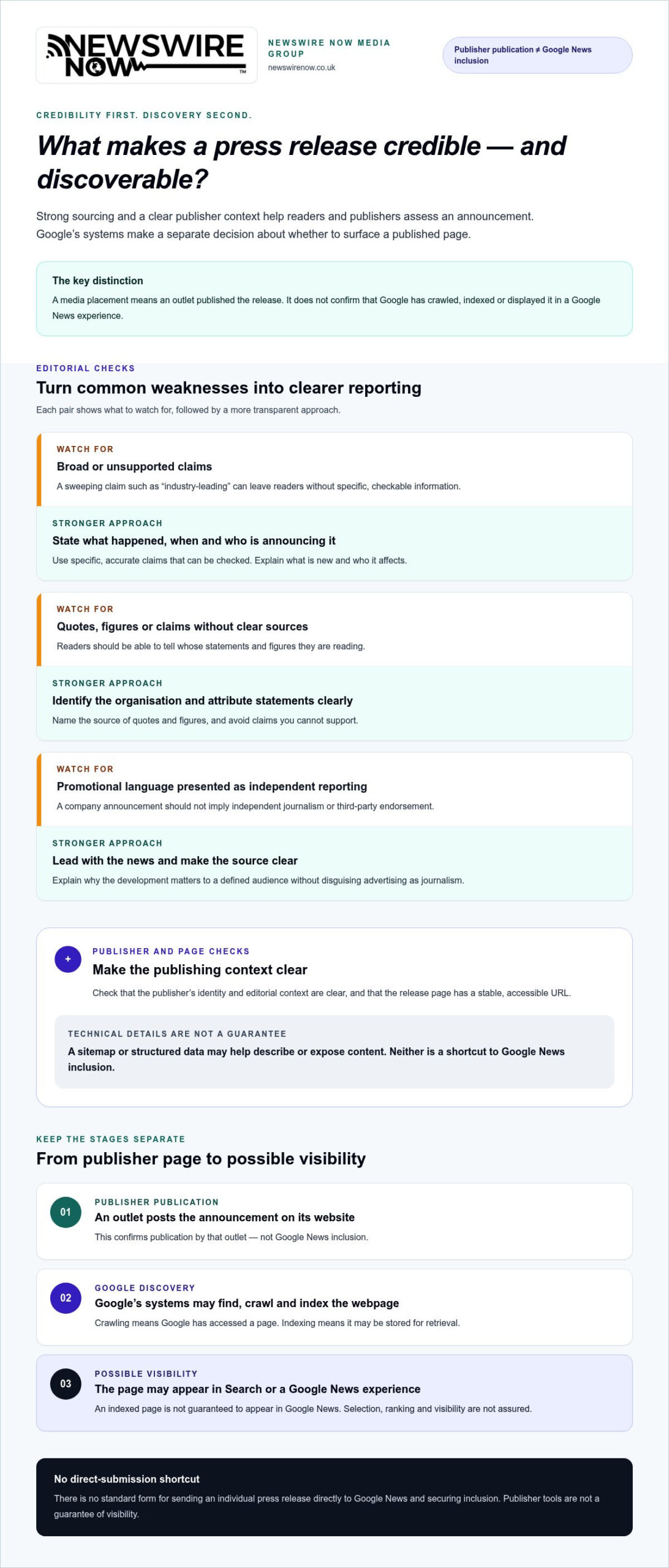
Consider this three-stage sequence:
- Publisher publication: An outlet posts a company announcement on its website.
- Google discovery: Google’s systems find the webpage and may crawl and index it.
- Possible visibility: The page may appear in Search or a Google News experience, but selection isn’t assured.
Each stage has a different outcome. A release can be live on an outlet’s site without being indexed, and an indexed page can remain absent from Google News. Distribution can support publisher consideration and publication, but it cannot control crawling, indexing, ranking or selection. Assess delivery against the placements and reporting actually provided, rather than assuming a Google News result will follow.
What makes a publisher’s press release suitable for Google News discovery?
A release’s prospects depend on more than its wording. The publishing context matters too: who publishes it, how clearly the page identifies its source, and whether the content gives readers a useful, credible account of a development. A polished release on a site with unclear ownership is not the same as transparent, well-sourced material published in a clear editorial context.
Keep two questions separate: Is this a credible, relevant announcement? and Can Google’s systems discover the published page? Strong editorial standards help readers and publishers assess content. Technical accessibility can help systems find it. Neither guarantees that Google News will display it. For current guidance, check Google’s official Google News content policies and Publisher Center documentation. Details can change.
Editorial signals that help readers and publishers assess a release
Make the substance verifiable. State what happened, when it happened and who is making the announcement. Attribute quotes and figures to their sources, and avoid claims you can’t support. A product launch, for example, is more informative when it explains what is new and who it affects, rather than relying on broad claims such as “industry-leading”.
Lead with the news, not promotional language. A company announcement can accurately describe the company’s own news, but it shouldn’t be presented as independent reporting or imply third-party endorsement. Clear attribution lets readers understand whose claims they’re reading.
- Use specific, accurate claims that can be checked.
- Identify the organisation behind the announcement and attribute statements clearly.
- Explain why the development matters to a defined audience, without disguising advertising as journalism.
Publisher and technical signals to verify before publication
Check that the publisher’s site makes its identity and editorial context clear, and that the release page has a stable, accessible URL. Google Publisher Center is a publisher tool, not a submission form that secures visibility for an individual announcement. A sitemap or structured data may help describe or expose content, but neither is a shortcut to Google News inclusion. Follow Google’s current documentation rather than treating any technical checklist as a guarantee.
Review the release and destination page together before distribution. Does the page make clear who published it? Can a reader distinguish company statements from independently verified information? Are the central facts consistent across the headline, body and supporting material? These checks improve clarity and credibility, but the decision to surface content remains with Google’s systems.
Editorial review can help identify unclear claims and prepare a release for publisher consideration. Newswire Now Media Group provides editorially reviewed press release distribution, a route to media placements rather than a promise of Google News visibility. If you’re preparing a release for distribution, editorial review and press release distribution can support a considered path to publisher assessment.
Why distribution does not guarantee a Google News result
Paying to distribute a press release can secure defined distribution or placement deliverables, depending on the service terms. It doesn’t buy Google’s decision to crawl a page, index it or show it in Google News. These are separate stages, controlled by different parties, and one result doesn’t automatically trigger the next.
That’s the distinction to keep in view when researching how to get press release on Google News: a publisher placement is a media outcome; Google News visibility is a platform outcome. Even if an outlet publishes a release, Google may not crawl or index the page, and an indexed page may not appear in Google News.
| Stage | Who controls it? | What it means |
|---|---|---|
| Publisher placement | The publisher and distribution service, within agreed terms | The release is distributed to or published by an outlet. |
| Google crawling | Google’s automated systems | Google accesses the published page. This alone doesn’t mean it will be indexed. |
| Indexing | Google’s systems | The page may be stored for retrieval in Search. Indexing doesn’t guarantee News visibility. |
| Google News appearance | Google’s systems | The content may be selected to appear in a Google News experience. Placement elsewhere doesn’t ensure this. |
What a placement guarantee can, and cannot, mean
A placement guarantee refers to the service’s stated deliverable, such as publication or distribution on an agreed outlet, subject to its terms. It isn’t a guarantee that Google will recognise the page as news, include it in Google News, rank it in Search, generate clicks or secure further media coverage. Publication by an outlet also doesn’t amount to Google endorsement. Read the promised deliverable precisely: a guarantee is only as broad as the service terms say it is.
A guaranteed publisher placement guarantees the stated media deliverable, not Google News inclusion, ranking or traffic. This is the clearest way to assess claims that connect paid distribution with platform visibility.
How to interpret a pickup report
A pickup report helps you review distribution outcomes, such as where a release was published or picked up. It isn’t a Google ranking report, and it doesn’t by itself confirm that Google crawled, indexed or displayed each page. Newswire Now Media Group provides a pickup report within 48 hours, so clients can review reported outcomes without mistaking them for a platform result.
For a clearer framework for assessing distribution deliverables and reporting, consult this press release distribution guide. Keep publisher evidence separate from Google visibility evidence, and assess each against the outcome it actually documents.
How to prepare a press release for publisher review and discovery
A clear, relevant release gives publishers a stronger basis for assessing your announcement and helps readers understand it quickly. It can’t guarantee Google News visibility, but careful preparation can reduce avoidable questions about the facts, the source and the news angle. Start with the announcement itself, not a list of keywords or promotional claims.
Use this sequence to prepare the material:
- Identify the news. Choose a timely, specific development and explain why it matters to the public or a defined industry audience.
- State the core facts. Establish who did what, when it happened and what changes as a result.
- Support each claim. Attribute quotes, statistics and other material claims, and provide context so they can be assessed.
- Check the destination and details. Make sure the release and its publisher information are accurate and easy to follow.
A focused release structure publishers can assess quickly
Make the headline factual and specific. Avoid unsupported superlatives such as “revolutionary”, and don’t repeat the target phrase unnaturally in an attempt to influence search systems. The opening should deliver the essential announcement straight away; the following paragraphs can add context, evidence and relevant quotes. Keep the organisation’s statements clearly attributed so readers can distinguish them from independently verified reporting.
A useful test is whether the central news can be summarised in one verifiable sentence. For example: “The organisation has opened a new research facility, adding capacity for its published programme of materials testing.” Use only details you can substantiate, and don’t add an outcome or significance that the evidence doesn’t support.
A final accuracy and distribution check
Before submitting the release, review every detail a publisher may need to verify. Check names, job titles, dates, figures, links and quote approvals. Confirm you have permission to use any supplied material, and make sure the linked destination reflects the announcement accurately. Small inconsistencies can undermine confidence in an otherwise clear release.
Then consider the audience. Select relevant sectors and professional groups rather than pursuing maximum reach among outlets unlikely to find the news useful. A focused distribution plan gives publishers a clearer reason to assess the announcement. If you’re planning follow-up activity, the guide to amplifying news on social media can help you think beyond the initial release.
These steps make a release more accurate and ready for publisher review, but they don’t guarantee a Google News appearance. Newswire Now Media Group provides editorially reviewed press release distribution to support publisher consideration. Distribute an editorially reviewed press release to put a clear, carefully prepared announcement before relevant outlets.
How press release distribution can create a credible route to Google News visibility
Distribution can put a release before publishers for consideration; it isn’t a direct submission to Google. For organisations exploring how to get press release on Google News, distribution is one part of a wider process: prepare a credible announcement, put it in front of relevant outlets and let Google’s systems make their own decisions about discovery and visibility.
Newswire Now Media Group carries out editorial review before distribution, helping prepare releases for publisher consideration. Its independent network includes more than 40 owned publications reaching millions of readers worldwide, alongside more than 500 trusted news outlets across 27 industry sectors and 37 professions. That breadth gives organisations a route to audiences across different fields; it doesn’t mean every outlet will publish every release or that Google will feature a published item.
What an editorially reviewed distribution process can provide
Editorial review and distribution are service activities. Placements, where provided under the applicable service terms, and a pickup report are measurable outcomes to assess. Google crawling, indexing, ranking and Google News appearance are separate platform outcomes, not deliverables that follow automatically from publication.
Newswire Now Media Group provides a pickup report within 48 hours, helping clients review distribution outcomes. The service also includes a money-back guarantee under its stated terms. Neither that guarantee nor guaranteed placements should be read as a promise of Google News inclusion, search ranking, clicks or further coverage. Keep the distinction clear when setting campaign objectives and evaluating results.
Choose a distribution route with clear outcome expectations
Start with the announcement and the audience it needs to reach. A specialist industry development may be better matched to relevant professional or sector outlets than to an indiscriminate list. Consider whether the distribution route’s audience and stated deliverables fit the news, then define success in terms the service can document, such as agreed placements and reported pickups. Treat potential Google visibility as a possibility, not a guaranteed delivery outcome.
The network’s coverage across 27 industry sectors and 37 professions offers a concrete basis for considering audience relevance. Its scale describes the distribution network, not a promise that every outlet is suitable for every release. A focused match between announcement and audience supports a more credible publisher approach than reach alone.
In practice, distribution creates a credible route by connecting a prepared announcement with publishers that may consider it. Editorial review supports readiness; the network provides access; reporting records outcomes. Google retains control over whether a page is crawled, indexed or surfaced in Google News. Keep those boundaries explicit in your expectations.
For a publisher-focused distribution route with editorial review and reporting, distribute your press release.
Turn your announcement into a considered media opportunity
Approach Google News as a possible outcome, not a campaign promise. Give a timely, well-supported announcement a clear route to relevant publishers, then assess the results against what distribution actually delivers. This keeps expectations grounded while helping you build a more deliberate media presence over time.
Newswire Now Media Group provides editorial review and distribution through more than 40 owned publications reaching millions of readers worldwide, alongside more than 500 trusted outlets across 27 industry sectors and 37 professions. A pickup report is provided within 48 hours. These are distribution and reporting deliverables, not assurances of Google News inclusion, ranking or traffic.
If your announcement is ready for publisher consideration, distribute your press release through Newswire Now. Set a clear audience and a measurable media objective, and give your news the opportunity to reach the right readers.
Frequently Asked Questions
Can I submit a press release directly to Google News?
No. Businesses don’t have a standard form for submitting individual releases to Google News. A publisher first decides whether to publish the announcement; Google may then discover the resulting webpage. Sending a release through a distribution service is a separate step, aimed at publisher consideration. If a provider describes a Google submission or guaranteed appearance, compare the exact service terms with Google’s current official guidance.
How do I get a press release picked up by Google News?
You can’t control whether Google News selects a particular release. Improve its readiness for publisher consideration by making the news timely, relevant and easy to verify, then distribute it to outlets that cover the subject. For instance, an announcement about a new research partnership is more useful to specialist readers if it clearly explains the partners, purpose and evidence. Treat a Google News appearance as a possibility, not a deliverable.
Does Google Publisher Center guarantee inclusion in Google News?
No. A Publisher Center account or publisher tool doesn’t guarantee that an individual page will appear in Google News, rank in Search or attract traffic. The tools have a publisher-facing role, so don’t treat account access as approval of every article. Before acting on a particular feature or requirement, consult Google’s current Publisher Center documentation and content policies, as the platform’s processes and guidance may change.
Can a press release appear on Google News without being submitted directly?
Yes, it may be discovered after a publisher puts the release online, without a direct submission to Google. For example, an outlet could publish an announcement on its website, where Google’s systems may later find it. That doesn’t mean the page will necessarily be indexed or shown in Google News. Keep the published page accessible and clearly attributed, but don’t treat those steps as a guarantee of discovery or selection.
Does press release distribution guarantee Google News coverage?
No. Distribution can provide service deliverables defined by its terms, such as specified media placements, but those don’t guarantee Google News coverage. Google controls its own selection systems, and an outlet’s decision to publish isn’t an endorsement by Google. Before purchasing distribution, distinguish between what the provider promises to deliver and what you hope Google may do with the published page.
How long does it take for Google News to pick up a press release?
There’s no universal pickup timeframe, and Google News appearance isn’t assured. Timing can vary depending on when an outlet publishes the release and whether Google’s systems discover and select the page. If you’re working to a launch date, plan distribution around the announcement and allow time for publisher decisions. A service report can document its stated distribution outcomes, but it can’t establish a Google News pickup unless it specifically verifies that result.
What should a press release include to improve its chances of being published?
Include a specific headline, a direct opening that explains the announcement and supporting details a publisher can assess. Name the people and organisations involved, clarify dates and figures, and attribute quotes to their speakers. For a product launch, state what has changed and when it becomes available rather than relying on claims such as “best in the market”. These choices support clarity, but can’t guarantee publication or Google visibility.
Ready to get your story published?
Distribute your press release across 500+ trusted media outlets — with editorial review and a full pickup report within 48 hours.
Send Press Release →