
How to Follow Up a Press Release and When to Wait

Wait 2–3 business days before sending your first follow-up on a press release. Knowing how to follow up on a press release means giving a journalist time to review the story, then sending a concise, useful email rather than repeatedly chasing a reply.
It’s understandable to want an answer quickly after sharing an announcement, but a well-timed, relevant message is more likely to protect the relationship than an immediate nudge. If the story has a firm deadline or genuinely new information, explain that clearly. Otherwise, keep the follow-up polite and measured.
This guide explains when to follow up, whether to use email, phone or social media, and what campaign details or interview availability to include. It also covers when to stop, so each contact adds context and helps build a lasting working relationship with journalists.
Key Takeaways
- Personalise each follow-up around the journalist’s coverage and the relevance of your story, rather than sending a generic reminder.
- Use email as your main channel, and keep any follow-up brief, clear and useful.
- Make it easy to assess the story by highlighting fresh campaign details, image availability or interview opportunities.
- Set a sensible limit on follow-ups and recognise when it’s time to move on without damaging the relationship.
1. Building long-term journalist relationships
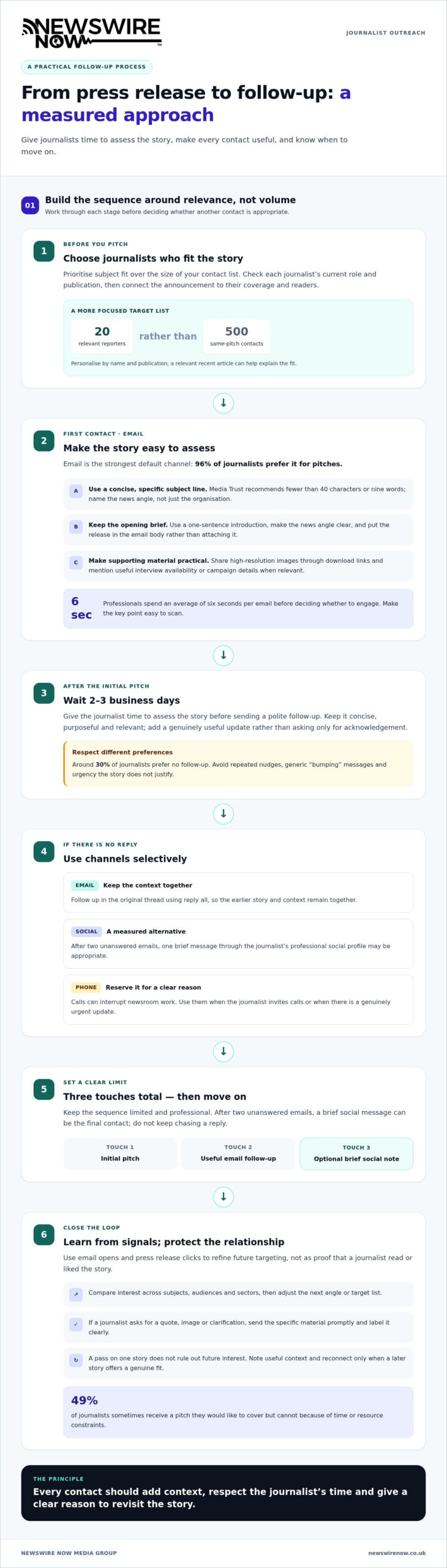
After an initial pitch, wait 2–3 business days before a polite follow-up. This gives the journalist time to assess the story. Around 30% of journalists prefer no follow-up, so keep each contact purposeful and limited. A practical approach to how to follow up on a press release starts with one relevant update, not a request for acknowledgement.
Prioritise fit over volume: target twenty reporters who cover your subject, rather than sending the same pitch to 500 contacts. Check each journalist’s current role and publication before writing. Media Trust recommends personalised emails that address the recipient by name and mention their publication. A reference to a recent article can show why your announcement suits their readers.
Use the journalist’s preferred contact route. If you don’t have a direct email, a publication’s news address can be a practical option; make the intended recipient and story angle clear. Email is generally the main channel for a pitch or follow-up. After two unanswered emails, one brief message through the journalist’s professional social profile may be appropriate. Keep to three touches in total, then move on.
Use reader and campaign analytics to refine your next target list. Review email opens and press release clicks to see which audiences engaged with the subject, then compare that interest with the publications and sectors those readers follow. Treat a click as a signal to investigate, not proof that a particular journalist wants another message. For example, if a sector-focused story draws clicks from relevant readers, prioritise journalists covering that sector next time.
If a journalist requests more information, reply promptly with the specific material they asked for, such as a quote or image. Keep your answer easy to use and make the relevant campaign detail clear. Good etiquette means addressing the journalist by name, staying concise and respecting their preferred channel. Avoid repeated nudges, generic “bumping” messages and claims of urgency that the story doesn’t justify. A useful update gives the journalist a clear reason to revisit the conversation.
2. Should I follow up via email, phone, or social media?
Email is the strongest default: 96% of journalists prefer it for pitches. Keep your follow-up in the original thread with reply all, so the earlier story and context stay together. Phone calls can interrupt newsroom work, so reserve them for journalists who invite calls or for a genuinely urgent update. After unanswered emails, a brief professional message on social media can be a measured alternative.
Make the subject line specific and concise. Media Trust recommends keeping press release email subject lines under 40 characters or nine words. Name the story’s news angle, not just the organisation; for example, “New research reveals changing consumer habits” gives the recipient a clear reason to engage. Keep the introduction to one sentence, then put the release in the email body rather than attaching it. Media Trust also recommends sharing high-resolution images through download links.
Personalise each pitch for UK journalists: use the recipient’s name, name their publication and explain how the story fits their coverage. Refer to a relevant article or audience interest, then make the news angle clear in your opening line. For example, a new apprenticeship programme may suit a publication covering skills and employment better than one focused on unrelated topics.
Use email open rates and press release clicks as signals for refining your next approach, not as proof that a journalist has read or liked the story. Compare engagement across subjects and target groups, then adjust the angle or recipient list. Professionals spend an average of six seconds per email before deciding whether to engage, so make the key point easy to scan. If you’re planning a campaign, explore press release distribution options alongside your journalist outreach.
3. Building long-term media relationships
A journalist’s decision not to cover one story doesn’t rule out future interest. Forty-nine per cent of journalists sometimes receive a pitch they would like to cover but cannot because of time or resource constraints. If a publication passes, acknowledge the reply courteously and note the topic or timing. A later announcement with a fresh angle may be a better fit for its audience.
Keep a simple record of each contact: publication, topics covered, previous responses and useful context from published stories. Before your next pitch, review the record and the journalist’s recent writing. For example, if a regional reporter covered local employment, a new apprenticeship programme may offer a relevant reason to reconnect. The link must be genuine, not a forced reference to their earlier work.
Build credibility by following through reliably. If a journalist requests a quote, image or clarification, send the specific material promptly and label it clearly. If a published release contains an error, tell the journalist promptly so they can make a correction. These practical steps show respect for deadlines and help keep future communication accurate.
After coverage appears, thank the journalist with a brief, specific note. Mention the article or broadcast, and share any useful audience response without turning the message into another pitch. Keep images and supporting details organised for future stories, and offer them only when they fit the journalist’s current focus. Over time, relevant contact, accurate information and professional responses give both sides a clearer reason to work together again.
4. Including campaign details and interview availability in a follow-up
A useful follow-up email gives an interested journalist a clear reason to revisit the story. Keep it to one to three sentences: refer to the original campaign, add a genuinely new detail, then offer a practical next step. For example, say that a spokesperson is available to discuss the announcement instead of simply asking whether the journalist has seen your release.
Present interview availability in a format the recipient can act on. State who can speak, their role and the subjects they can cover. Give clear time windows, including the relevant time zone if the journalist may be working elsewhere. If the spokesperson can discuss a particular finding or launch, name that angle so the journalist can quickly assess its relevance.
Make supporting material easy to find. Mention that high-resolution images are available and share a direct download link rather than adding large files to the email. Keep a campaign folder organised with approved images, captions, spokesperson details and the latest release. Label files clearly, such as “product launch press image”, so a journalist can identify the right asset without opening several documents.
Focus the message on what has changed since your first email. A new data point, an approved quote or a confirmed interview slot can add value; repeating the headline alone gives little reason to engage. Be precise about campaign details, including what the announcement concerns and why it matters to the publication’s audience. Don’t call a story time-sensitive unless a real deadline affects coverage. If the journalist requests a correction or extra information, respond promptly with the specific material requested.
Before sending, check that the interview offer, image link and campaign facts are current. A concise, accurate update supports stronger working relationships and gives the journalist usable information without another lengthy pitch. Prepare those details before your next follow-up so the recipient can assess the story and respond efficiently.
Newswire Now Media Group: Single Press Release Distribution
Newswire Now Media Group is a practical next step when you want your release distributed beyond direct journalist outreach. Its Single Press Release Distribution suits an individual announcement, while Multi-release Distribution Bundles support campaigns with several releases. Editorial Review and Media Pickup Reporting also support distribution and help you track coverage.
Releases are editorially reviewed and distributed to more than 500 trusted news outlets across 27 industry sectors and 37 professions. The service includes guaranteed placements and a comprehensive pickup report within 48 hours, giving you a record of reported media pickups to inform future campaign decisions.
If you’re ready to extend your release’s reach, visit Newswire Now Media Group online to explore its distribution options.
Make your next announcement count
Turn each campaign into a stronger starting point for the next. Record the story angle, the journalists contacted and the responses received. Use those notes to shape future outreach, focusing on relevant updates rather than contacting the same people without a new reason.
Knowing how to follow up on a press release is part of a wider communications plan: the announcement, targeted outreach and distribution should work together. If you want support sharing a release through media channels, Newswire Now Media Group offers distribution options and editorial review to help prepare your announcement for outreach.
Consider whether a single announcement or a series of releases better fits your campaign, then choose a clear next step. Contact Newswire Now Media Group to discuss your press release distribution needs. With a focused plan and relevant follow-through, your next announcement can support lasting media relationships and a more consistent presence.
Frequently Asked Questions
How long should I wait before following up on a press release?
Wait 2–3 business days before your first follow-up, unless the journalist has given a different timeframe. That pause allows time to review the announcement without letting the story become stale. If the release concerns a scheduled event, include the relevant date in your first email so the recipient can judge its timing. A genuine change, such as a postponed launch, merits a prompt factual update.
How many times can I follow up with a journalist?
Keep outreach to a maximum of three total touches, including the original pitch. For example, send the initial email, follow up once with a useful detail, then make one final attempt if the story remains timely. If there’s still no response, stop contacting that journalist about the announcement. Record the outcome and revisit the relationship only when you have a genuinely relevant new story.
Should I follow up via email, phone, or social media?
Email is usually the best channel because it lets journalists review the details when their workload allows. Use a phone call if the journalist has invited calls or a deadline makes a quick conversation necessary. After unanswered emails, a short, professional message on a public social account can be an alternative. Don’t contact them across several channels at once; choose one route that suits the recipient.
What if I follow up and get rejected?
Thank the journalist for replying, respect their decision and end the pitch. If they explain why the story isn’t suitable, note whether the issue was timing, audience fit or the angle, and use that insight to improve future outreach. Don’t argue or send the same announcement to another contact at the same publication immediately. A later story may be relevant if it gives you a fresh reason to reconnect.
When should you follow up with journalists after sending a press release?
For a standard announcement, send your first follow-up 2–3 business days after the release. Avoid late Friday messages, weekends unless the story is news-driven, and periods dominated by major breaking news. If you’re offering an exclusive, follow its agreed response window rather than treating it like a general pitch. A real deadline or material change can justify contacting the journalist sooner with a clear explanation.
How should you follow up on a press release by email or phone?
In an email, reply in the existing thread, use a clear subject line and state the story’s relevance immediately. Add one useful update, such as a newly available spokesperson, then close with a simple offer to provide details. On the phone, introduce yourself, name the release and ask whether it’s a suitable moment. If they’re busy, offer to send a concise email instead of extending the call.
Ready to get your story published?
Distribute your press release across 500+ trusted media outlets — with editorial review and a full pickup report within 48 hours.
Send Press Release →