
How Textile Manufacturing Companies Build Efficient Production Processes
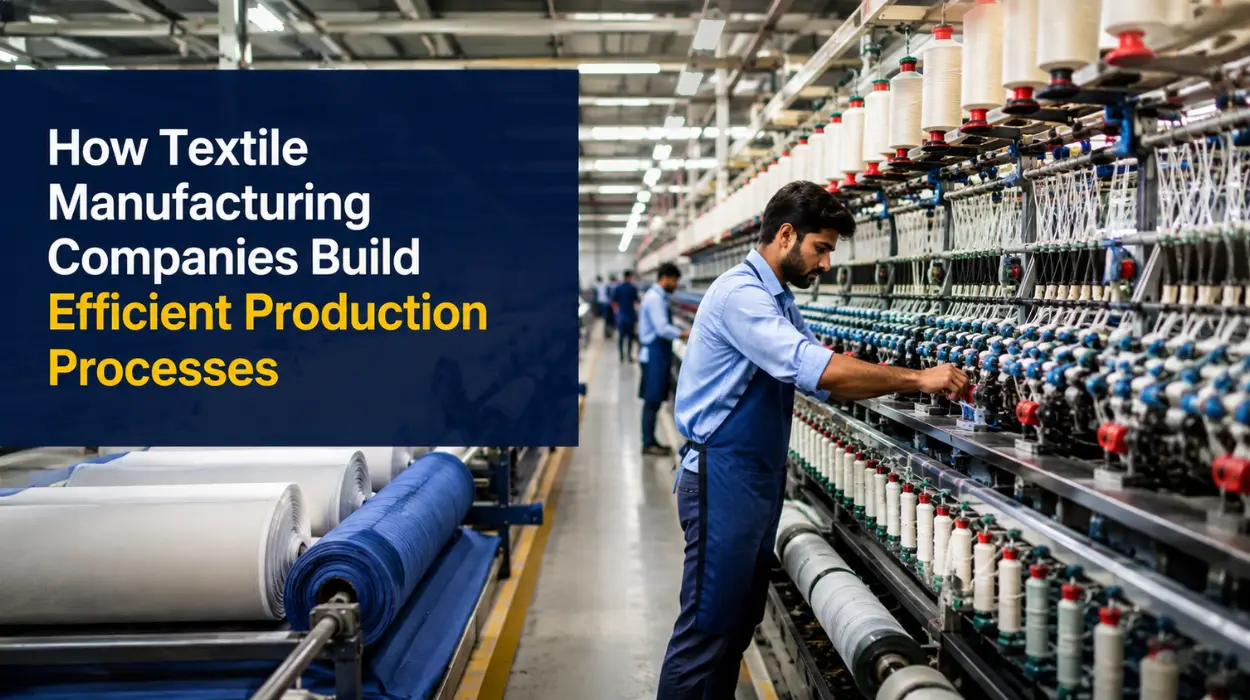
Textile manufacturing companies build efficient production processes by coordinating raw materials, machinery, labour, quality control, inventory, and delivery through measurable workflows. The strongest systems reduce downtime, control defects, balance production capacity, and use real-time data to improve decisions.
What production planning method creates the most efficient textile workflow?
A demand-led production planning method creates the most efficient workflow when production schedules match confirmed orders, available capacity, material supply, and delivery deadlines.
Textile production becomes more efficient when planning connects customer demand with machine capacity, labour availability, material supply, and quality requirements. Demand-led scheduling reduces idle capacity, controls work-in-progress, and gives production teams measurable targets for each manufacturing stage.
Match production capacity with confirmed demand
Textile factories operate through connected stages rather than isolated activities. Fabric preparation, spinning, weaving, dyeing, finishing, cutting, stitching, and packing each affect the next stage. Production planning therefore compares available capacity with confirmed orders. A factory producing 10,000 shirts must calculate fabric availability, sewing-line capacity, labour hours, and finishing capacity before releasing the schedule.
Make-to-order production reduces excess finished inventory when customer specifications vary frequently. Make-to-stock production supports standardised products with predictable demand. Batch production works effectively when similar fabrics, colours, or garments can share machine settings. The appropriate method depends on order structure, product variety, lead time, and capacity utilisation.
Which approach controls textile production costs more effectively?
Lean production controls avoidable costs by identifying waste across materials, movement, waiting time, overproduction, defects, and unused production capacity.
Cost-efficient textile production depends on measuring where resources are consumed. Lean manufacturing, process mapping, standard work, preventive maintenance, and production monitoring help manufacturers identify waste and compare the cost impact of different operational approaches.
Measure waste at each production stage.
Lean manufacturing evaluates production as a sequence of value-creating and non-value-creating activities. Excess movement increases labour time without improving the garment. Waiting between dyeing and finishing increases lead time. Rework consumes additional labour and materials. Unplanned machine stoppages reduce productive capacity.
Track production indicators at each stage rather than measuring only final output. Useful measures include machine utilisation, production cycle time, defect rate, rework percentage, material yield, and output per labour hour. For example, a stitching line producing 8,000 garments per shift can compare planned output with actual output to identify capacity losses. This approach gives managers operational evidence rather than relying on assumptions.
Is automation more effective than manual production for textile manufacturers?
Automation is more effective for repetitive, high-volume operations, while manual production remains valuable for complex designs, frequent product changes, and processes requiring detailed human judgement.
Automation improves consistency and throughput in repetitive textile operations, while manual processes provide flexibility for varied products. Manufacturers should evaluate automation through production volume, labour requirements, machine utilisation, product complexity, maintenance needs, and expected return on investment.
Compare automation with process flexibility.
Automated cutting systems can process repeated patterns with consistent measurements. Automated fabric inspection can identify defects at production speed that supports high-volume operations. Computer-controlled knitting and embroidery equipment also improves repeatability across standardised products. These systems require capital investment, technical maintenance, operator training, and reliable production data.
Manual operations provide greater flexibility when products change frequently. Skilled workers can adjust techniques for intricate garments, small production runs, and unusual construction requirements. The comparison therefore depends on production characteristics rather than automation alone. A manufacturer producing 50,000 identical units faces different efficiency requirements from a factory producing 500 customised garments.
Which quality-control approach reduces textile production losses?
Quality control at each production stage reduces losses more effectively than relying only on final inspection because defects can be identified before they move through additional processing.
Stage-based quality control identifies textile defects closer to their source. Fabric inspection, in-process checks, measurement controls, stitching inspection, and final audits create measurable checkpoints that reduce repeated processing and prevent defective products from reaching later stages.
Inspect quality before defects multiply.
Final inspection identifies problems after considerable production resources have already been consumed. A stitching defect discovered after washing, finishing, labelling, and packing creates higher rework costs than a defect identified directly on the sewing line. Process-based inspection moves quality control closer to the point where errors occur.
Establish measurable quality checkpoints for fabric, cutting, stitching, dyeing, finishing, and packing. Record defect types and their frequency. Compare recurring defects against operators, machines, materials, shifts, and production batches. This information allows production teams to identify patterns and address root causes instead of repeatedly correcting symptoms.
A strong quality system also supports a company’s wider reputation. Manufacturers seeking to understand how consistent operational performance contributes to building a strong industry reputation can connect production reliability with buyer confidence, supplier relationships, and long-term market credibility.
How does inventory management affect textile production efficiency?
Inventory management improves efficiency when raw materials, work-in-progress, and finished goods remain aligned with production requirements rather than accumulating without a defined operational purpose.
Efficient textile inventory management balances material availability against storage costs and production schedules. Accurate stock records, demand forecasting, reorder points, material tracking, and batch controls prevent shortages while reducing excess fabric, trims, yarn, dyes, and finished garments.
Balance material availability with inventory costs
Textile production depends on numerous inputs. Cotton, polyester, yarn, dyes, buttons, zips, labels, packaging, and other components must reach production at the required time. A shortage can stop a production line. Excess inventory can increase storage requirements and create obsolete stock when colours, specifications, or customer orders change.
Use inventory records that connect material quantities with production orders. Establish reorder points according to supplier lead times and confirmed demand. Track batches when material characteristics can affect product quality. For example, a dyeing operation can link colour batches with production records to investigate inconsistencies more quickly.
Which production technology provides the strongest operational visibility?
Integrated production management systems provide stronger visibility when they connect orders, inventory, machinery, quality data, labour activity, and production output within a common information flow.
Production technology improves operational visibility when manufacturing data moves between planning, inventory, production, quality, and reporting functions. Integrated systems allow managers to compare planned output with actual performance and identify delays before they affect delivery schedules.
Connect production data across departments.
Separate spreadsheets can create fragmented information when departments maintain independent records. Production managers may see output figures while procurement teams monitor material availability through another system. Quality teams may maintain separate defect records. These disconnected datasets make it difficult to identify relationships between delays, material shortages, machine performance, and defects.
Integrated manufacturing systems connect operational information. Sensors can provide machine-performance data. Enterprise resource planning systems can connect orders with inventory and procurement. Manufacturing execution systems can provide production-floor information. The value comes from connecting these data sources into decisions that production teams can act upon.
Manufacturers evaluating operational strategies can also examine how textile manufacturing companies structure production, quality, inventory, and supply-chain activities around measurable business objectives.
How can preventive maintenance improve textile production efficiency?
Preventive maintenance improves production efficiency by reducing unexpected equipment failures and keeping machinery operating within defined performance conditions.
Preventive maintenance schedules inspections, cleaning, lubrication, calibration, component replacement, and machine servicing before failures interrupt production. Textile manufacturers can compare maintenance records with downtime, defect rates, output losses, and repair costs to measure operational impact.
Schedule maintenance around production requirements
Unexpected equipment failures can interrupt connected production stages. A failed loom can delay fabric supply. A dyeing machine problem can affect finishing schedules. A stitching-machine failure can reduce line output. Maintenance planning therefore needs to consider both machine condition and production schedules.
Record machine downtime by cause and duration. Compare planned maintenance hours with unplanned stoppage hours. Monitor recurring faults and replacement intervals. This creates a maintenance history that supports decisions about repair, replacement, spare parts, and machine utilisation.
Which workforce strategy improves textile production efficiency?
A skills-based workforce strategy improves efficiency by matching trained employees with specific production tasks while using standard procedures to maintain consistent output.
Workforce efficiency depends on task-specific skills, standard operating procedures, balanced production lines, training, and measurable performance. Textile manufacturers can improve labour utilisation by identifying bottlenecks, reducing unnecessary movement, and assigning trained workers according to production requirements.
Balance skills with production-line requirements
Textile operations rely heavily on specialised skills. Cutting, sewing, inspection, dyeing, finishing, and machine operation require different competencies. A shortage of trained workers in one stage can create a bottleneck even when other production areas have spare capacity.
Create skill matrices that identify employee capabilities for defined tasks. Use standard operating procedures to document production methods. Cross-train workers where production conditions require flexibility. Balance workloads across connected operations so that one overloaded process does not restrict the output of an entire line.
How should textile manufacturers evaluate production efficiency methods?
Textile manufacturers should evaluate production methods through measurable indicators covering cost, quality, speed, capacity, material use, labour productivity, inventory, and delivery performance.
Production methods should be evaluated through comparable operational metrics rather than isolated output figures. Manufacturers can assess cycle time, defect rates, machine utilisation, material yield, labour productivity, inventory turnover, downtime, and on-time delivery to identify the most effective process improvements.
Compare operational performance consistently.
A production method that increases output but raises defects does not provide complete efficiency. A system that reduces inventory but creates material shortages can also undermine production continuity. Evaluation therefore requires multiple indicators.
Compare methods through measures such as:
- Measure machine utilisation before and after process changes.
- Calculate defect rates across defined production batches.
- Track cycle times for named processes such as stitching or dyeing.
- Record downtime by machine and production line.
- Compare material yield across defined fabric batches.
- Monitor on-time delivery against confirmed production schedules.
This approach allows manufacturers to compare operational changes using evidence. It also creates a foundation for continuous improvement.
What production process trends are shaping textile manufacturing?
Digital production monitoring, automation, predictive maintenance, traceability, and data-led quality management are reshaping textile manufacturing by making production performance more measurable and responsive.
Textile manufacturing is moving towards connected production environments where machines, inventory, quality systems, and planning tools generate operational data. These technologies support faster reporting, predictive maintenance, traceability, and more precise control of production resources.
Evaluate technology against operational needs.
Digital transformation should address defined production problems. Installing technology without connecting it to measurable objectives can increase complexity without improving efficiency. Manufacturers should identify bottlenecks before selecting production software, automation equipment, sensors, or analytics systems.
Traceability is also becoming important across textile supply chains. Production records can connect materials with batches, suppliers, processes, and finished products. Digital quality records can provide faster access to defect information. These capabilities support both operational control and transparent communication with buyers.
For organisations assessing the broader role of sector visibility, the relationship between efficient production and textile manufacturing companies also includes how operational reliability is communicated through credible media coverage and industry information.
What is the best way to compare textile production strategies?
The most reliable comparison evaluates each production strategy against the same operational criteria, including cost, quality, capacity, flexibility, lead time, workforce requirements, inventory, maintenance, and scalability.
No single production method fits every textile manufacturer. Efficient decision-making compares production strategies against product complexity, order volume, available machinery, workforce skills, supply-chain conditions, quality requirements, and delivery expectations before implementation.
Build a measurable comparison framework.
Manufacturers can evaluate production options by separating operational requirements from technology preferences. High-volume manufacturers may prioritise automation and machine utilisation. Customised manufacturers may prioritise flexibility and skilled labour. Export-focused manufacturers may place greater emphasis on quality consistency, traceability, and delivery reliability.
The comparison should also consider how process decisions affect business reputation. Consistent quality, dependable delivery, responsible resource use, and transparent production records can strengthen relationships with buyers and business partners. These outcomes connect factory efficiency with the wider commercial credibility of textile manufacturers.
Efficient textile production ultimately depends on alignment rather than one universal method. Production planning controls capacity. Lean practices reduce avoidable waste. Automation improves repeatability where volume supports it. Manual expertise preserves flexibility where product complexity demands it. Quality checkpoints reduce downstream losses, while inventory and maintenance systems protect production continuity. Digital technologies strengthen visibility when they connect operational data to measurable decisions. The strongest evaluation therefore compares methods against defined production requirements and verifies results through consistent performance metrics rather than adopting a single approach as universally superior.
Ready to get your story published?
Distribute your press release across 500+ trusted media outlets — with editorial review and a full pickup report within 48 hours.
Send Press Release →