
Getting featured in trade publications through journalist pitches and press releases

A magazine feature isn’t always a full-page profile. Getting featured in trade publications can mean appearing on a cover, being interviewed, receiving a quoted mention or having a journalist write a full story about your business or industry. The format depends on the story and the publication’s editorial decision.
It’s easy to assume coverage only comes from a direct pitch, but journalists may also find stories through press releases and publication submission forms. The key is to offer an angle that matters to the publication’s readers, rather than simply describe what your business sells. This article explains when to pitch a journalist, when distribution or a submission form may fit, and how to prepare a release and supporting materials. It also outlines what different kinds of magazine coverage involve, so you can choose an approach that suits your news and understand what a feature may deliver.
Key Takeaways
- Choose between a direct journalist pitch, press release distribution and a publication’s submission form based on your story and the outlet’s process.
- Lead with an industry issue or useful insight, and tailor the angle to the publication’s readers rather than focusing only on your product.
- Make a release easy to assess by including media contact details and a concise press kit with a short biography and clear images.
- Clarify what coverage means for your goals: a quote, interview or full feature each offers a different kind of visibility.
1. Should you pitch journalists or use distribution?
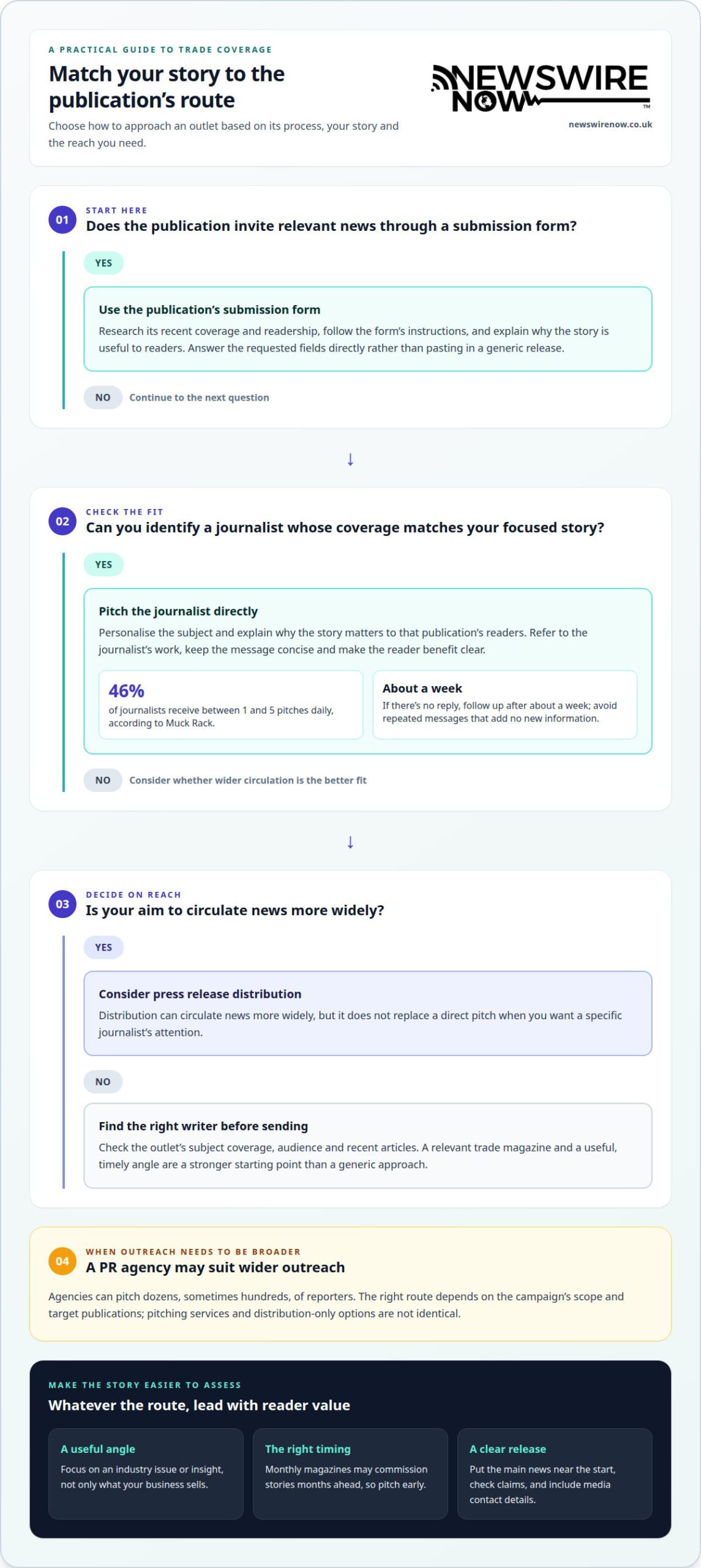
Pitch journalists directly when you have a focused story and can identify the right writer. A personal pitch lets you tailor the subject and explain why it matters to that publication’s readers. Press release distribution can circulate news more widely, but it doesn’t replace a direct pitch when you’re seeking a specific journalist’s attention. A PR agency may suit businesses seeking broader outreach, as agencies can pitch dozens, sometimes hundreds, of reporters.
Small businesses and experts can improve their chances by starting with a relevant trade magazine and a useful, timely angle. Identify the audience, read recent articles, then pitch a journalist whose coverage matches your subject. For example, an expert with insight into a change affecting their sector can offer context, evidence or an interview, rather than simply promote their services. Keep the message concise and make its value to readers clear.
Build relationships through relevant, personalised contact, not repeated generic emails. Refer to the journalist’s published work and explain why your information fits their beat. According to Muck Rack, 46% of journalists receive between 1 and 5 pitches daily, so a clear subject line helps distinguish a relevant approach. If there’s no reply, follow up after about a week; avoid repeated messages that add no new information. Monthly magazines may commission stories months ahead, so pitch early.
Trade journalism can also lead to other media roles. One journalist discovered trade and B2B magazines in 2012, completed a 12-week diploma with the Press and Media Association, then worked at New Model Adviser for a year and a half. That path illustrates how reporting, pitching ideas and learning an industry can build transferable experience. Common mistakes include contacting an unsuitable writer, sending a mass email, using a sales-led angle or following up too often. Check the outlet’s subject coverage and timing before sending anything.
2. Pitching industry trends rather than product announcements
Getting featured in trade publications often starts with an industry issue, not a product announcement. A trend pitch explains why a development matters to readers, using evidence, expert insight or a human story. For example, a new service becomes more relevant when you show how firms are responding to a wider change. Editors need stories that serve their audience, not simply promote a company.
Identify four to five major issues covered by leading publications in your sector. Read recent articles, then decide what distinct perspective your organisation can offer. A finance expert might explain how changing customer behaviour affects small firms, while a manufacturer could describe a practical shift in production. Tailor each pitch to the publication and the reporter’s work. Sheryl Garratt said roughly a quarter of pitches to publications where she worked were unsuitable for their readership.
Keep the email concise. Sum up the story angle in 20 words or fewer, then explain its relevance, why it matters now and what you can provide. A subject line such as “How rising costs are changing independent retailers” signals its topic and audience more clearly than “Company news”. Add a brief note about available evidence or interview access, so the journalist can quickly assess the story.
Human-interest details can make an industry story specific: show how a trend affects workers, customers or a local business. A survey of 1,200 small firms could reveal a wider pattern; a 42% rise in demand could illustrate a timely issue when supported by your evidence. Avoid inflated claims, unsupported figures and pitches sent unchanged to unrelated editors. A clear, well-supported angle gives journalists a useful starting point and makes getting featured in trade publications a more focused objective.
3. Submitting press releases through trade-publication forms
Use a publication’s submission form when it invites businesses to share relevant news or releases. First, research its recent coverage and readership, then match your subject to the topics its editors publish. Follow the form’s instructions, keep each answer focused, and include media contact details so journalists can follow up. A release sent through a form should still explain why readers would find the story useful.
What do PR agencies charge for trade-publication coverage in the UK? Fees depend on the campaign’s scope, target publications and outreach, and are provided after a quote request. These factors shape the work involved, so don’t compare an agency’s pitching service with a distribution-only option as though they were identical.
Write the release in clear, factual language, with the main news near the start and supporting detail afterwards. Check names, dates and claims before sending; a typo or unsupported statement can weaken the story’s credibility. Include a short press-kit biography of 150–250 words, a concise one-liner and professional photographs. Link to clear, uncluttered images instead of attaching large files, and provide a direct media-enquiry contact. This gives everyone handling the story accessible, consistent information.
Submission forms and press release distribution serve different purposes: a form sends material to a particular publication, while distribution circulates a release through a wider channel. Neither ensures editorial coverage. A startup seeking magazine attention may wait three months or longer between initial outreach and publication. Timing depends on editorial schedules, the story’s fit and any further information editors need. If a form requests specific details, answer those fields directly rather than pasting in a generic release. Google can help locate a magazine’s submission page, but follow the publication’s own instructions. A complete, relevant submission gives editors a clear basis for considering the story.
4. What getting featured in a magazine can mean
Magazine coverage can take several forms, and each gives your organisation a different role in the story. A cover appearance offers prominent visibility; an interview gives space to explain your expertise; a quoted mention adds your comment to a wider report. A full story written by a journalist may place your business, customers or sector within a broader narrative. “Featured” describes the coverage, not one fixed format.
Look beyond the word “feature” when assessing what appeared. Note the outlet, section, headline and whether your organisation is named, quoted or profiled. For example, a short expert comment in a specialist magazine reaches readers differently from a launch story built around your company. The article’s subject and context matter as much as its length or placement.
Coverage is editorial, so the finished piece may not follow your preferred wording or tell your business’s whole story. A journalist might use one comment as part of a wider industry report, or focus on a customer’s experience instead. Treat the published article as a record of what the outlet chose to tell its readers, not as an advert or endorsement. That distinction helps set realistic expectations and keeps follow-up communications accurate.
Once the article appears, share the published magazine coverage on your social channels, with your email audience and on your website. Keep a record of the outlet, publication date, article format and any resulting enquiries. Review branded search volume 4 to 8 weeks after publication, then assess coverage results at 30, 60 and 90 days after publication. These checks help distinguish immediate attention from sustained interest. If a release supports your media plans, plan your next press announcement with its intended audience and story angle in mind.
Newswire Now Media Group
Newswire Now Media Group helps businesses distribute news when a relevant trade story is ready to reach media outlets. Its independent network includes over 40 owned publications, and releases can be editorially reviewed and distributed to more than 500 trusted news outlets across 27 industry sectors and 37 professions.
Choose Single Press Release Distribution for a standalone announcement, or Multi-release Distribution Bundles for several releases. Editorial Review supports a clear, publication-ready submission, while Media Pickup Reporting shows where a release has appeared. These services can support your wider media approach, but editorial coverage still depends on each publication’s decisions.
If you’re ready to plan distribution for your news, contact Newswire Now Media Group.
Turn your next story into a media plan
Getting featured in trade publications is best treated as part of a wider communications plan, not a one-off announcement. Decide what you want the coverage to support, then match each release to a clear business development, product or industry milestone. This gives future pitches a consistent direction and helps you assess whether a mention reaches the audience that matters to your organisation.
For a standalone announcement or a sequence of news, Newswire Now Media Group offers Single Press Release Distribution and Multi-release Distribution Bundles. Editorial Review can help refine a release before distribution, keeping the story clear and focused for media audiences. Choose the approach that fits your announcement and communications schedule.
Ready to plan your next release? Contact Newswire Now Media Group to discuss your media distribution needs and take a considered next step towards greater visibility.
Frequently Asked Questions
What does it actually mean to get featured in publications?
It means an editorial outlet has included your business, expertise or contribution in published content. The reference might be a profile, a brief citation or a contribution to a wider report. Check the finished piece to see how your organisation is represented, what context surrounds the mention and whether readers can identify your role. A media appearance is editorial coverage, not necessarily an endorsement.
Should you pitch journalists or use distribution?
Pitch a journalist when you have a specific story suited to their reporting; use distribution when you want a release circulated to a broader media network. The choice depends on the news, target audience and resources available for outreach. A company announcing a sector-wide survey, for instance, might pitch relevant reporters directly and distribute the release to support wider visibility.
What makes a story publication-worthy?
A publication-worthy story offers readers information they can use, understand or act on. A new appointment alone may have limited relevance, but an appointment tied to a significant change in a specialist field could provide broader context. Strong stories have a clear reason for publication, credible supporting information and a source who can explain the implications. Keep promotional claims separate from evidence.
Which assets help you get featured faster?
Prepare materials that let an editor assess and develop the story without chasing basic information. Useful items include a named spokesperson, a short biography, a direct media contact, verified facts and relevant high-resolution photographs. For a product announcement, include clear product images and practical details. Label files clearly, and make sure spokespeople can respond consistently to likely follow-up questions.
What makes a story newsworthy to trade publications?
Trade publications look for developments that matter within their sector. A change in customer behaviour, a new technical approach or evidence of a shared business challenge may interest readers more than a company milestone alone. Explain what has changed, who is affected and why the issue matters now. A specialist publication will expect the angle and evidence to fit its readership.
How do you identify the right trade publications for your industry in the UK?
Start with your intended readers, then search for UK magazines and trade titles covering their profession or sector. Review recent articles, contributor profiles and recurring sections to understand the publication’s focus and preferred formats. Compare that editorial focus with your story’s subject and audience. A specialist outlet whose readers face the issue is usually a closer match than a broad business magazine.
Ready to get your story published?
Distribute your press release across 500+ trusted media outlets — with editorial review and a full pickup report within 48 hours.
Send Press Release →