
Investor relations press releases for financial disclosure

Financial disclosure is only useful when investors can understand the information and its significance. A press release for investor relations presents company news and key financial figures clearly, helping communicate updates to investors and the wider market. It supports market communications by giving important information a concise, accessible format.
It’s understandable to see a press release as simply an announcement, but its role is broader: it can help explain financial results, business developments and their relevance to stakeholders. This article explains why these releases matter, what information to include and how to make figures easier to interpret. It also covers how distribution fits into the process, so you can understand how a release can support clear, consistent communication.
Key Takeaways
- Put material financial figures and their context where readers can find and understand them quickly.
- Use clear headlines, concise explanations and relevant quotes to make market updates easier to follow.
- Choose announcements that matter to investors and other stakeholders, and make the purpose of each release clear.
- Plan distribution and reporting alongside the disclosure, while ensuring communications follow the requirements that apply to your organisation.
Distribution of financial and material information
Distribution carries financial announcements beyond a company’s own channels to journalists and other relevant audiences. For an earnings release, focus on timing, audience and how you will assess pickup.
Financial news and earnings releases
An earnings announcement can summarise results, explain material changes and direct readers to supporting information. Distribution makes the update available to media outlets that may report on the figures. A clear headline and prominent key numbers help readers identify the news. Align the timing and content with the company’s disclosure process so distribution supports the update’s purpose.
Reach and audience targeting
Reach depends on the distribution network and the audiences it serves. A high volume of releases on a newswire does not show whether the right readers saw an announcement. Consider which outlets and sectors fit the company’s subject, then choose distribution that reflects the intended audience. For example, a UK results announcement needs relevant financial and business coverage.
Rules for publishing investor news
For UK companies, distribution is a communications step, not a replacement for applicable disclosure requirements. Align the release, timing, supporting figures and publication process with the organisation’s procedures. Confirm the approved information, prepare the release, coordinate its issue and retain a record of what was distributed. This helps keep investor and media communications consistent.
Reporting helps measure distribution activity, including which outlets picked up a release and where coverage appeared. Review that report against the announcement’s audience and objectives; pickup indicates publication, not necessarily readership or investor engagement. Distribution pricing depends on the case and is given after a quote request. Scope, targeting, network and reporting needs shape the cost. A seamless process connects the approved release, its chosen audience and the follow-up measurement, rather than treating publication as the final step.
Investor relations and market communications
Investor communications should make company updates clear, relevant and consistent. A press release can explain a development to investors, analysts, employees and other stakeholders in one structured announcement. Issue it when the news matters to journalists and the intended audience, keeping routine commentary separate from announcements with genuine market relevance.
Start with a concise headline that identifies the development. Put important figures prominently, then explain their meaning in plain language. A financial update, for example, should distinguish reported results from the company’s explanation of them. Readers should be able to grasp the main point without searching through lengthy background. That improves the information’s visibility, not just its presence on a newswire.
A practical release can include a headline, opening paragraph, supporting details, relevant quotes, contact information and a company description. State the central update first, then add context. A quote from an authorised representative can explain the company’s position, while contact details give journalists a route for follow-up. Every element should support the same message.
Use a distribution network to make suitable updates available to relevant audiences, including media outlets covering the company’s sector. Global distribution may extend visibility beyond the UK, but geographic reach should match the announcement’s relevance and stakeholders. After publication, review available analytics or pickup reporting to see where coverage appeared. Treat those results as measures of distribution activity, not proof of investor engagement or understanding.
Plan communications around the announcement’s purpose. A single release may suit a standalone development, while a sequence of releases can give stakeholders updates across a longer programme. Single press release distribution can support a focused announcement when the message, audience and timing are defined.
Investor relations press release purpose
A press release for investor relations explains company developments in accurate, accessible language. It helps investors and the public understand what has changed, why it matters and how it relates to the company’s direction. An acquisition announcement, for example, can outline the rationale and expected effect without obscuring the central facts.
RNS announcements and press releases have different purposes. An RNS announcement is used for formal market disclosure, while a newswire release can add context and support wider media coverage. Do not treat a press release as a substitute for any regulatory disclosure the company must make.
Public companies can use releases to communicate financial news, business developments, leadership appointments or material changes in strategy. A results announcement can present figures alongside explanations of performance and relevant management commentary. The aim is not to promote every company activity, but to make genuinely newsworthy information understandable to stakeholders.
Accuracy is central. Label financial figures clearly and provide context, distinguish reported results from expectations, and ensure quotes reflect approved company positions. Journalists need enough detail to assess the story, but unsupported claims and ambiguous wording can weaken the message. Include a clear contact route for relevant follow-up.
Newswire distribution can put financial news before media outlets beyond a company’s own channels. This may support visibility and coverage, but publication alone does not show whether investors read or understood the release. Use pickup reporting to identify where the announcement appeared, then assess that activity against the intended audience and communication objective.
Before publication, align the release with the company’s disclosure process. Confirm the approved facts, clarify the intended audience and choose distribution that fits the announcement. Give each update a defined purpose, whether it explains earnings, a strategic decision or another development relevant to investors.
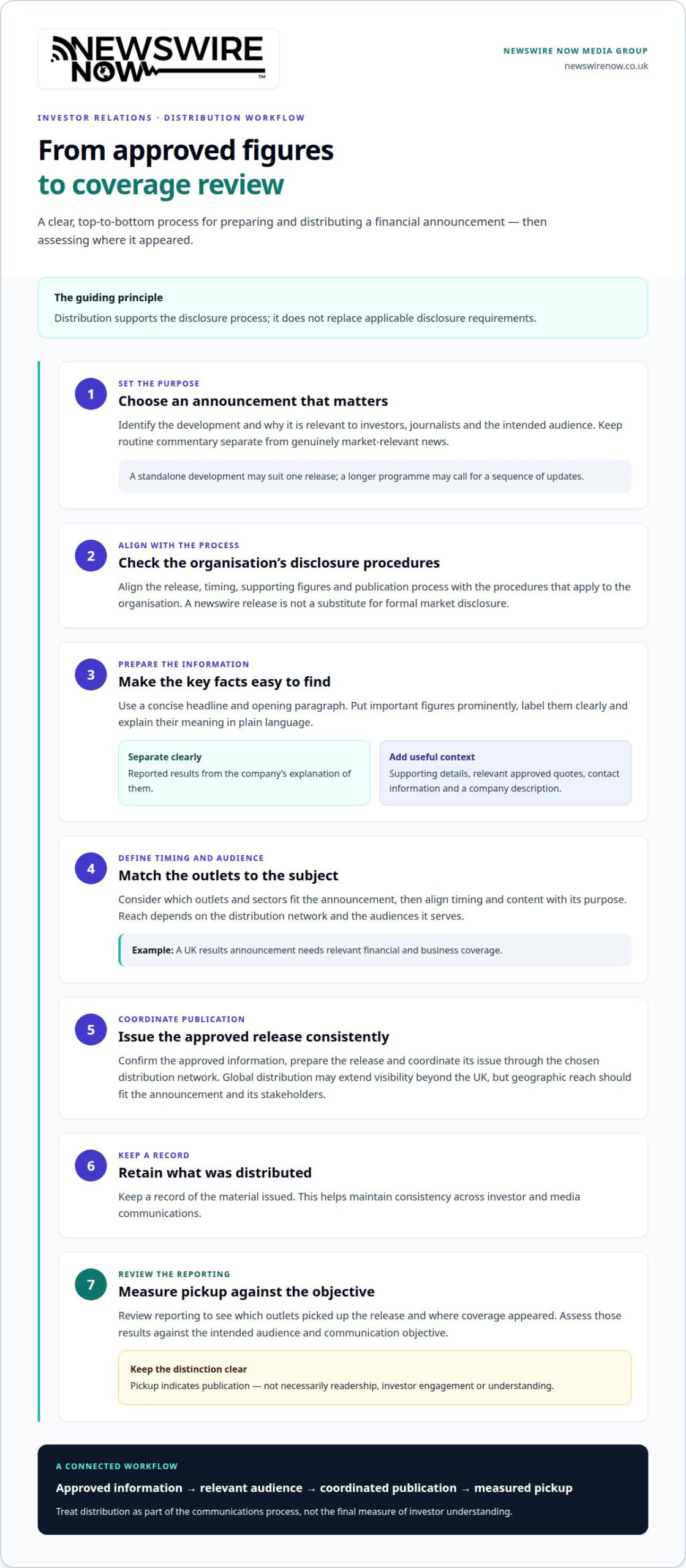
What are the UK rules for publishing company news to investors?
UK companies should align investor communications with the disclosure requirements that apply to their circumstances. The relevant process depends on the company, its market and the information being announced. A routine product update and a significant change to financial expectations may therefore need different review and publication decisions.
A press release supports communication but does not replace formal regulatory disclosure. Before publishing, identify the announcement’s purpose, confirm that the facts and figures are approved, and establish whether separate disclosure steps apply. An earnings update, for example, may need coordination with the company’s financial reporting process.
Set a clear internal sequence for each investor announcement. The responsible team can assess the information, approve the wording, set publication timing and retain the final version. This creates a record of what was communicated and helps prevent inconsistent versions reaching investors, journalists and other stakeholders. Ensure contact details and supporting context match the approved release.
- Classify the update: distinguish routine company news from information requiring formal disclosure consideration.
- Approve the content: check figures, dates, quotes and explanations against authorised company information.
- Coordinate publication: align release timing with the organisation’s disclosure process.
- Keep a record: retain the approved announcement and its publication details.
These steps help keep public communications accurate and consistent, but they don’t establish that a particular release meets every applicable requirement. A distribution platform can circulate approved news; it cannot determine the company’s regulatory obligations. For an earnings announcement, treat compliance review and media distribution as distinct parts of the communications plan.
Prepare your next investor update for clear, coordinated distribution once its content and publication process are ready.
Newswire Now Media Group: Single Press Release Distribution
Newswire Now Media Group supports investor communications through Single Press Release Distribution when a company has one approved announcement to share. Its independent network includes over 40 owned publications reaching millions of readers worldwide, alongside distribution to more than 500 trusted news outlets across 27 industry sectors and 37 professions.
Newswire Now Media Group provides editorial review for submitted releases and a Media Pickup Report to show resulting coverage. Companies planning recurring announcements can use Multi-release Distribution Bundles to distribute several releases. These services support media reach, but do not replace the company’s responsibility to manage regulatory disclosures and approve accurate information.
If you’re preparing an investor update, contact Newswire Now Media Group to discuss distribution.
Make your next investor update count
Give each announcement a defined role in your communications plan. Before preparing a press release for investor relations, decide what stakeholders need to understand, which approved information supports the message and how the release fits alongside formal disclosure. This focus keeps the communication relevant from drafting through distribution.
Choose the next step based on your schedule: a standalone announcement may suit Single Press Release Distribution, while recurring updates may suit Multi-release Distribution Bundles. Editorial Review is also available for submitted releases. Keep responsibility for the accuracy and approval of financial information within your organisation, and use distribution to communicate the approved update.
A clear plan turns an investor update into a deliberate part of market communications, rather than an isolated announcement. If you’re preparing a release, contact Newswire Now Media Group to discuss the next step. Start with a focused message and move forward with confidence.
Frequently Asked Questions
Why do I need these press releases?
Investor releases give stakeholders a consistent account of company developments, rather than leaving them to interpret isolated figures or incomplete updates. A results announcement, for example, can explain a change in revenue alongside its business context. This helps journalists report accurately and gives investors a clear reference point for company communications.
What is an investor relations press release?
An investor-relations press release communicates relevant business or financial news to investors and other stakeholders. Examples include results, strategic changes, acquisitions and leadership appointments. Prepared for external readers, it should identify the news clearly, explain its relevance and distinguish confirmed information from expectations or commentary.
What information should an investor relations press release include?
Include a precise headline, the central facts and enough context to explain their significance. For financial results, identify the reporting period and distinguish actual figures from forward-looking expectations. Add an authorised spokesperson’s quote if it offers useful perspective, along with relevant media contact details. Avoid claims unsupported by the company’s approved information.
How do I write an investor relations press release step by step?
First define the announcement’s audience and main message. Then organise the release in a logical order:
- Draft a factual headline and opening that state the development.
- Add supporting detail, relevant figures and necessary context.
- Include an approved quote and contact details where useful.
- Review accuracy, clarity and alignment with company approvals before distribution.
Keep each paragraph focused on one point.
Where can UK companies distribute investor relations press releases?
Companies can publish routine updates on their investor-relations pages and use a newswire to extend distribution to relevant media outlets. For publicly traded companies, formal market announcements and broader media communications serve different purposes. Keep the processes distinct: a newswire distributes an approved release but does not replace any formal disclosure channel applicable to the company.
How much does investor relations press release distribution cost in the UK?
For Newswire Now Media Group, the price depends on the project and is provided after a quote request. Cost factors include whether the requirement is for one announcement or multiple releases, the distribution scope and any relevant editorial review or reporting needs. This lets the proposed service reflect the release plan without assuming every company has the same communications requirements.
Ready to get your story published?
Distribute your press release across 500+ trusted media outlets — with editorial review and a full pickup report within 48 hours.
Send Press Release →