
Brand mentions: Measure reach, sentiment and conversions

A high mention count can still hide limited reach, negative sentiment or few conversions. To understand how to measure brand mentions, track volume alongside reach, sentiment, share of voice and engagement across relevant channels. Then connect those signals to website activity and conversions to assess whether visibility is contributing to business outcomes.
It’s easy to focus on how often a brand appears, but that number is more meaningful when you know who is discussing it, where it’s appearing and how people respond. Mentions can be positive, negative or neutral, so context matters as much as volume.
This guide explains what brand mention tools monitor, how to identify coverage gaps and which KPIs make reporting useful. You’ll also learn how to assess mentions across news, social media, reviews, forums and AI answers, and interpret the results without treating every mention as equally valuable.
Key Takeaways
- Separate positive, negative and neutral coverage to understand what mention totals say about audience perception.
- Look beyond exact brand-name matches to catch misspellings, indirect references and monitoring blind spots.
- Track coverage across news, social media, reviews, forums and AI answers for a clearer view of visibility.
- Use volume, reach, share of voice and conversion activity together to judge whether attention is translating into results.
What is a brand mention tool?
A brand mention tool finds online references and organises them into useful reports. It helps teams monitor multiple channels and analyse visibility, reputation and audience response.
Sentiment analysis
Brand mention sentiment analysis classifies references as positive, negative or neutral. A monitoring tool may analyse wording and context, then group mentions by sentiment for review. This matters because a rise in negative comments may call for a different response than growing positive coverage. For example, a product compliment and a delivery complaint both mention the brand, but signal different needs. Human review helps interpret ambiguous wording and sarcasm before teams act.
Sentiment and reputation management
Sentiment analysis helps with reputation management by showing how audience reactions change across coverage and conversations. Teams can use the results to spot spikes in negative sentiment, identify recurring concerns and prioritise responses. A complaint repeated across several channels may point to an issue that needs attention, while positive comments can reveal strengths worth reinforcing. Treat sentiment as a signal to investigate, not a complete judgement of reputation: the context and source of each mention still matter.
Topic analysis adds detail to sentiment scores by grouping mentions around themes such as onboarding, service or product quality. If 30% of negative mentions in a quarter concern onboarding friction, that pattern gives teams a clear issue to investigate. The combination of topic and sentiment helps distinguish a broad reputational concern from one specific customer experience. It also gives communications and customer teams a more valuable basis for strategy.
Trend analysis compares mention volume, sentiment and topics during campaign activity. A report can show whether coverage increased during a campaign, which messages appeared and whether reactions were favourable or critical. Teams can also compare their mention patterns with competitors to understand changes in share of conversation. These comparisons don’t prove a campaign caused a change, but aligned timing, recurring themes and channel data can help assess its contribution and shape the next campaign.
Manual checks to catch monitoring blind spots and noise
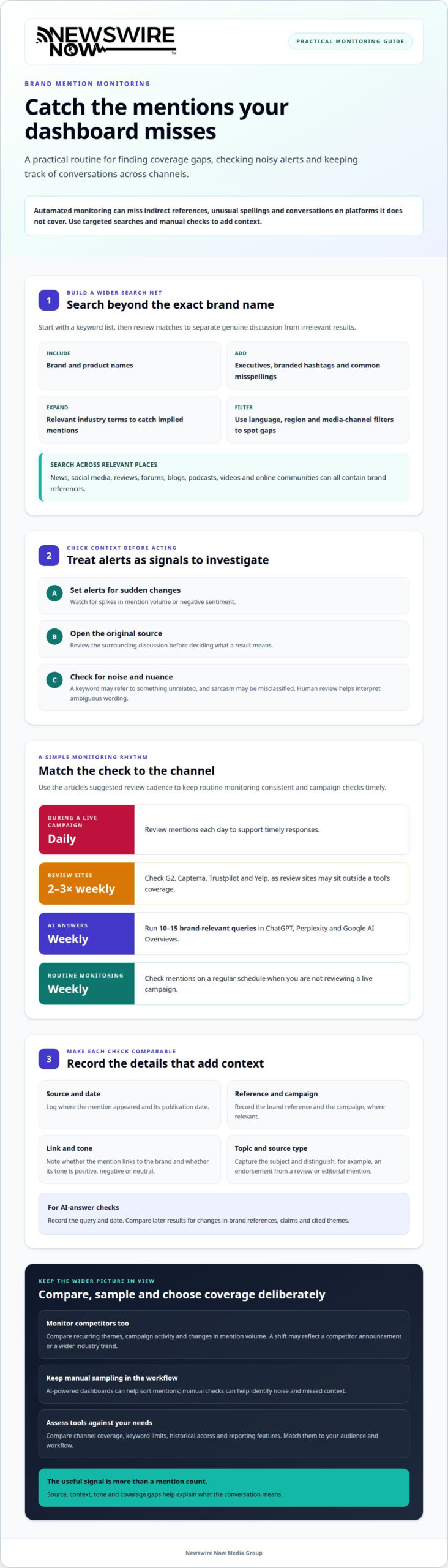
Automated monitoring can miss indirect references, unusual spellings and conversations on platforms it doesn’t cover. Start with a keyword list that includes your brand, products, executives, branded hashtags and common misspellings. Add relevant industry terms to catch implied mentions, then review examples to separate genuine discussion from irrelevant matches. A dashboard filtered by language, region and media channel can make coverage gaps easier to spot.
Set alerts for sudden spikes in mentions or negative sentiment, then check each alert against its original source. Review the surrounding discussion before treating a result as a reputational issue: a keyword may refer to something unrelated, or a sarcastic post may be misclassified. During a live campaign, review mentions daily; for routine monitoring, check weekly. This workflow supports timely responses while keeping your view of changes consistent.
Reviews and AI answers need their own manual checks. Review sites may fall outside a tool’s coverage, so check G2, Capterra, Trustpilot and Yelp two to three times per week. Once a week, run 10 to 15 brand-relevant queries in ChatGPT, Perplexity and Google AI Overviews. Compare answers for changes in brand references, claims and cited themes. Record the query and date so later checks reveal patterns, not just isolated results.
Monitor competitors alongside your own brand to understand which topics and platforms are driving industry conversation. Compare recurring themes, campaign activity and changes in mention volume: a shift may reflect a competitor announcement or a wider industry trend. AI-powered dashboards can help sort mentions, but manual sampling is still useful for identifying noise and missed context.
Compare monitoring tool pricing by channel coverage, keyword limits, historical access and reporting features. Match those factors to your audience and workflow rather than paying for features you won’t use. For earned media activity, an editorial review can help prepare releases for distribution and measurement.
Tracking mentions across news, social media, reviews, forums and AI answers
Measure coverage by collecting mentions from relevant channels, then grouping results by source, region and language. For UK coverage, include national and regional media, and search relevant language variations alongside English brand terms to capture local discussion.
Mention sources across media and communities
Brand mentions can appear in news articles, social media, blogs, forums, podcasts, videos, reviews and online communities. Tracking across these sources matters because each reaches audiences in different contexts. A news report can shape public understanding, while a forum thread may expose practical concerns. A podcast host could mention a product to an audience of 50,000 listeners, illustrating why source and potential reach belong in the record.
Log the source, publication date, brand reference and campaign, where relevant. Record whether the mention includes a link, and note its tone and topic. This gives teams a consistent view of coverage, including references that don’t link to the brand. It also helps distinguish an influencer endorsement from a customer review or editorial mention.
Web, social media and review searches
Search the web and social media using brand-name variations and platform-specific queries. Include product names, branded hashtags and common misspellings, then review results across social platforms, news sites, review services and forums. Search functions and indexing differ between platforms, so a single method won’t surface every relevant conversation.
For regional coverage, segment results by language, location and channel where possible. Compare UK-wide results with relevant regional publications and community discussions rather than treating all coverage as one audience. Keep search terms and filters consistent across reporting periods. Otherwise, changes in results may reflect a revised search rather than a real shift in visibility.
Connect each mention to useful context: the campaign, audience and next action. Alerts can flag a sudden increase or negative discussion, while manual review confirms what a post means. If an influencer shares campaign content, record the platform and engagement alongside the mention. This makes coverage easier to interpret and helps teams decide whether to respond, share the content or include it in reporting.
Brand mention KPIs: volume, reach, sentiment, share of voice and conversions
To understand how to measure brand mentions, connect visibility, audience response and business outcomes. Read the KPIs together: a high volume alone can’t show whether conversations reached relevant people or prompted action.
Mention volume and reach
Mention volume counts brand references, while reach estimates how many people could have encountered them. Track both to distinguish frequent discussion from broad exposure. A cluster of posts in one small community may increase volume without matching the reach of coverage across major publications. Compare the same channels and reporting periods, then use engagement to add context to potential exposure.
Reach is an estimate, not proof that everyone saw or remembered a mention. Use platform-reported audience figures where available, and keep the calculation method consistent. Social listening can reveal which conversations attract responses, shares or saves. These insights help assess whether visibility is building awareness or simply increasing the total.
Sentiment and share of voice
Sentiment records whether mentions are positive, negative or neutral; share of voice compares your brand’s mentions with competitors’ total mentions. Together, they show how much conversation you hold and its overall tone. Calculate share of voice by dividing your brand’s mentions by all competitor mentions, then multiplying by 100. For example, 500 mentions out of 2,000 total gives a 25% share.
Pair that percentage with sentiment and topic analysis. A growing share may seem positive, but a rise driven by critical conversations calls for a different response. A brand monitoring tool can group mentions by channel and theme, helping teams see what changed and where action may matter. If you’re deciding how to measure brand mentions for a campaign, connect these signals to its intended outcome.
Connect mentions to conversions by comparing campaign timing and referral activity with tracked outcomes, such as enquiries or purchases. Use consistent campaign tags and reporting windows, then distinguish direct referrals from broader influence. Mentions can contribute to a customer journey without being its final click, so treat conversion data as one part of the assessment. To align channel activity with measurable goals, strengthen your social media marketing around the outcomes you track.
Newswire Now Media Group
Newswire Now Media Group helps businesses extend news visibility and understand where releases are picked up. If your measurement plan includes earned media, press release distribution can support campaign reach, while Media Pickup Reporting provides a record of coverage.
Choose Single Press Release Distribution for an individual announcement, or Multi-release Distribution Bundles for several planned releases. Editorial Review supports the release before distribution. These services can complement brand monitoring by making campaign coverage easier to identify and assess alongside mentions from other channels.
Newswire Now Media Group distributes releases to more than 500 trusted news outlets across 27 industry sectors and 37 professions. Consider this route when you have a newsworthy announcement and want to measure its media pickup as part of wider visibility reporting. Contact Newswire Now Media Group to discuss your distribution needs.
Turn measurement into your next decision
Make reporting useful by deciding in advance which business decision it should inform. Before the next campaign, agree who will review the results, which signals matter and how findings will shape future communications. This gives your team a clear purpose for tracking, rather than producing a report that stops at the numbers.
A practical way to decide how to measure brand mentions is to connect each metric to a specific action. For example, a change in audience response might prompt a messaging review, while strong coverage could inform your next announcement. Keep your approach consistent, then refine it as your priorities change.
If you’re planning a campaign and want to strengthen its media reach, discuss your distribution needs with Newswire Now Media Group. A focused next step can help turn measurement into clearer decisions and more purposeful communications.
Frequently Asked Questions
What Should You Monitor?
Monitor the names customers use, not just your official brand name. Include product lines, former names, executive names, campaign hashtags and common spelling errors. Add terms associated with a distinctive product or service, such as a branded feature name. Keep competitor names in a separate search group so comparisons don’t inflate your mention totals. Review the list when your brand or campaigns change.
What counts as a brand mention, including unlinked mentions?
A brand mention is an online reference to your business, product or brand, whether or not it contains a clickable link. “Acme’s new collection” counts even if the words don’t link anywhere. A direct mention names the brand; an indirect mention refers to it without using its name. Record unlinked references too, since they can reveal discussion that link-only tracking misses.
How do you measure brand mentions across social media, news, blogs and forums?
Use a consistent search list, then gather results from each channel into one record. Capture the date, source, wording, campaign and whether the mention links to your site. For example, log a newspaper article separately from a repost of that article on social media. Deduplicate copied content before counting, and retain channel labels so reporting shows where conversations originated.
Which tools track brand mentions and how do they compare?
Social listening platforms focus on social conversations, while broader media monitoring services may also cover news, blogs and other sources. Compare each tool’s channel coverage, language and regional filters, alert options, export formats and access to historical data. Pricing depends on the tool and the selected coverage or features, so assess the reporting workflow alongside the cost. Manual searches can help fill gaps.
How do you calculate brand mention volume and share of voice?
Set a reporting period and count relevant, unique brand mentions within it; remove duplicates and unrelated uses of the same name. For share of voice, divide your brand’s mentions by the combined mentions for your brand and selected competitors, then multiply by 100. Keep competitor selection and search rules unchanged between reports, or comparisons won’t reflect like-for-like changes.
How do you measure brand mention sentiment accurately?
Classify each relevant mention as positive, negative or neutral, then review ambiguous results in their original context. A phrase that seems critical may be quoted from someone else, while irony can confuse automated classification. Check the post, article or discussion thread before assigning a final label. Keep examples that explain unusual classifications so later reviewers can apply the same standards.
Ready to get your story published?
Distribute your press release across 500+ trusted media outlets — with editorial review and a full pickup report within 48 hours.
Send Press Release →