
Non-profit press release distribution costs and discounts

A UK charity shouldn’t assume a non-profit press release distribution discount will automatically apply: eligibility can depend on where the organisation is based. Distribution costs depend on factors such as reach, targeting and the services selected; the price is provided after a quote request. Free routes, including an organisation’s own website, social media and direct email to media contacts, can also help share an announcement.
It’s reasonable to want a clear budget before committing, especially when funds need to support the organisation’s work. Compare what each route delivers, not just its cost: distribution, editorial review and pickup reporting serve different purposes, and sending out a release doesn’t guarantee media coverage.
This guide explains what shapes distribution costs, why overseas discount terms may not apply to UK organisations, and what to look for in reach and reporting. It also explains when free channels may be enough and when a paid service could help put a release in front of a wider, more relevant media network.
Key Takeaways
- Compare distribution options by their reach, targeting and reporting, not just the headline cost.
- Check discount eligibility carefully: terms designed for US charitable organisations may not suit a UK charity.
- Use reporting to distinguish where a release was distributed from whether it generated meaningful media attention.
- Choose free channels such as your website, social media and direct media emails when they fit your audience and resources.
- Set clear expectations: distribution can increase visibility, but it does not guarantee media coverage.
How much does a press release distribution cost?
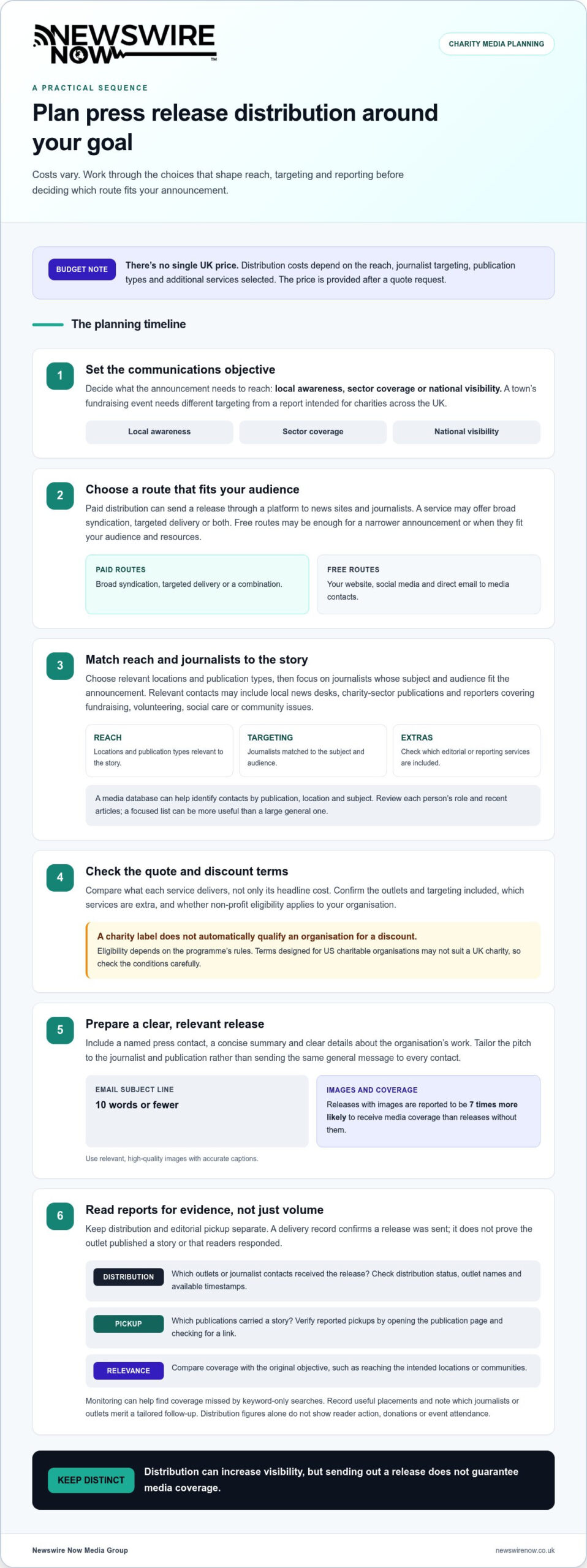
There’s no single UK price for press release distribution. Costs depend on the selected reach, journalist targeting, publication types and additional services. For a charity, assess non-profit press release distribution against the audiences and outcomes the announcement needs to reach, rather than focusing on a headline price alone.
Paid distribution can send a release through a platform to news sites and journalists. A service may provide broad syndication, targeted delivery or both. Before choosing, identify whether the priority is local awareness, sector coverage or national visibility. A fundraising event in one town, for example, needs different targeting from a report intended for charities across the UK.
Which UK media outlets and journalists cover charities and non-profits? Relevant contacts include local news desks, charity-sector publications and journalists covering fundraising, volunteering, social care or community issues. Match each release to the publication’s audience and the journalist’s recent reporting. For example, send a local project announcement to reporters who cover that area.
A media database can help identify journalists by publication, location and subject. Use it to build a focused list, then review each contact’s role and recent articles before sending. A tailored list is more useful than a large general one when it focuses on reporters likely to cover the announcement. Group contacts by subject, such as education charities or homelessness, and tailor the pitch accordingly.
- Reach: Choose the locations and publication types relevant to the story.
- Targeting: Match journalists to the announcement’s subject and audience.
- Extras: Check which editorial or reporting services are included.
Journalist resources can make a release easier to assess. Include a named press contact, a concise summary and clear details about the organisation’s work. Keep an email subject line to 10 words or fewer. Images can support the story: releases with images are reported to be 7 times more likely to receive media coverage than releases without them. Use relevant, high-quality assets with accurate captions.
What are the risks of using paid press release distribution services? A broad list can reach irrelevant journalists, and distribution itself can be mistaken for editorial coverage. Review the outlets and targeting included, distinguish distribution from pickup, and check for extra charges before committing. Paid distribution is useful when its reach and reporting address a defined communications need; direct email, a website or social media may suit a narrower announcement.
Distribution reports and follow-up reports
A distribution report records where a release was sent or published; follow-up monitoring helps assess what happened afterwards. For a charity announcing a local food project, the report may show which outlets received the release, while monitoring can identify a resulting article. Keep these outcomes separate: delivery confirms distribution, but doesn’t by itself prove editorial coverage or audience response.
Before distribution, decide what the report needs to help your team understand. If the aim is regional awareness, prioritise relevant local outlets and publication details. If the announcement supports a national campaign, assess national coverage separately from local mentions. A clear objective makes the report easier to interpret and prevents a long outlet list from being mistaken for impact.
Read each report for evidence you can act on. Look for the release title, distribution status, outlet names, publication links and any available timestamps. Check whether an outlet published the story, rather than simply receiving it. A delivery record for a regional newspaper, for example, isn’t the same as a link to its published article.
- Distribution: Which outlets or journalist contacts received the release?
- Pickup: Which publications carried a story or reproduced the announcement?
- Relevance: Did the coverage reach the locations or communities named in your objective?
- Next action: Which journalists or outlets merit a tailored follow-up?
Use monitoring alongside the report. Search the organisation’s name, campaign title and distinctive phrases from the release, then compare the results with reported pickups. A charity promoting a winter appeal, for instance, can record coverage that mentions the appeal but not its campaign name. This can explain why keyword-only monitoring missed a relevant article.
Analytics need context. A high number of distribution records doesn’t show whether readers acted, and an article link doesn’t establish donations or event attendance. Compare coverage with your communications objective, then review related measures your organisation already tracks, such as service enquiries or visits to the campaign page. Be careful with attribution: other activity may also affect those results.
Make follow-up a short, repeatable process. First, verify each reported pickup by opening the publication page. Next, log the outlet, date and story angle in a coverage record. Then identify unanswered journalist enquiries or relevant contacts for follow-up. Finally, share useful coverage with colleagues and note what the next release should clarify. A media pickup report can bring reported placements together in one record to support this review.
Non-profit qualification for discounted rates
Discount eligibility depends on the programme’s rules, not simply an organisation describing itself as a charity. The discount terms described here apply to eligible US-based non-profit charitable organisations. They require IRS 501(c)3 charitable status and a valid US-based website, so a UK charity should not assume it qualifies.
The detailed terms offer eligible organisations 30% off Standard-level targeted press release distribution plans. A separate description refers to a discount plan of up to 25%. These rates relate to the US-based programme, not a general UK charity entitlement. For a UK organisation, the practical first step is to distinguish its own registered status from US tax classifications.
In particular, the US eligibility criteria refer to IRS 501(c)3 status. The terms also say 501(c)4 trade groups may be eligible, but generally will not qualify. These are US classifications; they are not interchangeable with UK charity registration. A UK non-profit should therefore assess any discount against the stated programme criteria, rather than assume that its charitable purpose meets them.
Applicants must submit two pieces of information to apply. The release must be for the non-profit organisation, and its “About the Organization” paragraph must identify it as a 501(c)(3) non-profit. Once approved, the organisation must enter its discount code during checkout or payment in the secure e-commerce system. Keep the approval and code details together so the final payment step doesn’t get missed.
A discount reduces the cost of an eligible plan, but doesn’t change who the release needs to reach. Before choosing a discounted targeted plan, define the audience, location and subject. A community health announcement, for example, may need relevant health publications, while a national fundraising update may call for broader sector coverage. Compare the plan’s targeting with that communications goal.
Search visibility and media coverage are separate outcomes. Distribution can put a release before media outlets, but it doesn’t mean a search engine will rank it prominently or that journalists will publish a story. Help readers find the announcement with a clear headline, the organisation’s name and specific language about the programme. Keep the release accurate and aligned with the page or campaign you want readers to find.
For UK charities, the key decision is whether a discount’s eligibility rules match their organisation and whether the plan reaches a relevant audience. Treat US criteria as terms for a specific programme, not a UK-wide offer. Then weigh the eligible distribution, targeting and reporting against the communications budget and purpose.
The purpose and benefits of press release distribution
Distribution gives a charity a structured way to put a timely announcement before media outlets and journalists. It can raise awareness of a new service, explain a campaign result or share a practical update with communities. For example, a charity opening a local advice centre can use a release to explain who the service helps, where it operates and how people can access it.
The value lies in matching the announcement to its intended audience. A local volunteering drive may suit relevant publications, while research about a national issue could interest specialist journalists and wider news desks. Define the communications objective first, then align the release’s subject, distribution audience and follow-up activity. This keeps media relations focused on relevant contacts, not broad exposure alone.
Distribution can also provide a consistent account of an organisation’s work. A clear release gives journalists the key details in one place, including the organisation’s name, campaign purpose, dates and press contact. This helps readers understand the announcement quickly and gives staff a reliable reference when answering enquiries or sharing the news through their own channels.
Multimedia may strengthen the material available to a newsroom. Press releases with video are reported to be 14 times as likely to be picked up by the media as releases without video. A charity could include a short interview with a project lead or footage showing a community initiative. The video should support the central news point, not distract from it.
Distribution is one part of a communications plan, not a replacement for direct relationships. After a release goes out, a charity can share the announcement through its website, email updates and social media. If a journalist follows up, respond with accurate details and a relevant spokesperson. Record resulting coverage and enquiries against the original campaign objective, such as raising awareness of a service or encouraging event attendance.
A pay-as-you-go approach can suit organisations with occasional announcements, such as a grant award or one-off event. It lets a team treat each release as a distinct communications activity, rather than planning around repeated distribution. For regular campaigns, compare that approach with a multi-release arrangement, considering planned frequency, targeting and reporting needs. The right option depends on the organisation’s schedule and priorities.
Set expectations internally before distribution begins. Decide who approves the release, who handles journalist responses and what evidence will indicate progress. A campaign team might track relevant media coverage alongside enquiries about the service. These measures show how distribution contributes to awareness and relationships while keeping the organisation’s wider goals in view.
Free press release distribution for UK charities and non-profits
UK charities can share announcements without paid distribution by using their own channels and targeted emails to journalists. The best route depends on the story, audience and time available for outreach.
Free Distribution for Non-Profits
Start with the charity’s website, then share the announcement through its social media accounts, email updates and relevant member networks. These channels give an organisation control over timing and presentation, while direct journalist outreach puts a story before selected media contacts. Free distribution avoids a service fee, but staff still need time to prepare, send and monitor the release.
How do UK charities distribute press releases directly to journalists? Identify reporters who cover the issue or location, find their current contact details through publication websites or a media database, then send a short, personalised email. Put the news in the subject line, keep it to 10 words or fewer, and include the release in the email or as an accessible attachment.
How should a UK non-profit write and format a press release? Open with the five Ws: who, what, when, where and why. Put the most important news first, use short paragraphs, and include a named press contact, clear organisation details and relevant supporting information. For example, a community arts charity announcing a new project should state its location, launch date and intended participants upfront.
Comparing Distribution Services
How do press release distribution services compare for UK non-profits? Compare the outlets reached, journalist targeting, editorial review, reporting and suitability for the intended audience. A broad platform may provide wider distribution, while direct email gives a charity more control over its chosen contacts and message.
For a one-off announcement, weigh single-release distribution against the time needed to build and manage a targeted list. Organisations with a planned series of campaigns can compare multi-release options with separate one-off activity. In either case, review whether distribution focuses on relevant publications, local coverage or a national audience, and what reporting helps assess the results.
Free channels work well when a charity already has engaged followers or a strong list of relevant journalists. Paid distribution may be worth considering when a campaign needs broader targeting or structured reporting. Neither route replaces a clear news angle: an editorial team needs a timely, specific reason to cover the story.
Plan your next announcement by matching its audience, format and distribution route. Explore press release distribution options for a structured route to media outreach.
Newswire Now Media Group: Single Press Release Distribution
Newswire Now Media Group provides Single Press Release Distribution for organisations sharing a specific announcement. Each submitted release receives editorial review before distribution to more than 500 trusted news outlets across 27 industry sectors and 37 professions. Its independent media network includes over 40 owned publications reaching millions of readers worldwide.
This option suits a charity with one timely announcement and a defined media objective. Multi-release Distribution Bundles can support organisations planning several releases, while Media Pickup Reporting provides a comprehensive pickup report within 48 hours. Distribution includes guaranteed placements, giving organisations a clear basis for reviewing delivery alongside reported media pickup.
For a release that needs editorial review and structured distribution, consider whether single-release distribution fits your campaign. Visit newswirenow.co.uk to explore Newswire Now Media Group’s press release distribution service.
Plan your next announcement with purpose
Make non-profit press release distribution part of a wider communications plan, rather than treating publication as the final step. Before your next announcement, agree who needs to hear it, what action you want them to take and how your team will respond to enquiries. This preparation aligns the release, media outreach and follow-up around one clear objective.
Choose the distribution approach that fits your schedule: a single release for a specific announcement, or Multi-release Distribution Bundles for planned communications. Editorial Review can support the release before distribution. The next step is to match your announcement and audience with the right option, then organise the material your team will need for publication and follow-up.
Contact Newswire Now Media Group to discuss your distribution requirements. With a clear objective and a considered plan, your next announcement can become a focused part of your charity’s communications.
Frequently Asked Questions
Do you offer discounts on bulk orders?
Yes, Multi-release Distribution Bundles offer discounted rates for clients purchasing multiple release credits in advance. They can suit charities planning several announcements, such as a seasonal appeal followed by a campaign update. Consider how many releases your organisation expects to distribute and whether each has a distinct media objective. A bundle is most relevant when planned communications justify purchasing multiple credits instead of handling each announcement separately.
How many media contacts will my press release be sent to?
Distribution reaches more than 500 trusted news outlets across 27 industry sectors and 37 professions. That figure describes outlets, not a count of individual journalist contacts who receive every release. The relevant audience depends on the announcement and its targeting. A charity sharing a specialist research report, for example, needs suitable sector publications, while a public event may call for broader coverage.
What are the benefits of effective PR distribution?
Effective distribution can put a timely announcement before media outlets that serve its intended audience. For example, a charity launching a new advice service can use a release to explain who it supports and how to access it. A clear news angle also gives journalists a concise source of information. Track whether resulting coverage supports a defined objective, such as service awareness or campaign enquiries.
What are the best press release distribution services for UK non-profits?
The right service depends on your charity’s communications needs, not a universal ranking. Compare the outlet network, sector relevance, editorial review and reporting provided. A one-off announcement may suit single-release distribution; a planned communications programme may call for a multi-release bundle. If your team already has suitable journalist contacts, direct email outreach can complement paid distribution and keep the pitch tailored.
How much does non-profit press release distribution cost in the UK?
The price depends on the case and is given after a quote request. Cost factors include distribution reach, targeting, publication types and selected services. For budgeting, define the announcement’s audience and required reporting before comparing options. A release intended for a specialist sector may need different targeting from a national campaign. UK charities should also distinguish their own budget requirements from discount programmes with overseas eligibility rules.
Are there free or discounted press release distribution options for UK charities?
Yes. Charities can share releases through their websites, social media, email updates and direct journalist outreach without paying for distribution. Discount programmes also exist, but eligibility terms matter: the programme described in this article requires US charitable status and a valid US-based website. A UK charity should treat these criteria as specific to that programme, not as a general UK discount.
How can non-profits measure press release reach and media coverage?
Separate distribution records from evidence of published coverage. Log each article’s publication, date and relevance to the campaign, then compare results with the objective set before release. For example, a charity promoting an advice line can record media mentions alongside enquiries received during the campaign. Use consistent campaign names in internal records so colleagues can connect coverage, audience response and communications activity during later reviews.
Ready to get your story published?
Distribute your press release across 500+ trusted media outlets — with editorial review and a full pickup report within 48 hours.
Send Press Release →