
Press Release for Reputation Management: How to Measure Brand Mentions

More brand mentions don’t automatically mean a stronger reputation. A press release for reputation management can put verified information in front of media audiences, but coverage alone can’t show whether people found it relevant, trusted the message or changed their view of your brand. The useful question isn’t just how often your name appeared. It’s what those mentions tell you.
That distinction matters when you report results. A pickup count documents distribution, but it doesn’t prove favourable sentiment or audience impact. Newswire Now Media Group distributes releases to more than 500 trusted news outlets and provides a pickup report within 48 hours. These are useful inputs to a wider measurement process. This article explains how to set measures before distribution, assess coverage for relevance and sentiment, and interpret audience response in context. You’ll also learn to report what the data supports, distinguish visibility from trust, and use your findings to shape future communications.
Key Takeaways
- Set a baseline and define a monitoring period so you can compare brand mentions consistently.
- Look beyond mention volume by assessing source relevance, sentiment, key-message inclusion and audience action.
- A press release for reputation management can support visibility, but coverage alone doesn’t demonstrate trust or improved sentiment.
- Report observed results separately from interpretation and business outcomes that need additional evidence.
- Newswire Now’s independent network includes more than 40 owned publications reaching millions worldwide, providing distribution inputs for broader measurement.
What a press release can, and cannot, do for reputation management
A reputation-focused press release shares news in support of a wider communications objective. It can make timely, verifiable information easier for journalists and audiences to find, and add context that may be missing from existing coverage. But greater visibility is not the same as greater trust. A release can’t guarantee a favourable response or a change in public perception.
Reputation management involves shaping and responding to how an organisation is perceived. A press release is one tool within that work, not a substitute for listening, addressing concerns or demonstrating change. A press release for reputation management is most useful when it gives a defined audience credible information it needs, rather than simply promoting the organisation.
When a press release can support a reputation objective
Start with a real announcement, such as a verified milestone, leadership update or corrective action. Identify the audience and the question the news answers. For example, an announcement about corrective action should explain what happened, what the organisation has done and what comes next. Timely, factual detail can add context to a brand narrative. Promotional claims without evidence are less likely to address genuine concerns.
Why coverage is not the same as improved reputation
A media pickup confirms that information appeared in a source. A brand mention records that the organisation was discussed. Neither shows, on its own, how readers interpreted the coverage or whether their views changed. Even a favourable article is one observation, not proof of a lasting shift in public perception. The actions described in a release must also be carried out and sustained.
Keep three signals separate when assessing a release:
- Coverage: where the announcement was published or picked up.
- Mentions: how and in what context the brand appears in coverage.
- Perception: how audiences respond or express their views.
These signals can inform one another, but they are not interchangeable. A release may gain coverage without reaching the people whose questions matter. A mention may be neutral, critical or factual rather than an endorsement. Audience response needs its own evidence, so don’t infer trust from publication volume alone.
Before distribution, check every claim against reliable information and remove language that overstates what has changed. If the announcement concerns a problem, communication should sit alongside practical steps to address its cause. This gives readers useful information and gives your evaluation a sound basis: you can assess what was communicated, what coverage followed and what evidence exists of audience response, without presenting visibility as reputation repair.
How to measure brand mentions after a reputation-focused press release
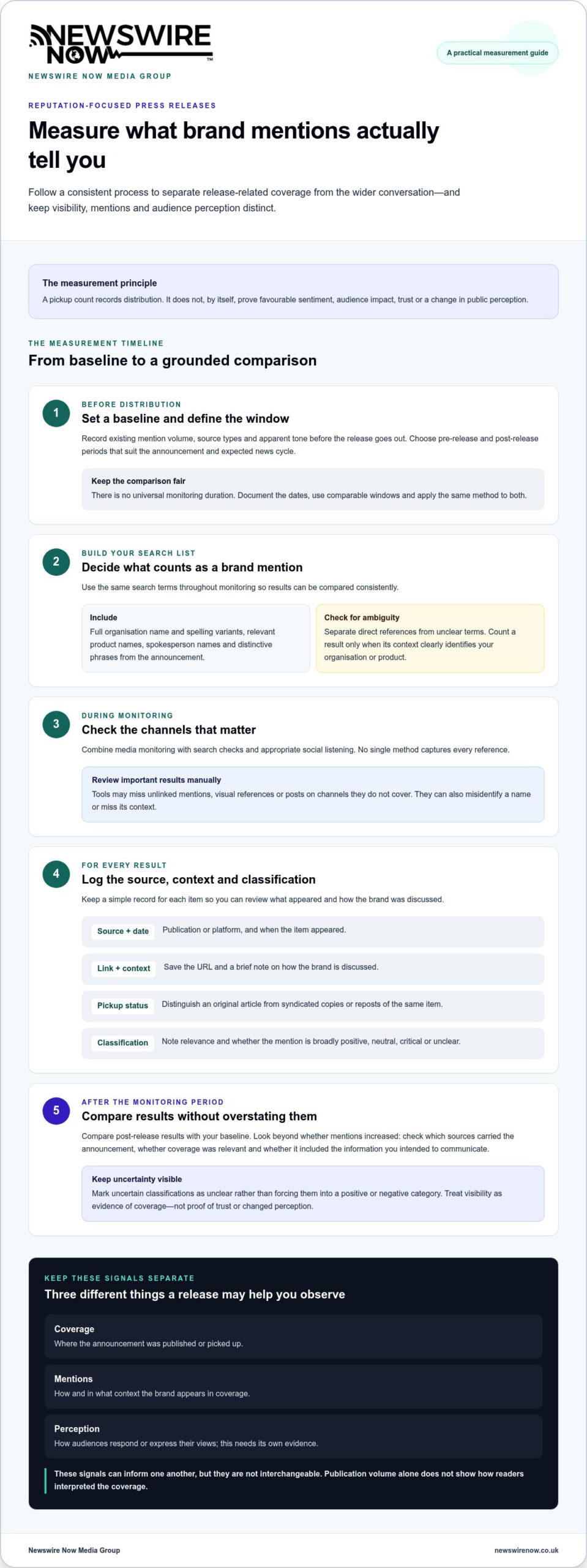
Use a consistent process to separate release-related coverage from the wider conversation about your organisation. A brand mention is a reference to an identifiable brand, product or representative. It may appear in a news article, search result or social post, but check each result: a name may be ambiguous, and repeated copies of one story don’t necessarily represent separate editorial coverage.
For a press release for reputation management, define your monitoring method before distribution. Set a baseline, monitor, classify, compare and report. This creates a record of what changed while keeping your findings tied to the announcement, rather than treating every new reference as an outcome.
Set a baseline and define what counts as a mention
Before the release goes out, record the existing volume of mentions, the types of sources they come from and their apparent tone. Choose pre-release and post-release periods that suit the announcement and expected news cycle. There’s no universal duration. Document the dates, use comparable windows and apply the same method to both.
Build a search list to keep monitoring consistent. Include the organisation’s full name and common spelling variants, relevant product names, spokesperson names and distinctive phrases from the announcement. Separate direct references from ambiguous terms. If a product name is also an everyday word, count a result only when its context clearly identifies your product or organisation.
Track mentions across relevant channels
Combine media monitoring with search checks and appropriate social listening. No single method captures every reference. Monitoring tools can miss unlinked mentions, visual references or posts on channels they don’t cover. They can also misidentify a name or miss its context. Review important results manually, particularly those that could affect your assessment of the announcement.
For each result, keep a simple log with:
- Source and date: record the publication or platform and when the item appeared.
- Link and context: save the URL and a brief note on how the brand is discussed.
- Pickup status: distinguish an original article from syndicated copies or reposts of the same item.
- Classification: note whether the mention is relevant and broadly positive, neutral, critical or unclear.
Compare post-release results with your baseline. Check not only whether mentions increased, but also which sources carried the announcement, whether the coverage was relevant and whether it included the information you intended to communicate. Mark uncertain classifications as unclear rather than forcing them into a positive or negative category.
Finish with a concise report that states the monitoring periods, method, verified findings and limitations. A pickup report can help identify placements, but it is one input to this wider process. If distribution is part of your plan, Newswire Now press release distribution is one option for sending an announcement to media outlets.
Which reputation signals matter beyond the number of brand mentions?
Mention volume is a useful measure of visibility, but it can’t tell you whether coverage reached a relevant audience, accurately conveyed the announcement or influenced anyone’s view. For a press release for reputation management, assess several signals together and choose each one to answer a specific question. This makes reporting more informative than a single headline count.
Match each metric to the question it answers
Compare results with the release’s communication objective. If the aim was to explain a verified change, check whether relevant sources included the essential facts. If the aim was to reach a particular stakeholder group, assess whether the publications or channels are relevant to that audience. Each metric describes a different part of the campaign, so don’t use one as a substitute for another.
| Metric | Question it answers | Main limitation |
|---|---|---|
| Mention volume | How often was the brand referenced? | More mentions show visibility, not improved reputation. |
| Source relevance | Did coverage appear in sources that matter to the intended audience? | A relevant outlet doesn’t prove that its readers saw or acted on the story. |
| Sentiment | Was the language broadly positive, neutral or critical? | Labels can miss context, irony or mixed reactions. |
| Message inclusion | Did coverage accurately include the key facts? | Presence of a message doesn’t show that readers accepted it. |
| Audience action | Did people respond, engage or take a measurable next step? | Actions may have other causes and don’t automatically indicate trust. |
Interpret sentiment and reach cautiously
Automated tools can help organise coverage, but review a sample of results manually before reporting sentiment. A critical article may accurately report a corrective action. Irony can make positive words negative, while neutral reporting may simply state facts. Keep unclear or mixed items distinct instead of forcing every mention into a positive or negative category.
Apply similar care to reach figures. Estimated reach usually describes potential exposure, not verified readership. Evidence of audience response may include engagement or a recorded action, but neither alone proves that coverage caused a change in perception or business performance. Keep those claims separate.
Measured coverage shows where and how a release appeared; reputational impact is an interpretation that requires separate evidence. Report mention volume, source relevance, message accuracy, sentiment and audience action as distinct findings. This gives decision-makers a clearer view of what the release achieved, what remains uncertain and which signal deserves closer attention in the next campaign.
How to evaluate a press release campaign without overstating results
A useful review starts with the objective set before distribution, then compares the evidence with your baseline. If the goal was to make a verified update more visible, relevant coverage and accurate inclusion of key facts are pertinent results. They don’t, by themselves, prove that audiences trust the organisation more or that business performance changed.
For a press release for reputation management, separate observations from interpretation. Record what you can verify, label conclusions as interpretations and avoid attributing wider outcomes to the release without supporting evidence. For example, enquiries may rise around the same time as coverage, but other activity or external events could also have contributed.
Build a clear post-release review
Make the review concise enough to use and detailed enough to audit. Summarise relevant mentions and their sources, then note whether essential messages appeared accurately. Include examples to show how you classified sentiment, especially when an item was mixed or ambiguous.
Compare the findings with the baseline using the same monitoring approach and defined periods. State any limits that could affect the comparison, such as gaps in tool coverage, duplicate syndicated stories or changes in the wider news cycle. A clear report might organise findings under:
- Observed: verified mentions, source details and message inclusion.
- Interpreted: what the pattern may suggest about visibility or audience response.
- Unproven: assumptions or business outcomes that need separate evidence.
This separation makes the report more credible for leadership and gives teams a reliable record for future communications. For decisions that extend beyond one announcement, the online reputation management decision guide can help place campaign findings within a broader strategy.
Turn the findings into responsible next steps
Let the evidence guide what happens next. If readers appear to lack essential information, prepare a clarification. If feedback raises a substantive concern, consider appropriate stakeholder engagement and address the underlying issue. If the evidence is too limited to support a sound conclusion, continue monitoring rather than presenting an early signal as a settled result.
Correct factual inaccuracies through an appropriate, transparent correction process. Don’t try to obscure fair criticism or inflate positive coverage to counter it. Log corrections, unresolved questions and stakeholder feedback, then carry those points into the next communication plan. If supporting social communications are appropriate, use the news amplification guide to plan how to extend the announcement responsibly.
For a distribution plan informed by clear reporting criteria, explore press release distribution. Keep campaign results grounded in what the evidence shows, and use the review to guide the next communication rather than claiming more than it proves.
How Newswire Now supports measurable press release distribution
A press release distribution service provides a route for an announcement to reach media outlets and a record of reported placements. Newswire Now Media Group supports that process through an independent network of more than 40 owned publications, reaching millions of readers worldwide, and distribution to more than 500 trusted news outlets across 27 industry sectors and 37 professions.
That reach creates an opportunity for visibility, not a promise of improved reputation. Distribution does not resolve an underlying issue or guarantee that audiences will trust a message. For a press release for reputation management, the value lies in pairing a relevant announcement and defined audience with evidence you can assess against your campaign objective.
What distribution and pickup reporting can contribute
Editorial review provides a checkpoint before distribution, while the network offers access to a range of media outlets. Distribution spans different industry sectors and professions, which can help you consider where an announcement may be relevant. The service includes guaranteed placements and a pickup report within 48 hours. The report records reported placements. It doesn’t establish how many people read an item, how they interpreted it or whether their confidence in the organisation changed.
Use the report as one part of your evaluation. Compare the reported outlets with the audiences you intended to reach, then assess placements against your baseline and original objective. Review the coverage to see whether the announcement appeared as expected and whether its key information was represented accurately. Treat this as distribution evidence, not a complete measure of reputation.
Choose a distribution route that fits the announcement
Consider the news and its intended audience before choosing a route. A discrete, one-off announcement may suit single-release distribution. If you have repeated announcements, multi-release bundles offer an option for ongoing needs. In either case, relevance should guide your assessment: an outlet’s sector or professional focus matters more than a large placement count with little connection to your audience.
For example, assess a leadership update against the audiences for whom the change matters. Judge a corrective announcement by whether it reaches people seeking accurate information, not simply by how many placements appear. Apply the same measurement discipline to both: record the outlets, review the coverage and interpret the results in light of the announcement’s purpose.
Newswire Now Media Group’s distribution and pickup reporting can provide practical evidence for this process, while wider monitoring and audience feedback help complete the picture. Distribute a press release with Newswire Now Media Group, then assess the reported placements against your baseline, intended audiences and campaign goals.
Make your next announcement more accountable
Use each campaign review to sharpen decisions about the next communication. Before approving a press release for reputation management, decide what the findings should help your team determine: whether to clarify a message, continue monitoring, adjust the intended audience or wait until operational action is complete. Agreeing this in advance makes reporting useful beyond a retrospective account of placements.
Set a clear owner for follow-up and a point at which the team will revisit the evidence. If questions remain unresolved, keep them visible rather than forcing a positive conclusion. If the next announcement is ready, make its purpose and intended audience explicit so its performance can be assessed against a meaningful objective. A consistent review process helps communications teams learn, adapt and report confidently without claiming more than the evidence supports.
Put your next announcement into a distribution plan with measurable objectives. Distribute your press release with Newswire Now and build on your findings with a clear next step.
Frequently Asked Questions
Can a press release improve a company’s online reputation?
It can contribute to reputation work by making verified information easier to find, but publication alone can’t guarantee a better public perception. For example, an announcement about a service improvement is more credible when customers can experience that improvement after the release. Treat communication as one part of the response, and assess reputation separately through relevant audience feedback, ongoing coverage and evidence that the promised action took place.
How do you measure brand mentions after a press release?
Search for the organisation, product and spokesperson names, as well as distinctive phrases from the announcement. Save each relevant result with its source, publication date and context, and remove duplicate copies from your unique-coverage count. For a press release for reputation management, also check whether the announcement’s key facts were included accurately. Keep representative examples alongside totals so the report reflects what the mentions actually say.
What is the difference between a brand mention and a media placement?
A media placement is an item published by a media outlet, while a brand mention is a reference to the organisation, its product or representative. One article can contain several references but still count as one placement. A mention might also appear in a social post or discussion that isn’t a media placement. Distinguishing the two prevents syndicated copies or repeated references in one story from inflating coverage totals.
How long should you monitor brand mentions after a press release?
There’s no fixed monitoring period that suits every announcement. Base it on the expected news cycle, the communication objective and whether relevant discussion is still appearing. A short-lived update may need a different review window from a crisis response that continues to attract questions. Record your chosen start and end dates, and extend monitoring if meaningful coverage or stakeholder reactions continue beyond the initial period.
Can brand-mention tools accurately measure sentiment?
They can help sort large volumes of material, but automated sentiment labels aren’t always reliable. A tool may classify a factual article as positive because it contains approving language, or miss irony and indirectly expressed criticism. Review a sample of results manually, check ambiguous items in context and report uncertain classifications honestly. Use automation to prioritise review, not as a substitute for judgement about what an article means.
What should a press release pickup report tell you?
A pickup report should help identify reported placements for review against your campaign objective. Check the listed outlets and coverage, confirm that the organisation and announcement are represented as expected, and note whether items are original stories or copies of the same report. A pickup record demonstrates where distribution resulted in reported placement. It doesn’t establish readership, favourable interpretation or a change in public trust.
Does a higher number of brand mentions mean a better reputation?
No. Mention volume measures how often a brand appears in tracked results, not whether those references are favourable, relevant or trusted. A surge could follow positive news, criticism or a developing issue. Read the coverage and consider who published it, what was said and how intended audiences responded. Compare those findings with the reason for the announcement before describing an increase as a reputational gain.
How can a press release support reputation management during a crisis?
A release can communicate verified facts, explain what the organisation is doing and provide a clear point for updates during a crisis. State what is known, avoid speculation and correct information if facts change. Communication must accompany practical action on the issue itself. Monitor questions and coverage after publication so subsequent updates address genuine information gaps, rather than simply repeating claims that audiences may not yet trust.
Ready to get your story published?
Distribute your press release across 500+ trusted media outlets — with editorial review and a full pickup report within 48 hours.
Send Press Release →