
What Does a Press Release Look Like: Anatomy of a News Story
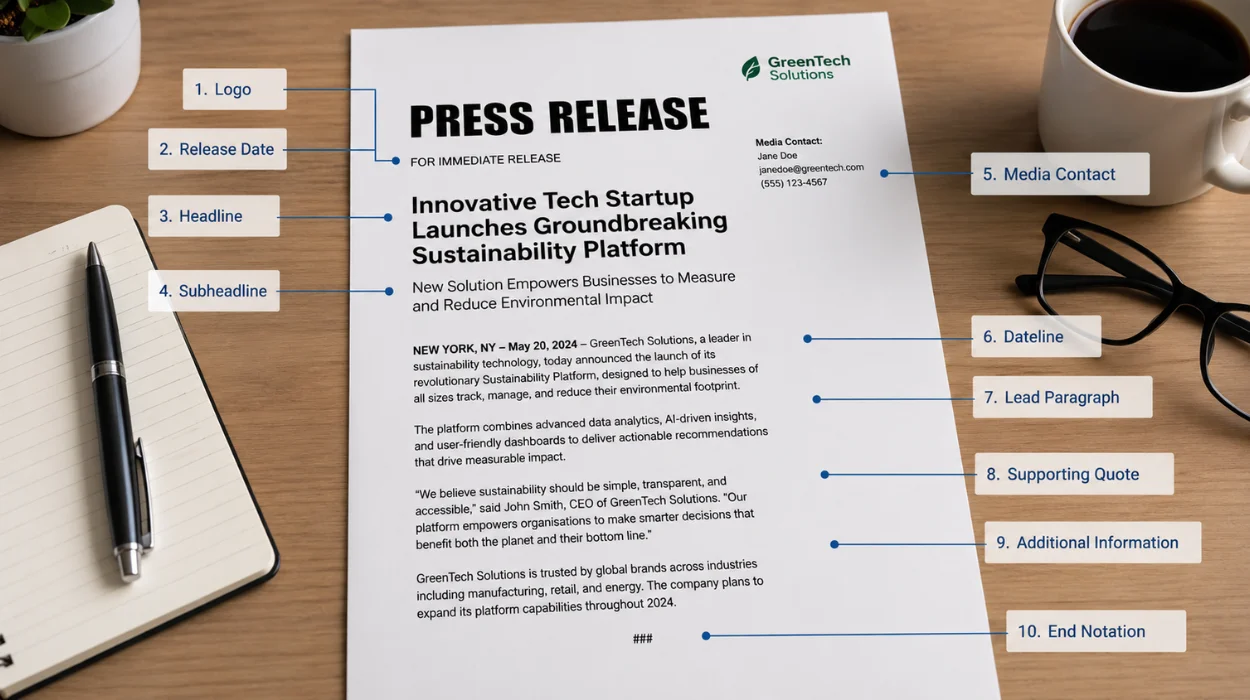
A press release is a structured news document that presents verified information in a journalistic format for media use. It follows a standard anatomy that enables editors, journalists, and indexing systems to read, assess, and distribute the story efficiently.
What is the core structure of a press release?
A press release is a formatted document consisting of a headline, dateline, lead paragraph, body content, quotes, boilerplate, and media contact details. Each component performs a defined role within the information hierarchy. The structure aligns with the inverted pyramid model used in journalism. The most important facts appear at the top, followed by supporting details and context. This format enables rapid scanning by journalists working under deadlines. It also supports machine readability for indexing systems such as Google News. Consistent structure increases the probability of accurate syndication across media platforms.
Headline and subheadline
The headline defines the primary news angle in a single sentence. It uses precise language and includes key entities such as company names, locations, or product identifiers. A subheadline expands the context by adding a secondary detail or outcome. This pairing establishes clarity before the reader enters the main text. Editors evaluate headlines within seconds, so clarity directly affects pickup rates. Headlines also influence how aggregators categorise the content.
Dateline and lead paragraph
The dateline identifies the city and date of the announcement. It confirms the geographic and temporal relevance of the news. The lead paragraph answers five core questions: who, what, when, where, and why. This paragraph defines the entire story in 30–40 words. Journalists often extract this section directly for coverage. Indexing systems analyse the lead to determine topical relevance.
Why does the inverted pyramid define press release writing?
The inverted pyramid is a hierarchical writing structure that prioritises essential information at the beginning of a news document. This structure ensures immediate comprehension. Journalists scan the first paragraph to determine editorial value. If relevance exists, they continue reading; if not, they discard the piece. The inverted pyramid supports partial publishing, where editors trim lower sections without losing meaning. News syndication platforms rely on this structure to summarise content automatically. The format also improves crawl efficiency for search engines.
Information hierarchy
The first level contains critical facts such as announcements or results. The second level adds supporting data including statistics or background. The third level provides supplementary context such as industry implications. Each level decreases in priority. This hierarchy ensures that the most valuable information remains visible even if the document is shortened.
Editorial efficiency
Editors manage large volumes of incoming releases daily. A structured hierarchy reduces reading time. It also increases the probability of publication without extensive rewriting. Efficient formatting directly affects media visibility.
How are press release paragraphs structured?
Press release paragraphs are concise, factual, and structured to present one idea per paragraph. Each paragraph contains 5–7 sentences focusing on a single concept. This structure improves readability for both humans and algorithms. Sentences use active voice and factual language. Paragraph transitions maintain logical progression from core facts to supporting details. Clarity ensures accurate interpretation by journalists.
Sentence construction
Each sentence defines one fact or explanation. Complex ideas are divided into separate sentences. This approach reduces ambiguity. It also aligns with journalistic standards used by outlets such as Reuters and Associated Press.
Paragraph flow
Paragraphs follow a logical sequence. The first paragraph defines the announcement. The second expands with supporting details. Subsequent paragraphs introduce quotes, data, and context. This flow ensures continuous comprehension.
What role do quotes play in a press release?
Quotes provide attributed statements that add authority, perspective, and human context to the news story. Quotes are typically from executives, stakeholders, or subject-matter experts. They interpret the announcement rather than repeat facts. Journalists use quotes to enrich articles with direct voice. Quotes also verify authenticity by linking statements to identifiable individuals.
Types of quotes
- Add executive perspective — includes statements from CEOs or founders explaining strategic significance.
- Provide technical insight — includes commentary from engineers or analysts explaining mechanisms.
- Deliver stakeholder validation — includes remarks from partners or clients confirming impact.
Each quote must remain factual and relevant. Overuse reduces credibility.
How does the boilerplate define organisational identity?
A boilerplate is a standardised paragraph that describes the organisation issuing the press release. It appears at the end of the document. This section includes core facts such as founding year, headquarters location, and primary services. It remains consistent across releases. Journalists use this section to verify organisational background. Search engines associate repeated boilerplate content with entity recognition.
Key elements of a boilerplate
- Define organisational scope — explains industry and services
- State operational scale — includes number of locations or markets served
- Reference official channels — includes website or newsroom
Consistency strengthens brand identity across publications.
How do media contact details support journalist outreach?
Media contact details provide direct communication channels for journalists seeking verification or additional information. This section includes a contact name, email address, and phone number. Journalists use these details to request interviews or clarifications. Accurate contact information increases the likelihood of coverage. Missing or incorrect details reduce credibility.
Required contact fields
- Include contact name — identifies responsible representative
- Provide email address — enables written communication
- Add phone number — supports urgent queries
Clear contact details streamline communication between organisations and media professionals.
How does formatting affect press release readability?
Formatting defines how easily a press release is read, scanned, and processed by humans and machines. Standard formatting includes short paragraphs, clear headings, and consistent spacing. This structure supports readability across digital and print environments. Journalists often copy content directly into editorial systems. Clean formatting reduces editing time. Search engines analyse structured content more efficiently.
Formatting standards
- Use clear headings — separates sections logically
- Maintain consistent spacing — improves visual clarity
- Apply standard punctuation — ensures readability
Formatting directly influences how quickly a release is processed.
How do press releases get indexed by Google News?
Press releases get indexed by Google News through structured content, publisher authority, and compliance with news guidelines. Google News analyses content using automated crawlers. These crawlers evaluate originality, clarity, and relevance. Structured headlines and datelines improve recognition. Regular publishing frequency increases crawl rates. Compliance with Google News Publisher Guidelines ensures eligibility.
Indexing mechanisms
- Analyse structured data — uses schema markup such as Article schema
- Evaluate publisher authority — considers historical credibility and consistency
- Crawl content frequency — indexes frequently updated sources more often
Indexing determines visibility in news search results.
How do journalists source stories from press releases?
Journalists source stories from press releases by scanning for newsworthiness, verifying facts, and extracting usable content. Newsrooms receive hundreds of releases daily. Journalists prioritise releases with clear angles and credible data. They extract headlines, leads, and quotes for publication. Verification includes cross-checking facts with additional sources. Releases that align with editorial focus are more likely to be used.
Selection criteria
- Identify news relevance — aligns with current events or industry trends
- Verify factual accuracy — confirms data and statements
- Assess editorial fit — matches publication audience
Efficient sourcing depends on clarity and credibility.
How does syndication distribute press releases across media networks?
Syndication is the process of distributing press releases across multiple media platforms through interconnected publishing systems. Distribution networks share content with partner sites. This expands reach beyond the source. Syndication relies on structured formatting and metadata. Content is replicated across news portals, blogs, and aggregators. Each platform maintains attribution to the original release.
Syndication process
- Distribute content through wire services — including PR Newswire, Business Wire, and EIN Presswire.
- Replicate across partner publications — increases visibility across regions.
- Maintain source attribution — ensures original publisher recognition
Syndication amplifies exposure across digital media ecosystems.
How does timing influence press release effectiveness?
Timing determines when a press release is published to maximise visibility and media pickup. Releases are scheduled according to news cycles. Weekday mornings align with newsroom activity. Embargoes allow journalists to prepare coverage before public release. Time zone alignment ensures simultaneous global distribution. Strategic timing increases the probability of coverage.
Timing strategies
- Schedule weekday releases — aligns with editorial workflows
- Use embargoes for exclusivity — provides early access to journalists
- Align with time zones — ensures global synchronisation
Timing directly affects distribution impact.
How does a press release differ from other business content?
A press release differs from other business content by adhering to journalistic standards rather than promotional language. It reports facts instead of selling products. The tone remains neutral and informative. Structure follows news conventions instead of marketing formats. Journalists use releases as source material, not advertisements. This distinction defines its role within PR & Press Release Distribution.
For a deeper comparison of organisational approaches to communication strategies, see how PR Agencies vs Generalist Firms operate within media ecosystems.
How does structure influence distribution success?
Structure influences distribution success by determining readability, credibility, and machine processing efficiency. A well-structured release enables faster editorial decisions. It also improves indexing accuracy. Clear hierarchy ensures that essential information remains visible. Consistent formatting supports syndication across platforms. Structural precision increases the likelihood of publication and reach.
Press release anatomy defines how information moves from an organisation to the media ecosystem. Each structural component contributes to clarity, verification, and distribution. This framework ensures that news content remains accessible to journalists, indexing systems, and global audiences.
Ready to get your story published?
Distribute your press release across 500+ trusted media outlets — with editorial review and a full pickup report within 48 hours.
Send Press Release →